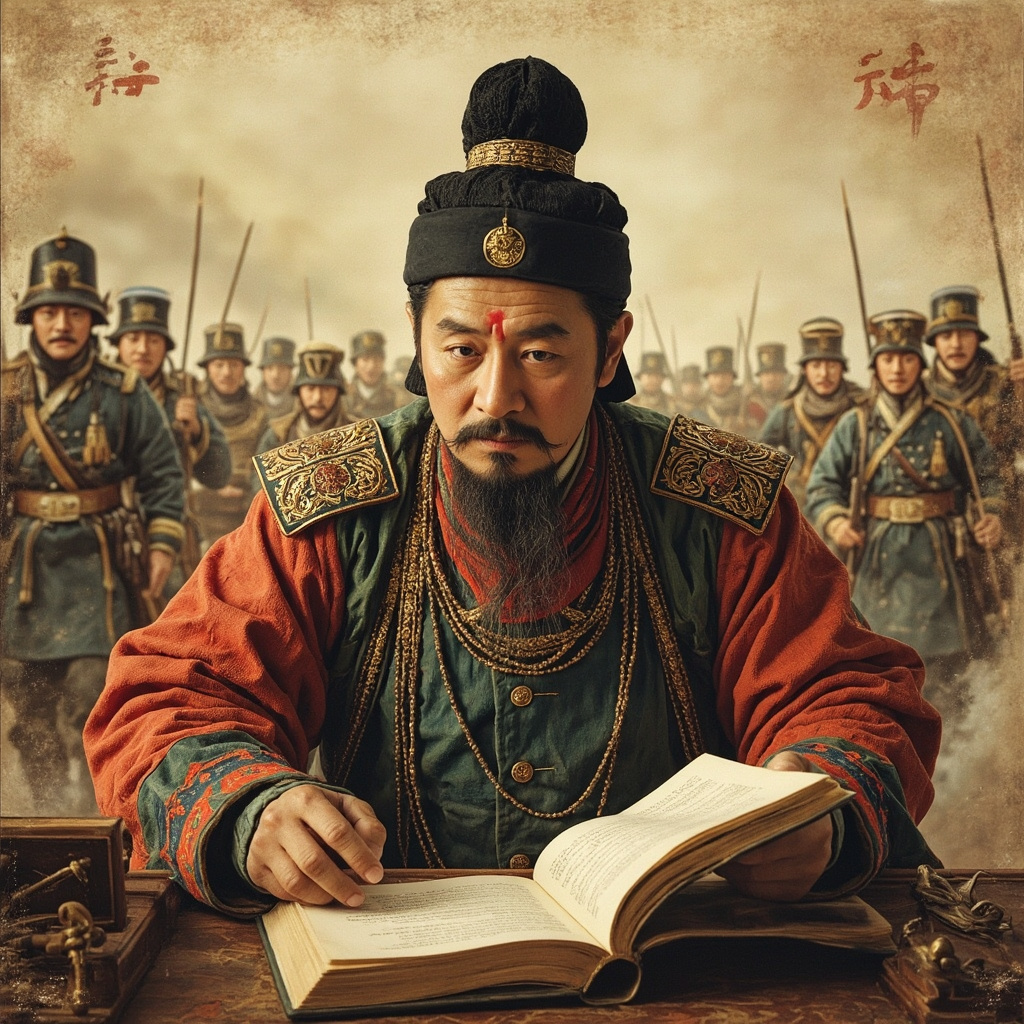
In 260 BC, the armies of Qin and Zhao faced each other across a valley in what would become one of the bloodiest battles in ancient Chinese history. The Zhao general, a man named Zhao Kuo, had spent decades studying the art of war. He had read every military text available. He could recite Sun Tzu from memory. He could analyze battle formations with the precision of a scholar and the confidence of an expert.
When the Qin forces ambushed his army in the narrow valley of Changping, Zhao Kuo responded exactly as the textbooks prescribed. He deployed his forces in what the ancient military manuals called the “serpent formation.” He directed his cavalry to flank using the “eagle sweep” maneuver. He issued orders that were textbook-perfect, textbook-precise, and textbook-useless.
The Qin soldiers didn’t read the same books. They fought like soldiers who had been in a dozen real battles, not like students demonstrating technique in a courtyard. They didn’t cooperate with Zhao Kuo’s perfectly executed maneuvers. They just killed.
By the time the Battle of Changping ended, 450,000 Zhao soldiers lay dead. Zhao Kuo himself was cut down in the chaos, his body never identified among the tens of thousands of corpses. His theoretical knowledge of war had killed an entire army.
This is the story behind 纸上谈兵 — zhǐ shàng tán bīng — literally “talking about battle on paper.” The idiom describes someone who can discuss a subject eloquently and theoretically but cannot actually perform when it matters. In English, we might say someone is “all talk and no action,” or that they’re “book-smart but not street-smart.” But zhǐ shàng tán bīng is more specific: it captures the particular danger of someone who has learned everything about something without ever having done it, and who therefore lacks the crucial ingredient that no book can teach.
The Real Zhao Kuo: A Cautionary Tale About Talent and Hype
The story of Zhao Kuo is one of ancient China’s most frequently cited cautionary tales, and yet the lesson seems to need re-learning in every generation. Zhao Kuo was not a fool. He was, by all accounts, genuinely brilliant — a man with an exceptional mind for military theory who had studied the classics of military strategy since childhood. His father, a famous Zhao general, had recognized his son’s intellectual gifts early and nurtured them carefully.
But there’s a problem with raising a theoretical prodigy in an ancient Chinese context: the best way to become a great general is to fight in actual battles. War is not a purely intellectual discipline. It requires judgment under chaos, the ability to adapt to conditions that don’t match any textbook scenario, and the psychological resilience to make life-or-death decisions when everything is going wrong. These skills can only be developed through experience. They cannot be learned from reading about other people’s experience.
Zhao Kuo had studied. He had never fought.
When the Battle of Changping began, Zhao Kuo was appointed to replace the aging general Lian Po, who had been using a defensive strategy that was working but was taking too long for the Zhao court’s patience. The new king of Zhao, who had come to power convinced that Zhao Kuo’s theoretical mastery was the key to quick victory, ordered Lian Po replaced with the young theorist.
The results were exactly what anyone with actual military experience would have predicted.
The Battle That Destroyed an Army
To understand why Zhao Kuo’s approach failed so catastrophically, you need to understand the basic facts of the Battle of Changping. The Qin army, under the brilliant general Bai Qi, had maneuvered to cut off Zhao forces from their supply lines. Zhao Kuo’s army was deep in enemy territory, running low on food, and surrounded on three sides by Qin troops.
A real general — one who had fought before — would have recognized the trap immediately and done the only sensible thing: break out before the encirclement was complete. Even if it meant abandoning supplies and taking heavy casualties, survival was possible.
Zhao Kuo, consulting his textbooks, saw a different situation. The textbooks described how to fight when surrounded. They described formations that maximized defensive strength when trapped. They described tactics for turning a defensive position into a killing ground. Zhao Kuo had studied these scenarios meticulously, and so he ordered his men to hold position and fight defensively — exactly as the manuals prescribed.
The problem was that Bai Qi wasn’t following the manual. The Qin general saw Zhao Kuo’s defensive deployment and simply surrounded it more completely, then waited. He had no need to attack. He had food. Zhao Kuo’s army didn’t. Within weeks, the Zhao soldiers were starving. When they finally broke and ran, the Qin cavalry slaughtered them in the open field.
What the Idiom Really Means
The phrase zhǐ shàng tán bīng is used in Chinese today to describe exactly the kind of failure Zhao Kuo experienced. It’s applied to people who talk eloquently about business but go bankrupt when they actually start a company. It’s applied to people who analyze sports with the confidence of coaches but couldn’t execute a single play. It’s applied to anyone who has accumulated extensive theoretical knowledge of a practical discipline without ever getting their hands dirty actually doing it.
The critical insight encoded in the idiom is that there is a category of knowledge — sometimes called “tacit knowledge” or “embodied knowledge” — that cannot be transferred through books or lectures. It can only be developed through experience. This is why a master craftsman can look at a piece of work and know instantly what’s wrong with it, while a trained academic analyzing the same piece might miss subtle flaws that a real craftsman would never make. The academic has never developed the feel for the material that comes from thousands of hours of practice.
Military strategy is particularly susceptible to this problem because battle is inherently unpredictable. The textbooks can describe general principles, but every actual battle is a unique combination of factors that has never occurred before and will never occur again. The general who has actually fought in battles has developed judgment — the ability to read a situation, detect patterns, and make decisions under pressure — that no amount of theoretical study can replace.
The Modern Workplace and the Theory-Practice Gap
In the modern knowledge economy, zhǐ shàng tán bīng appears with particular frequency in discussions of management and leadership. We have entire industries built around people who can analyze business strategy with extraordinary sophistication but who have never actually run a company, never hired and fired people, never made a payroll, never had to deliver on a promise to investors. These people can produce beautiful slide decks about company culture and employee motivation. When they actually become executives, the results are often disastrous.
The best organizations have learned to be suspicious of pure theory. They test candidates not just on what they know but on what they’ve done. They want evidence of actual accomplishment, not just analytical facility. This is the ancient wisdom of zhǐ shàng tán bīng embedded in modern hiring practice: the person who has talked about battle on paper may know all the right words, but they’ll face the same fate as Zhao Kuo when the real arrows start flying.
There’s also an important personal application. Most of us are guilty at some point of letting theoretical knowledge substitute for actual experience. We read about how to build a business, how to maintain relationships, how to develop skills — and we feel like we’re making progress. But reading about something and actually doing it are fundamentally different activities that develop different parts of your capability. The book can teach you the vocabulary. Only practice can teach you the judgment.
The Deeper Lesson About Knowing What You Don’t Know
Perhaps the deepest aspect of the Zhao Kuo story is that he didn’t know what he didn’t know. A person who is genuinely incompetent in some area typically has no way to recognize that incompetence — this is what psychologists call the “Dunning-Kruger effect.” Zhao Kuo had studied so much that he was genuinely confident in his mastery. He had no framework for understanding that his knowledge was incomplete in exactly the ways that mattered most.
This is the true danger of zhǐ shàng tán bīng. It’s not just that the theoretical approach failed — it’s that Zhao Kuo couldn’t see why it was failing until it was far too late. He kept applying textbook solutions because the textbooks were all he had, and he couldn’t perceive that the battlefield was a different kind of place than the texts described.
The best guard against this failure is humility about the gap between knowing and doing. The moment you catch yourself saying “I understand this completely” about something you’ve only studied theoretically, that’s the moment to remember Zhao Kuo and his 450,000 dead soldiers.
Talk is cheap. The real test comes when you have to actually do.
Explore more Chinese historical idioms that reveal the gap between theory and practice, and the wisdom ancient Chinese stories still offer about human nature and expertise.