The Tang Dynasty: China’s Golden Age of Culture and Power
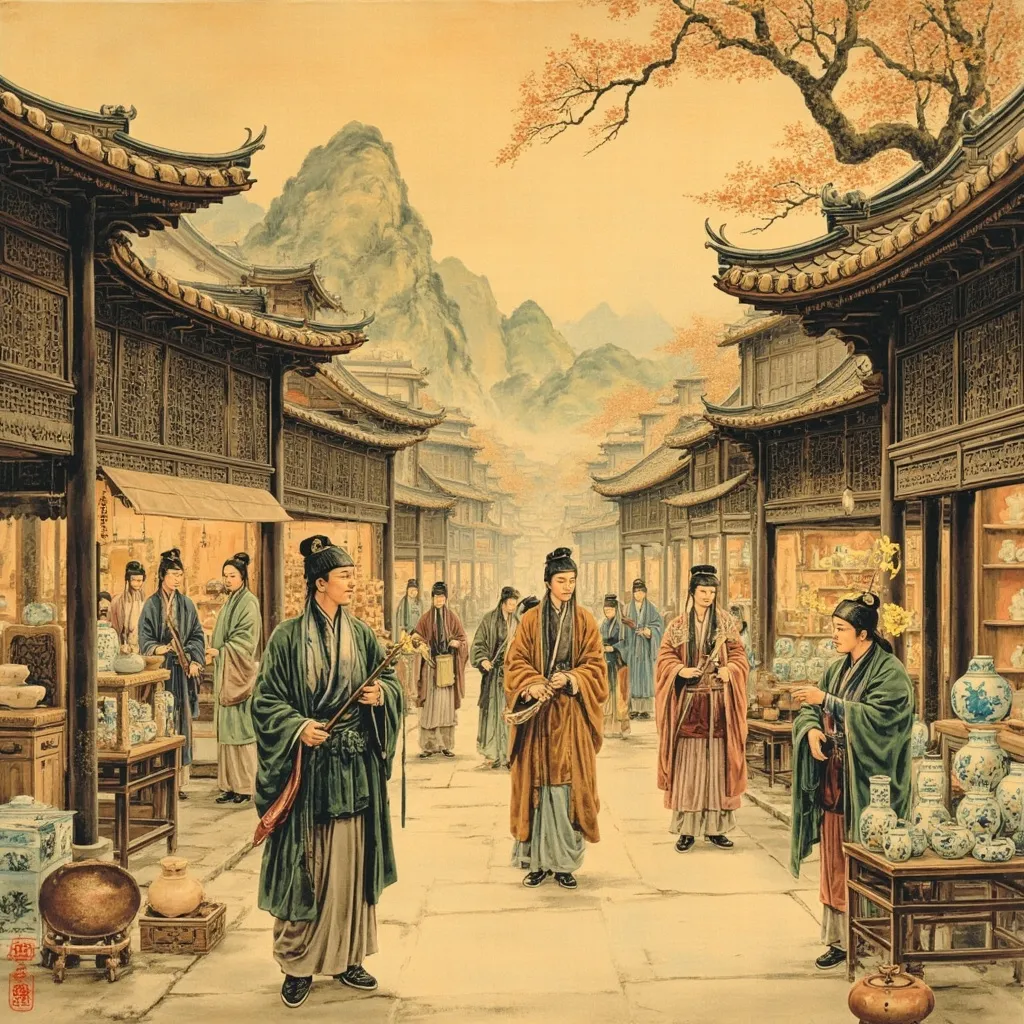
The summer heat of 713 CE settles over Chang’an like a heavy silk curtain. In the imperial palace, Emperor Xuanzong lounges in his private garden, watching elegantly dressed court ladies practice a newly fashionable dance—the liyuan, with its flowing sleeves and delicate footwork. Beyond the palace walls, the city’s one million inhabitants go about their day: Persian merchants hawk exotic spices in the eastern markets, Korean monks in saffron robes walk toward the great Dajianfu Temple, and Tang poets compose verses in teahouses while serving girls pour Oolong tea from ceramic pots decorated with cobalt blue patterns. Somewhere in the city, a young poet named Li Bai—later hailed as the “Immortal Poet”—is likely drunk on millet wine, composing verses that will be memorized by Chinese schoolchildren for the next thirteen hundred years.
Welcome to the Tang Dynasty, a period that dominated the ancient world. If you’re an American reader, imagine the Tang Dynasty as China’s version of the Roman Empire at its height—a time of territorial expansion, cultural sophistication, and international influence. Like Rome, the Tang presided over a vast territory spanning thousands of miles, hosted diverse populations from across the known world, and created artistic and intellectual achievements that still shape civilization today. And like Rome, the Tang Dynasty eventually fell—but its legacy continues to influence Chinese culture, politics, and aesthetics.
In this article, we’ll explore why historians call the Tang Dynasty China’s “golden age,” discover the figures who shaped this era, and understand why this period still matters to readers thousands of miles and a millennium away.
What Was the Tang Dynasty?
The Tang Dynasty ruled China from 618 to 907 CE—289 years that witnessed remarkable cultural achievements. To put this in perspective for American readers: when the Tang began, the Byzantine Empire was still a major power, and the Maya civilization was reaching its classical peak. When the Tang fell, Charlemagne had already been crowned Holy Roman Emperor, and the Viking Age was just beginning in Scandinavia.
The Founding: From Sui to Tang
The Tang Dynasty emerged from the ashes of the short-lived Sui Dynasty (581-618 CE), which had reunified China after nearly four centuries of division and war. The Sui emperor, Yang Guang, was a tyrannical ruler who bankrupted the empire with massive construction projects—including the Grand Canal connecting the Yellow and Yangtze Rivers—and disastrous military campaigns against Korea. When rebellion erupted across the country, a general named Li Yuan saw his opportunity.
Li Yuan was a member of China’s aristocratic elite, a descendant of the great Han Dynasty imperial family. In 617 CE, he seized control of the strategic city of Chang’an (modern-day Xi’an) and declared himself Emperor Gaozu, founder of the Tang Dynasty. His son Li Shimin, later known as Emperor Taizong, proved to be one of China’s greatest military strategists, unifying the empire through a combination of diplomacy, strategic marriages, and ruthless warfare.
Emperor Taizong (626-649 CE) is often considered the greatest ruler in Chinese history. He established a system of governance that balanced aristocratic power with meritocratic bureaucracy, created a legal code that influenced Asian legal systems for centuries, and presided over a period of prosperity and cultural flowering.
A Dynasty of Surprises
What makes the Tang Dynasty stand out is how it defied the expectations of its time. In an era when women had virtually no political power anywhere in the world, the Tang produced the only female emperor in Chinese history: Wu Zetian, who ruled from 690 to 705 CE and dominated Chinese politics for nearly half a century. In an age when foreign influences were typically viewed with suspicion, the Tang welcomed merchants, monks, and artists from across Eurasia, making Chang’an the most cosmopolitan city on Earth.
The Peak of Chinese Civilization
Historians call the Tang Dynasty China’s “golden age.” Between the reign of Emperor Taizong in the 7th century and the An Lushan Rebellion of the 8th century, Chinese civilization reached a height of sophistication that would not be matched for another thousand years.
A Golden Age of Poetry
If you could travel back to 8th-century Chang’an and attend a dinner party, you would see something notable: a gathering of poets composing verses in real time, competing to see who could create the most beautiful lines about the moon, wine, or friendship. Poetry in the Tang Dynasty was not merely an art form—it was a social skill expected of anyone with pretensions to education or refinement.
Li Bai: The Romantic Genius
Li Bai (701-762 CE) is perhaps the most famous poet in Chinese history, and his work exemplifies the Tang Dynasty’s romantic spirit. Born in what is now Central Asia, Li Bai spent his life wandering across the Chinese empire, drinking wine, befriending recluses, and composing verses that capture the sublime beauty of nature and the fleeting nature of human joy.
Consider this famous poem, “Thoughts While Sitting Alone by the Moon”:
Before my bed, moonlight glows so bright
I think it’s frost upon the ground.
I raise my head and view the bright moon,
I lower my head and think of home.
In just twenty words, Li Bai captures loneliness, homesickness, and the universal human experience of looking at the same moon that shines over everyone we love. This is why his poetry has endured for over thirteen centuries—Li Bai expressed emotions that every human being understands.
Another of Li Bai’s masterpieces takes readers on an imaginary journey across space:
The birds have vanished into the sky,
And now the last cloud drains away.
We sit together, the mountain and I,
Until only the mountain remains.
This poem, “Alone in the Mountains,” shows Li Bai’s unique ability to capture the profound stillness of nature and the spiritual connection between humans and the universe.
Du Fu: The conscience of the Tang
If Li Bai was the golden age’s romantic genius, Du Fu (712-770 CE) was its conscience. Where Li Bai celebrated wine, nature, and friendship, Du Fu wrote about war, poverty, and the suffering of ordinary people. His poetry provides a window into the darker realities of Tang society that more celebratory writers ignored.
Du Fu’s “Spring View” was written during the An Lushan Rebellion, when much of China was devastated by civil war:
The country is broken, only mountains and rivers remain.
The city is deserted, with spring grass and trees growing thick.
The wind brings the scent of war, the blossoms seem to weep.
I have not seen my wife and children for three years.
This is not the Tang Dynasty of imperial grandeur and cosmopolitan sophistication—this is the Tang of refugees, broken families, and shattered lives. Du Fu’s willingness to confront the empire’s failures makes him a moral voice that transcends his era.
Wang Wei: The Poet-Painter
Wang Wei (699-761 CE) represents a third strand of Tang poetry—the contemplative, Zen-inspired tradition that finds peace in nature’s stillness. Unlike Li Bai’s energetic wanderings or Du Fu’s anguished social commentary, Wang Wei’s poetry evokes the silence of mountain monasteries and the gentle flow of streams.
Empty mountain, no man is seen,
Only the echoes of human voices.
Returning sunlight enters the deep forest,
And shines again upon the green moss.
Wang Wei was not only a poet but also a master painter, and his work influenced Chinese art for centuries. His poems describe scenes that could also be paintings—precise, serene, and deeply harmonious.
The Tang Dynasty produced over 48,000 poems by nearly 2,300 poets. This explosion of poetic creativity was not limited to elite scholars; emperors composed verses, soldiers wrote poetry on battlefields, and merchants composed poems to send home to their families. Poetry truly was the language of the Tang.
Art and Calligraphy
Poetry was not the only artistic field to flourish during the Tang. Painting reached new heights of sophistication, particularly in the depiction of aristocratic women, palace scenes, and Buddhist subjects.
Zhang Xuan and Zhou Fang
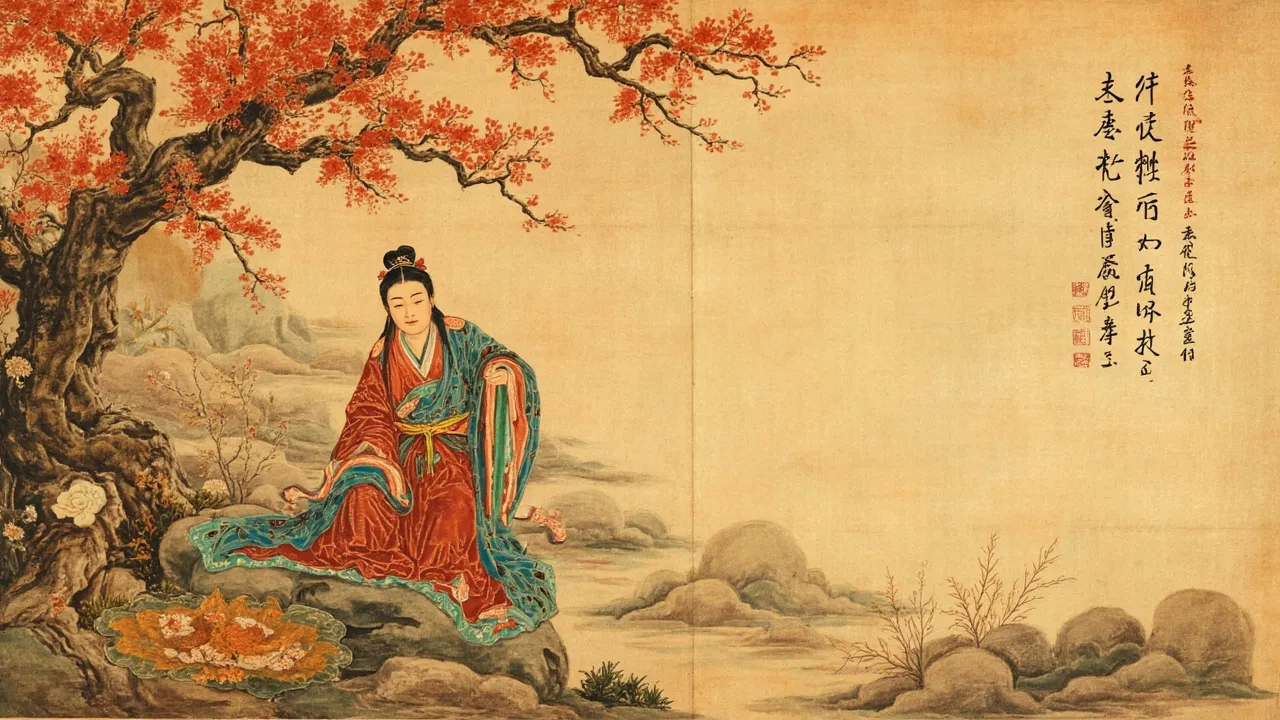
Zhang Xuan (c. 713-755 CE) was renowned for his paintings of palace women, capturing the luxurious lifestyles of the Tang elite with remarkable detail. His work “Court Ladies Preparing Newly Woven Silk” shows court women inspecting luxurious fabrics, their flowing robes and elegant poses demonstrating the Tang aesthetic of sensual beauty and refined taste.
Zhou Fang (c. 8th-9th century CE) continued this tradition, creating images of plump, elegant women in elaborate costumes that defined the Tang ideal of feminine beauty. Unlike the slender figures preferred in later Chinese dynasties, Tang beauty standards celebrated full-figured women—reflecting the era’s prosperity and its openness to foreign influences.
Chinese calligraphy—the art of beautiful writing—also reached unprecedented heights during the Tang. The script style known as “regular script” (kaishu) was standardized during this period and remains the standard form of Chinese handwriting today. Famous calligraphers like Yan Zhenqing (709-785 CE) created works that are still studied and admired for their power, elegance, and emotional intensity.
Innovation and Technology
The Tang Dynasty was not merely a period of artistic achievement; it was also an era of technological innovation that changed human civilization.
Woodblock Printing
While the exact origins of printing are debated, the Tang Dynasty certainly saw the development of woodblock printing—the technique of carving text or images onto wooden blocks, inking them, and pressing paper onto the block to create prints. The earliest surviving printed texts date from the Tang period, including the famous Diamond Sutra of 868 CE, the oldest dated printed book in existence.
This innovation eventually spread across the world, revolutionizing the spread of knowledge and making books affordable for ordinary people. The Tang Chinese had no way of knowing that their woodblock technique would eventually evolve into the printing press that Martin Luther would use to transform European religion and politics.
Gunpowder
Perhaps the most consequential Tang innovation was the accidental discovery of gunpowder—the mixture of sulfur, charcoal, and potassium nitrate (saltpeter) that Chinese alchemists created while seeking elixirs of immortality. By the late Tang period, Chinese military engineers had developed rudimentary weapons using this explosive mixture, including fire arrows and bombs.
Like printing, gunpowder would eventually transform world history—in ways the Tang never imagined. The Chinese used their invention primarily for fireworks and signaling; it would take several centuries for gunpowder to evolve into the guns and cannons that reshaped warfare across the globe.
Other Tang innovations included the development of mechanical clocks, advances in medicine and pharmacology, and improvements in ceramics that produced the famous Tang sancai (three-color) glazed pottery still prized by collectors today.
The World’s Dominant Power
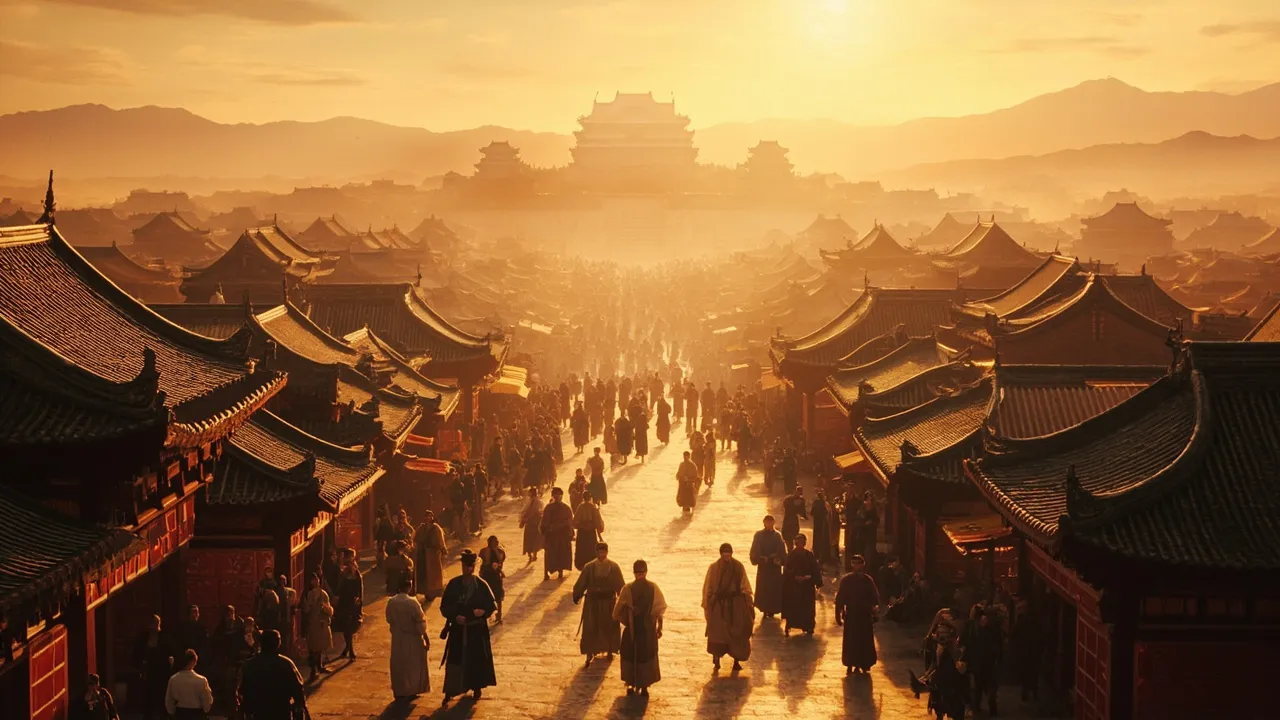
To understand the Tang Dynasty’s global significance, American readers might compare it to the United Nations plus Hollywood plus Silicon Valley—all rolled into one. Chang’an, the Tang capital, was the largest city in the world at the time, with a population exceeding one million. For comparison, the largest European cities of the era—Constantinople, Baghdad, and Cordoba—had populations of perhaps 100,000 to 500,000.
The Silk Road and International Exchange
The Tang Dynasty controlled the legendary Silk Road—the network of trade routes connecting China to the Mediterranean world. Along these routes traveled not only silk, spices, and precious metals but also ideas, religions, technologies, and artistic styles.
A Cosmopolitan Capital
Chang’an in the 8th century was a city that would have astonished any visitor from Europe or the Middle East. The city’s streets were laid out in a grid pattern that would later influence New York City’s layout. It featured massive markets where you could buy Persian carpets, Indian spices, Central Asian horses, and African ivory—all in the same day.
Neighborhoods in Chang’an were organized by ethnicity and occupation. The Persian Quarter housed merchants from the Sassanian Empire and later the emerging Islamic Caliphate. The Korean Quarter hosted thousands of students who came to study Chinese culture and Confucian classics. Buddhist temples stood alongside Zoroastrian fire temples and Nestorian Christian churches—the latter supported by the Tang emperors, who saw value in the “Luminous Religion” from the West.
This cosmopolitan atmosphere extended to the imperial court. Emperor Xuanzong (712-756 CE) was famously infatuated with his concubine Yang Guifei, whose family came from Central Asian origins. The emperor surrounded himself with foreign musicians, dancers, and artists, and foreign fashion styles—including tight-fitting robes and tall hats from Persia—became all the rage among the Tang elite.
The Spread of Buddhism
One of the most significant outcomes of Tang cosmopolitanism was the spread of Buddhism beyond China. Buddhist monks from China traveled to Korea, Japan, and Vietnam, establishing monasteries and teaching the doctrines of the Buddha. The Buddhist tradition that developed in East Asia—distinct from the forms that developed in Sri Lanka, Southeast Asia, or Tibet—remains a major world religion today.
The Tang Dynasty also saw Buddhism reach its peak of influence within China itself. Massive cave temples like those at Longmen and Dunhuang were carved and decorated with thousands of Buddhist sculptures and paintings, many of which survive today as some of humanity’s greatest religious art.
Empress Wu: The Only Female Emperor
No discussion of the Tang Dynasty can avoid the figure of Wu Zetian (624-705 CE)—the only woman in over two thousand years of Chinese history to rule as emperor in her own right.
Rise to Power
Wu Zetian began her political career as a low-ranking concubine of Emperor Taizong. After Taizong’s death, she became a Buddhist nun—as was customary for childless concubines—only to be recalled to court by his successor, Emperor Gaozong, who made her his principal consort. Over the next two decades, Wu systematically eliminated her rivals, including Gaozong’s empress and his sons from other women, until she effectively controlled the empire.
When Gaozong suffered a stroke in 660 CE, Wu took over the running of the empire, making all important decisions while the emperor remained a figurehead. After Gaozong’s death, Wu eliminated her own sons as potential rivals and, in 690 CE, proclaimed herself emperor of a new Zhou Dynasty—becoming the only woman in Chinese history to rule as " emperor" rather than as empress regnant.
Her Reign
Wu Zetian’s reign (690-705 CE) was marked by both brutality and genuine achievement. She eliminated thousands of potential rivals through executions, exiles, and systematic purges. Her secret police force, the “Great Cloud Police,” terrorized the aristocracy and crushed dissent.
Yet Wu also proved to be a capable ruler. She expanded the empire’s territory, reformed the civil service examination system to select talented administrators regardless of birth, and supported Buddhist construction projects that remain among China’s greatest cultural monuments. Her reign demonstrated that a woman could rule China—and ruled effectively—though her example would never be repeated.
Wu Zetian died in 705 CE, forced to relinquish power after a palace coup. Her sons restored the Tang Dynasty, and later Chinese historians—almost always male—depicted her as a villainess who subverted proper gender hierarchies. Yet Wu’s reign remains a unique chapter in world history: proof that even in highly patriarchal societies, exceptional individuals could sometimes break through barriers.
The Fall of the Tang
All golden ages must end, and the Tang Dynasty’s decline was as dramatic as its rise had been glorious.
The An Lushan Rebellion
In 755 CE, General An Lushan—a Sogdian (Central Asian) mercenary who had become a favorites of Emperor Xuanzong—declared himself emperor of a new Yan Dynasty and launched a rebellion against the Tang. What followed was a catastrophic civil war that lasted until 763 CE and killed an estimated 13 to 36 million people—roughly one-third of China’s population at the time.
The rebellion had multiple causes: resentment among frontier generals against the central government’s interference, the personal enmity between An Lushan and the powerful Yang family (who controlled access to the emperor), and the general decay of Tang military discipline after decades of peace. But the proximate cause was the emperor’s obsessive relationship with his beautiful concubine Yang Guifei, whose family used their influence to promote their own cronies while alienating capable military leaders.
The story of Yang Guifei and the general who rebelled against the emperor who loved her has become one of Chinese history’s greatest tragic romances, retold in countless poems, novels, and operas. When Emperor Xuanzong fled the capital in 756 CE, his soldiers—blaming the Yang family for the crisis—demanded that the emperor execute Yang Guifei and her relatives. The emperor, after great anguish, complied.
The Aftermath
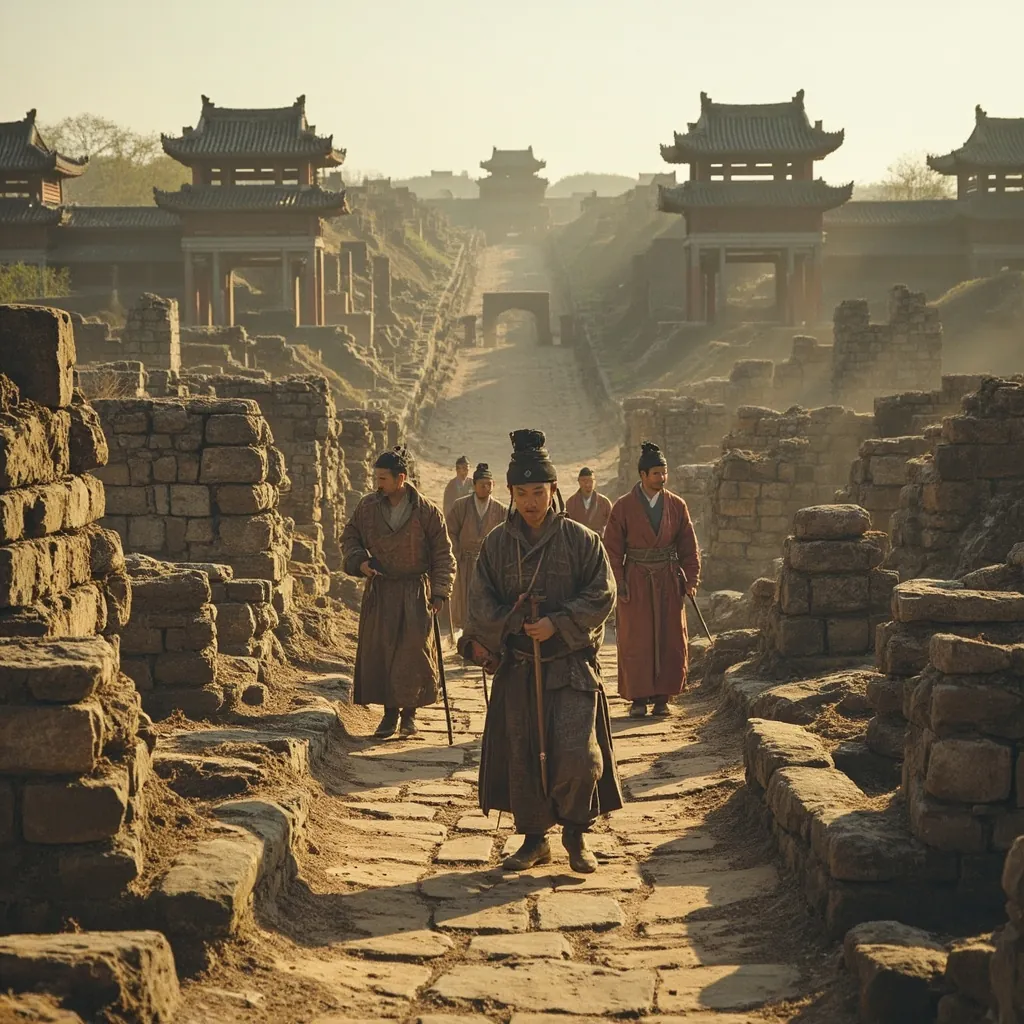
The An Lushan Rebellion destroyed the Tang Dynasty’s golden age, though the dynasty technically continued for another 150 years. The central government’s authority collapsed, and regional military governors—known as jiedushi—became increasingly independent. The imperial court became a battleground for eunuch factions and competing aristocratic cliques. The great Tang capital of Chang’an was sacked multiple times by Tibetan and rebel forces.
By the early 10th century, the Tang Dynasty had effectively collapsed, giving way to a period of fragmentation known as the Five Dynasties and Ten Kingdoms period (907-960 CE). When a new unified Chinese dynasty—the Song—finally emerged in 960 CE, it would adopt a very different approach to governance, emphasizing civilian control over the military and limiting the power of military commanders.
Why the Tang Dynasty Still Matters Today
More than eleven hundred years after the Tang Dynasty fell, its legacy remains deeply embedded in Chinese culture—and increasingly visible in global popular culture as well.
Cultural Influence on East Asia
The Tang Dynasty created a cultural template that shaped East Asia for centuries. Chinese poetry, painting, calligraphy, and ceramics established aesthetic standards that Korea, Japan, and Vietnam adopted and adapted. Even today, the Tang aesthetic—with its bold colors, flowing lines, and celebration of material prosperity—remains the popular image of traditional Chinese culture.
When you watch Korean historical dramas or visit Japanese temples, you are seeing cultural elements that originated in the Tang Dynasty. The elaborate ceremonial robes, the architectural styles, the musical instruments, and even the tea ceremony all trace their origins to Tang innovations.
Tang Aesthetics in Modern China
In contemporary China, the Tang Dynasty has become a symbol of national pride and cultural confidence. The Chinese government’s massive investments in cultural heritage preservation often focus on Tang-era sites. The “Tang style” (唐风) has become a popular aesthetic in fashion, interior design, and popular media.
Chinese television has produced numerous historical dramas set in the Tang Dynasty, featuring elaborate costumes, romantic plots, and depictions of the era’s cosmopolitan grandeur. These shows attract hundreds of millions of viewers domestically and have become popular exports across Asia and increasingly in Western markets.
Lessons from Tang Governance
The Tang Dynasty also offers lessons for understanding Chinese governance traditions. The Tang civil service examination system, which selected government officials through competitive examinations in Confucian classics, established a meritocratic tradition that continued in various forms until the early 20th century. Modern China’s emphasis on examination-based selection in its civil service has deep roots in Tang innovations.
The Tang also demonstrated both the possibilities and dangers of international openness. The Tang embrace of foreign merchants, religions, and cultural influences made the dynasty fabulously wealthy and culturally creative—but also created dependencies on Central Asian revenues and vulnerabilities to foreign military threats that contributed to the dynasty’s eventual collapse.
Tang Dynasty in Global Popular Culture
Evidence of the Tang Dynasty’s continuing influence appears in global popular culture. The South Korean television drama “The Glory” features characters who discuss Tang Dynasty poetry. Chinese mobile games set in the Tang period attract millions of players. Academic conferences on Tang history draw scholars from around the world.
Even the foods we eat bear Tang imprints: noodles, dumplings, and tea—all popularized during the Tang era—have become global staples. When you enjoy a bowl of ramen or a cup of green tea, you are participating in a culinary tradition that the Tang Dynasty helped create.
Conclusion: The Enduring Legacy of China’s Golden Age
The Tang Dynasty represents one of humanity’s great civilizational achievements. In just under three centuries, the Tang created a cultural legacy that has endured for over a millennium—poetry still studied in schools across Asia, art still admired in museums worldwide, and innovations like printing and gunpowder that reshaped global history.
For American readers, the Tang offers a case study in how civilizations rise, flourish, and eventually fall. The Tang’s openness to foreigners brought creativity but also created vulnerabilities. The dynasty’s meritocratic institutions produced brilliant administrators but also generated aristocratic resentments. The emperors’ personal lives—from Emperor Xuanzong’s passion for Yang Guifei to Empress Wu’s climb to power—show how individual choices can shape the fate of nations.
Today, as China once again emerges as a global power, understanding the Tang Dynasty helps us appreciate the depth and complexity of Chinese civilization. The Tang was not simply a precursor to modern China—it was a golden age in its own right, a period when Chinese culture achieved a richness and sophistication that still inspires awe more than a millennium later.
📚 Recommended Reading & Products
Disclosure: This article contains affiliate links. We earn a commission on qualifying purchases.