In 1900, a farmer digging a well outside Luoyang in central China broke through the roof of an ancient underground chamber. Inside lay rows of glazed figures — camels loaded with supplies, horses mid-gallop, armored warriors, court ladies with elaborate hairstyles, and foreign merchants with deep-set eyes and curly hair. The farmer had rediscovered a Tang dynasty tomb, sealed for over a thousand years, filled with objects designed to serve the dead in the afterlife.
Among the finds were dozens of vibrant glazed ceramics covered in bold splashes of amber yellow, olive green, and creamy white. Western archaeologists and dealers, struck by the three most prominent colors, called them “tri-color” pottery — and the name stuck. But the name is misleading. Tang Sancai, which literally means “Tang three colors,” was never limited to three hues. The term refers to a tradition of multi-colored lead-glazed ceramics, typically using yellow, green, and white as dominant tones, with blue, brown, and black appearing as secondary accents. The artistry lay in controlling which colors would flow and pool during firing, creating unique patterns no two pieces share.
This is the story of how an accidental discovery in a farmer’s field gave the world one of ancient China’s most recognizable art forms — and why these objects are far more than just decorative curiosities. They are three-dimensional archives of a civilization that was, for its time, the most cosmopolitan and globally connected on Earth.
The Lead Glaze Revolution: How Tang Sancai Got Its Colors
Most people assume that “three colors” means exactly three distinct hues applied like paint. The reality is far more interesting. Tang Sancai belongs to a category of ceramics called low-fired lead-glazed pottery, distinct from true porcelain. The glaze was made from lead oxide and silica, mixed with copper or iron compounds to produce colorants. Unlike the high-fired stoneware or porcelain that would later dominate Chinese ceramic traditions, Tang Sancai was fired at temperatures around 800°C — warm enough to melt the glaze but cool enough to preserve the porous earthenware body beneath.
The firing process happened in two stages. First, the shaped and dried figure was bisque-fired at low temperature. Then the lead glaze was applied and the piece was fired again. During this second firing, the lead-based glaze would liquefy and flow. Since copper and iron colorants were applied in separate areas and mixed during melting, the final result was partially controlled and partially accidental — a marriage of craft and chance. A piece loaded into the kiln near a piece with blue pigment might develop unexpected blue streaks. This is why no two Tang Sancai figurines look exactly alike, and why each one carries the fingerprints of a 1,200-year-old chemical reaction.
The tradition emerged during the reign of Emperor Gaozong (r. 649-683) and reached its peak during the Kaiyuan era of Emperor Xuanzong (713-741) — the height of the Tang dynasty’s power and prosperity. Before the Tang, Chinese potters had experimented with colored glazes, but the Tang period saw lead-glaze technology mature into a full artistic tradition. The palette expanded beyond simple earth tones to include bright copper green, antimony yellow, and, remarkably, blue — a color derived from imported cobalt pigments that had arrived via the Silk Road from Persia.
For Americans thinking about this in familiar terms, it’s a bit like the difference between mass-produced American diner pottery and hand-thrown artisanal ceramics. One is uniform and predictable; the other carries the unpredictable beauty of a process that can never be fully controlled. Tang Sancai is artisanal pottery elevated to the status of high art.
Buried with the Dead: The World of Mingqi
Here is the fact that surprises most people: Tang Sancai were almost never used in daily life. They were mingqi —明器, literally “bright vessels” or “vessels for the afterlife.” The Chinese believed that death was a continuation of life, and that the deceased needed the same comforts, possessions, and companions in the tomb that they had enjoyed in the living world. So Tang families with sufficient means filled burial chambers with ceramic copies of everything from kitchen utensils to entertainment performers.
The result is that the overwhelming majority of surviving Tang Sancai — the pieces you see in museums today — were excavated from tombs. They were not created to be admired. They were created to be buried. This distinction matters enormously in understanding what these objects tell us about Tang society.
The figurines fall into several categories. There are animals: Bactrian camels with their distinctive double humps, prancing horses, recumbent oxen, galloping mules, and occasional exotic animals like lions (likely never seen in life by most Tang people, but symbolically powerful). There are humans: court attendants with serene expressions, armored warriors equipped with spears and shields, musicians playing lutes and flutes, and — most fascinating from a cultural perspective — foreign figures.
Persian merchants, Central Asian musicians with their hands frozen mid-play on instruments not native to China, and camel drivers with braided hair: these figures document the presence of non-Chinese peoples in the Tang capital with an immediacy that no written text can match. They were buried in the tombs of wealthy Chinese who had dealings with the Silk Road trade networks, their ceramic companions serving both as a comfort in the afterlife and as a record of the owner’s worldly connections.
The largest concentrations of Tang Sancai come from two geographic heartlands: the Shaanxi region around the capital Chang’an (modern Xi’an), and the Luoyang area in Henan province. Imperial tombs in the Qianling and other imperial burial complexes north of Chang’an yielded extraordinary quantities of high-quality Sancai. The famous Tianzhongshan tomb near Luoyang contained over 400 ceramic pieces alone. These were not mass-produced items for ordinary burials — they represent elite expenditure on an afterlife that mattered deeply.
Camels and Foreign Figures: The Silk Road on Your Mantel
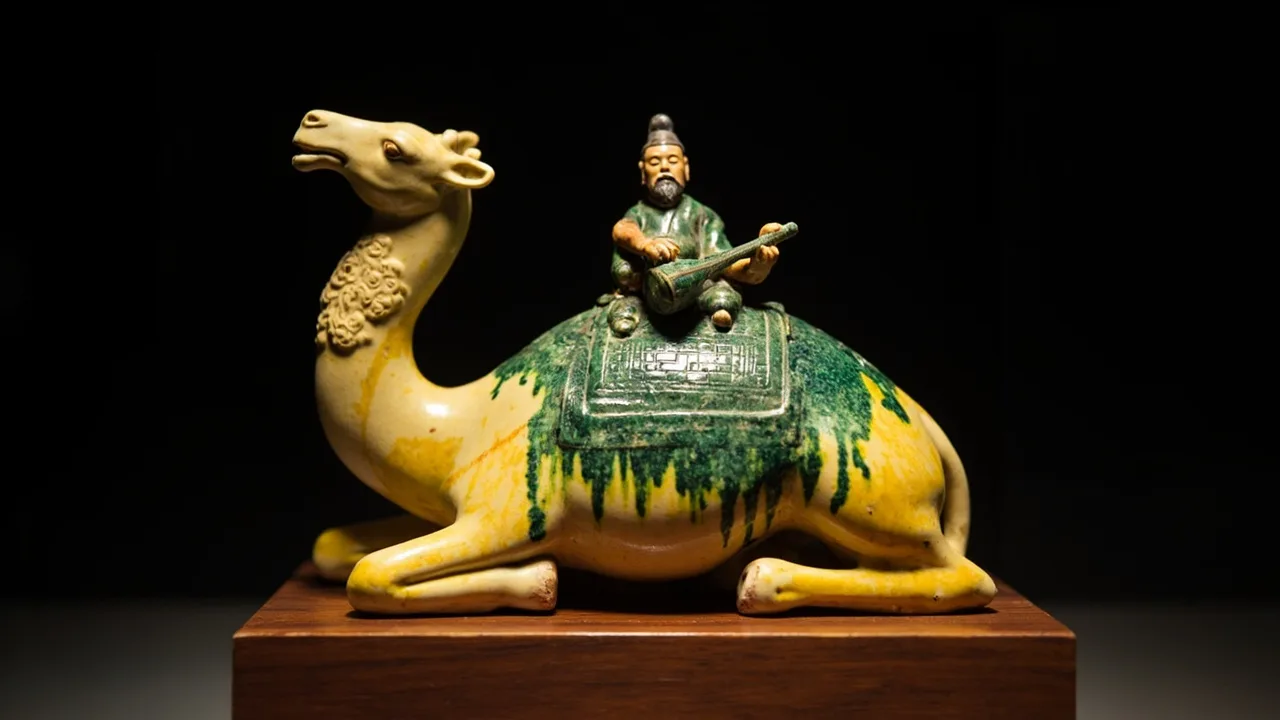
If there is one image that defines Tang Sancai in the popular imagination, it is the camel laden with foreign musicians. A search for Tang Sancai on any museum website will surface this motif repeatedly: a Bactrian camel in full stride, a howdah (open-topped carrier) strapped to its back, and inside the howdah a small orchestra of foreign figures playing Central Asian instruments.
These pieces are remarkable for what they reveal about Tang cosmopolitanism. The Tang capital of Chang’an was, in the 8th century, one of the largest and most diverse cities on Earth. Estimates suggest a population of around one million, including substantial communities of foreign merchants, diplomats, monks, and performers from Persia, Central Asia, Arabia, Korea, Japan, and Southeast Asia. The Silk Road was not an abstract trade route — it was a daily reality lived out in Chang’an’s markets, temples, taverns, and diplomatic reception halls.
The camel figurine with musicians is a visual essay on this cultural encounter. The instrument most commonly depicted is the Pipa, a pear-shaped lute that arrived in China from Central Asia via the Silk Road and would become one of China’s most beloved instruments. Foreign figures with curly hair, wearing pointed caps and patterned Central Asian garments, are rendered with a naturalist’s attention to the details that set them apart from Chinese figures: facial structure, dress, posture, and the instruments they played.
Perhaps the most famous example is the Tang Sancai camel with foreign musicians housed at the National Museum of China in Beijing. The piece shows a camel in vivid amber and green glaze, its head alert and tilted slightly forward as if walking. Strapped to its back is a howdah containing four figures: three musicians playing pipa, flute, and a percussion instrument, and what appears to be a singer. The faces are rendered with individual character — not stereotypes, but recognizable as portraits of real people or close observations of life.
Beyond camels, other foreign figures appear throughout the Tang Sancai corpus. There are波斯商人 (Persian merchants) depicted with characteristic dress and hairstyles. There are armored soldiers from the Western Regions. There are court women whose hairstyles and cosmetics reflect Central Asian fashion trends. The Sancai workshop was, in effect, a visual census of the international community of Chang’an.
For Americans, a useful comparison might be how a museum today might display objects from a major international airport or a global city’s downtown — but instead of being on display for the living, these objects were陪葬 (buried with the dead) as the Tang believed the dead deserved the same worldly comforts.
Japanese Nara Tri-Color: When China Came to Japan
The Silk Road did not only run westward. It ran eastward as well, across the Yellow Sea and through the Korean peninsula to the Japanese archipelago. By the 8th century, Japan was an eager student of Chinese civilization, sending official envoys called遣唐使 (ken tō shi, “envoys to Tang”) to Chang’an to study everything from government administration to Buddhist scripture to ceramic arts.
This is how Tang Sancai arrived in Japan. Japanese potters observed the Tang lead-glazed tradition, adapted the techniques to local materials and aesthetics, and created what they called奈良三彩 (Nara Sancai). The Nara period in Japan lasted from 710 to 794, overlapping precisely with the height of Tang Sancai production. Japanese craftspeople, working primarily at the Heijō-kyō (modern Nara) imperial capital, produced their own three-color glazed pottery for use in Buddhist temples and aristocratic burials.
What makes this particularly significant is that the Japanese did not simply copy the Chinese originals. They adapted. Nara Sancai tends toward simpler forms, more restrained palettes, and motifs drawn from Japanese Buddhist iconography rather than Tang secular life. Where Chinese Sancai depicts foreign musicians on camels, Japanese examples feature Buddhist guardian figures, lotus motifs, and ceremonial vessels. The glazing technique arrived in Japan, but the cultural meaning was transformed.
The evidence for this transmission is not merely circumstantial. The Shoso-in, a treasure house at Todai-ji temple in Nara, contains an extraordinary collection of Nara-period objects — including both imported Tang Sancai pieces brought to Japan by envoys and Japanese-made Nara Sancai. The collection includes a Tang-imported Sancai horse with a Persian-style harness, alongside locally produced Japanese pieces clearly derived from the same tradition. Today, the Shoso-in collection in Nara is one of the most important archives of early Japanese-Chinese cultural exchange anywhere in the world.
The transmission of Sancai technology to Japan also marks a key turning point in Japanese ceramic history. Before the arrival of lead-glazed Tang-influenced pottery, Japanese ceramics had been primarily unglazed stoneware. The Nara and subsequent Heian period experiments with lead glaze laid the technical groundwork for Japan’s own extraordinary glazed ceramic traditions, eventually leading to the world-renowned tea ceremony ceramics of the Momoyama and Edo periods.
This is an example of how cultural transmission is never passive: ideas and techniques cross borders and are immediately reimagined, adapted, and made native. The camel with foreign musicians became, in Japan, the lotus vessel and the temple guardian. Same glaze technology, entirely different visual vocabulary.
Markets, Museums, and the Myth of Everyday Tang
The story of Tang Sancai in the modern era is a story of disruption and rediscovery. From the late Qing dynasty through the Republic of China period (roughly the 1890s through 1940s), tomb raiding became systematic in the Loesang region near Luoyang. Unscrupulous dealers and foreign antiquities collectors emptied hundreds of Tang-era tombs, removing Sancai pieces by the crate and selling them to museums and private collectors in Europe and America.
The British Museum, the Metropolitan Museum of Art in New York, the Musée Guimet in Paris, and the Field Museum in Chicago all hold significant Tang Sancai collections acquired during this period. The volume is staggering — one 1920s estimate suggested that over 10,000 Tang Sancai pieces had left China in the preceding three decades. Many of the finest pieces ended up in the Arthur M. Sackler collections at Harvard’s Arthur M. Sackler Museum and the Smithsonian Institution in Washington D.C.
This is why the National Museum of China’s “Tang Sancai Camel with Foreign Musicians” is classified as a national treasure — it is one of a very small number of significant Tang Sancai pieces that remained in China and was never smuggled out. The Chinese government has been working for decades to track and repatriate looted Tang cultural relics, and Tang Sancai has become a symbol in these ongoing diplomatic and legal negotiations.
There is also a persistent and misleading myth that Tang Sancai were everyday household items — that a Tang family might have eaten their dinner from a Sancai bowl or drank tea from a Sancai cup. This is false. The professional consensus among ceramic historians is unambiguous: Tang Sancai were overwhelmingly mingqi, funerary objects. You would no more use a Tang Sancai horse as a dinner plate than you would use a tombstone as a cutting board.
This misconception likely arose because early Western collectors, not understanding the burial context, treated Sancai as secular decorative objects. It was commercially convenient — funerary provenance doesn’t help auction prices. But modern scholarship is clear: Tang Sancai were designed for the dead, not the living.
The modern replica market has done little to correct this misunderstanding. Luoyang-based workshops today produce high-quality Tang Sancai replicas that are sold to tourists and collectors worldwide. While the replicas are often excellent in their technical accuracy — using similar clay bodies and lead-based glazes — they blur the line further between the sacred funerary object and the decorative souvenir. Some workshops have faced criticism for passing their replicas as genuine antiquities, a fraud that exploits both collectors and the historical record.