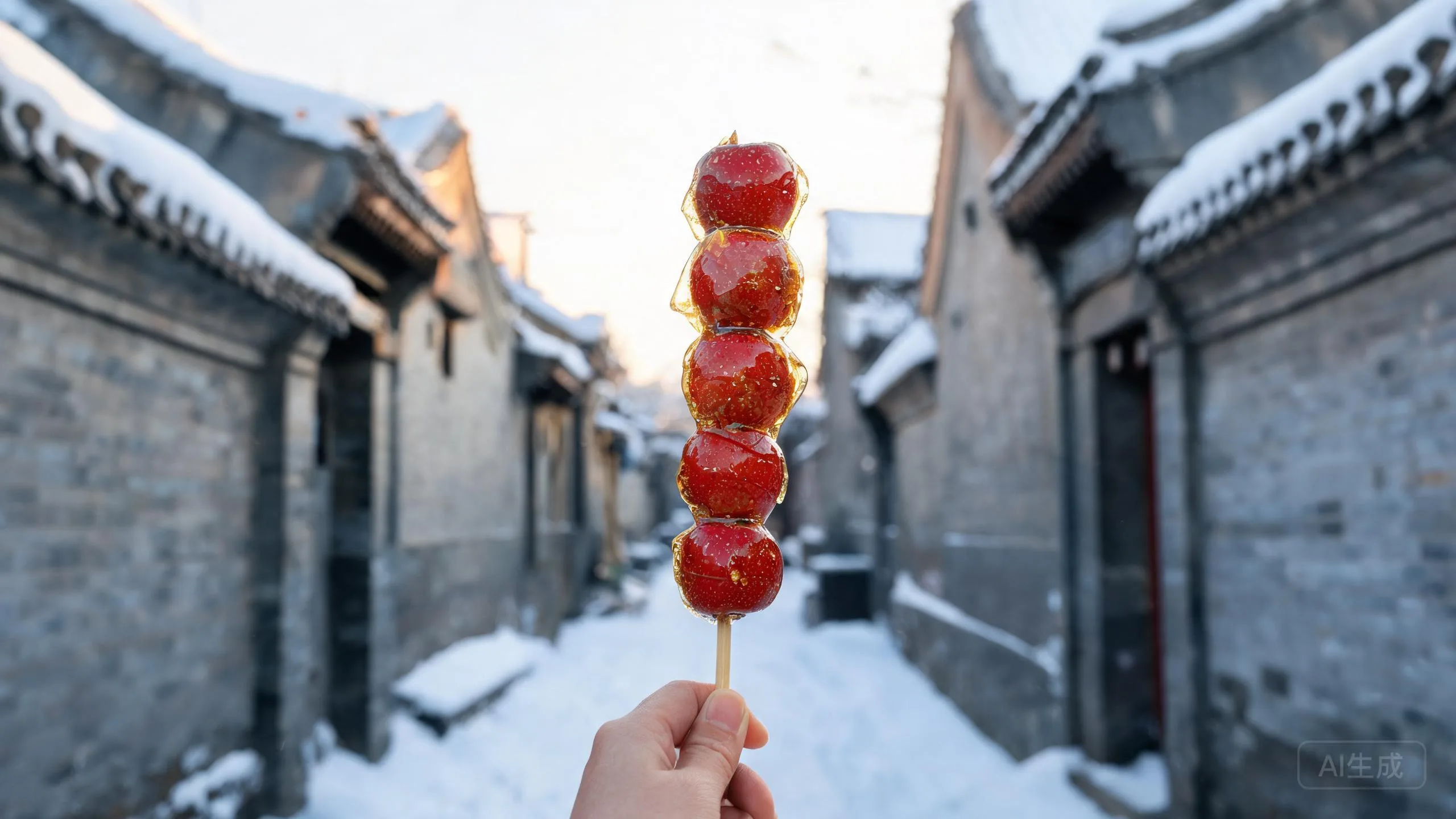
In the winter of 2019, short videos of something shiny, red, and strung on bamboo sticks started filling social media feeds around the world. The clips showed a simple preparation — fruit on a skewer, dipped in hot sugar syrup, left to cool into a glass-like shell that cracked satisfyingly under the teeth. In Mandarin the snack is called tanghulu (糖葫芦), and on TikTok it was being called everything from “candied hawthorn” to “Chinese candy apples.” What the videos didn’t show was the eight-century history behind that simple stick, or the Song dynasty palace, the street-corner vendor, and the winter festival that all figure into the story of how one small snack became the most recognizable winter treat in China.
The hawthorn berry (shan zha, 山楂) has been a staple of Chinese herbal medicine for centuries. Ancient physicians noted that it helped digestion, eased nausea, and could calm a cough. For Chinese emperors — who had access to the finest herbalists in the realm — shan zha was a regular ingredient in palace prescriptions. By the reign of Emperor Guangzong of the Southern Song (r. 1189 – 1194 CE), court physicians had developed a concentrated candy version called bing tang hulu red (冰糖葫芦) — literally “ice sugar hawthorn on a stick” — in which fresh hawthorn fruits were skewered and coated with a thick syrup of rock candy and water. The emperor’s consort was reportedly cured of a persistent digestive complaint after eating the preparation regularly. Whether or not the story is true, the recipe stuck. It migrated from the imperial pharmacy to the palace kitchen, and from the palace kitchen into the streets of临安 (Lin’an), the Southern Song capital, where street vendors adapted the expensive palace version into an affordable winter treat for ordinary people. That movement — from palace to street — is the central thread of tanghulu’s 800-year life.
From Palace Remedy to Winter Street Treat
The Southern Song capital of Lin’an was one of the largest cities in the world at the time, with a population exceeding one million. Its streets were a chaos of craftsmen, merchants, scholars, and laborers — and its food scene was correspondingly vibrant. Street food in Song dynasty cities was not cheap or degraded; many dishes that began as vendor food were later absorbed into elite cuisine, and some went the other direction, climbing down from palace kitchens into the market stalls below. Tanghulu took the second path.
The original palace formula called for high-quality bing tang — rock candy, the most refined sugar available at the time — and fresh hawthorn fruits selected for uniformity of size and absence of blemishes. Street vendors replicated the process with more affordable ingredients, using ordinary white sugar in place of rock candy, but keeping the essential technique: skewer the fruit, cook the syrup to the right consistency, dip the fruit quickly, let it cool in cold winter air. The cold was not incidental. The entire craft depended on the temperature differential between the hot syrup and the winter atmosphere. In the north of China, where winters are sharp and dry, this was easy to achieve. In the south, vendors learned to ice their fruit first, or to work in cold cellars, to ensure the sugar would set properly. The fundamental chemistry has not changed in eight hundred years.
By the Ming dynasty (1368 – 1644 CE), hawthorn candy on a stick had become a recognized winter specialty in Beijing and the northern provinces. The Manchu imperial court, ruling from Beijing after 1644, adopted the snack as part of the northern Chinese food culture. By the Qing dynasty, it was a fixture of the winter months — available from street vendors, sold at temple fairs, and present in the households of both commoners and officials. The bamboo skewer was not merely a convenience; it was part of the logic of the snack. A single stick held five to seven hawthorn fruits in a row, making the portion visible and shareable, turning an individual candy into something that could be broken apart and offered to others.
The Shape-Shifting Candy: How Tanghulu Learned to Be Everything
If there is one thing that explains tanghulu’s longevity, it is adaptability. The core formula — fruit on a stick, coated in sugar — is simple enough to accommodate almost any fruit, any nut, and any regional preference. Over eight centuries, the hawthorn base has been joined by strawberries, mandarin orange segments, grapes, gooseberries, banana chunks, and even small sweet potatoes. In the south, where hawthorn is less common, tangerine segments (ju hulu) and strawberries (cao mei tanghulu) are now at least as popular as the original. In the north, however, hawthorn remains the definitive version, and a tanghulu made with anything else is considered a variation rather than the real thing.
This regional split is one of the most interesting features of tanghulu’s cultural geography. In Beijing, the classic bing tanghulu (冰糖葫芦) is still made with hawthorn, and the sugar coating should be thin, translucent, and glassy — you should be able to see the fruit through it. A properly made Beijing tanghulu has what vendors call a tang feng (糖风), literally “sugar wind”: when the hot-syrupped fruit is lifted out and held in the cold air, the sugar draws out into fine threads that catch the breeze and shimmer. Getting the tang feng right is the mark of a skilled vendor, and the sound of the sugar hitting cold air is the snack’s most distinctive auditory signature.
Tianjin, the port city two hours east of Beijing, has its own version called tang dui lian (糖堆儿), which adds toasted sesame seeds to the sugar coating. The sesame gives the surface a grainy texture and a slightly nutty flavor that distinguishes it from the smooth Beijing style. In the northeastern provinces — Heilongjiang, Jilin, Liaoning — the skewers are larger, with five to seven hawthorn fruits each, and the sugar coating is often slightly thicker to withstand the extreme cold. Shandong province has its own bing tang shan zha (冰糖山楂) tradition, where the hawthorn is sometimes replaced entirely by small Fuji apples or radish slices for a savory-sweet version. In Changsha, the southern city famous for its spice-forward cuisine, you will find tanghulu made with mandarin orange segments and coated in a syrup that sometimes includes osmanthus flowers for a floral note. None of these variations would confuse a Chinese person about what they are eating — they are all recognizably tanghulu, the same fundamental idea expressed in different regional vocabularies.
The Craft Behind the Crunch: How Real Tanghulu Is Made
Making good tanghulu at home is not difficult, but it requires attention to one thing above all others: temperature. The sugar syrup must be cooked to exactly 160°C (320°F) — the so-called “hard crack” stage, where the syrup forms a thin, brittle, glass-like coating when cooled. Below that temperature, the coating will be sticky and soft. Above it, the sugar will caramelize and taste bitter. For this reason, a good candy thermometer is the single most useful tool for the home tanghulu maker.
The process, step by step, looks like this. First, select firm, blemish-free hawthorn fruits. Remove the stems but leave the fruit whole — do not remove the seeds, which give tanghulu its characteristic slightly tart undertone. Thread five to seven fruits onto a bamboo skewer, leaving a small gap between each one so the syrup can coat all surfaces. Next, prepare the syrup: equal parts sugar and water (a 1:1 ratio by volume) in a wide, heavy-bottomed pot. Bring to a boil over medium-high heat, then continue cooking without stirring until the thermometer reads 160°C. The syrup will be completely clear at this point.
Remove the pot from the heat. Working quickly, hold the skewer over the pot and use a spoon to pour the hot syrup over the fruit, rotating the skewer to ensure an even coating. Alternatively, plunge the entire skewer into the syrup and lift it out immediately, letting excess drip back into the pot. This is the most critical moment in the process. The syrup must be hot and the outside temperature must be cold — ideally below 5°C (41°F) — for the coating to set instantly into a glassy shell. If the syrup has been removed from the heat for more than thirty seconds, it will begin to thicken and the coating will be uneven. Hold the completed skewer up and listen: if you hear a faint crackling sound, the tang feng is forming and the coating will be thin and crisp. Set the skewer aside on a sheet of parchment paper to cool completely.
A properly made tanghulu will keep at room temperature for one to two days, though the sugar coating will begin to absorb moisture from the air after the first twelve hours and will gradually lose its crispness. The sugar coating, it should be noted, serves a functional purpose beyond aesthetics: the thick sugar shell seals the surface of the fruit and prevents microbial growth, which is why tanghulu made before the advent of refrigeration could last for hours in winter air without spoiling. The combination of preservation and sweetness is what made it such a practical winter snack in an era before cold storage.
The Cultural Symbol: Why a Simple Candy Means So Much
In northern China, the arrival of cold weather is inseparable from the sight of a tanghulu vendor. Historically, vendors carried their wares on wooden racks balanced across the back of a bicycle, calling out their presence in the frozen air. In Beijing’s hutongs — the narrow alleyways that run between grey brick walls — a bicycle vendor with a rack of glossy red tanghulu is one of the defining visual markers of winter. The sight is so characteristic that when the BBC filmed a documentary about Beijing in winter a few years ago, the tanghulu vendor was one of the first subjects they captured on camera.
At temple fairs — the annual religious festivals held at Buddhist and Taoist temples throughout China — tanghulu is one of the staple offerings. Temple fairs are social events as much as religious ones, drawing crowds of families who come to eat, buy small crafts, and watch performances. Tanghulu fits naturally into this context: it is inexpensive, visually appealing, and can be eaten while walking. Its colors — the deep red of hawthorn visible through translucent sugar — make it one of the most photogenic items at any festival. For many Chinese people who grew up in the north, the smell of hot sugar syrup on a winter street is one of the most powerful triggers of childhood memory. A 1980s pop song called “Bing Tang Hulu” (冰糖葫芦) became a minor cultural phenomenon when it was released, its lyrics describing the candy as “a tree hung with red lanterns” and the song continuing to be associated with the snack decades later.
The confection also carries a curious double identity in Chinese culture. Because it originated as a medicinal preparation — hawthorn is still used in TCM to aid digestion and lower blood cholesterol — there is a persistent belief in some communities that tanghulu is “good for you” in a way that ordinary candy is not. This belief is not universal, and it tends to coexist with an equal and opposite awareness that a tanghulu is also, plainly, a candy made by dipping fruit in sugar. The ambiguity is part of the snack’s appeal. It exists in the space between medicine and indulgence, between tradition and novelty, between the imperial court and the street corner.
Going Global: Tanghulu in the Modern World
The international spread of tanghulu tracks closely with the broader global interest in Chinese food culture that accelerated in the 2010s and 2020s. Chinese restaurants and food halls in New York, London, Toronto, and Sydney have featured tanghulu on their menus for years, usually positioned as a shareable dessert or a visual spectacle. In Chinese communities outside mainland China — in Singapore, Malaysia, Hong Kong, and Taiwan — tanghulu has long been a familiar fixture at night markets and food stalls.
The social media moment was decisive. Between roughly 2018 and 2020, #tanghulu and #bingtanghulu collectively accumulated hundreds of millions of views on TikTok and Instagram, with home cooks and food influencers replicating the candy with mixed results. Some of the viral videos showed genuinely skillful vendors in Chinese cities; others featured approximation made with marshmallows and melted chocolate that would be unrecognizable to anyone familiar with the real thing. The global version of tanghulu has, in some cases, drifted considerably from the original. Some international versions omit the bamboo skewer entirely, serving the candied fruit in cups. Others use food coloring to create rainbow-coated versions that would surprise a Beijing vendor. Still, the core appeal remains recognizable: fruit, sugar, a satisfying crunch, and the particular pleasure of eating something that is simultaneously ancient and new.
Food festivals in North America and Europe have increasingly included tanghulu as a featured item, particularly festivals focused on Asian street food. The Smorgasburg market in Los Angeles, which has become something of an incubator for new food trends, has hosted vendors specializing in tanghulu made with various fruits, and the lines at those stalls have sometimes extended around the block. This international visibility has created a productive tension: the global audience wants an “authentic” experience, but authenticity in tanghulu means something different in Beijing than it does in Los Angeles, and the tension between those two standards is unlikely to resolve anytime soon.