There are writers whose work becomes more famous than their lives, and writers whose lives become more famous than their work. Tao Yuanming is unusual in being both, more or less simultaneously, and in having his life and work end up describing the same thing: a refusal. He refused the official career he was being pushed into. He refused the writing conventions of his age. He refused the bargain that most ambitious men in the fourth century CE were making, in which you served a corrupt patron in exchange for salary, status, and the slow poison of being someone other than yourself. In place of all of that, he wrote about picking chrysanthemums by the eastern fence, drinking cheap wine, going home, and not bowing.
The Peach Blossom Spring — a 425-character piece of prose, less than a thousand words in English — is his most famous work. It is also one of the founding texts of utopian literature, not just in China but globally. Everyone who has ever written a story about a hidden valley, a secret commonwealth, a place where nobody outside can find you, is in some way writing after Tao Yuanming. The story’s structure is so familiar now that it is easy to forget how strange it was when he put it down. There was no real precedent for it. There was no literary form to put it in. He made one up.
He was a strange man. He was also, as far as I can tell, one of the most honest men who ever lived. Both of those facts matter.
The Official Who Wouldn’t Stay Official
Tao Yuanming — also known as Tao Qian (陶潛), and traditionally referred to as Tao Jinling or “the old gentleman of the eastern fence” — was born in 365 CE in what is now Jiujiang, Jiangxi province, in the lower Yangzi. The family was a small aristocratic one, old enough to claim descent from Tao Kan, one of the great generals of the early Eastern Jin. By the time Tao Yuanming was born, however, the family had fallen on harder times. His father died when he was young. He was raised by his mother and an older cousin, in a household that had the literary and cultural capital of an old gentry family but not the cash.
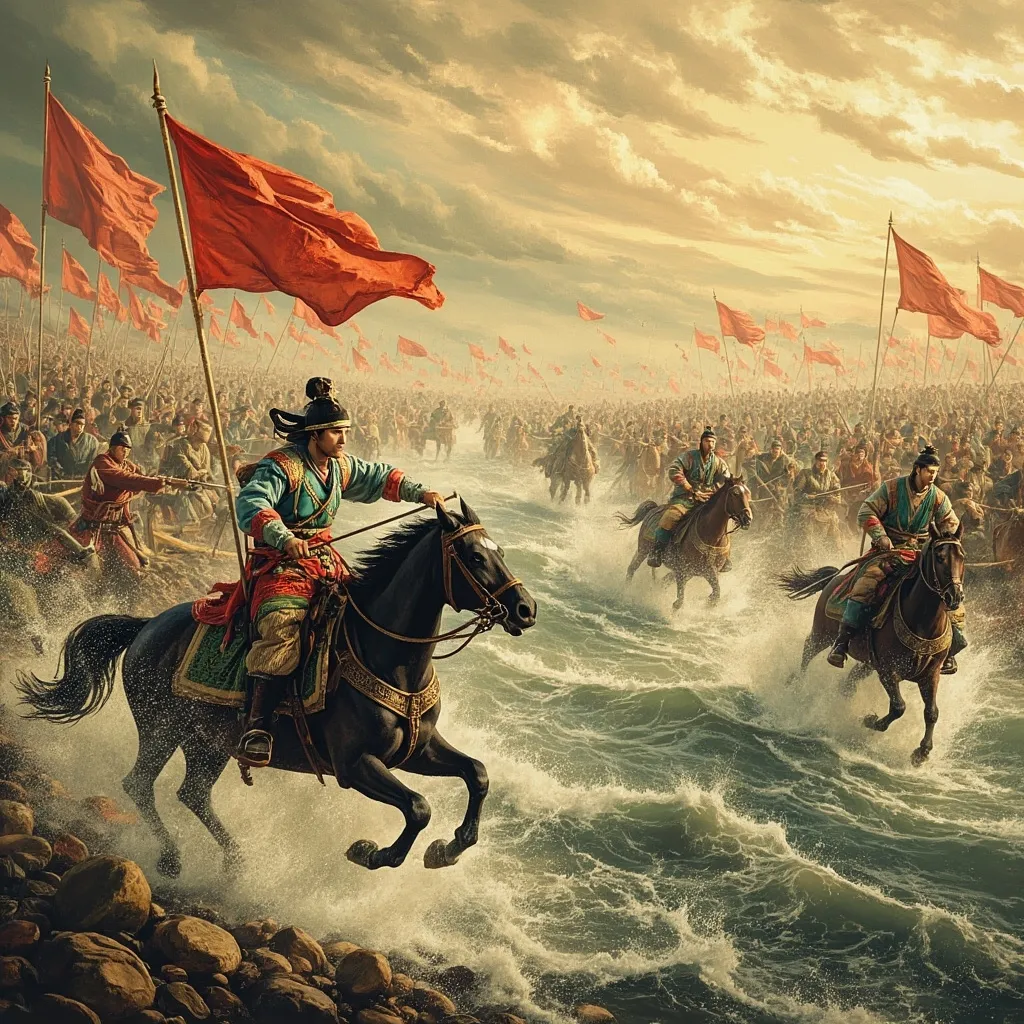
This mattered. The Eastern Jin court was, by the standards of earlier dynasties, decadent and demoralized. The court itself was in the south — Jiankang (modern Nanjing), with Hangzhou and Suzhou behind it — running an exile government after the loss of the north to non-Han dynasties. The gentry of the period had developed an elaborate culture of refined escapism: drinking, philosophical conversation, Buddhist and Daoist debate, calligraphy, the appreciation of exotic objects. They were brilliant. They were also, in the moral sense, lost. The most famous of them, Xie An and his nephew Xie Xuan, had pulled off a stunning military victory at the Battle of Fei River in 383, then retired into cultivated leisure. The next generation did almost nothing.
Tao Yuanming entered this world as a young man. He passed the local examinations — not the imperial exams, which had not yet been fully developed, but the lower-level xiangshi and xiaolian that identified promising candidates for minor office. He was given a position as a minor official in the region. He held it, on and off, for about thirteen years.
The accounts differ on the exact sequence. The story that became canonical, possibly shaped by Tao Yuanming himself, is that in 405 CE, after serving for eighty-one days as the magistrate of Pengze — a small county on the Yangzi, north of modern Jiujiang — he received an official visit from his superior, the inspector of the provincial government. The visit required Tao Yuanming to put on formal robes, bow, and receive the man with full ceremony. He did so, on one account while still wearing his hemp working clothes, and was visibly pained throughout. After the inspector left, he concluded that he could no longer serve, and resigned his post. He gave his reasons in a famous letter to his younger brother: he could not “bow to a child” — a reference to the inspector — “just to keep a salary.” He would rather farm.
The exact circumstances are contested, and modern scholars have questioned whether the resignation was a single dramatic event or a slow drift. What is not contested is the result. Tao Yuanming went home. He stayed home. He wrote about being home.
For readers who want to engage with the primary sources in translation, A. C. Barnes’s [product_affiliate: A.C. Barnes translation of the complete poems of Tao Yuanming, Jars of Wine] is the standard scholarly edition. For the prose, which includes the Peach Blossom Spring, Cyril Birch’s [product_affiliate: Cyril Birch anthology of Chinese literature, Anthology of Chinese Literature] includes most of the short pieces that made Tao Yuanming famous.
A New Kind of Chinese Poem
What Tao Yuanming did to Chinese poetry is hard to overstate. The dominant poetic mode of his age was the fu — long, elaborate, formal rhapsodies in which the poet would be given a subject by a patron and was expected to compose something technically virtuosic. The other dominant mode was the courtly five-character line of the court poets, which valued formal elegance, allusion, and display.
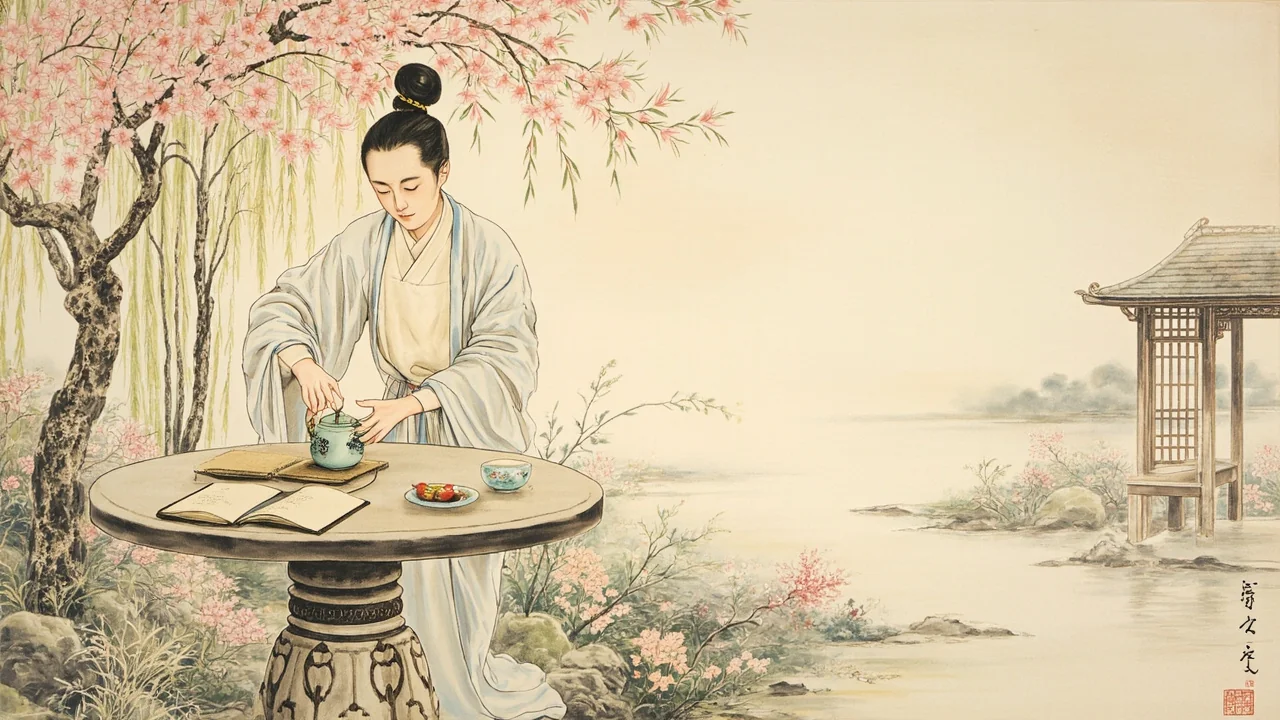
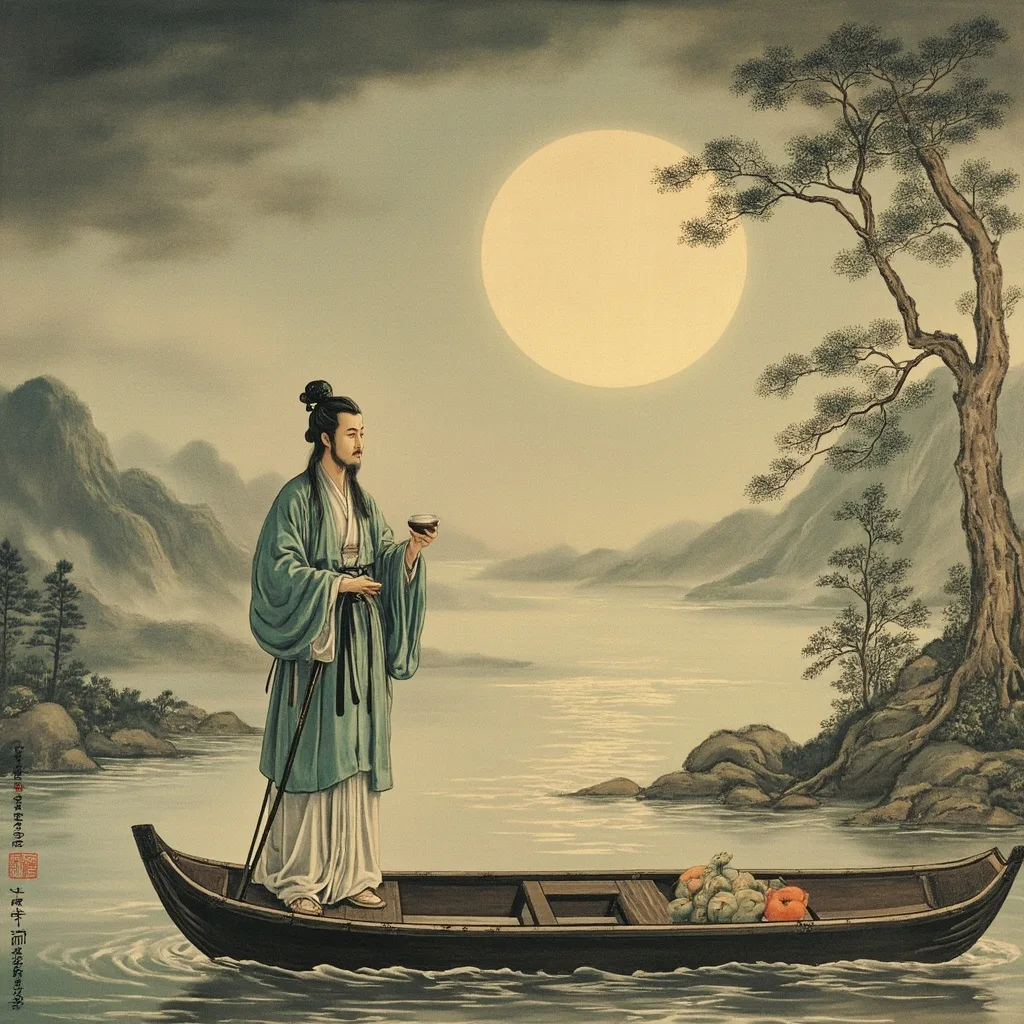
Tao Yuanming wrote five-character poetry, but he wrote it differently. The poems are short. They are about small things: chrysanthemums, a broken jug of wine, the south wall of his house catching afternoon sun, his children playing in the courtyard. They avoid allusion. They avoid ornament. They avoid the kind of courtly polish that would have marked a poet of social standing. They sound — to a reader in translation — almost embarrassingly plain: “Picking chrysanthemums by the eastern fence, I see the south mountain at a distance.” The line reads as a piece of gentle observation. It is also one of the most famous lines in the language.
This plainness was not naive. It was a deliberate aesthetic choice. The biographical tradition says that Tao Yuanming wrote some of these poems drunk, in a working tunic, by the south wall of his thatched house. They were not composed for patrons. They were not composed for presentation. They were composed for himself and, sometimes, for the handful of friends who came by to drink with him. That freedom — the freedom to write the way you would speak to a friend, rather than the way you would present to a court — was unusual enough in his time that it took about a century for later poets to figure out how to do it on purpose.
The poems are also political. Reading the biographical tradition, you quickly notice that Tao Yuanming’s refusal to serve, his refusal to bow, his decision to go back to the land, were not quiet, personal acts. They were arguments. The gentry of the Eastern Jin had developed a complex political ritual in which political service was, by definition, morally compromised. To serve was to participate in a system you couldn’t stomach. To refuse was to opt out of public life entirely. Tao Yuanming’s refusal made that choice visible. By going home, he made the absence of going home — the question of what everyone else was doing — sharper.
The most-cited modern interpretation, by James Hightower and others, treats Tao Yuanming as a kind of secular Daoist: someone who had absorbed the Daodejing and Zhuangzi deeply enough that he could not be a Confucian official in good conscience. That interpretation has its merits. It’s also a bit too clean. Tao Yuanming was a Confucian who couldn’t be a Confucian; he was a reader of the Zhuangzi who couldn’t sit still; he was a poet who wanted the world to be different and who, when he couldn’t change it, made his home into something the world didn’t quite know how to fit into its categories.
A nice way into this is [product_affiliate: Tao Yuanming selected poems in Chinese and English, facing page edition], which gives you the original and the translation together. For the prose tradition, [product_affiliate: Anthology of Six Dynasties poetry and prose, including Tao Yuanming, Burton Watson translation] is an essential single volume.
The Peach Blossom Spring
Now the utopia.
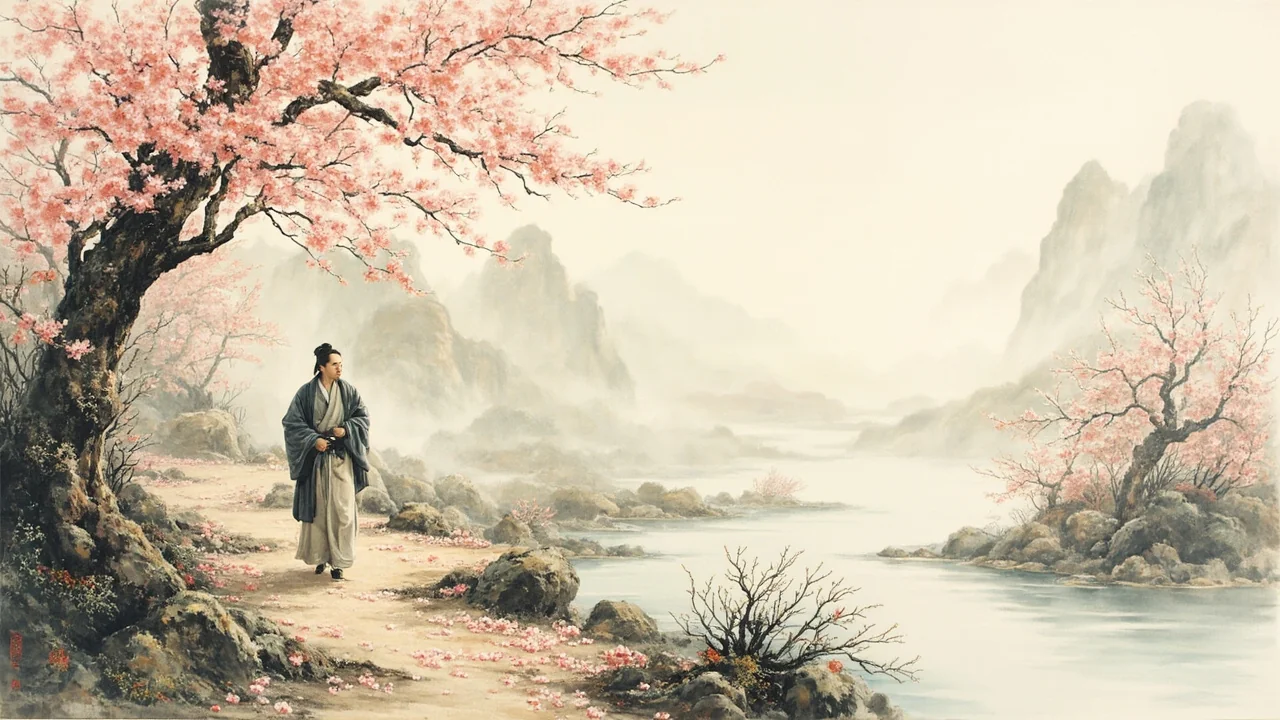
The Peach Blossom Spring — Taohua Yuan Ji (桃花源記) — is dated by some scholars to 421 CE. It begins with a fisherman who is following a stream, in the spring, through a field of fallen peach blossoms. He goes upstream into a passage between the cliffs. The passage ends at a small, hidden valley.
In the valley there is a settlement. The people are simple and well-fed. They have been there for several generations. They have not heard of the Han Dynasty — they are descended from refugees from the Qin conquest, who hid there to escape the wars and the forced labor. They have no landlord. They have no corvée labor. They have no calendar reform, no imperial edicts, no succession wars. They grow their own food. They marry their own. They die their own deaths.
The fisherman stays for a few days. They ask him about the outside world. He tells them — cautiously, as the prose implies — about the fall of the Qin, the rise of the Han, the wars of the Three Kingdoms, the Jin conquest. They are amazed that so much has happened. He leaves. He goes back out. He marks the route. He reports to the local magistrate. The magistrate sends people to find it. They cannot.
The story ends with two short paragraphs. The scholar Liu Ziji, who hears the story, suggests going back to find it but never does. He writes a poem about the moment, with the line “No one knows where the high road leads; the world outside is its own separate realm.” The fisherman has returned to the world and the world has not changed. The hidden valley is still hidden. The text does not claim it ever existed. It does not ask us to believe it existed. It just notes that someone went looking and didn’t find it.
That is the whole text. 425 characters. It was added, by tradition, as a postscript to a longer poem about the Peach Blossom Spring that Tao Yuanming had written separately. The two have been read together for about sixteen centuries.
What is striking about the story is how little it explains. Why does the valley exist? Why do the people there speak Chinese? Why has nobody else found it? Why do they accept the fisherman’s presence without locking him up, and why do they let him go? The story doesn’t care. It is not interested in those questions. It is interested in one question: what would the world look like if it were not the world?
For readers who want to engage with the prose, Cyril Birch’s [product_affiliate: Cyril Birch translation of the Peach Blossom Spring with Tao Yuanming biography] is widely used. For the broader tradition of utopian and hidden-valley literature, [product_affiliate: Rocca, Mountain of Paradise, utopia in Chinese literature] is the best single-volume study.
The Story’s Afterlife
The Peach Blossom Spring was enormously influential. It produced an immediate tradition of Chinese hidden-valley literature — stories, poems, essays, paintings — about real or imagined places that existed outside the imperial system. By the Tang dynasty, the Peach Blossom Spring had become a stock image: an abandoned landscape with peach blossoms by a stream and a few thatched roofs, on the silk paintings of Wang Wei and his successors. By the Song, the story had acquired its own exegetical tradition, with commentaries debating whether the place was real, where it might be, whether it had existed in other dynasties.
It also became, almost immediately, a political text. Rebels and dissidents invoked it. Land reform movements cited it. Daoist and Buddhist sectarian communities used it as a model for their own settlements. The historian Chen Yinke, in the twentieth century, argued that the Peach Blossom Spring was not a retreat from the world but a critique of it — that the hidden valley’s lack of imperial tax was the point. This reading is still contested. It is one of the more interesting debates in modern Chinese intellectual history.
Outside China, the story traveled. It entered Japan by the Heian period and was adapted into waka and into a number of ukiyo-e woodblock landscapes. It entered Europe in the late nineteenth century through French sinology and reached English readers through Arthur Waley’s translations, where it became, along with the Saga of the Peach Blossom Spring, a kind of founding text of Asian-influenced utopianism. The structural similarities between the Peach Blossom Spring and later Western utopias — More’s Utopia, Bacon’s New Atlantis, even the lost-civilization subgenre of late-Victorian fiction — have been noted many times. The direction of influence is harder to pin down. The point is not who influenced whom. The point is how few texts survive in the imagination of the world for sixteen centuries. The Peach Blossom Spring is one of them.
Why a Farmer Still Matters
Tao Yuanming died around 427 CE, in or near his home in Jiangxi, after a long life of intermittent poverty, hard farming, and steady writing. By the time he died, he had been largely forgotten. The court he had refused to serve was already collapsing. The Eastern Jin would fall in 420 CE, replaced by the Liu Song, and then by a cascade of short-lived southern dynasties, until the Sui reunified China in 589.
His reputation was rescued by a later generation. The great Tang poet Du Fu wrote about him in the eighth century. Bai Juyi wrote about him. Su Shi, who was closer to him in temperament than almost any other writer in Chinese history, wrote the famous couplet: “The clever ones of this world know him; the ones who follow him are not his equals.”
The phrase is a translation of Su Shi’s poem on him. It is the standard epitaph. It is also, in a way, the whole problem. Tao Yuanming became, after the Song, a kind of cultural symbol of the disengaged scholar. His poems were anthologized. His life became a set piece. He was held up as an example for other writers who wanted to refuse the world.
What got lost in the canonization was something simple: he was a working farmer who wrote poems because he needed to write them, and he didn’t bow to people he didn’t respect because he couldn’t bring himself to do it. He was not a symbol. He was a person. The Peach Blossom Spring is what you get when someone who can’t bow to a corrupt inspector keeps writing anyway.
If you want to bring a piece of his world into your own, a few things are worth looking at. The [product_affiliate: dried chrysanthemum tea, hand-picked, similar to what Tao Yuanming would have brewed] is a direct sensory link. For something more durable, [product_affiliate: Chinese landscape painting reproduction of a Peach Blossom Spring scene, hand-rolled xuan paper] is the visual tradition he invented. And for anyone who wants to read the poems themselves, the [product_affiliate: Penguin Book of Chinese Verse, A.C. Barnes translation, including complete Tao Yuanming] is still the best single-volume English collection.
Most of the writers we remember are writers who made some kind of accommodation with power. Tao Yuanming is interesting because he didn’t. He also managed to write something that has lasted. That is rarer than it sounds. It is the rarest thing in literature: a refusal that did not destroy the work. He gave up the career. He kept the poems. Sixteen centuries later, we’re still reading them.