In 675, a young poet named Wang Bo traveled to Nanchang, a city in southern China along the Gan River. He was 26 years old, which in Tang Dynasty terms meant he was just beginning his career as a scholar-official. He was also in a complicated personal situation — he had recently been pardoned from a period of exile after getting involved in a lawsuit that nearly ended his life. The details of that lawsuit are murky and historians still debate them. What matters is where he went while he was in Nanchang, and what he wrote while he was there.
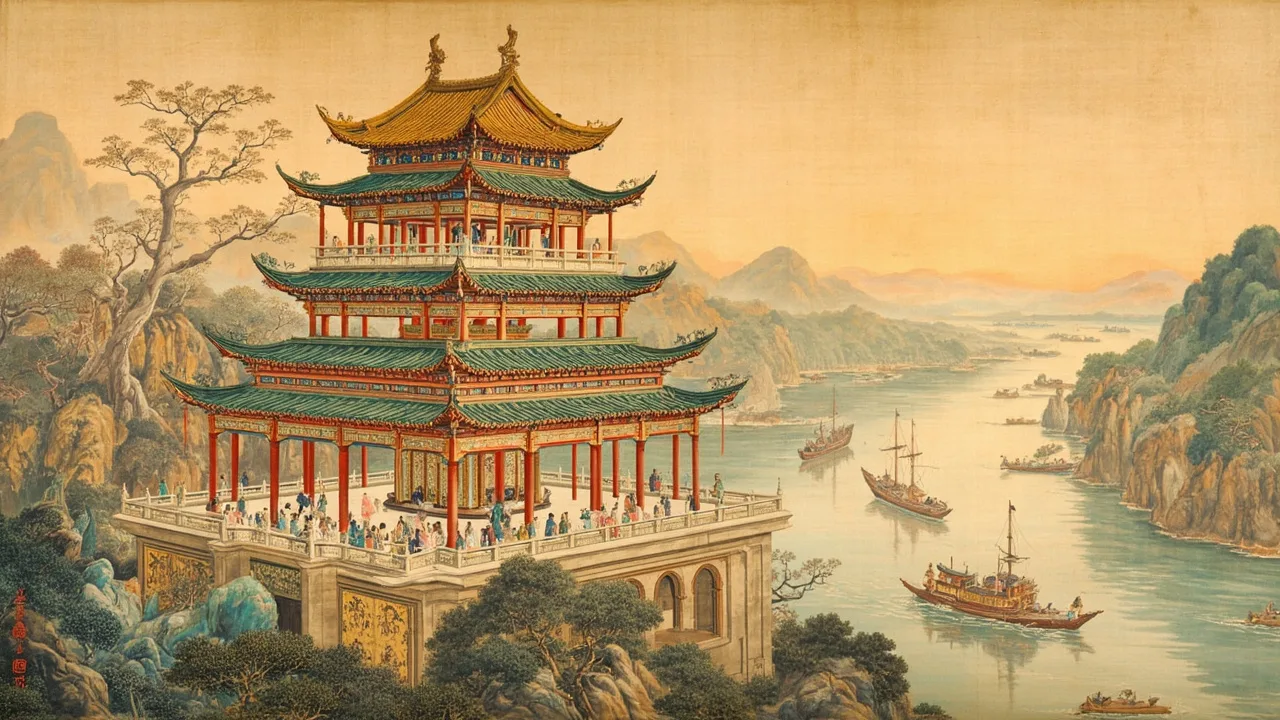
The local governor, a man named Yan Gao, was hosting a banquet at Tengwang Pavilion, a newly rebuilt structure overlooking the river. These kinds of gatherings were common in the Tang Dynasty — local officials invited scholars and poets to drink wine, compose verses, and celebrate regional achievements. Yan invited Wang Bo to attend. The young poet came, saw the view from the pavilion, and proceeded to write one of the most celebrated pieces of prose in Chinese literary history.
The piece is called “Preface to the Tengwang Pavilion,” and it is only about 700 characters long. Within that short space, Wang Bo described the pavilion, the river, the mountains, the weather, and the people at the banquet. Then he turned to reflection and melancholy, and he wrote about time, about loss, and about how beauty fades. The combination of vivid description and philosophical depth made this text immediately famous. It has been memorized by Chinese schoolchildren for 1,300 years.
Who Was Wang Bo
Wang Bo was born in 650, in what is now Shanxi Province, into a family that was prominent in the early Tang period. His father held government positions, and his grandfather was actually a famous poet named Wang Heng. This family background meant Wang Bo grew up with access to education and literary models that many of his contemporaries did not have.
He was a prodigy by any measure. He began writing poetry at age six, and by fourteen he had already passed the civil service examinations at the provincial level. His writing was already attracting attention from senior officials who recognized his talent. The Tang civil service system was highly competitive — only a small percentage of candidates ever passed all the levels required to become a full official — and Wang Bo was navigating it with apparent ease.
But his early career was turbulent. He was known for being careless about hierarchy and protocol, writing poems that offended powerful officials, and generally behaving in ways that did not fit the mold of a proper Confucian scholar. In 666, he was involved in some kind of incident — historians are uncertain about the specifics — that resulted in his exile to a remote region. Some sources suggest he got into a dispute over credit for composing an official document. Others suggest he was simply in the wrong place at the wrong time during a court intrigue.
Whatever the cause, the exile lasted for several years. During this period, he was removed from the literary circles of the capital and from the possibility of advancing his career. This was a common punishment for scholar-officials who ran afoul of political powers — you were not executed, but you were marginalized, removed from influence, and essentially forgotten.
Wang Bo used his exile to write. He composed poetry and prose, refined his style, and built a reputation for literary brilliance that was recognized even in his absence. By the time he was pardoned and allowed to return to the capital, he was arguably the best prose writer of his generation.
The banquet at Tengwang Pavilion happened during his return journey. He was traveling south, probably heading toward a new posting, and stopped in Nanchang. Governor Yan Gao, who may have been a family friend or political ally, invited him to the pavilion ceremony.
The Writing of a Masterpiece
The story goes that when Wang Bo arrived at the banquet, he was seated in a position of lower status, away from the most prominent guests. The host and the other invited scholars were older and more established in their careers. They probably expected Wang Bo to remain quiet and respectful.
But when it came time to compose verses for the occasion, Wang Bo stood up and asked for paper and brush. He wrote the first section of the preface at incredible speed, apparently without revision. The host and the other guests were stunned by the quality of what they were seeing. As he continued writing, the atmosphere shifted from polite interest to genuine amazement.
This origin story has the ring of literary legend — the overlooked young genius who silences the room with his talent. Whether it happened exactly this way is impossible to verify. But the story survived because the text itself feels like it was written in a single burst of inspiration. There is an energy and urgency to the prose that rewards re-reading.
The preface opens with geography. Wang Bo describes Nanchang’s position along the Gan River, its proximity to mountains and lakes, and the strategic importance of its location in the early Tang. He notes that the previous prince of Tengwang had ordered this pavilion built in 653, and that it had been rebuilt recently after suffering damage from a flood. He gives the reader a clear picture of the physical setting.
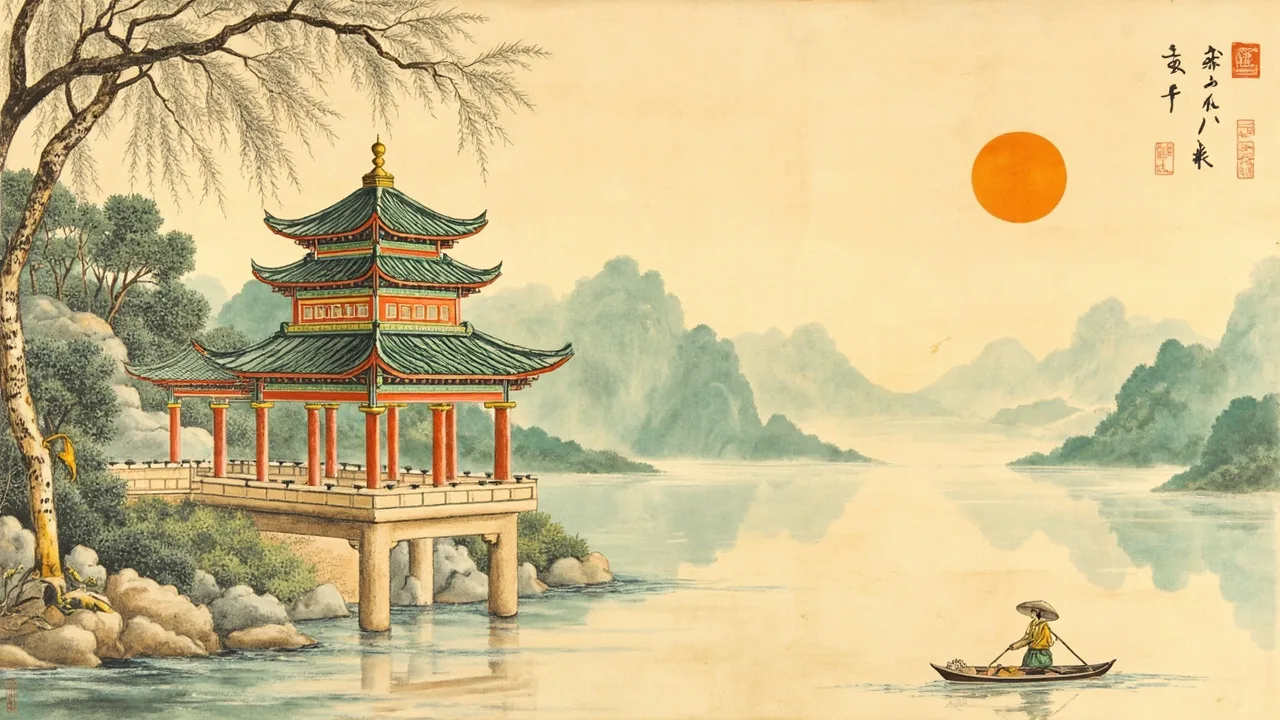
Then he shifts to description of the river and the sky. His language here is precise and beautiful. He describes the autumn waters flowing in wide expanses, the mountains shrouded in mist, the way light catches the water at sunset. He mentions fishing boats passing through reeds, wild geese flying south, and the particular quality of southern Chinese light in autumn. It is visual writing of a high order.
The most famous lines come toward the end of the descriptive section: “落霞与孤鹜齐飞,秋水共长天一色” — “The setting sun’s glow and the lone duck fly together; the autumn waters share one color with the distant sky.” These two lines are so perfectly balanced and visually evocative that they have been quoted, adapted, and referenced countless times in Chinese literature. They also happen to be the lines that made Wang Bo’s reputation.
The Philosophical Turn
After describing the scene, Wang Bo shifts tone. He begins to reflect on the people at the banquet, and then more broadly on the nature of human achievement and the passage of time.
He lists famous figures from history who had passed through this region. Some were great generals. Some were talented scholars. Some were officials who had achieved remarkable things. All of them, without exception, are dead now. Their accomplishments are recorded in history books, but they themselves are gone.
He writes about how the banquet will end, how the guests will disperse, how even the most memorable gatherings become memories and then fade from memory entirely. This is not nihilism — Wang Bo is not saying nothing matters. Instead, he is acknowledging the transient nature of human experience while also affirming that the act of creation, of writing something beautiful, is a way of pressing back against time.
This is a theme that runs through much of Tang Dynasty literature, and it connects to broader Chinese philosophical traditions about the relationship between the individual and time. Confucian thought emphasizes the importance of leaving something behind through service and good governance. Daoist thought emphasizes the flow of time and the wisdom of going with natural cycles. Buddhist thought, which was spreading rapidly through China during Wang Bo’s lifetime, emphasizes the illusion of permanence and the ultimate vanity of attachment.
Wang Bo seems to draw on all three traditions in his conclusion. He acknowledges loss and change as fundamental aspects of experience, while also celebrating the beauty that exists in the present moment. The preface is not a downer. It is a celebration of what is beautiful right now, made more poignant by the awareness that it will not last.
Why This Matters to Americans
The closest American literary parallel to Wang Bo’s preface is probably the work of the Romantic poets — writers like Keats and Shelley who also grappled with beauty, mortality, and the power of art to outlast human life. Wang Bo is doing something conceptually similar to what Keats does in “Ode to a Nightingale” or what Whitman does in his meditative poems about death and impermanence.
The difference is context. For Wang Bo, the philosophical stakes were rooted in Tang Dynasty Chinese culture, with its particular blend of Confucian, Daoist, and Buddhist influences. For American Romantics, the philosophical stakes were rooted in European Enlightenment thought and American Transcendentalism. But the underlying emotional territory — the awareness that beautiful things end, and that this makes them more precious — is recognizable across cultures.
There is also something for Americans in the story of Wang Bo himself. He was a young person with extraordinary talent who made mistakes, suffered consequences, and still managed to produce enduring work. The American cultural myth celebrates the self-made person, the individual who overcomes adversity through talent and determination. Wang Bo fits this template even within a very different cultural framework.
American readers who are interested in Chinese literature often start with more famous names — Li Bai, Du Fu, Su Shi. These are excellent choices, but Wang Bo offers something different. He wrote at an earlier moment in Tang culture, before the high Tang reached its peak, and his style has a raw energy that later poets sometimes lack. He is considered one of the Four Great Poets of the Early Tang, alongside Yang Jiiong, Lu Zhaolin, and Zhang Chu. Reading him gives you a sense of how Tang literary culture developed before it reached its most famous expressions.
The Pavilion Itself
Tengwang Pavilion has been destroyed and rebuilt many times over the centuries. The original structure from 653 is long gone, replaced multiple times due to fires, wars, and natural deterioration. The current building dates to 1989, reconstructed after the previous version was destroyed in a fire in 1983.
This pattern of destruction and reconstruction is common for Chinese cultural landmarks. The physical structure is less important than the location and the associated literature. When Chinese people visit Tengwang Pavilion today, they are not going to see a 1,300-year-old building. They are going to stand at a location that has been continuously meaningful for over a millennium, a place where Wang Bo once stood and wrote words that made the location immortal.
The pavilion sits on the south bank of the Gan River in modern Nanchang, the capital of Jiangxi Province. Nanchang is not on most American tourists’ China itineraries, which usually focus on Beijing, Shanghai, Xi’an, and perhaps the southern scenic areas around Guilin and Huangshan. But Jiangxi Province has a rich cultural heritage that most visitors miss. It was the home of Wang Bo’s contemporary, the poet Tao Yuanming, and it is also the region where Chinese ceramic traditions reached some of their highest expressions.
Visiting Tengwang Pavilion is a way to step off the well-worn tourist path and engage with a deeper layer of Chinese literary history. When you stand at the railing of the pavilion and look out at the Gan River, you can try to see it as Wang Bo saw it. The river has changed — the banks are more built up, the water traffic is different — but the light at sunset, the movement of birds, the general shape of the landscape remains recognizable.
“Preface to the Tengwang Pavilion” has been translated into English many times, and no translation fully captures the original. Wang Bo wrote in a form called pianwen, or “parallel prose,” which uses balanced, rhythmic sentence structures and extensive literary allusion. The form was designed to be read aloud and appreciated for its sonic qualities as much as its meaning. Translations necessarily lose the sound.
That said, several English translations are worth consulting for anyone who wants to engage with the text beyond summary descriptions. Arthur Waley’s translation in “A Century of Chinese Poetry” includes a version of the preface. More recent translators like David Knechtges, who specializes in ancient Chinese prose, have produced careful scholarly translations that attempt to preserve some of the original’s literary qualities.
Even without reading the original, however, you can appreciate the structure of the piece. It moves from concrete description to philosophical reflection, from celebration to melancholy, from personal experience to universal insight. This movement mirrors how human minds actually work when we encounter something beautiful — we enjoy it, we reflect on it, we become aware of our own mortality, and then we either retreat into denial or accept the situation with grace. Wang Bo chose acceptance, and his acceptance is what gives the preface its power.
Wang Bo wrote during a period that historians call the Kaiyuan era, named after the reign period of Emperor Xuanzong, who ruled from 712 to 756. This was the height of early Tang power and cultural achievement. The empire was wealthy, the bureaucracy was functioning well, and artistic production was flourishing at every level.
The civil service examination system was becoming more important during this period, which meant that literary talent mattered more than ever for anyone who wanted a government career. Wang Bo’s ability to write brilliant prose was not just an artistic accomplishment — it was a practical skill that could determine his social standing and his access to political power.
This created a specific cultural environment where literary skill and political authority were closely linked. A man who could write a preface like Wang Bo’s was demonstrating that he had the intellectual capacity to govern. The act of composition was also an act of political positioning. When Wang Bo wrote at Governor Yan’s banquet, he was reminding everyone present of his abilities. The preface was both art and advertisement.
This link between literature and governance is one of the distinctive features of traditional Chinese political culture, and it persists in modified forms to this day. Chinese political rhetoric still draws heavily on classical literary allusions. Senior officials are expected to be able to recite passages from texts like “Preface to the Tengwang Pavilion.” Understanding these allusions gives Americans a window into how Chinese political communication works, and why literary education remains central to Chinese elite formation even in the modern era.
The next time you read something by an American president or political figure that draws on a literary reference — Lincoln’s use of Shakespeare, Kennedy’s evocation of ancient Greek democracy — you are seeing a distant cultural cousin of the same phenomenon that made Wang Bo’s preface so politically significant in its original context.
[AFFILIATE: “The Columbia Anthology of Early Chinese Literature” - Contains translations of Wang Bo and other early Tang poets with scholarly introductions]
[AFFILIATE: River Cruise Guide to China’s Yangtze and Gan River - Practical guide for visiting Nanchang and exploring Jiangxi Province’s cultural heritage]
[AFFILIATE: Chinese Calligraphy Art Print - Features famous literary calligraphy including lines from “Preface to the Tengwang Pavilion”]