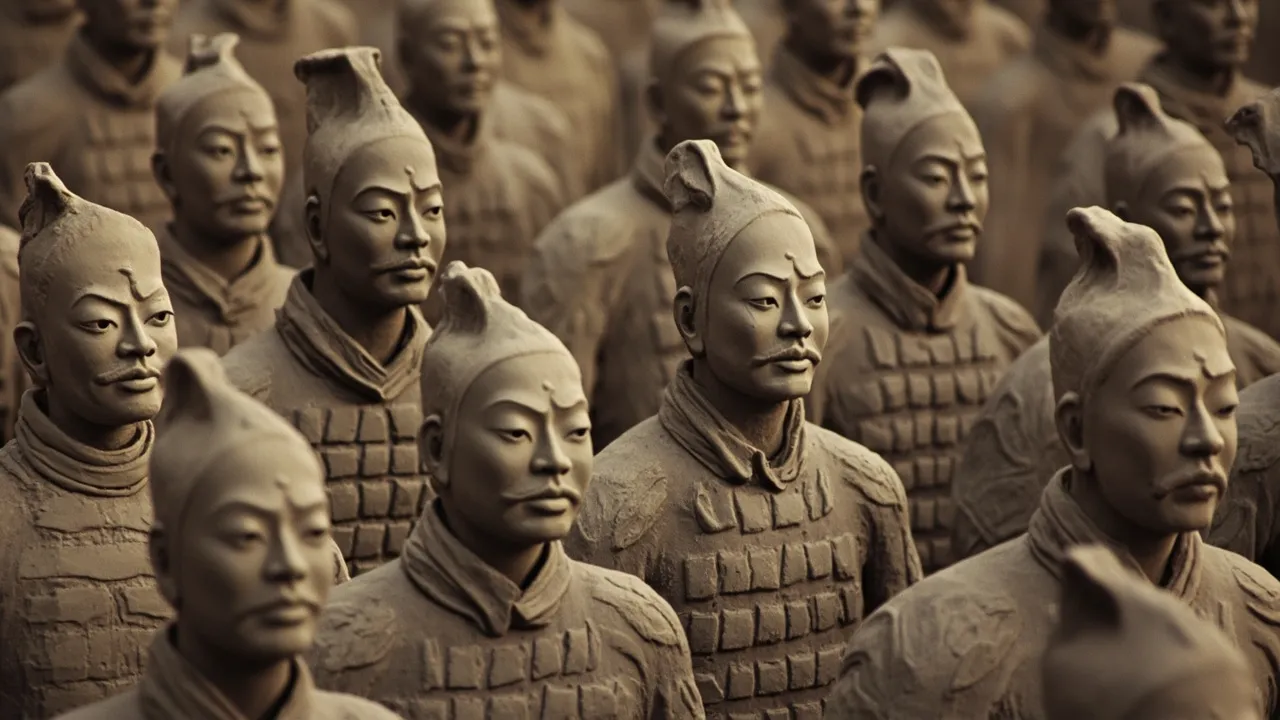
The Terracotta Army: China’s Ancient Army That Defied Time
Some discoveries happen by pure accident. Others unfold through years of patient research and meticulous planning. The Terracotta Army occupies a category entirely of its own — a find so massive, so unexpected, and so absolutely breathtaking that it fundamentally changed how historians and archaeologists think about ancient China and the remarkable achievements of its earliest emperors.
If you’ve ever seen photographs or videos of thousands of life-sized clay soldiers standing in military formation, you’ve glimpsed one of the wonders of the ancient world. Located in the historic city of Xi’an in central China, the Terracotta Army represents one of the largest and most significant archaeological discoveries in human history. These aren’t mass-produced replicas or modern reconstructions — they’re the genuine article, crafted over two thousand years ago and buried in the earth until a group of farmers digging a well accidentally unearthed them in the spring of 1974.
What you’re looking at when you study the Terracotta Army is nothing less than an ancient emperor’s extraordinary dream of immortality, preserved in clay and earth. The story behind how these warriors came to exist, how they were lost to the world for millennia, and how they were finally rediscovered is absolutely fascinating — a tale of imperial ambition, human craft, and the incredible patience of history waiting to be found.
Discovery of the Wonder
Picture this scene: it’s March 1974, and a group of farmers in China’s Shaanxi province are digging a well in a rural area outside Xi’an. They’re searching for water in a region that has been cultivated farmland for centuries — land that has been passed down through countless generations and worked by countless hands. One farmer, a man named Yang Zhifa, digs his shovel into the earth and hits something unexpectedly hard. He pulls out a fragment of terracotta — a broken head of a human figure, complete with detailed features that look almost alive, as if the person had been frozen mid-thought.
At first, nobody paid much attention to the discovery. Broken clay pieces weren’t entirely unusual in this area; archaeological relics from various historical periods were sometimes found during farming work, and most discoveries turned out to be relatively mundane. But Yang Zhifa was a curious man, and rather than throwing the fragment away or using it as a doorstop, he kept digging. What he found would eventually stun the entire world and captivate the imagination of millions.
Word spread quickly through the village. Local officials were notified, and eventually, archaeologists from across China arrived to investigate the site and assess what had been discovered. What they uncovered exceeded anyone’s wildest imagination. Beneath the fields, arranged in precise military formation, lay thousands upon thousands of life-sized soldiers. There were infantrymen standing in disciplined ranks, archers with bows at the ready, cavalrymen mounted on detailed horses, and charioteers gripping the reins of bronze chariots. It was an entire army frozen in time, waiting silently beneath the earth for over two thousand years.
The excavation work continued for months, then years. More than four decades later, archaeologists are still working diligently at the site, and they’ve only uncovered approximately 5% of the total area that researchers believe contains similar artifacts. That’s right — what you see today at the museum is just a tiny fraction of what lies beneath the surface. The full scope of this discovery might never be fully revealed in our lifetime, as the excavation work proceeds slowly and carefully to preserve every detail.
Here’s a number that puts the sheer scale of the Terracotta Army into proper perspective: researchers estimate there are approximately 8,000 individual soldier figures, 130 chariots, and 670 horses in the complete collection. Each figure stands about 6 feet tall — roughly the height of an average modern man — and no two faces are exactly alike. Take a moment to really let that sink in. Someone, somewhere more than two thousand years ago, supervised the creation of thousands of unique human faces, each one slightly different from the next in its features, expression, and character. It represents one of the most ambitious artistic and organizational undertakings in all of human history.
The discovery of the Terracotta Army didn’t just revolutionize our understanding of ancient China — it instantly became one of the most famous archaeological sites in the entire world. Today, it draws millions of visitors each year from every corner of the globe, all eager to witness this incredible testament to human creativity and imperial ambition.
The Qin Emperor’s Vision
To understand why these extraordinary soldiers exist, you need to understand the remarkable and somewhat terrifying man who ordered their creation: Qin Shi Huang, the first emperor of a unified China. This is a figure whose life story reads like something out of an epic historical drama — a man who conquered an entire civilization, unified a fractured nation under one rule, and then spent his remaining years desperately trying to conquer death itself.
In 221 BCE, Qin Shi Huang succeeded in conquering all of the rival states that had warred with each other for centuries and became the first emperor to rule all of China under a single banner. He was a man of immense, almost superhuman ambition, but he was also plagued by equally immense paranoia. Having survived numerous assassination attempts during his long and violent rise to power, he became absolutely obsessed with two things: living forever and ensuring his safety even in death.
Qin Shi Huang believed, as many古代 Chinese rulers did, that death was simply a transition to another life — a passage to a different realm where the soul would continue to exist and require the same comforts, luxuries, and protection it enjoyed in the mortal world. If he could surround himself with all the trappings of his earthly power in death, he reasoned, he would rule just as powerfully in the world beyond. And what better army to have at his side in eternal slumber than the very same forces that had conquered China and placed the imperial crown upon his head?
The emperor therefore ordered the creation of an army unlike anything the world had ever seen before. These soldiers would not be made of perishable materials like wood that would rot or metal that would rust. Instead, they would be crafted from terra cotta — baked earth that would last forever, seemingly impervious to the passage of time. He gathered the finest craftsmen in his vast realm and set them to work on this monumental project. The construction took decades to complete and employed hundreds of thousands of workers — artisans, sculptors, clay workers, and laborers drawn from across the empire.
But here’s where the story takes an almost tragic and certainly ominous turn. Historical records from that era suggest that after the army was buried and the project was complete, Qin Shi Huang ordered the craftsmen and artisans who had created the soldiers killed so they could never replicate the work or reveal its secrets to anyone else. The idea was that no other emperor — no other person — should ever possess an army like this one. Accounts vary considerably on whether this mass execution actually occurred in full, but the emperor’s legendary paranoia certainly makes it plausible. He wanted this army to be absolutely unique — a one-of-a-kind testament to his power and vision that could never be duplicated by future generations.
The construction wasn’t limited to soldiers alone, although they form the most impressive and numerous part of the discovery. The burial complex includes not just the fighting men but also officials, musicians, acrobats, and servants — a complete miniature court ready to serve the emperor in eternity. There are real bronze chariots and horses, buried in separate pits and discovered in different stages of preservation. Everything was designed with painstaking care to recreate the imperial court in miniature, ready to serve Qin Shi Huang forever.
Qin Shi Huang died in 210 BCE while on a tour of his massive empire. His death triggered a cascade of events that quickly led to the collapse of his dynasty. The Qin empire soon crumbled, and the Han dynasty rose to replace it, inheriting and building upon many of the administrative innovations Qin Shi Huang had pioneered. But the Terracotta Army remained hidden beneath the earth, waiting silently for over two millennia, perfectly preserved in the dry Chinese soil.
The Warriors and Their Secrets
What makes the Terracotta Army so extraordinarily compelling isn’t just the sheer numbers — it’s the incredible detail, variety, and individuality of each figure. Let’s break down what archaeologists have discovered over the decades of careful study and excavation.
First and most numerous are the infantrymen. These make up the largest group of figures and stand in careful military formation, facing east toward what ancient Chinese strategists considered the direction of potential enemies. They wear traditional Chinese armor plates and are organized into distinct units based on their position in the battle line. Each infantryman is armed with actual bronze weapons — spears, swords, dagger-axes, and other implements of war — many of which still have their original sharp edges. When researchers first tested these ancient weapons, they discovered, to their amazement, that they were still sharp enough to cut through modern metal. The metallurgical techniques used to create these weapons were so advanced that they wouldn’t be matched by European smiths for centuries.
Then you have the cavalrymen, each mounted on carefully crafted horses. These mounted figures are slightly smaller than the infantry soldiers, designed to fit realistically on horseback. The horses themselves are true masterpieces of ancient sculpture — you can clearly see the veins in their necks, the defined shapes of their ribs, and expressions that look almost alive, as if they might break into movement at any moment. The attention to anatomical detail is extraordinary, showing that the craftsmen who created these figures possessed an intimate understanding of horse anatomy.
The charioteers represent yet another distinct category of figures. These figures wear different armor than the infantry soldiers, and their hands are positioned as if permanently gripping the reins that would have controlled their horses. The bronze chariots themselves, each pulled by four horses, had to be painstakingly reconstructed from thousands of fragments because they were buried in pieces — likely intentionally dismantled as part of the burial ritual, a symbolic “dismantling” for the afterlife that paralleled the demobilization of a real army.
Now, here’s the part that really blows people’s minds when they first learn about it: no two faces are alike. Each and every soldier has distinct facial features — different shaped noses, different eyes, different ears, and different hairstyles. Some scholars believe the artisans actually used real soldiers as models, capturing their actual appearances in clay so the emperor would be accompanied by recognizable individuals even in death. Others think the figures were created based on a sophisticated system of standardized parts that could be mixed and matched in nearly infinite combinations to create variety. Either explanation points to an enormous investment of time and creative energy. The result, regardless of which theory proves correct, is remarkably lifelike — these aren’t generic soldiers, they seem to be individuals.
The army is also organized into distinct military units, just like a real fighting force. There are archers in crouching positions, ready to fire arrows at approaching enemies. There are heavily armored soldiers positioned in the front lines, acting as living shields for the troops behind them. There are officers and generals standing apart from the common soldiers, identifiable by their different armor styles and distinctive headwear that marks their rank. It’s a complete military organization, a miniature army just waiting for orders that would never come.
Here’s something else that surprises many visitors to the site: the figures were originally painted in vivid, almost garish colors. Bright reds, deep blues, forest greens, and numerous other hues covered every surface of every figure. When the warriors were buried in their pits, the colors were preserved in the airless, stable environment for over two thousand years. But the moment they were exposed to air and light during excavation, the colors began to fade within seconds — a process of rapid oxidation that archaeologists were helpless to prevent at first. Today, most figures appear in their natural terracotta shade, which is still beautiful in its own earthy way. However, researchers have been developing new techniques to preserve the remaining pigmentation on figures still buried in the ground, and some recently excavated pieces do still retain traces of their original colors.
Archaeological Marvel
The Terracotta Army site isn’t just a collection of impressive statues arranged in pits. It’s an entire underground complex that continues to reveal new secrets with each passing year. Let me walk you through what makes this place such an extraordinary archaeological marvel and one of the most significant historical sites on Earth.
The burial area covers approximately 22 square miles — that’s larger than many modern cities. The army is arranged in three main pits, each with its own specific purpose and strategic significance. Pit One, the largest and most impressive, contains the main battle force — approximately 6,000 soldiers arranged in careful formation, facing east toward what was considered the direction of enemies and the rising sun. Pit Two holds the more specialized military units: archers, cavalry, and the chariot forces that would have provided mobile strike capability. Pit Three appears to have been the command center, with high-ranking officers and a smaller but more elite contingent of troops representing the general staff and strategic reserve.
But the army itself is only part of the story. Surrounding the main burial site are numerous other pits containing different treasures and artifacts. There are pits containing bronze birds, which archaeologists believe were symbolic representations of the emperor’s soul ascending to heaven — a poetic nod to Chinese beliefs about the afterlife. There are pits containing strange figures that might represent entertainers, servants, or other members of the imperial household. One particularly significant pit contained the remains of real horses — not terracotta representations, but actual animals that were sacrificed to serve the emperor in death, just as they might have served him in life.
The technical achievement represented by these figures is nothing short of staggering. Each soldier weighs approximately 300 to 400 pounds and stands over 5 feet 8 inches tall — lifelike human dimensions. They were constructed in separate pieces — head, torso, arms, and legs — and then carefully assembled. The manufacturing process was clearly standardized to some degree, allowing for mass production, yet individual artisans added their own flourishes and details that made each figure unique. This sophisticated combination of mass production techniques with artistic creativity and individual expression is something that archaeologists and historians still don’t fully understand, and it continues to inspire admiration and research.
In recent years, the site has been developed into a world-class museum that handles millions of visitors annually while protecting the irreplaceable artifacts. The pits are enclosed in massive climate-controlled buildings that protect the figures from the elements and allow visitors to walk along elevated viewing platforms. You can stand above the excavation sites and look down at the workers — both the ancient craftsmen who built this army and the modern archaeologists who are still carefully uncovering figures from the earth, piece by painstaking piece.
One of the most remarkable aspects of the entire site is what hasn’t yet been found. The main tomb of Qin Shi Huang himself, located nearby on the same vast complex, remains largely unexcavated. Historical texts from that era describe it in almost fantastical terms — rivers of mercury flowing through underground channels, precious gems representing the stars, and elaborate booby traps designed to punish and deter tomb robbers. Whether these descriptions are literal truth or imperial propaganda designed to intimidate potential enemies, nobody knows for certain. The Chinese government has been appropriately cautious about opening the main tomb, preferring to wait until conservation technology becomes available that might better preserve whatever extraordinary treasures lie inside.
The ongoing excavation and conservation work uses cutting-edge technology that would have seemed like science fiction to the ancient craftsmen who built the army. Three-dimensional scanning allows researchers to create detailed digital models of each figure. Computer modeling helps archaeologists understand how the army was originally arranged and what organizational principles guided its construction. Advanced conservation techniques are constantly being developed to better preserve the fragile terracotta and any remaining pigmentation. In 2023, scientists used advanced DNA analysis to study the remains of horses buried with the army, learning fascinating details about the breeding practices and veterinary care of these ancient animals.
Visiting Xi’an Today
If you’re thinking about seeing the Terracotta Army in person, you’re in for an experience you’ll never forget. Xi’an has developed into a modern, sophisticated tourist destination while carefully preserving its ancient character and rich historical heritage. Here’s everything you need to know to plan your visit and make the most of this extraordinary opportunity.
The Terracotta Warriors Museum is located about 25 miles east of Xi’an’s city center, in the rural area where the original discovery was made. You can reach the site by taking a taxi from anywhere in the city, by joining an organized tour group, or by taking a public bus that runs regularly from the city center. Most visitors allocate at least half a day for the full experience — there’s an enormous amount to see, and you’ll want plenty of time to soak it all in and let the significance of what you’re witnessing really sink in.
Tickets typically cost around 150 yuan (approximately $20 USD) for adults, though prices can vary depending on peak seasons and any special exhibitions that might be running. The museum is open year-round, with slightly different hours between the summer and winter seasons. From March through November, the site is open from 8:30 AM to 6:00 PM. From November through March, hours are 8:30 AM to 5:00 PM. Last entry is typically two hours before closing, so plan accordingly.
Here’s an essential pro tip: try to arrive early in the morning or later in the afternoon to avoid the biggest crowds. The site can get extremely busy, especially during Chinese national holidays and the summer vacation months when millions of domestic tourists visit. If you can possibly visit on a weekday during the off-season — say, in late autumn or during the winter months — you’ll have a much more peaceful and contemplative experience that allows for genuine reflection rather than simply fighting through crowds.
What should you expect when you arrive at the museum? The facility has been expanded and developed over the years and is now spread across multiple buildings. You’ll first enter a large exhibition hall with detailed displays explaining the history and significance of the site, including video presentations and artifact showcases that help orient visitors to what they’re about to see. Then you’ll move into the actual excavation areas, walking along elevated viewing platforms that give you a bird’s-eye view of the pits. The scale is genuinely hard to comprehend until you’re standing there in person — rows and rows of figures stretching out before you, some fully exposed and displayed in all their glory, others still partially buried in earth where they’ve rested for over two millennia.
Beyond the main army, there’s also the Museum of the Emperor Qinshihuang’s Mausoleum Site, which includes additional exhibits and the remarkable opportunity to see conservation work in progress, where dedicated experts are carefully piecing together fragments and stabilizing fragile figures. The site has also expanded to include outdoor gardens, recreation areas, and facilities for visitors that make the experience comfortable and accessible.
While you’re in Xi’an, be sure to take time to explore the city itself, which has been an important center of Chinese civilization for over 3,000 years and served as the starting point of the famous Silk Road trade route. The old city walls are remarkably well-preserved — you can actually walk or rent a bicycle and ride along the top of them, getting spectacular views of both the modern city and its historical core. The Muslim Quarter offers incredible street food and a fascinating chance to experience China’s diverse cultural heritage, as this neighborhood is home to one of China’s largest and most vibrant Muslim communities. The Big Wild Goose Pagoda is another must-see attraction, offering both historical significance dating back to the Tang Dynasty and beautiful architecture that has been photographed by millions of visitors.
For those travelers with more time to spare, Xi’an serves as an ideal gateway to other historical sites in the region. You can take day trips to see other tomb complexes scattered across the countryside, explore ancient temples that have been centers of worship for millennia, or visit the Huaqing Hot Springs where Emperor Xuanzong famously met the beautiful Yang Guifei in Tang Dynasty legend.
A few practical tips to help you prepare: wear comfortable shoes, as you’ll be doing a considerable amount of walking on hard surfaces throughout the museum complex. Bring plenty of water, especially during the summer months when Xi’an can get extremely hot and humid. And strongly consider hiring a guide or renting an audio tour — the history comes alive so much more vividly when you understand what you’re looking at and the stories behind each remarkable discovery.
Conclusion
The Terracotta Army is far more than a tourist attraction or an archaeological curiosity, however remarkable those aspects may be. It serves as a window into the ambitions, fears, and extraordinary capabilities of ancient China — a civilization that in many ways was more advanced than contemporary Europe and whose innovations in administration, warfare, and public works continue to influence the modern world. It tells the compelling story of an emperor who feared death so profoundly that he created an entire army to accompany him into eternity. It reveals the technical mastery of craftspeople who worked over two thousand years ago with tools and techniques we are still trying to fully understand. And it reminds us in the most vivid possible way that history is constantly waiting just beneath our feet, patient and full of wonders just waiting to be discovered by someone with the curiosity to look.
When you stand before these ancient clay soldiers, you’re looking at far more than impressive statues. You’re looking at a dream of immortality, at the immense weight of an empire, at the extraordinary skill of artisans whose names were never recorded but whose work has outlasted empires and dynasties. You’re witnessing one man’s attempt to defeat death itself, preserved in earth and waiting quietly to be found by a world that had forgotten he ever existed.
The farmers who discovered the Terracotta Army in 1974 probably had no idea what they had found. They were looking for water to irrigate their crops, not for one of the greatest archaeological treasures in human history. But that’s often how the most remarkable discoveries happen — not in laboratories or research institutions, but in the simple, patient work of ordinary people going about their lives and paying attention to the world around them.
If you ever get the chance to visit Xi’an and see the Terracotta Army in person, take it. Seize that opportunity without hesitation. There’s nothing quite like standing before these ancient figures, trying to imagine the hands that shaped them and the empire that created them. It’s a connection to the human past that’s as close as we’re likely to get — a bridge spanning over two thousand years, built from clay, ambition, and the enduring power of human creativity.
The Terracotta Army waits, as it has for over two millennia. Ready to tell its story to anyone willing to listen and learn.