In October of 206 BC, a army of rebelling forces marched into Xianyang—the glittering capital of the Qin Empire—and the world held its breath. This was the city that had stood at the center of China’s first emperor’s power for fifteen years. It was filled with magnificent palaces, the accumulated treasures of a conquered nation, and the headquarters of the most feared bureaucracy in Chinese history. The Qin emperor had just fled the city in panic, and now the victors were about to decide what to do with this extraordinary prize.
Two leaders dominated the Chu-Han rivalry that had emerged from the ashes of the Qin collapse. Xiang Yu, the young military prodigy from Chu, had just won a stunning victory at Julu and now commanded the largest army in China. Liu Bang, an older and seemingly more ordinary man from沛县, had used cunning and political skill to become Xiang Yu’s chief rival. When Liu Bang’s forces entered Xianyang first—ahead of Xiang Yu’s much larger army—what Liu Bang did next would determine the entire future of China.
He abolished the Qin legal code.
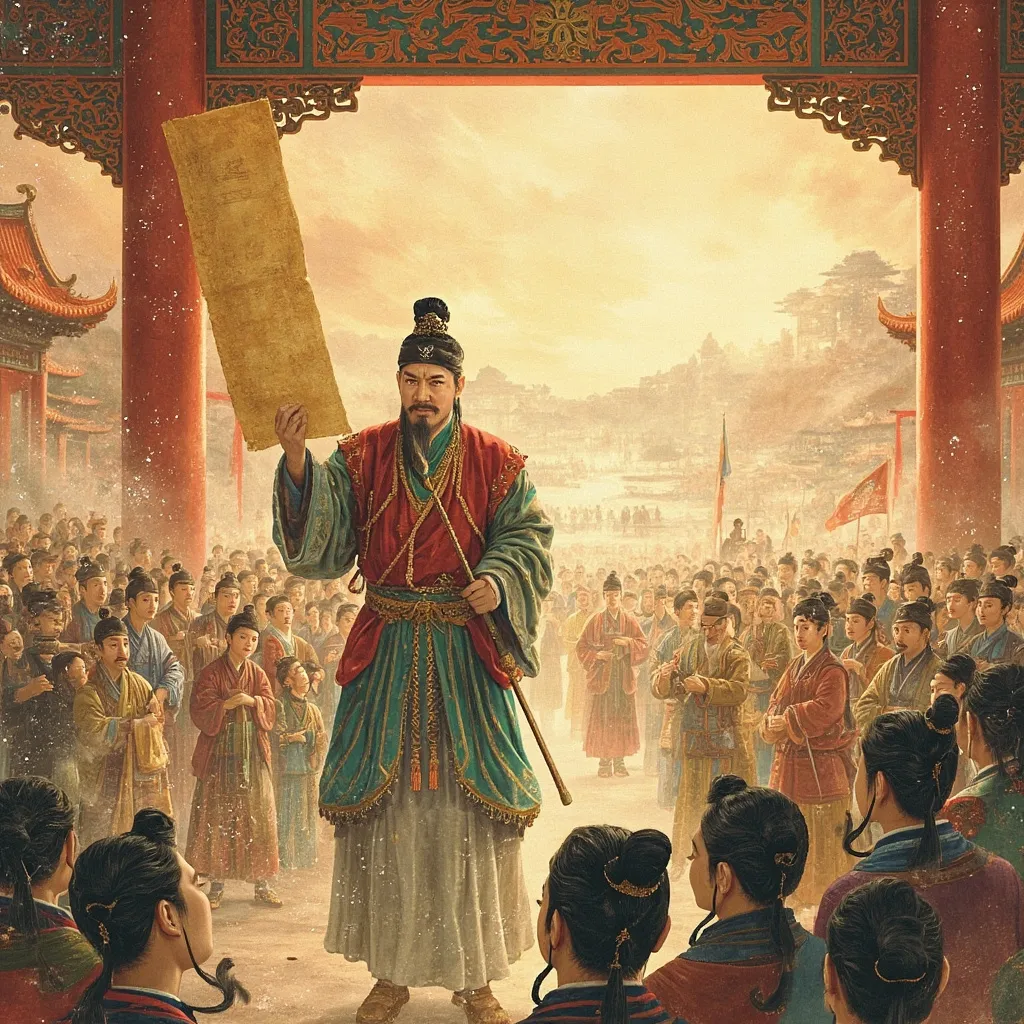
Not in a complicated way. Not through endless committees and new legislation. He gathered the people of Xianyang and told them three simple things: from this moment on, only three laws would apply. Murder would be punished by death. Injury would be punished by death. Theft would be punished by death. Everything else—all the thousands of regulations, all the collective punishment statutes, all the brutal punishments that had made the Qin regime a nightmare for ordinary people—was gone.
This was 约法三章—yuē fǎ sān zhāng—the three-point law agreement. Three laws to govern a city of over a million people. Three laws to replace fifteen years of tyrannical legalist rule. Three laws that said, in the clearest possible terms: we are not here to oppress you.
The Brutality the Qin Left Behind
To understand why this gesture was so revolutionary, you need to understand what the Qin legal code had actually been like. Emperor Qin Shi Huang had unified China in 221 BC, and his governance philosophy came from a school of thought called Legalism—fa jia—which held that humans were naturally selfish and needed to be controlled through strict laws and severe punishments. The Qin code reflected this fully.
Qin laws punished not just crimes but also failed to report crimes. They punished entire families for the offenses of one member. They had invented a grotesque catalog of physical punishments—branding, cutting off noses, cutting off feet, castration—that were applied for relatively minor offenses. A man could be sentenced to hard labor for years for something as simple as failing to report a neighbor’s overdue taxes. The Qin bureaucracy, for all its efficiency in extracting resources and building monuments, had made ordinary life a daily exercise in fear and survival.
When Liu Bang’s army entered Xianyang, the people had every reason to expect more of the same. Armies in ancient China had a well-earned reputation for pillaging conquered cities. The soldiers who had just fought their way in would expect to be rewarded with whatever they could take. This was normal. This was expected. And this was what Xiang Yu fully intended to allow, according to the historical records—by contrast, when Xiang Yu later entered the city of Xianyang after Liu Bang, his forces reportedly burned the city and killed countless people.
Liu Bang did something different. After entering the city, he immediately sealed up the treasury and the warehouses, posting guards to protect them. He then summoned the local elders and representatives and gave them his three-point law. He appointed no new tax collectors. He issued no new decrees requiring labor service. He simply said: we are taking over, and things are going to be better than before.
The people of Xianyang wept with joy. According to the Records of the Grand Historian, they scrambled to bring food and drink to Liu Bang’s soldiers, and the city celebrated as if a long nightmare had finally ended. Liu Bang’s reputation in the region exploded overnight. He had done something no Qin official and few conquering warlords had ever done: he had made the people feel genuinely safe.
The Political Genius of Simplicity
What makes the three-point law so remarkable from a political standpoint is not just its mercy—it is its strategic clarity. Liu Bang was not a naive idealist. He understood exactly what he was doing. He was playing a long game for the support of the people, and he understood that the way to win hearts was not through complicated new institutions or grand speeches about reform. It was through the simplest possible message: things will be better now.
The three-point law worked because it was simple enough for everyone to understand,记住了, and repeat. In a world where most people couldn’t read and where communication traveled by foot, a governing principle that could be summarized in three sentences was infinitely more powerful than a thousand-page legal code that only officials could interpret. Every person in Xianyang knew immediately what was allowed and what wasn’t. Murder, injury, theft: these were the crimes everyone already understood. Everything the Qin had built to control people through obscure regulations—the collective punishment rules, the thought crimes, the endless bureaucratic requirements—all of it simply vanished.
This simplicity also served Liu Bang’s practical interests. He did not have the administrative capacity to implement a new legal code even if he’d wanted to. His forces were smaller than Xiang Yu’s, his supply lines were stretched, and he was about to face a much larger opponent who was headed toward Xianyang with tens of thousands of battle-hardened soldiers. Liu Bang needed to consolidate power in Xianyang as quickly as possible, and he needed the city’s support if he was going to have any chance of surviving the coming confrontation with Xiang Yu. The three-point law achieved both goals simultaneously: it won him popular support, and it took almost no administrative effort to enforce.
The Meeting at Hong Gate
The story of 约法三章 does not end with Liu Bang’s entry into Xianyang. Almost immediately, Xiang Yu arrived with his enormous army and was furious—absolutely furious—that Liu Bang had gotten to the capital first and had made himself popular with its people. According to the historical account, Xiang Yu seriously considered killing Liu Bang right there. The two leaders were brought together in a tense confrontation at 鸿门 (Hong Gate), where Xiang Yu’s advisor, the famous strategist 范增 (Fan Zeng), urged the young warrior to strike.
What happened next is one of the most famous scenes in Chinese history—the “Feast at Hong Gate” (鸿门宴). Liu Bang, outnumbered and outmatched, played a remarkable game of political theater. He humbled himself before Xiang Yu, attributed his capture of Xianyang to Xiang Yu’s great leadership, and carefully managed to avoid triggering Xiang Yu’s famous temper. Through a combination of luck, careful words, and some help from Xiang Yu’s own uncle who had connections to Liu Bang’s side, Liu Bang survived the encounter and rode away with his life.
Xiang Yu went on to burn Xianyang’s palaces and slaughter its people. Liu Bang, who had offered the three-point law and genuine safety, quietly retreated to his own territories and began building the coalition of support that would eventually give him the throne. The people of Xianyang remembered who had treated them with respect. They remembered 约法三章.
The Fall of Xiang Yu, the Rise of Liu Bang
The contrast between the two leaders only sharpened over the following years. Xiang Yu, for all his military genius, repeatedly alienated the very people he conquered through his brutality and his insistence on traditional Chu nobility privileges. Liu Bang, for all his lack of martial prowess—he was reportedly a poor swordsman and worse archer—consistently won over local populations through his pragmatic mercy and his willingness to share power with capable advisors.
The four-year Chu-Han Contention that followed was not primarily a war of armies. It was a war of perception. And in that war of perception, Liu Bang’s three-point law at Xianyang was perhaps his single most powerful piece of propaganda. Every time a new region considered which side to support, the memory of how Liu Bang had treated Xianyang weighed heavily: he had been the leader who, upon entering the greatest prize in China, had said three laws and nothing more. He had been the leader who did not kill, did not burn, did not loot. He had been, in that crucial moment, the obvious choice for anyone who wanted to live in peace.
Liu Bang established the Han Dynasty in 202 BC and became Emperor Gaozu of China—the founding ruler of the dynasty that would give the Chinese people their name for the next two thousand years. His empire was built on a simple foundation: treat people with basic decency, and they will choose you over any tyrant. The three laws he proclaimed in Xianyang were not just a transitional governing tool—they were a statement of philosophy that would shape Han governance for centuries.
What “Three-Point Law Agreement” Means Today
In modern Chinese, 约法三章 is used to describe any situation where someone lays out a few simple, clear rules for cooperation. You might use it when a new boss says there will be only three company policies to start. You might hear it when a parent sits down with a teenager and says, “Here are three things I need from you.” The phrase carries connotations of both fairness and simplicity—it suggests that someone is choosing to govern or interact through clarity rather than complexity, through mutual agreement rather than imposed authority.
The deeper lesson of the phrase, though, is about what we might call “strategic mercy.” Liu Bang did not offer the three-point law out of naive idealism. He did it because he understood that governing through fear is expensive—you need more soldiers, more prisons, more enforcers—and that governing through trust is both cheaper and more effective. When you give people security and treat them like adults capable of understanding three rules rather than children who need a thousand regulations, they tend to cooperate rather than resist.
This is an idea that has not aged badly. Modern organizations that succeed through empowerment rather than control, through clear simple principles rather than dense employee handbooks, through trust rather than surveillance, are in some sense practicing the same wisdom that Liu Bang stumbled upon in 206 BC. The three-point law was not just good politics. It was good management.