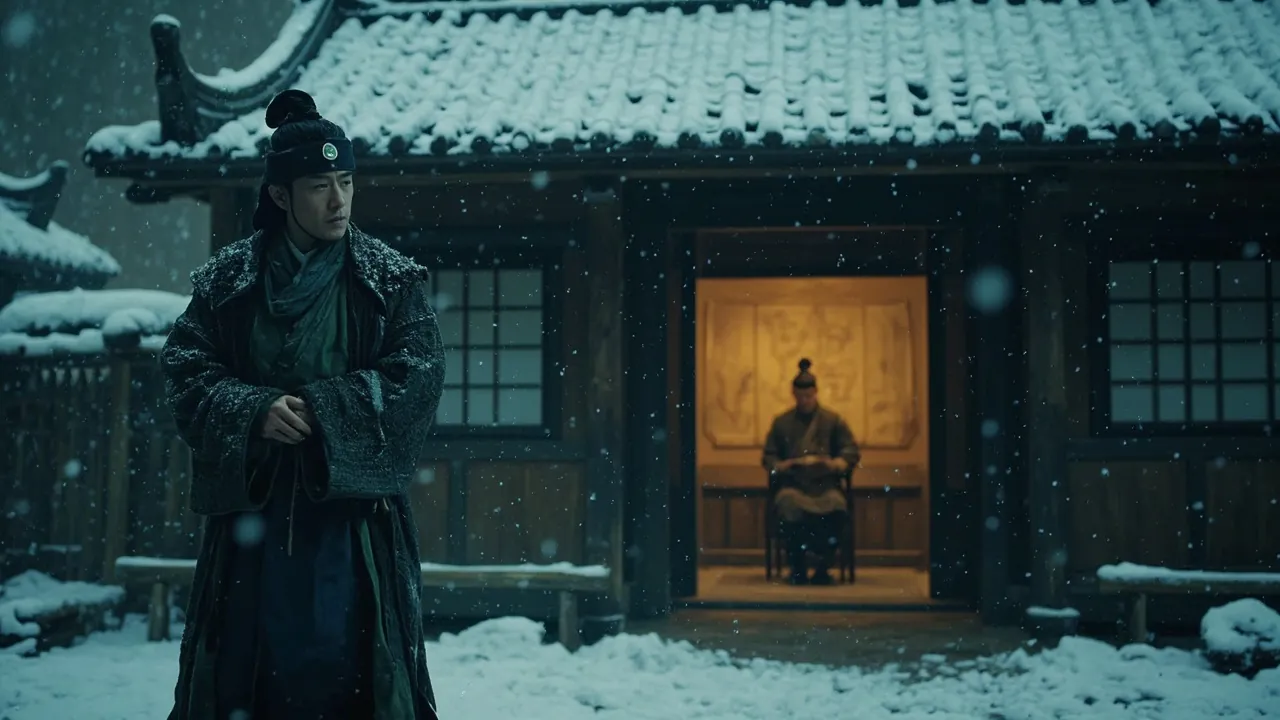
Imagine the President of the United States showed up at your apartment—not once, not twice, but three times—in the middle of winter, just to ask you to come work for him. That’s basically what happened in ancient China, and it’s the story behind one of the most famous idioms in Chinese culture: 三顾茅庐 (sān gù máo lú), literally “three visits to the thatched cottage.”
The Desperate Warlord and the Hidden Genius
The year is around 207 CE. China is in chaos. The once-mighty Qin Dynasty has collapsed, and the land is divided among dozens of warlords fighting for control. One of them—a man named Liu Bei—finds himself in serious trouble. His army is small, his territory is shrinking, and his main rival, the brilliant and ruthless Cao Cao, is crushing him at every turn.
Liu Bei had heard rumors of a young man living in a remote countryside village near Longzhong. This man, named Zhuge Liang (诸葛亮), was only in his twenties but was said to possess knowledge that could reshape the fate of nations. Local scholars whispered that he had studied military strategy, political theory, and the art of governance for years—all while living in a simple grass hut, farming his own vegetables, and reading ancient texts.
To Liu Bei, this sounded like his last hope.
There’s just one problem: Zhuge Liang had turned down every other warlord who came calling. He wasn’t interested in power or fame. He wanted to wait for the right leader—one who was truly worthy.
Liu Bei decided to take the risk anyway.
The First Visit: A Closed Door
Liu Bei packed gifts, gathered his two best generals—Zhang Fei and Guan Yu—and set off for the countryside. It was winter, and the roads were icy. After a long journey, they finally found the thatched cottage.
Liu Bei knocked politely. No answer.
He knocked again. Still nothing.
It turned out that Zhuge Liang was inside, taking a nap.
Zhang Fei, the hot-tempered warrior, was furious. “Let me go burn the door down!” he shouted.
Liu Bei stopped him. “No,” he said. “We wait.”
So they waited. And waited. And eventually, they left—without ever meeting Zhuge Liang.
The Second Visit: Still Asleep
Liu Bei wasn’t discouraged. A few months later, he tried again.
This time, he brought even more gifts and an even more sincere heart. He traveled through spring rains and muddy roads to reach the cottage once more.
Again, Zhuge Liang was asleep when they arrived.
But this time, something was different. While waiting, Liu Bei noticed something on Zhuge Liang’s wall—a map. It was a detailed analysis of the entire Chinese continent, marking the positions of every major warlord, every strategic fortress, every supply route. It was the work of a mind that had been thinking about nothing but national strategy for years.
Liu Bei studied the map carefully. He left a heartfelt note. And again, he departed without meeting the man.
The Third Visit: The Famous Conversation
By the third time, winter had returned. Snow was falling. Zhang Fei grumbled constantly—why should his noble older brother kneel before some village farmer three times?
But Liu Bei was determined. He dressed formally, like he was visiting a king, and made the journey one more time.
This time, Zhuge Liang was awake.
The meeting lasted for days. They talked about the state of the empire, about Liu Bei’s chances against Cao Cao, about what it would take to unite China again. Zhuge Liang laid out a complete strategic plan—now famous in Chinese history as the “Longzhong Dui” (隆中对)—detailing exactly how Liu Bei could build an empire from scratch.
When it was over, Liu Bei asked Zhuge Liang to become his chief advisor.
Zhuge Liang, moved by Liu Bei’s persistence and sincerity, finally agreed.
The Legacy of 三顾茅庐
Zhuge Liang would go on to become one of the most celebrated figures in Chinese history. He served Liu Bei faithfully, helping him build the Shu Han kingdom and standing up to the mighty Cao Cao. After Liu Bei’s death, Zhuge Liang continued to serve Liu Bei’s son, leading military campaigns and governing the country with wisdom and integrity until his death in 234 CE.
But the story of those three visits became more than just a historical anecdote. It became a symbol of something deeper: the importance of sincerity, humility, and persistence in seeking talent.
In Chinese culture, the idiom 三顾茅庐 is used to describe the act of sincerely and repeatedly inviting someone to take a position or help with a task. It’s not just about asking once and giving up. It’s about showing genuine respect through persistent effort—even when you have to overcome rejection, wait in the cold, or swallow your pride.
What This Means for Americans
You might be thinking: this sounds like the hiring stories we tell in America. Think about it. Steve Jobs reportedly called John Sculley at Pepsi with the line “Do you want to spend the rest of your life selling sugar water, or do you want to come change the world?” Or the legendary persistence of Howard Schultz in convincing Starbucks to let him pitch his ideas.
But in ancient China, there was no Silicon Valley, no venture capital, no corporate headhunters. There was only the personal visit—the willingness to travel, to wait, to humble yourself before someone you believed in.
The next time you read about a tech CEO flying across the country to recruit a brilliant engineer, or a sports team owner persisting until a star player agrees to sign—you’re seeing a very modern version of 三顾茅庐.
The Deeper Lesson
Zhuge Liang wrote about this meeting years later in his famous essay, the “Memorial on the Expedition” (出师表). He wrote: “三顾臣于草庐之中,咨臣以当世之事,由是感激"—“Three times he visited me in my thatched cottage, consulting me on affairs of the state; I was deeply moved.”
Those words capture something universal: talent wants to be recognized, but it also wants to be earned. The best people don’t just accept any offer that comes along. They wait for leaders who demonstrate something more than just power or money. They wait for people who show, through their actions, that they are truly worthy of trust.
Liu Bei showed it by coming three times. In the end, that made all the difference.
Key Takeaways
- 三顾茅庐 (sān gù máo lú): Three visits to a thatched cottage—showing sincere, persistent respect when seeking help or talent
- Origin: Liu Bei visiting Zhuge Liang in 207 CE, three times before Zhuge Liang agreed to join him
- Modern usage: Describing a leader’s sincere, repeated efforts to recruit someone exceptional
- Cultural parallel: Similar to how American companies describe “going the extra mile” to recruit top talent
The next time you need someone’s help with something important, remember Liu Bei. Sometimes, showing up matters more than what you say when you get there.