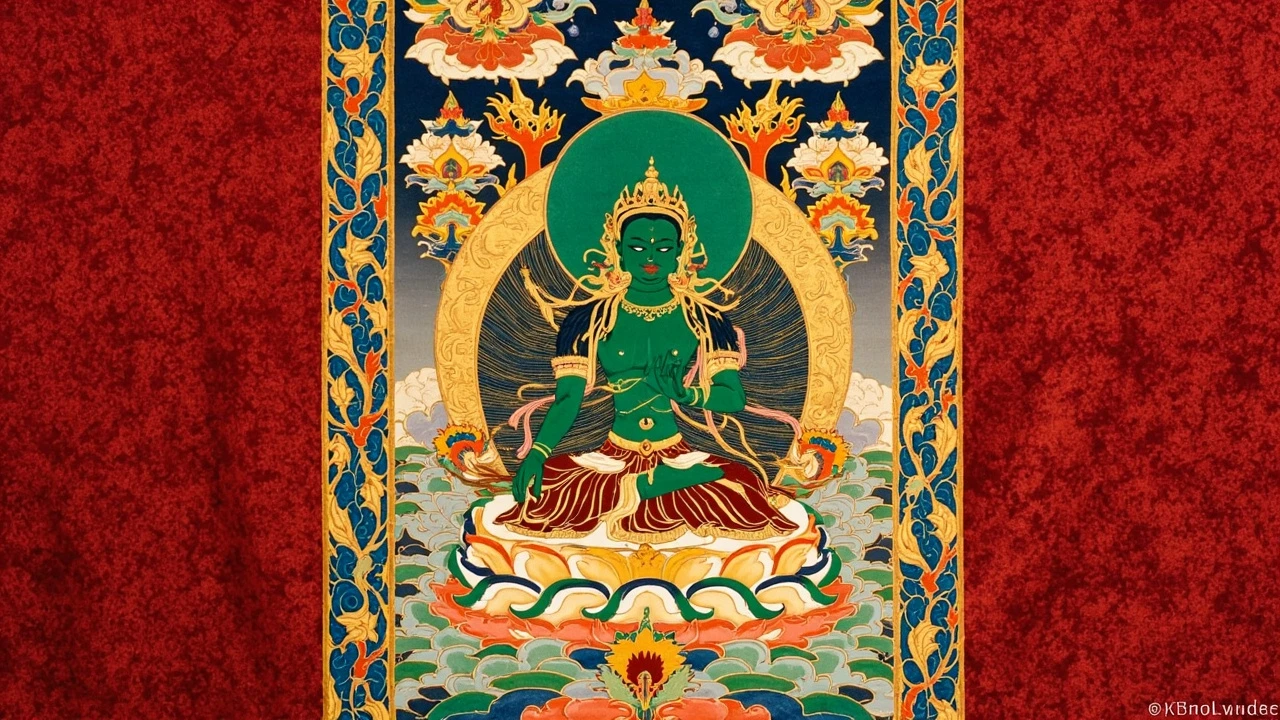
If you’ve ever wandered into a Buddhist art museum in New York, San Francisco, or D.C., chances are you’ve stopped in front of a thangka without quite knowing what you were looking at. A thangka is one of those art forms that strikes you first as decoration — vibrant colors, gold leaf, an otherworldly central figure seated in lotus position — and only slowly reveals itself as something much more serious. These aren’t paintings in the way a Renaissance altarpiece is a painting. They’re tools. They’re textbooks. They’re sacred technology, designed to focus a meditating mind and transmit precise theological information across centuries.
A thangka (sometimes spelled thangka, tangka, or tanka) is a Tibetan Buddhist scroll painting, traditionally mounted on cotton or silk and designed to be rolled up for transport and unrolled for ritual use. Most are rectangular and vertical, sized to hang on a monastery wall or to be held aloft during ceremonies. The largest can be enormous — twenty feet tall, carried by teams of monks during festival processions. The smallest fit in the palm of your hand.
What makes a thangka different from, say, a Christian icon or a Japanese Buddhist painting is the combination of three things: an extraordinarily strict iconographic grid (the measurements, proportions, and postures are not artistic suggestions, they’re mathematical specifications drawn from canonical texts), a transmission system that ties every painting to a specific master-apprentice lineage, and the use of mineral pigments that give the colors a staying power no oil paint could match. A well-made thangka painted in the 17th century can look more vivid than a magazine printed last year.
This article is for readers who’ve seen a thangka, admired it, and wondered what was going on. We’re going to look at how they’re made, what they depict, why they took so long, and how a tradition that dates back over a thousand years is still alive in studios from Dharamsala to Lhasa to Kathmandu.
What Exactly Is a Thangka?
The word “thangka” comes from the Tibetan thang yig or thang ka, meaning “recorded message” or “flat painting.” The word captures the dual function: a thangka both depicts and instructs. It’s an image, but it’s also a document.
Thangkas serve three main purposes in Tibetan Buddhist practice. First, they’re meditative aids: a monk or lay practitioner unrolls a thangka of, say, Green Tara and uses it as a focal point for visualization practice, building up a mental image so precise that they can call it up with eyes closed. Second, they’re teaching tools: a monastery might have dozens of thangkas illustrating the same deity from different angles or in different life stages, used to instruct novice monks in iconography (a set of visual rules that govern how sacred figures can and cannot be depicted). Third, they’re objects of devotion in their own right — a household in Lhasa or Dharamsala might commission a thangka of their family’s patron deity to hang in a home shrine, accumulating merit for the family.
The format itself is portable. A thangka is typically constructed in three layers: a central painted panel, a border of silk brocade (often red, yellow, or blue), and a wooden dowel at the bottom so the painting can be rolled and unrolled. The top has a wooden rod with hanging cords. Unrolled, a thangka transforms a bare monastery wall into a portable temple.
The subjects are diverse. There are thangkas of individual Buddhas and bodhisattvas (enlightened beings who choose to remain in the world to help others). There are mandala thangkas — concentric geometric diagrams representing the architecture of enlightened mind. There are lineage thangkas showing rows of teachers in a transmission line, each face a portrait of a specific historical master. There are narrative thangkas telling the life of the Buddha in sequential panels. There are medical thangkas illustrating the Tibetan medical system, and astrological thangkas mapping the heavens.
In short: if it mattered in Tibetan Buddhism, someone eventually painted a thangka of it.
How a Thangka Is Made
This is where the story gets intense.
A serious thangka takes between one and fifteen years to complete, depending on size and complexity. The largest, most elaborate pieces — like the set of famous historical thangkas preserved at the Rubin Museum in New York — can take a team of senior painters nearly a decade. Even a modest devotional thangka of a single deity might occupy a single artist for two or three years.
The reason isn’t perfectionism for its own sake. It’s because every element of a thangka is governed by a system of measurements, proportions, and colors laid out in canonical texts. The most important of these are the Tsalag Kangyur and the writings of Buton Rinchen Drub, the 14th-century scholar who compiled many of the iconographic standards still used today. A thangka painter isn’t free to “express themselves” the way a Western artist is. They’re working within a tradition whose rules were established centuries ago and whose authority is sacred.
The process begins with the cloth. Tibetan painters traditionally use a tightly woven cotton or, for finer work, Chinese silk. The cloth is stretched on a wooden frame and treated with a sizing — a mixture of hide glue, chalk, and sometimes yak milk — to create a surface that will hold mineral pigments without bleeding. After the sizing dries, the surface is polished smooth with a smooth stone or a piece of glass, sometimes for days.
Then the iconographic grid. The artist draws the central figure using a system of concentric circles, squares, and intersecting lines that locate the body’s key points — the crown of the head, the navel, the heart, the lotus throne. Each deity has its own grid. The proportions are fixed: a Buddha’s body is composed of exactly 125 “finger-widths” (a finger-width being the width of the Buddha’s own finger, naturally), and each part of the body has a prescribed number of those widths. The face alone is divided into nine sections by horizontal and vertical lines. There’s no improvising this.
Once the grid is in place, the artist sketches the figure in light charcoal or pencil. For a master painter, this step alone can take weeks because every contour, fold, and ornament must align perfectly with the underlying geometry.
Then comes the color. This is what distinguishes a thangka from almost every other painted tradition on earth.
The pigments are mineral, ground from stones and earth: malachite for green, azurite for blue, cinnabar for red, calcite for white, sulfur for yellow. Some pigments are remarkably precious — lapis lazuli from Afghanistan was historically the source of the deepest blues, and gold leaf, beaten to a thickness of less than a micron, is used for halos, ornaments, and the highlights on robes. The pigments are bound with hide glue, a small amount mixed with water at the start of each painting session.
Painting begins with the larger fields of color — the sky behind the figure, the lotus throne, the garments. Then come the details: facial features, hand gestures (mudras, each one with a fixed meaning), jewelry, the tiny figures that often populate the borders and corners. The painter works from coarse to fine over months or years.
The final step is something called “opening the eyes,” or tongdrel. When the painting is otherwise complete but the central figure’s eyes are still unpainted, a consecration ceremony is held. A lama or senior monk recites prayers, makes offerings, and at the climactic moment, paints the pupils of the deity’s eyes with a single delicate brushstroke. In older traditions, the artist who had worked on the thangka would not even be present for this — only the lama, the patron, and the assembled community. The idea is that the deity is “called into” the painting at this moment, transformed from an image into a living sacred presence. After the eyes are opened, the thangka can be used for ritual and meditation.
The Lineage System: How Knowledge Moves Through Hands
One of the things that strikes Western visitors most about thangka painting is how traditional it remains. A thangka painted in 2026 looks recognizably the same as one painted in 1626. That’s not because nobody is innovating — there are plenty of contemporary thangka artists experimenting with style, materials, and subject matter — but because the core practice is transmitted through formal apprenticeship.
Traditionally, a boy (and more rarely today, a girl) would enter a monastery or a master’s workshop around age ten or twelve and spend the next seven to fifteen years learning. The training is hierarchical. Junior apprentices do the preparatory work: sizing cloth, mixing pigments, drawing grids, painting backgrounds and minor figures. As they progress, they’re allowed to paint more important elements. Eventually, after demonstrating mastery of the iconographic grid and the painting techniques, they’re permitted to paint a thangka of their own under supervision.
The lineage matters enormously. A thangka by an artist of the Menri tradition (named after the Menri Monastery in Tibet, founded in 1409 and now headquartered in Dolanji, India, after the Chinese destruction of the original in the 1960s) carries a specific stylistic lineage traceable back through named teachers. The “three generations of Menri” — Choying Gyatso, Sangye Yeshe, and the contemporary lineage holders — are the equivalent of a recognizable school of painting, much as you might identify a Renaissance altarpiece as Florentine or Venetian based on stylistic evidence.
The Kham tradition, centered in eastern Tibet (now the western Sichuan/Tibet Autonomous Region borderlands of China), produces thangkas with brighter colors, sharper lines, and a more folk-art feel than the more restrained Menri style. The Kathmandu or Newari tradition — practiced by the Newar people of Nepal’s Kathmandu Valley, who were painting Buddhist icons long before Tibetan Buddhism reached Tibet — has its own distinct vocabulary, with finer brushwork and a denser, more ornamental composition.
When you compare these traditions, you’re seeing something like comparing the Florentine and Sienese schools of Renaissance painting: same basic subject matter, broadly shared iconography, but markedly different aesthetic personalities.
Major Subjects and Their Meanings
A few subjects appear so frequently that any reader of thangka will encounter them again and again.
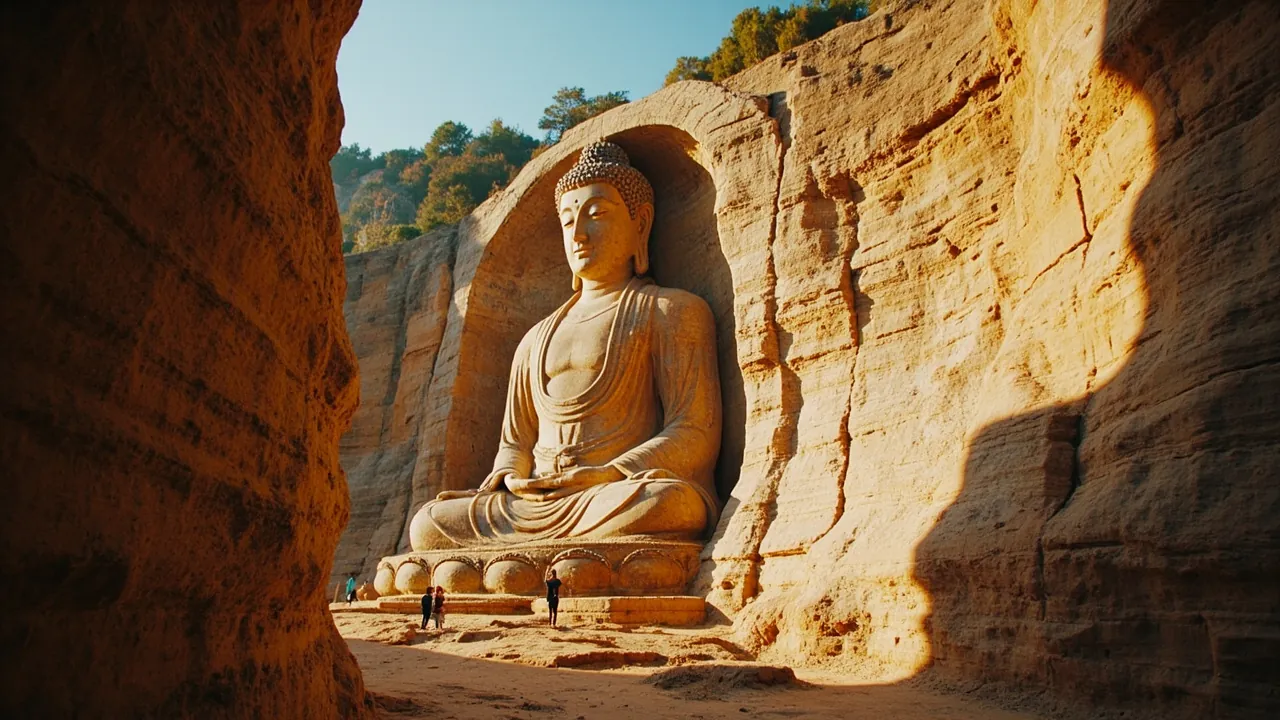
Buddha Shakyamuni is the historical Buddha, the prince who became the enlightened teacher. He’s almost always depicted in earth-touching mudra (his right hand reaching down to touch the ground, calling the earth to witness his enlightenment), seated on a lotus throne, with a ushnisha (the cranial bump that signifies expanded consciousness) on his head. His robes are simple monastic robes, and his expression is serene and inward.
Green Tara and White Tara are two of the most beloved female figures in Tibetan Buddhism. They’re bodhisattvas of compassion and protection — Green Tara is the active, swift-to-respond savior who leaps to help those in danger; White Tara is the calm, long-lived goddess associated with healing and longevity. They’re typically depicted seated, with one leg extended (in the case of Green Tara, ready to leap up), holding the stem of a lotus that blooms beside them. Green Tara is green, White Tara is white, and both have seven eyes — two normal, plus one in the forehead and one in each palm and sole.
Bhaisajyaguru, the Medicine Buddha, is the healer par excellence. He’s typically blue (sometimes golden-yellow in certain traditions), holding a medicine bowl and the stem of the myrobalan plant. He’s particularly popular in medical and healing contexts, and his thangkas are often commissioned by families whose members are ill.
Mandalas are abstract, geometric — circles and squares containing a palace of deities, with gates at the four cardinal directions. They’re used as meditation blueprints: the meditator mentally enters the mandala and visits each chamber, encountering different aspects of enlightened mind. A mandala thangka can take five years to paint. When the meditation is complete, the mandala is ritually destroyed — sometimes by sweeping the colored sand into a central point and pouring it into a river — to symbolize the impermanence of even the most sacred forms.
Lineage masters are portrayed in thangkas that show the chain of transmission: a senior teacher at the center, surrounded by his students, their students, and so on. These are important historical documents — sometimes the only record of a master’s appearance — and they’re venerated almost as much as the deities themselves.
Comparison with Other Sacred Painting Traditions
The most natural comparison for a Western reader is Christian icon painting, particularly the Byzantine and Russian Orthodox tradition. The parallels are real: both traditions use mineral pigments, both use gold leaf for halos, both require consecration before the image can be used in worship, both rely on a strict iconographic canon. An Orthodox iconographer would understand exactly what a thangka painter means when they say the icon has rules.
But there are differences. Orthodox icons are painted on wood panels, not cloth scrolls. The thangka’s portability — the fact that it can be rolled up and carried on the back of a yak or a monk — has no real Orthodox equivalent. And the Buddhist emphasis on meditation visualization, where the image becomes a tool for the meditator to construct a mental counterpart, doesn’t quite map to the Orthodox use of icons, which is more about veneration and contemplation of an external sacred presence.
The comparison with Japanese Buddhist painting is also illuminating. Japanese Buddhist art — particularly the great Zen ink paintings of the Kamakura and Muromachi periods — shares with thangka painting the emphasis on sacred subject matter and disciplined technique, but the aesthetic is almost opposite. Where thangka is colorful, ornate, and geometrically precise, Zen ink painting is monochromatic, suggestive, and minimalist. A thangka of a single deity might take years; a Hasegawa Tohaku pine forest took perhaps months, and Hokusai’s wave took days. Both traditions serve spiritual purposes; they simply inhabit opposite ends of the aesthetic spectrum.
What makes thangka unique is the combination of portability, geometric precision, and the “opening of the eyes” ceremony. There’s nothing quite like it in Christian, Hindu, Islamic, or East Asian Buddhist art.
The Modern Revival
The 20th century nearly destroyed thangka painting. The Chinese annexation of Tibet in 1950, the Cultural Revolution from 1966 to 1976, and the destruction of hundreds of monasteries scattered Tibetan religious life across India, Nepal, and the diaspora. Master painters died. Apprenticeships were interrupted. Priceless thangkas were burned or sold.
But the tradition didn’t die. The most important revival happened in Dharamsala, India, where the Tibetan government-in-exile is headquartered and where the Dalai Lama has lived since 1959. The Tibetan Institute of Performing Arts, founded in 1959, includes a thangka painting school. The Norbulingka Institute, founded in 1960, runs one of the most respected traditional arts programs in the diaspora, training new generations of painters in the Menri tradition.
In Lhasa itself, the Tibet Art School and the Tsechokling Arts Association have begun training young Tibetan painters again, and contemporary Chinese-trained thangka painters are producing work for both Tibetan and international markets. The style today is sometimes more commercial — brighter colors, simplified compositions aimed at tourist demand — but serious traditional work continues.
Kathmandu’s Bhaktapur district remains an important center of Newari thangka painting, with a long tradition of Newar artists producing both traditional Buddhist and Hindu works for monasteries across the region.
International interest has helped. Thangka exhibitions at the Metropolitan Museum of Art, the Rubin Museum of Himalayan Art in New York, the British Museum, and the Guimet in Paris have introduced the form to Western audiences. Reproductions are widely available, and many Western Buddhists commission thangkas from traditional ateliers for their home shrines.
Why Thangkas Matter Now
There’s a question that comes up whenever religious art enters the global conversation: is this tradition still alive, or are we watching a museum piece being lovingly maintained? The answer for thangka is clear: it’s alive, and it’s still changing.
The basic techniques — mineral pigments, hide glue binder, gold leaf, strict iconographic grid — remain the same as they’ve been for centuries. But contemporary thangka painters are also working with new commissions, new patrons, and new contexts. There are thangkas of contemporary teachers alongside classical Buddhas. There are thangkas that include environmental themes, like the climate mandalas that have been used in interfaith ceremonies about climate change. There are thangkas being made as collaborations between Tibetan masters and Western artists.
If you want to see a thangka in person, the easiest entry point is a museum — the Rubin in New York is the largest collection outside Asia, but the Met, the British Museum, the Guimet, and the Hong Kong Heritage Museum all have significant holdings. Many sell high-quality reproductions through their gift shops, which are a good way to live with one for a while and see what changes in your own perception over weeks and months.
Or, if you’re lucky enough to travel, you can visit Dharamsala and watch painters at work in the Norbulingka Institute’s open studios. Watching a senior thangka painter do the final highlights on a Green Tara’s jewelry — a single brushstroke of gold leaf, a milligram of pigment worth more than its weight in gemstones — is one of those small experiences that recalibrates what you think of as “art.”
Recommended Products
Here are a few items that can help you engage with thangka art at home, whether you’re a serious practitioner or just starting to learn about Himalayan Buddhist culture:
- thangka-print: A high-quality reproduction print of a traditional thangka — perfect for a home meditation corner or study wall.
- tibetan-buddhist-book: An accessible introduction to Tibetan Buddhist iconography and the symbolism in thangka paintings.
- meditation-mala-beads: A traditional 108-bead mala used for mantra recitation, often paired with thangka meditation practice.
- himalayan-art-print: A curated collection of Himalayan art, including thangkas, that makes a great coffee-table introduction.
- calligraphy-set: Useful for studying the Tibetan and Sanskrit scripts that often appear in thangka inscriptions.
Conclusion
A thangka is many things at once. It’s a painting. It’s a textbook. It’s a sacred object. It’s a meditation tool. It’s a record of a lineage. It’s a portable temple that can be unrolled on a monastery wall or carried on a mountain pilgrimage. The fact that these functions coexist in a single object — that the same piece of art can instruct a novice monk, focus a meditating lama, and accumulate merit for a sponsoring family — is what gives thangka its enduring strangeness.
For Western viewers, the most useful thing to remember is that a thangka isn’t really meant to be looked at the way we look at a painting in a gallery. It’s meant to be used. Rolled up, carried, unrolled for ceremony, contemplated for hours, used to build a mental image so vivid that you can call it up with eyes closed. A thangka isn’t an image of a Buddha. It’s a doorway into a specific state of attention.
When you stand in front of one — in a museum in New York, a monastery in Dharamsala, a shrine in Lhasa — what you’re looking at is the outer layer of a tradition that goes back over a thousand years and is still being passed, brushstroke by brushstroke, from master to apprentice.