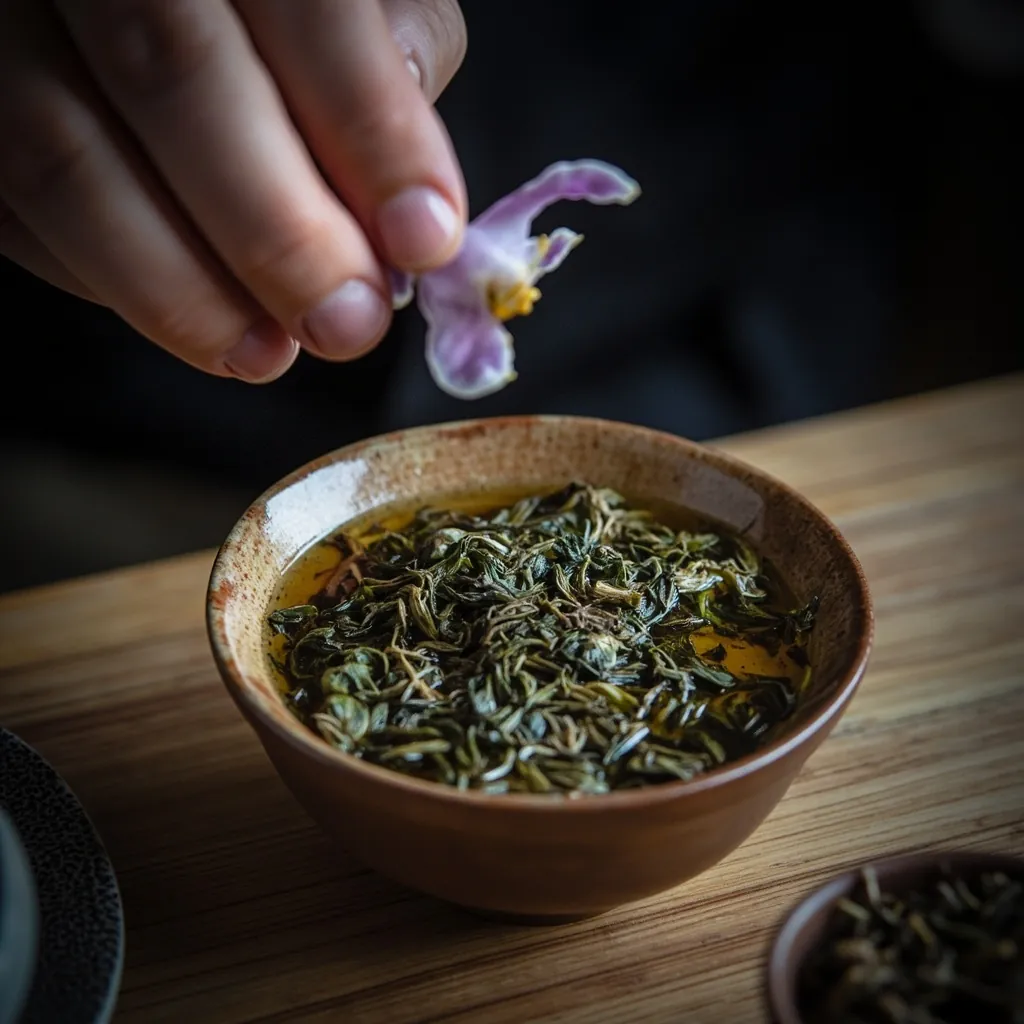
Tieguanyin Oolong Tea: The Iron Goddess of Anxi
Of all the tea varieties China has given the world, Tieguanyin occupies a particularly storied place. It is the tea that introduced millions of Westerners to the concept of oolong — that middle ground between green and black where oxidation creates a complexity that neither tea type can match alone. And it carries a name that is, frankly, one of the most evocative in all of tea: Iron Goddess of Mercy.
I still remember my first proper encounter with high-quality Tieguanyin. A tea merchant in Shanghai, a stern woman who clearly had no patience for people who didn’t take their tea seriously, dropped a small measure of leaves into a Gaiwan and began the ritual of Gongfu brewing. The first rinse was almost violent in its aroma — floral, sweet, almost too much — but then came the actual liquor, and everything shifted. The taste was silky, rounded, with this persistent orchid note that stayed on the palate long after the cup was empty. I understood immediately why people devoted entire lives to this tea. It was not just a beverage; it was a conversation with centuries of craft.
The Iron Goddess: Myth and Naming
The story behind the name Tieguanyin is one of those delightful Chinese origin tales that walks the line between legend and history. Guan Yin is the bodhisattva of compassion — the Goddess of Mercy in popular Western understanding — widely venerated in Chinese Buddhism. The “Tie” part means iron, which raises an obvious question: why would a goddess be made of iron?
The most widely told version goes like this: in the Anxi region of Fujian province, there was a poor farmer named Wei (or Wang, depending on the telling) who made a living picking tea. One day, he encountered an old monk at a temple who seemed to need help carrying water up the mountain. The farmer, moved by compassion, assisted the monk day after day until one day the monk led him to a specific rock and told him to dig. Beneath the rock, the farmer found a tea plant with unusually dark, glossy leaves — different from anything he’d seen. He cultivated it, processed its leaves, and the resulting tea was extraordinary. When he brought it to market, people were amazed. The tea became known in honor of the monk who had shown him the rock: Tieguanyin, the Iron Goddess of Mercy who had appeared in the form of that wandering monk.
Whether you take this as literal history or beautiful myth, the naming has stuck for over a century and a half. The tea itself, though, is very much real — and its connection to the name has become so strong that “Tieguanyin” is now synonymous with a specific style of oolong from Anxi, regardless of the many sub-varieties now cultivated there. The original “true” Tieguanyin cultivar still exists in Anxi and is propagated by tea farmers who maintain the genetic lineage of those original plants discovered all those years ago.
The Art of Half-Oxidation: Understanding Oolong Processing
What separates oolong from green tea — and from black tea — is the degree of oxidation (called “fermentation” in Chinese tea terminology, though it’s technically enzymatic oxidation rather than microbial fermentation). Green tea is fixed immediately after picking to prevent oxidation entirely. Black tea is fully oxidized, giving it that dark color and robust, malty character. Oolong sits in the middle, and Tieguanyin specifically occupies a range from roughly 15% to 50% oxidation depending on the specific style and producer.
For Tieguanyin, the process is a carefully orchestrated series of steps that can take place over a single day or stretch across several. It begins, like all tea, with withering — spreading the freshly picked leaves in the sun to lose moisture and begin softening. This initial withering is followed by indoor withering, where the leaves are spread thin and allowed to oxidize slowly in a cool, shaded room. This is where the magic happens: enzymes in the leaf cells begin reacting with oxygen, creating new aromatic compounds that will later define the tea’s character. The skill lies in knowing when to stop — too little oxidation and the tea tastes green and underdeveloped; too much and it starts approaching black tea territory.
The next critical step is shaqing — the same pan-fixing process used in Longjing — which halts oxidation at the precise point the producer desires. This requires experience and intuition. The leaves are tossed in hot drums or woks, the heat denaturing the enzymes and locking in the flavor. From there, the leaves are rolled — traditionally by hand, though machine rolling is common in larger operations — to shape them and break cell walls, releasing oils that contribute to aroma and creating the tight ball shape that is Tieguanyin’s signature appearance. A final drying sets the tea and completes the processing.
The result is a leaf that, when brewed, produces a liquor that ranges from pale honey to deep amber depending on oxidation level. Light-oxidized Tieguanyin (often labeled “qingxiang” or “fragrant style”) tends toward floral, green, almost green-bean notes — these are the most popular varieties in recent decades. Heavier-oxidized versions develop deeper, rounder, more toasty flavors with less of that raw green edge, and are considered more traditional by older enthusiasts who remember when heavy oxidation was the norm.
The Orchid Fragrance: What Makes Tieguanyin Unique
If you ask Tieguanyin lovers what distinguishes this tea, most will answer without hesitation: the fragrance. Specifically, the orchid note — a floral, sweet, slightly creamy aroma that is Tieguanyin’s signature and its most prized quality. This fragrance is so characteristic that experienced tasters can identify Tieguanyin blind, purely from the aroma profile.
This fragrance doesn’t happen by accident. It’s the product of specific cultivars, specific processing, and — critically — specific growing conditions. The Anxi region benefits from a subtropical climate, frequent fog, and elevations that range from a few hundred to over a thousand meters above sea level. These conditions stress the tea plants just enough to produce leaves with higher concentrations of aromatic compounds. Add to that the hand-processing, which preserves volatile oils that machine processing might damage, and you have the foundation for that distinctive orchid character.
In tea-tasting terminology, this fragrance is often described as “lanxiang” — literally orchid fragrance. But the experienced nose detects much more: nuances of cream, sweet butter, sometimes a hint of toasted rice, and underneath it all, that persistent floral backbone. Premium Tieguanyin will often display this note not just on the nose but in the aftertaste (called “hougan” in Chinese), which can linger pleasantly for minutes after you’ve finished the cup. It’s one of the most compelling sensory experiences in tea — this long, slow fade of floral sweetness that seems to evolve the longer you sit with it.
The leaf itself, when viewed dry, has a distinctive appearance: dark green, glossy, and rolled into tight ball or comma shapes that unfurl dramatically when steeped. Watching those balls open in a glass teapot is one of the small pleasures of the tea experience — the leaves practically bloom in the hot water, releasing their fragrance in waves with each subsequent steep.
Gongfu Brewing: Getting the Most from Your Tieguanyin
While Tieguanyin can be brewed Western-style in a regular teapot or cup, it truly shines under Gongfu brewing — the traditional Chinese method that maximizes extraction through high leaf-to-water ratios and short, repeated infusions.
The name “Gongfu” (功夫) literally means “skill” or “effort,” and the brewing method lives up to the name. It requires a few pieces of equipment: a Gaiwan (a lidded bowl) or small clay teapot (often Yixing clay, which itself absorbs flavor over years of use), a公道杯 (gongdao bei, or fairness pitcher) to ensure even distribution, small tasting cups, and a tea tray to contain the mess. But before you invest in a full Gongfu setup, understand that the philosophy is more important than the gear. At its core, Gongfu brewing is about giving your tea the attention it deserves — a practice as much about the ritual as the result.
For Tieguanyin, the typical approach uses about 5-8 grams of leaf per 100ml of water. Water temperature should be around 90-95°C (195-205°F) — hot, but not quite boiling. The first infusion is a rinse: pour hot water over the leaves, let them sit for just 5-10 seconds, then discard this liquid. It cleans the leaves and wakes them up without extracting significant flavor. The second infusion is your first real taste: 15-20 seconds. The third might be 25-30 seconds, and each subsequent infusion can be slightly longer as the leaves exhaust their flavor compounds gradually.
What you’ll notice is how the tea evolves. Early infusions tend toward bright floral notes, while later ones reveal deeper layers — honey, toast, a creamy richness that wasn’t apparent at first. A good-quality Tieguanyin can yield eight, ten, even fifteen infusions, each one different from the last. This is part of the joy of oolong: the tea tells a story over time, not all at once. Each steep reveals another facet, another chapter in the tea’s unfolding character.
Health Benefits: Why Tieguanyin Belongs in Your Daily Routine
Beyond its aesthetic pleasures, Tieguanyin has a long history in Chinese medicine as a tea with genuine health properties. Modern science has begun to corroborate what traditional practitioners observed centuries ago, identifying compounds that support health in measurable ways.
Oolong teas, including Tieguanyin, are notably rich in polyphenols — antioxidant compounds that help neutralize free radicals in the body. Studies have associated regular oolong consumption with improved cardiovascular health, including healthier cholesterol profiles and better blood pressure regulation. The polyphenols in oolong appear to help reduce LDL cholesterol while maintaining or increasing HDL cholesterol levels, a finding that has been replicated in multiple independent studies.
One particularly interesting area of research involves oolong’s effects on metabolic health: several studies have suggested that regular oolong drinkers show improved insulin sensitivity and lower rates of type 2 diabetes. The mechanism appears to involve both the polyphenols and the moderate caffeine content, which together help regulate blood sugar more effectively than either compound alone. While Tieguanyin is certainly not a treatment for diabetes, incorporating it as part of a balanced diet represents a sensible lifestyle choice.
The moderate caffeine content in Tieguanyin — less than black tea but more than most green teas — provides a clean, focused energy without the jitters that sometimes accompany coffee. The L-theanine present in tea also modulates caffeine’s effects, producing a state of calm alertness that tea enthusiasts often describe as “focused” rather than “wired.” This combination is particularly valuable for knowledge workers or anyone who needs sustained mental clarity without the crash that often follows coffee.
For digestive health, many Chinese practitioners recommend Tieguanyin specifically. The partially oxidized leaf is considered warming to the digestive system in traditional medicine terms, and anecdotally, many people find that a cup of Tieguanyin after a heavy meal helps ease discomfort and promotes digestion. The tannins in oolong tea also have a mild antibacterial effect that may support gut health more broadly.
Perhaps most relevant for modern life: research has suggested that the compounds in oolong tea may support weight management by slightly increasing metabolic rate and promoting the breakdown of fats. Several clinical studies have shown modest but measurable effects on fat oxidation during exercise. While Tieguanyin is certainly not a weight-loss miracle, incorporating it as a daily beverage in place of sugary drinks is a simple habit with measurable benefits over time.
Recommended Products
Premium Anxi Tieguanyin - Spring Harvest — Direct-source from Anxi County, Fujian. Light oxidation, pronounced orchid fragrance. 100g sealed bag. $38
Yixing Zisha Clay Teapot - 120ml — Traditional unglazed purple clay teapot. Ideal for oolong brewing. Pre-seasoned with Tieguanyin. Each pot individually carved. $75
Gongfu Tea Brewing Set - Complete — Includes Gaiwan, fairness pitcher, 6 tasting cups, tea needle, and foldable bamboo tray. Everything needed for traditional oolong brewing. $65
Tieguanyin Tea Tasting Notes Journal — Guided journal for recording brewing parameters, flavor observations, and preferences across 100+ sessions. Includes flavor wheel reference card. $18
Digital Temperature-Controlled Gooseneck Kettle — Precision temp control from 60-100°C in 1° increments. Essential for dialing in the ideal 90-95°C temperature for Tieguanyin. $55