Traditional Chinese Music: A Journey Through Sound
Close your eyes and listen. Not to the familiar strains of pop music or the pounding rhythms of modern production, but to something older and stranger. Imagine a single note, sustained and pure, rising from a gut string. Then another note, slightly higher, creating a gap that somehow feels complete rather than empty. Now imagine a melody that seems to hang in the air like incense smoke, moving slowly, inviting you to breathe with it rather than tap your foot. This is traditional Chinese music—a sound world that has been developing for over three thousand years, carrying meaning and emotion in ways that still feel fresh and surprising today.
For American listeners raised on Western pop music with its tight verse-chorus structures and predictable chord progressions, traditional Chinese music can be disorienting. The scales are different. The rhythms bend in ways that feel unnatural at first. The emotional logic follows a different path. But if you give it a chance, you’ll discover a musical tradition that’s endlessly subtle, deeply expressive, and capable of communicating feelings that Western pop can’t even approach. Let’s take a journey through the world of traditional Chinese music—its history, its philosophy, its instruments, and why it matters today.
The Philosophy Behind the Sound
Before you can understand traditional Chinese music, you have to understand something about how the Chinese think about sound itself. In the West, we’ve been trained to think of music as entertainment or art—something we listen to for pleasure or emotional response. The ancient Chinese saw music quite differently. They believed music could actually shape reality.
This idea goes back to the earliest days of Chinese civilization. The ancient Chinese character for music (乐, yue) shares its form with the character for medicine (藥, yao)—suggesting that music was considered a kind of healing force. The philosopher Confucius, writing around 500 BCE, taught that proper music could bring harmony to society and virtue to individuals. Music wasn’t just pleasant; it was morally and spiritually significant.
The ancient Chinese developed a theory of pitch that differed fundamentally from Western systems. Where Western music developed the 12-tone chromatic scale, traditional Chinese music centered on pentatonic scales—five-note systems that create that distinctive “Eastern” sound. Think of a piano keyboard and play only the black keys—you’re hearing a pentatonic scale, and you’ll immediately recognize the sound from countless Chinese films and restaurant soundtracks.
But here’s what Western listeners often miss: Chinese music isn’t just about the notes themselves. It’s about the spaces between the notes—the silences, the pauses, the way a note fades away. Chinese musical aesthetics value the “breath” between sounds, the space that allows the listener to absorb what’s just been played. This reflects a broader Daoist philosophy that emphasizes naturalness, spontaneity, and the flow of energy (qi) through all things.
There’s also the concept of yin and yang—the complementary forces that the Chinese saw everywhere in nature. In music, yin represents stillness, softness, descending movement. yang represents activity, loudness, ascending movement. A skilled Chinese musician manipulates this balance continuously, creating compositions that breathe and shift like the natural world.
The Instruments: Voices of the Ancient World
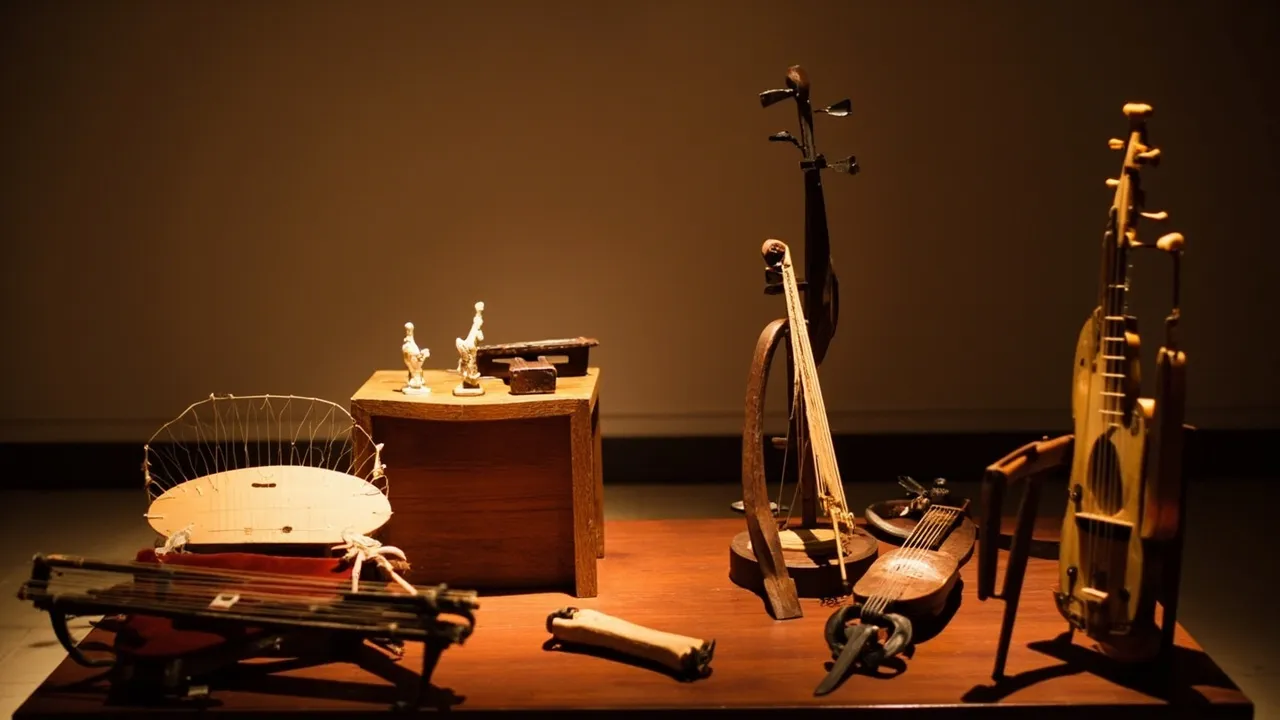
Traditional Chinese music is inseparable from its instruments. Where Western classical music developed around the orchestra—a collective of strings, winds, and brasses—Chinese music evolved around solo instruments and small ensembles, each with its own distinctive voice. Let’s meet some of the most important ones.
The guzheng (古筝), sometimes called the Chinese zither, is one of the oldest and most beloved instruments. With a history stretching back over 2,500 years, this long, rectangular instrument has strings stretched across a wooden body. Traditional guzhengs had 21 strings (modern versions may have more), and players pluck them with finger picks while the other hand adds expression by pressing the strings to bend notes.
The guzheng has an extraordinary range of sounds. It can produce delicate, bell-like tones in its higher registers and deep, resonant booms in the lower ones. Traditional pieces often try to imitate nature—water flowing, horses galloping, wind rustling through leaves. One famous piece, “The Terraced Fields,” actually manages to sound like someone climbing up and down steps. When you hear a guzheng, you’re hearing thousands of years of continuous tradition.
The guqin (古琴), often confused with the guzheng, is a different instrument altogether—more subtle, more intimate, with a shorter history of only about 3,000 years. The guqin has seven strings and a narrower body, producing softer, more contemplative sounds. For centuries, it was considered the instrument of scholars and cultivated gentlemen, played in private chambers as a meditation on nature and self-cultivation. The guqin is so deeply associated with Chinese literati culture that it’s considered one of the “four arts” that every educated person should master (along with calligraphy, painting, and the game of go).
The erhu (二胡) is a two-stringed instrument that’s held vertically, like a fiddle. Despite its simple construction—a wooden body covered in snake skin, with two strings stretched over a wooden bridge—it produces an extraordinary range of emotions. The erhu’s voice can sound like a human voice singing, weeping, or laughing. It’s particularly suited to expressing sadness, longing, and melancholy—which is why it’s so often heard in film scores when a scene calls for poignancy or loss. The sound takes some getting used to for Western ears, but those who acquire a taste for it find it hauntingly beautiful.
The pipa (琵琶), often called the Chinese lute, has a pear-shaped body and four strings. Don’t let its small size fool you—this instrument is incredibly agile, capable of lightning-fast runs, percussive rhythms, and expressively bent notes. Players use a special technique, striking the strings with fingernails (or tiny picks attached to the fingers) to create a distinctive attack that’s both bright and percussive. Famous pipa pieces include “The Spring Flowers in the Moonlight,” which paints vivid images of nature, and “Ten Thousand Horses Galloping,” which lives up to its name with thundering, energetic rhythms.
Beyond these stringed instruments, Chinese music features an array of wind and percussion instruments: the dizi (flute), sheng (mouth organ), paigu (drums), and many others. Each has its own character and role in ensembles. The dizi, for instance, can sound remarkably like a bird singing, while the sheng produces rich, chord-like harmonies that seem impossible from such a small instrument.
Regional Styles: China’s Musical Diversity
One thing that surprises many Westerners is just how musically diverse China is. With 56 recognized ethnic groups and a territory spanning thousands of miles, China contains dozens of distinct musical traditions that can differ as much from each other as European classical music differs from American blues.
The Jiangnan region (the area around Shanghai and the lower Yangtze River) is famous for its silk and bamboo music—gentle, refined pieces originally played by amateur ensembles in teahouses and private gardens. This music is associated with the gentry class, with scholars and cultured people who played for their own enjoyment rather than for audiences or payment. It’s subtle, understated music that rewards patient listening.
Northern China, by contrast, has a much more robust musical tradition. The Shaanxi area, home to the ancient capital of Xi’an, developed a dramatic style that’s often associated with opera and folk singing. The qin opera style from this region features powerful, nasal vocals and dramatic emotional expression. When you think of the “Chinese sound” in many Hollywood films, it’s often this northern style that’s being evoked.
In the southwest, Yunnan Province and other mountainous regions are home to the many ethnic minorities who maintain their own musical traditions. The Naxi people of Yunnan, for instance, have a unique musical tradition called dongba, which uses a distinctive notation system that may be the oldest living musical notation in the world. These minority traditions represent a parallel musical world to Han Chinese classical music, equally rich and equally worth exploring.
The music of the Silk Road—the trade routes connecting China to Central Asia, Persia, and the Mediterranean—represents yet another stream. This music blends Chinese, Persian, Indian, and Middle Eastern elements, producing a cosmopolitan sound that’s quite different from the more “pure” Chinese traditions. Uygur music from the Xinjiang region, for instance, features distinctive rhythmic patterns and melodic inflections that reflect Central Asian influences.
Traditional Music in the Modern World
Traditional Chinese music hasn’t stood still—it continues to evolve, adapt, and find new audiences both in China and around the world. Understanding how this music exists in the modern era helps explain its ongoing significance.
In mainland China, there’s been a concerted effort since the late 20th century to preserve and promote traditional music. Government-sponsored conservatories train students in classical instruments and styles. Professional ensembles like the China National Traditional Orchestra perform for domestic and international audiences. The government has recognized many traditional music forms as Intangible Cultural Heritage, providing some protection against the homogenizing pressures of globalization.
At the same time, traditional Chinese music has found new life in fusion contexts. Musicians like Tan Dun, who scored the film “Crouching Tiger, Hidden Dragon,” blend traditional sounds with Western orchestral music, creating works that appeal to global audiences while maintaining Chinese musical identity. The popular “New Age” or “world music” market has also embraced traditional Chinese instrumentation, with ambient albums featuring guzheng or erhu finding appreciative listeners worldwide.
For American listeners interested in exploring traditional Chinese music, there are more resources available now than ever before. Streaming services offer extensive collections of traditional and classical Chinese music. YouTube channels dedicated to Chinese music provide accessible introductions. Even video game soundtracks and film scores frequently incorporate traditional Chinese instruments, providing an easy entry point for curious listeners.
One of the best ways to experience this music is in live performance. Chinese cultural centers in major American cities regularly host concerts of traditional music. If you’re lucky enough to visit China, attending a traditional music performance—perhaps at Beijing’s Temple of Heaven or in a Suzhou garden—can be a transcendent experience. The music was designed to be experienced in specific spatial and aesthetic contexts, and visiting those contexts brings the music to life in ways that recordings alone cannot.
The Four Arts and Musical Education
In traditional Chinese culture, music was considered one of the essential accomplishments of a cultivated person. Along with calligraphy, painting, and the board game go, musical ability was part of the “four arts” (siyi) that marked an educated gentleman. This wasn’t about professional performance—rather, playing music was seen as a form of self-cultivation, a way to cultivate patience, discipline, and aesthetic sensitivity.
This approach to music education contrasted sharply with Western traditions (then and now), which often emphasized technical virtuosity as the highest goal. In Chinese tradition, technical skill was necessary but not sufficient. What mattered more was the musician’s inner state—their emotional depth, their connection to the music, their ability to communicate genuine feeling rather than mere technical display.
The guqin, with its intimate sound and meditative qualities, was particularly associated with this literati tradition. Scholarly works on guqin playing emphasized the importance of proper posture, breathing, and mental preparation. Before playing, a guqin player was expected to calm their mind and cultivate the right internal state. This approach to music as spiritual practice rather than mere entertainment reflects broader Chinese philosophical concerns with self-cultivation and the integration of art and life.
Music in Chinese Opera
Chinese opera represents one of the most distinctive and complex performance traditions in the world. Unlike Western opera, which developed primarily as an elite art form for aristocratic audiences, Chinese opera evolved from folk traditions and gradually incorporated elements from various social strata.
The forms of Chinese opera that developed during the Yuan Dynasty—and which reached their height during the subsequent Ming and Qing dynasties—combine singing, acting, dialogue, martial arts, and acrobatics into unified theatrical performances. Each regional style has its own characteristic melodies, staging conventions, and表演 (performance) traditions.
Jingju (Peking opera) is perhaps the most internationally recognized form, developed in the late 18th century and early 19th century. It features highly stylized acting, elaborate costumes and makeup, and a distinctive vocal style that takes years to master. Performers specialize in specific role types—sheng (male roles), dan (female roles), jing (painted face male roles), and chou (comic roles)—each with its own performance conventions.
Kunqu, sometimes called Kun opera, is older and more refined, originating in the Jiangsu Province area during the Yuan Dynasty and reaching its peak in the Ming. Known for its poetic lyrics and gentle, flowing melodies, Kunqu was historically performed for aristocratic audiences and was considered the most cultured form of opera. UNESCO recognized Kunqu as an Intangible Cultural Heritage in 2001, and efforts to preserve and promote this art form continue today.
The instrumentation in Chinese opera differs from Western opera’s orchestral accompaniment. Instead, a small ensemble of instruments provides continuous musical support—typically including suona (a double-reed instrument with a powerful, piercing sound), drums, cymbals, and other percussion. This musical accompaniment signals the emotional tone of scenes, marks transitions, and provides cues for performers.
The Modern Revival
Traditional Chinese music faces challenges in the modern world, as it does everywhere that traditional arts compete with mass entertainment. Yet there are encouraging signs of revival and innovation.
Young musicians in China are rediscovering their musical heritage, blending traditional sounds with contemporary styles. Pop musicians incorporate traditional instruments into their recordings. Rock bands feature the guzheng or erhu alongside electric guitars. Film composers draw on traditional music while employing modern production techniques.
International interest in traditional Chinese music has grown substantially. Musicians from around the world collaborate with Chinese traditional artists, creating fusion projects that introduce new audiences to ancient sounds. Academic programs in ethnomusicology have increased attention to Chinese music traditions, and Western orchestras increasingly program works featuring traditional Chinese instruments.
For American listeners wanting to explore this music, the journey is easier than ever. Streaming platforms like Spotify and Apple Music have extensive traditional Chinese music collections. YouTube channels like “China文化” and “Traditional Chinese Music” provide accessible introductions. Even video game soundtracks—like those for the popular “Journey to the West” adaptations—frequently feature traditional instrumentation.