On a clear spring night in 721 CE, the Tang dynasty astrologer Yi Xing (一行, 683–727) climbed the steps of an imperial astronomical terrace in Chang’an and tilted a bronze armillary sphere toward the southern sky. He had been tasked by Emperor Xuanzong with predicting, to the day, when a lunar eclipse would darken the moon over the imperial capital. Yi Xing’s secret wasn’t intuition or luck. It was a 2,000-year-old map of the sky — a system of twenty-eight precise star groups stretched along the path the moon traces every month. With that map and a few careful measurements, he could point a finger at any patch of the heavens and tell an emperor what was going to happen there.
That map is called the 二十八宿 (Èrshíbā Xiù), the Twenty-Eight Mansions, and it is the oldest continuous celestial coordinate system still in use anywhere on Earth.
What Are the Twenty-Eight Mansions?
The Twenty-Eight Mansions are the Chinese equivalent of the constellations along the zodiac — but the comparison undersells them. In the West, the zodiac is twelve imaginary slices of sky named for twelve mostly-unrelated constellations. The Twenty-Eight Mansions are twenty-eight precise star groupings that run like beads along the exact path the moon, the sun, and the five visible planets trace across the heavens every month and every year.
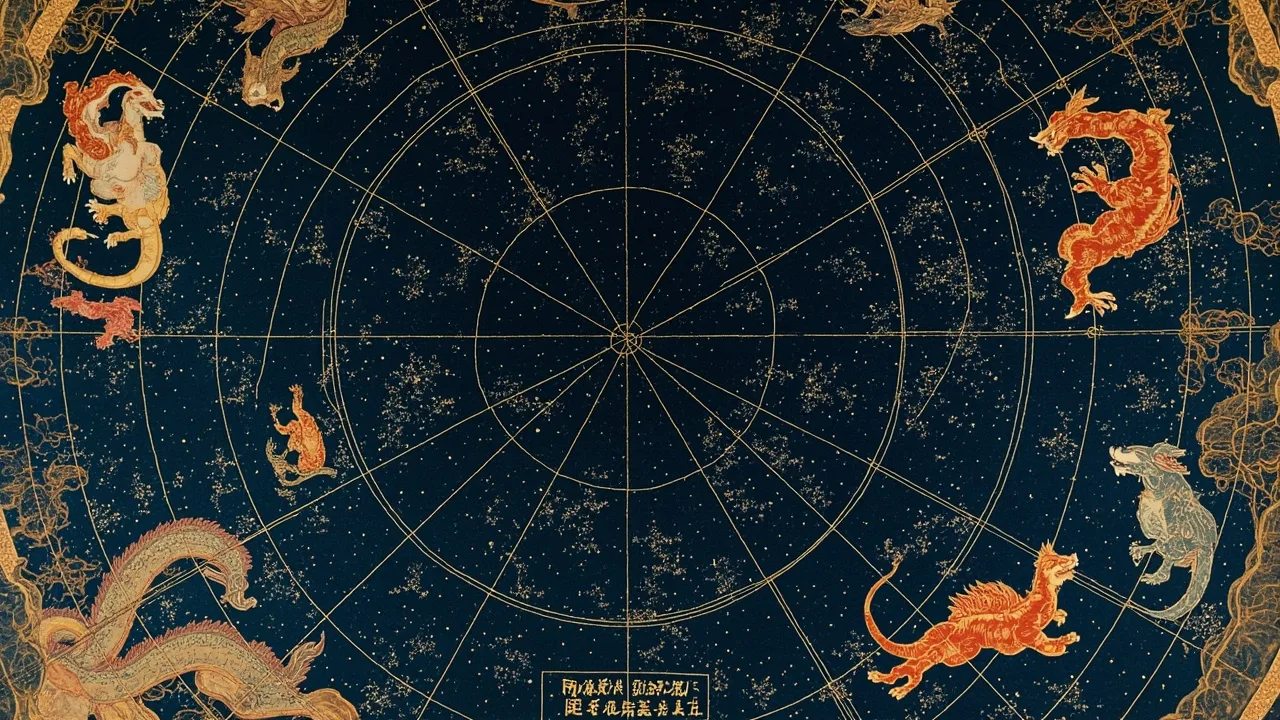
The Chinese divided the entire visible sky into three nested regions:
- Three Enclosures (三垣, Sān Yuán) — the Purple Forbidden (紫微垣, Zǐwēi Yuán) around the north celestial pole, the Supreme Palace (太微垣, Tàiwēi Yuán) to its east, and the Heavenly Market (天市垣, Tiānshì Yuán) to its west. Together these enclose the pole where the emperor’s throne sat, his court, and his market — a celestial mirror of the imperial capital.
- Four Symbols (四象, Sì Xiàng) — four great beasts guarding the four cardinal directions: the Azure Dragon of the East, the White Tiger of the West, the Vermilion Bird of the South, and the Black Tortoise of the North.
- Twenty-Eight Mansions — the four symbols are each split into seven mansions, giving twenty-eight precise stellar landmarks spaced roughly evenly along the ecliptic.
Each mansion got a single-character or two-character Chinese name that described the star pattern it contained: Horn (角, Jiǎo), Neck (亢, Kàng), Root (氐, Dī), Room (房, Fáng), Heart (心, Xīn), Tail (尾, Wěi), Winnowing Basket (箕, Jī) for the Dragon; Pleiades Hairy Head (昴, Mǎo) for the Tiger; and so on. These weren’t poetic flourishes. They were working labels. A court astronomer who said “the moon is in the Heart” meant the moon had reached a specific, repeatable spot in the sky.
The Four Symbols and Their Mansions
The four cardinal beast-symbols are the backbone of the system, and each one has seven mansions. They march around the sky in the order the moon rises through them each month.
The Azure Dragon of the East (青龙, Qīng Lóng) — the constellation of spring, ruled by the wood element and the color green-blue. Its seven mansions are: 角 (Jiǎo, Horn, in Virgo), 亢 (Kàng, Neck), 氐 (Dī, Root), 房 (Fáng, Room), 心 (Xīn, Heart, containing the red giant Antares), 尾 (Wěi, Tail), and 箕 (Jī, Winnowing Basket, in Sagittarius). The dragon’s head rises in the east at the spring equinox.
The White Tiger of the West (白虎, Bái Hǔ) — the constellation of autumn, ruled by metal. Its seven mansions are: 奎 (Kuí, Legs), 娄 (Lóu, Bond), 胃 (Wèi, Stomach), 昴 (Mǎo, Pleiades Hairy Head — the famous star cluster), 毕 (Bì, Net), 觜 (Zī, Turtle Beak), and 参 (Shēn, Three, the three stars of Orion’s Belt). The tiger’s head sets in the west at the autumn equinox.
The Vermilion Bird of the South (朱雀, Zhū Què) — the constellation of summer, ruled by fire and the color red. Its seven mansions are: 井 (Jǐng, Well), 鬼 (Guǐ, Ghost), 柳 (Liǔ, Willow), 星 (Xīng, Star), 张 (Zhāng, Extended Net), 翼 (Yì, Wings), and 轸 (Zhěn, Chariot, in Corvus).
The Black Tortoise of the North (玄武, Xuán Wǔ) — a snake entwined around a turtle, the constellation of winter, ruled by water. Its seven mansions are: 斗 (Dǒu, Dipper), 牛 (Niú, Ox), 女 (Nǚ, Girl), 虚 (Xū, Emptiness), 危 (Wēi, Rooftop), 室 (Shì, Encampment, containing the Pleiades-like cluster we call the Beehive), and 壁 (Bì, Wall).
This four-fold division wasn’t just astronomy. It was woven into medicine, feng shui, military planning, and ritual. A doctor who prescribed herbs according to the Inner Canon of the Yellow Emperor (黄帝内经, ~1st century BCE) timed the prescription to which mansion the moon occupied.
Origin and Earliest Records
The Twenty-Eight Mansions didn’t appear in a single moment. They accreted over centuries, with the earliest recognizable traces in the oracle bones of the late Shang dynasty (~1400–1100 BCE). Inscribed turtle shells and ox scapulae from Anyang record eclipses, comets, and the risings of certain stars — and a handful of those stars carry names (especially Mǎo, the Pleiades) that match the later mansion system. The Pleiades mattered to herders. When that cluster disappeared from the night sky for a month each year, the calendar flipped.
By the Warring States period (475–221 BCE), the system was substantially codified. The earliest known text that lists all twenty-eight mansions by name is the 《甘石星经》 (Gān Shí Xīng Jīng, the Star Classic of Gan and Shi), attributed to the two astronomers Gan De (甘德) of the state of Qi and Shi Shen (石申) of the state of Wei. The work dates to roughly the 4th century BCE — at least a century before the Greek astronomer Eudoxus of Cnidus wrote his Phaenomena, which is usually credited with the first Greek constellation list.
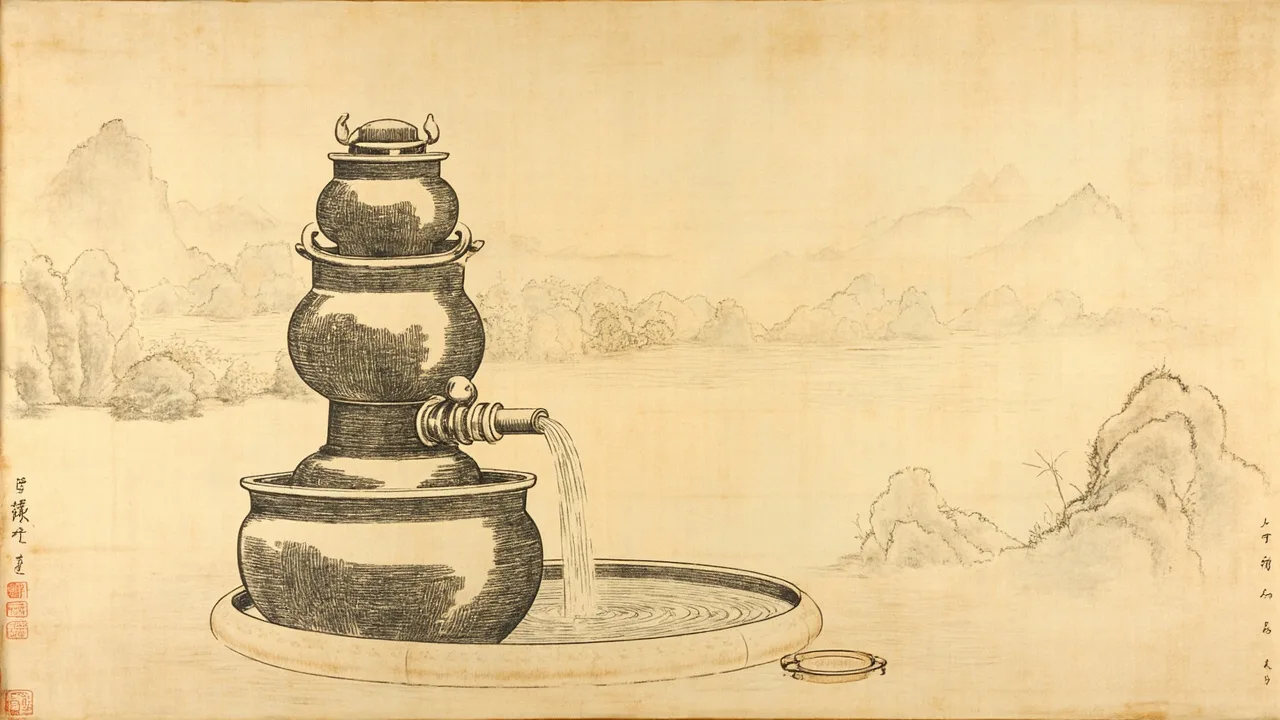
Gan De and Shi Shen weren’t working in isolation. Their observations built on records going back further. The Zuozhuan (左传, ~4th century BCE) mentions eclipses timed to the moon’s position “in the Heart” (心宿), and the Shiji (史记, the Records of the Grand Historian by Sima Qian, finished ~94 BCE) catalogues the mansions as a working list. By the time of the Han dynasty astronomer Zhang Heng (张衡, 78–139 CE), the system was complete enough that he built a water-powered armillary sphere that mechanically rotated past the twenty-eight markers — a device so impressive that later dynasties kept rebuilding copies of it.
How the Mansions Were Actually Used
Five big jobs needed precision, and the Twenty-Eight Mansions delivered it for two and a half millennia.
A coordinate system. Every Chinese astronomer learned the moon’s path as twenty-eight marked positions rather than an empty curve. Where the Greeks measured positions in degrees along an abstract zodiac, Chinese observers said: “the moon is at the second star of the Heart mansion, three degrees into the constellation.” It was concrete and instantly verifiable by anyone who knew the sky.
Calendar work. The Chinese lunisolar calendar requires knowing the exact moment of each new moon and the exact length of the tropical year. Because each mansion crosses the meridian at a predictable sidereal time, an observer could determine the time of night anywhere by timing the rising of a known mansion. The Han dynasty calendar reforms of 85 BCE used the mansions as their fundamental grid.
Eclipse prediction. This is what Yi Xing was doing in 721. Eclipses happen when the sun, moon, and a node line up — and that node line drifts. By tracking which mansion the moon occupied on past eclipse dates, an astronomer could extrapolate the node and predict the next eclipse. Yi Xing’s calculation for the Tang court was within an hour of the actual event.
Navigation. By the Tang dynasty (618–907 CE), Chinese, Arab, and Indian sailors on the Indian Ocean all used stellar navigation. The Tang monk Jian Zhen (鉴真, 688–763) sailed to Japan using star sightings; his sixth voyage in 753, finally successful, carried him past the Ryukyu islands by reading Polaris and the southern mansions. By the time of the Ming admiral Zheng He (郑和, 1371–1433), the Star Manual (《郑和航海图》 and its associated geng lu 星盘 star tables) explicitly listed which mansions crossed the zenith at which latitudes — a practical almanac for open-ocean voyaging from Nanjing to Malindi. The Venetian traveler Marco Polo (~1254–1324), crossing the Indian Ocean in the 1290s, was so struck by the precision of Arab star navigation that he recorded in his book how his crew checked the ship’s position by the Pole Star and the southern mansions.
Timekeeping. Imperial clocks were built around the mansions. The famous Su Song astronomical clock tower (苏颂水运仪象台, completed 1092 CE in Kaifeng) used a water-driven escapement that mechanically tracked the moon’s position through the twenty-eight mansions and rang a bell automatically when the moon crossed each one.
Cultural Influence Beyond China
The Twenty-Eight Mansions were never a Chinese-only system. They radiated outward in every direction China traded.
In Korea, the system was adopted wholesale during the Three Kingdoms period (57 BCE – 668 CE). The Samguk Sagi (三国史记, completed 1145) records Korean court astronomers timing events by the mansions. The famous Gyeongju Cheomseongdae observatory (경주 첨성대, ~632 CE) — the oldest surviving astronomical observatory in East Asia — was calibrated against the Twenty-Eight Mansions. Korean star maps from the Joseon dynasty still mark all twenty-eight.
In Japan, the mansion system arrived with the adoption of Chinese writing and astronomy in the 7th century. Japanese court astronomers used it alongside the Western zodiac for nearly a thousand years. The Tenmon Bunya (天文分野) and the Inmyō (陰陽道, Onmyōdō) occult-scholarly tradition kept the mansions alive long after the imperial court stopped using them for calendar reform.
In Vietnam, the mansions were part of the Chinese cultural package absorbed during a thousand years of northern rule. Vietnamese folk astrology today still divides the month by mansion-day, called “ngày vọng”.
The most remarkable eastward transmission was to Tibet, where the mansions were incorporated into Tibetan astrology in the 8th century CE. Today, the Tibetan lunar mansion system (སྐར་མ་སོ་དྲུག་ཀེ་རུ་བརྒྱད་) uses the same twenty-eight names — the only major variation is the inclusion of additional Indian nakshatra-style mansions for a 27-mansion variant used in some monasteries.
Westward, the transmission was just as consequential. Chinese star charts reached Baghdad in the 8th century during the Abbasid translation movement. Chinese astronomers working at the caliph al-Mansur’s court in the 760s brought with them the Yuanjiao (元嘉) star tables and the mansion system. Scholars like the astronomer Ya’qub ibn Tariq blended the Chinese mansions with the Indian nakshatra and the Greek zodiac to produce the syncretic system used by later Islamic astronomers — and that hybrid is the direct ancestor of the constellation system the Mongol Empire carried back into China in the 13th century.
Modern Legacy
The Twenty-Eight Mansions never went away. They just got quieter.
Chinese astrology still uses them. A traditional Chinese astrologer today reads a client’s birth chart by the mansion the moon occupied at birth — much as a Western astrologer reads the zodiac sign. The mansion names still appear in fortune-telling almanacs (通胜) sold at every Chinese New Year market, in Hong Kong, Singapore, and Guangdong. The “Today’s Mansion” reading tells you whether the day is favorable for travel, marriage, surgery, or business — based on the same twenty-eight positions the Warring States astronomers calculated.
In astronomy, the system is finally being recognized in the wider world. Western scholarship has long studied the Twenty-Eight Mansions as one of the great parallel traditions to the Greek zodiac; modern planetarium software, including Stellarium and SkySafari, ships with the Chinese asterism overlays. The Pleiades cluster in Taurus, marked as 昴 (Mǎo, “Hairy Head”) in the Chinese system, is the same patch of sky that NASA’s James Webb Space Telescope has trained its mirrors on — a target Chinese court astrologers had been writing about since the Bronze Age.
In spaceflight, the mansions got an unexpected second life. The China National Space Administration named its orbital station 天宫 (Tiāngōng, “Heavenly Palace”) — a name that resonates with the Three Enclosures (三垣), the imperial-court region of the ancient sky. The station’s core module is 天和 (Tiānhé, “Harmony of Heaven”); its lab modules are 问天 (Wèntiān, “Asking Heaven”) and 梦天 (Mèngtiān, “Dreaming of Heaven”). Each spacecraft in the Shenzhou series carries a name that echoes the celestial vocabulary — a quiet nod to the same sky the Warring States astronomers watched.
A Few Famous Mansions in Detail
Four of the mansions carry weight disproportionate to their size, because each one anchors something the rest of the sky turns around.
昴 (Mǎo, “Hairy Head”) — the Pleiades cluster. The most-tracked star group in human history, and almost certainly the oldest mansion in the system. Chinese, Greek, Maya, and Aboriginal Australian astronomers all singled out this faint cluster in Taurus. Mǎo was the marker for the start of spring in the Shiji’s calendar tables; the Shang oracle bones mention its disappearance. When Galileo Galilei pointed his telescope at it in 1610 and counted 36 stars, he was looking at the same patch of sky the Anyang priests had read 3,000 years earlier.
参 (Shēn, “Three”) — Orion’s Belt. Three stars so bright and so evenly spaced that no ancient culture could miss them. In China, the asterism was an asterism: not one mansion but a Western sidekick to 觜 (Zī, the Turtle Beak) and a forerunner to the rest of Orion. Shēn was so famous that the phrase “to be separated by the three stars of Shēn” (参商不相见) became a classical allusion for friends or lovers fated never to meet — because Shēn and 商 (Heart in the Dragon, with Antares) rise on opposite sides of the sky at opposite seasons.
心 (Xīn, “Heart”) — the red supergiant Antares in Scorpius, the literal “Heart of the Dragon.” Antares is so red that it rivals Mars in color — the Greek name Antares literally means “rival of Ares (Mars).” The Chinese knew it as 心宿二 (Heart mansion, second star) and read it as the dragon’s raging heart. A lunar occultation of 心 was recorded on an oracle bone from the reign of King Wu Ding (~1200 BCE), one of the earliest datable astronomical observations in any culture.
箕 (Jī, “Winnowing Basket”) — four faint stars in Sagittarius drawn as a basket for separating grain from chaff. Jī was the “winds mansion” — when the moon was in Jī, the wind was supposed to rise, a piece of folk astronomy still echoed in some Chinese weather lore today.
From Oracle Bones to Orbital Stations
What makes the Twenty-Eight Mansions remarkable isn’t any single brilliant insight. It’s endurance.
The same sky-positions were used to time oracle-bone sacrifices in Anyang around 1200 BCE, to plan Han dynasty irrigation projects, to navigate the Indian Ocean under Zheng He in 1410, to set the date for a Cantonese wedding in 2024, and to name the modules of a space station orbiting 400 kilometers above the Earth in 2026. A few details got refined — Han astronomers added two extra stars to one mansion here, Ming observers tightened a boundary there — but the underlying map barely budged.
When Yi Xing climbed the steps at Gaocheng on a spring night in 721 CE, he was using a system that any astronomer from the Warring States period would have recognized instantly. And when a Chinese astronaut docks a spacecraft at 天和 today, that spacecraft is sliding into a berth named with the same vocabulary. The Twenty-Eight Mansions are not a museum piece. They are a working astronomical language, still being spoken after twenty-five centuries.
That’s not something the Greek zodiac can claim.
Image Prompts
Hero Image
A museum-quality celestial map showing the Twenty-Eight Mansions of Chinese astronomy. The celestial sphere rendered as a rotating globe with the north pole at center and ecliptic curving across. Four great beasts — Azure Dragon (青龙) in the east, White Tiger (白虎) in the west, Vermilion Bird (朱雀) in the south, Black Tortoise (玄武) in the north — each composed of seven star clusters with Chinese character labels. Three purple enclosures (三垣) surround the north pole: Purple Forbidden, Supreme Palace, Heavenly Market. Style: traditional Chinese ink-and-gold-leaf star chart on aged indigo paper, with delicate constellation lines connecting silver-white stars. Subtle Song dynasty painting aesthetic, deep blue-black background with vermilion and gold accents, museum-quality rendering, soft aged-paper texture.
Section Image 1 — Four Symbols Overview
A celestial sphere diagram showing all four guardian beasts arranged around the earth at the four cardinal directions: Azure Dragon rising in the east with stars in green-blue, White Tiger descending in the west in white, Vermilion Bird soaring in the south in red-orange, Black Tortoise coiled in the north in black. Each beast composed of seven visible star clusters. Style: classical Chinese astronomical illustration on dark indigo silk, gold constellation lines, brush-painted beasts visible only as outlines formed by their stars, traditional Suzhou silk embroidery aesthetic, museum lighting, wide aspect ratio.
Section Image 2 — Azure Dragon Seven Mansions
A detailed chart of the eastern sky showing only the Azure Dragon’s seven mansions spread in an arc from south to east to north: 角 (Horn, in Virgo), 亢 (Neck), 氐 (Root), 房 (Room), 心 (Heart with bright red Antares glowing), 尾 (Tail), 箕 (Winnowing Basket in Sagittarius). The dragon’s body suggested by faint blue constellation lines forming a serpentine shape among the stars. Stars marked with small Chinese characters. Style: traditional Tang dynasty star map aesthetic, ink on indigo, gold accents for the Heart mansion star, deep celestial blue background with subtle cloud patterns, brush calligraphy labels.
Section Image 3 — Vermilion Bird
The southern sky showing the Vermilion Bird constellation as a magnificent red-and-gold phoenix spreading its wings. Seven mansions labeled: 井 (Well, containing the Beehive cluster), 鬼 (Ghost, with the Crab Nebula glowing faintly), 柳 (Willow), 星 (Star), 张 (Extended Net), 翼 (Wings), 轸 (Chariot). The bird’s wings rendered in flaming red brushstrokes against deep black sky, individual stars visible as bright pinpricks forming the bird’s body. Style: Song dynasty court painting style, vermilion and ink on silk, dramatic flame-feather details, museum-quality framing.
Section Image 4 — Ancient Observatory
A Tang dynasty astronomer (or Han dynasty scholar) in scholarly robes operating a large bronze armillary sphere at the top of a stone observatory tower at night. The tower resembles the Gaocheng Observatory with stepped buttressed walls. The astronomer looks up at a star-filled sky while pointing at the instrument. A small lamp illuminates the bronze rings. Mountains visible in the background. Style: Tang dynasty court painting, fine-line gongbi brushwork, rich mineral pigments, deep night sky with visible stars, scholarly figure in flowing robes, atmospheric perspective, museum-quality historical Chinese art style.
Section Image 5 — Comparison Map
A side-by-side astronomical comparison diagram: on the left, a circular Chinese star map showing the Twenty-Eight Mansions in concentric rings with the Four Symbols on the outer edge; on the right, a circular Western star chart showing the twelve zodiac constellations along the same ecliptic path. The two maps are connected by a flowing band showing which Western constellations overlap with which Chinese mansions (e.g., Scorpius = Heart and Tail mansions, Orion’s Belt = Three mansion, Pleiades = Hairy Head mansion, Sagittarius = Winnowing Basket mansion). Style: dual-toned comparative astronomical plate, Chinese side in indigo with gold and vermilion, Western side in cream parchment with black ink, scholarly comparison-chart aesthetic, museum exhibition panel style.