If you’ve ever eaten at a Xinjiang restaurant in Beijing, Shanghai, or Chicago, you’ve already met the Uyghur people — you just may not have known their name. They’re the ones serving you sizzling lamb skewers dusted with cumin, hand-pulled noodles slick with tomato and pepper, and naan bread so good it’s barely cooled by the time it reaches your table. They’re also one of the most discussed and least understood ethnic groups in contemporary China, and one of the most musically accomplished communities in all of Central Asia.
To understand the Uyghurs, you have to follow the Silk Road back through two thousand years. Their history, food, music, and dress are all answers to a single underlying question: what happens when a Turkic-speaking people inherit a cosmopolitan oasis culture at the geographic crossroads of Asia? The answer is one of the most distinctive and absorbing cultural traditions in the world.
Who Are the Uyghurs?
The Uyghurs (维吾尔族, Wéiwú’ěrzú) are a Turkic-speaking ethnic group whose homeland is the Xinjiang Uyghur Autonomous Region in northwest China, particularly the southern Tarim Basin and the cities of Kashgar, Khotan, Turpan, Urumqi, and Hotan. Within China, they number approximately 12 million people, making them one of China’s larger officially recognized ethnic minorities. A diaspora community — many of them descendants of migrants who left Xinjiang in the twentieth century — lives in Kazakhstan, Kyrgyzstan, Uzbekistan, Turkey, Germany, the United States, and Saudi Arabia.
The ethnic identity is layered. Linguistically, the Uyghur language belongs to the Karluk branch of Turkic languages, related to Uzbek. Religiously, the community is overwhelmingly Muslim, predominantly Sunni, with a Sufi devotional tradition that has shaped their religious practice for centuries. Culturally, however, Uyghur identity draws on a much older Indo-Iranian substrate — the ancient peoples of the Tarim Basin (the Tocharians, the Sogdians, the Khotanese) — fused with later Turkic migrations and Islamic civilization.
The Uyghur identity as we understand it today is the result of centuries of conversion, migration, and synthesis. The name “Uyghur” itself is ancient — it appears in 8th-century Orkhon inscriptions describing a steppe empire in Mongolia — but the modern Uyghur ethnic group crystallized in the Tarim Basin after the collapse of the Uyghur Khaganate in 840 CE and the migration of Uyghur peoples southwest into Xinjiang. By the time Islamic civilization reached the region in the 10th century, a recognizably Uyghur cultural identity was already taking shape.
Tarim Basin Geography and Silk Road Heritage
The geography is half the story. The Tarim Basin, where most Uyghurs live, is one of the most physically distinctive regions on earth. It’s a roughly 1,000-kilometer oval of land, walled in by the Tian Shan mountains to the north, the Pamirs to the west, the Kunlun to the south, and the Taklamakan Desert at the center. The Taklamakan is one of the driest and deadliest deserts in the world — its name in Uyghur is sometimes translated as “you go in, you don’t come out.”
Life there is impossible without water, and water in the Tarim Basin comes from snowmelt off the surrounding mountains, pooling into oases at the foot of the Kunlun and the Tian Shan. The major Uyghur cities — Kashgar, Khotan, Hotan, Turpan, Kucha — are oasis cities built on this principle: dense, irrigated, agriculturally rich, ringed by absolute desert. The result is a settlement pattern that looks almost like a chain of green beads strung along an empty thread.
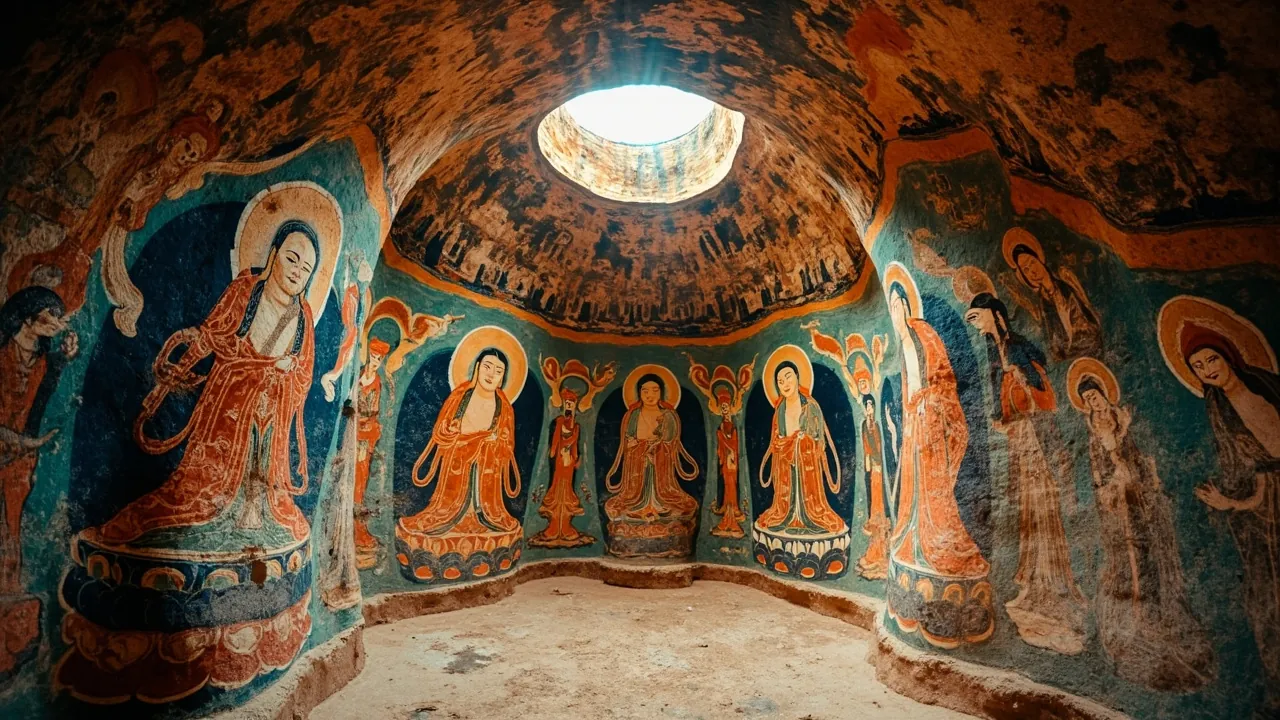
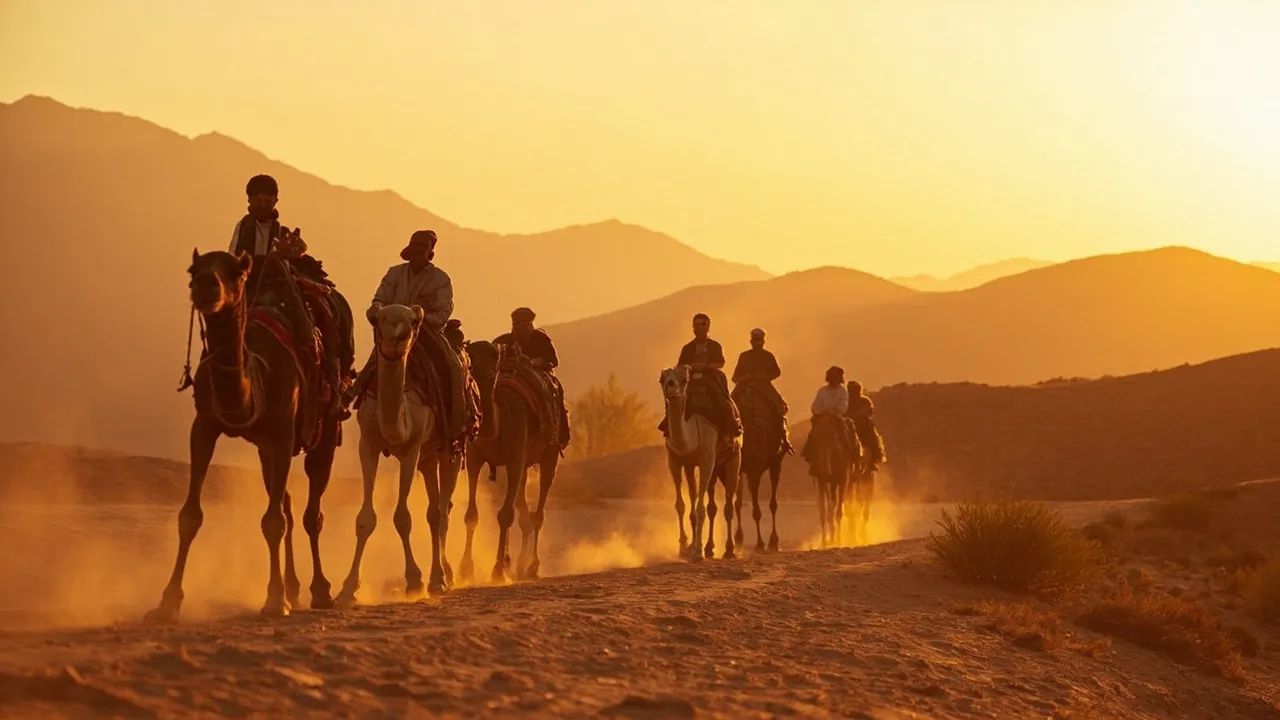
This geography made the Tarim Basin a transit zone for millennia. The oasis cities were the waystations on the southern Silk Road, where caravans carrying silk from China to the Mediterranean would stop to rest, trade, and resupply. They were also where Buddhism, Manichaeism, Zoroastrianism, and eventually Islam first entered China from the west. The Silk Road wasn’t a single road but a network of routes, and the Uyghur cities were the nodes that kept it functioning.
The legacy of the Silk Road is everywhere in Uyghur culture. The Uyghur language is itself partly a Silk Road artifact — its vocabulary absorbed Persian, Arabic, Russian, Mongolian, and Chinese words over centuries of trade. Uyghur music incorporates Persian modal structures and Indian rhythmic patterns alongside Turkic melodies. Even Uyghur cuisine — heavy on lamb, wheat, dried fruits, and rice pilaf — has more in common with Central Asian and Persian cooking than with Han Chinese food.
Language: A Script That Changed Three Times
One of the most remarkable things about the Uyghur language is its writing system, which has changed three times in recorded history.
In the early Uyghur Khaganate period, Uyghurs wrote in the Old Turkic runic script — angular signs carved into stone. After conversion to Manichaeism and then Buddhism, Uyghur scribes adopted a modified Sogdian script (an Aramaic-derived alphabet), which they used to translate Buddhist texts and Manichaean prayers. This “Old Uyghur” script was used extensively along the Silk Road, and many of the surviving texts from Turfan and Dunhuang are in this alphabet.
When Islam spread into the Tarim Basin during the 10th–11th centuries, Uyghurs converted — and with conversion came the adoption of a modified Arabic script. This Arabic-based Uyghur alphabet is what most Uyghurs used through the early twentieth century. It’s written right-to-left and includes a few letters modified for Turkic vowel sounds not present in standard Arabic.
In the 1960s and 70s, the Chinese government twice tried to switch Uyghur to a Latin-based alphabet — first in 1959, then more thoroughly in 1982 — before settling back on the Arabic-based script as the standard. So modern Uyghur writing is once again Arabic-script-based, with some additional diacritics. Walk into a Uyghur bookstore in Kashgar today and the books look almost Arabic — flowing right-to-left script — but if you ask the shopkeeper what language it is, they’ll say Uyghur.
Dress: The Doppa Hat and the Long Braids
Uyghur dress is recognizable from across a crowded bazaar, and a few items do most of the work.
The doppa (دوپپا or 四楞小花帽, “four-corner small flower hat”) is the signature item. It’s a small, rounded, square-cornered embroidered cap, traditionally made of black velvet with colorful silk-thread embroidery in floral and geometric patterns. Different regions have distinct doppa styles: Kashgar doppa tends to be densely embroidered in red and gold; Hotan doppa uses more white and green; Turpan doppa is often black with subtle ornamentation. Uyghur men and women both wear the doppa, and it’s a marker of ethnic identity that you can spot in any crowd.
For women, the iconic feature is long braided hair. Traditional Uyghur women wore their hair in two long braids, often decorated with beads, coral, or silver ornaments. The braids were sometimes gathered under the doppa in public or worn loose for special occasions. Today, many Uyghur women in Xinjiang have shorter modern haircuts, but the braided style persists in folk performances and weddings.
For everyday wear, Uyghur men often wear a chapan (袷袢), a long, quilted cotton robe in bright stripes or solid colors, sometimes with a sash at the waist. The robe is practical for the desert climate — cool in summer, warm in winter — and elegant enough for daily wear. Women’s clothing often features silk dresses in vivid colors, sometimes paired with fitted vests.
Food: Lamb, Naan, and Pilaf
Uyghur cuisine is built around a few core ingredients: lamb, wheat, rice, peppers, tomatoes, onions, and dried fruits. The signature dishes are now found across China.
Nang (馕) is the foundational bread — a flat, round, slightly chewy loaf baked in a tandoor-like clay oven. It’s eaten at every meal and used as a utensil for scooping meat and sauce. There are dozens of nang varieties, including sesame nang, onion nang, and meat-stuffed samsa (烤包子). Nang can be kept for weeks, which historically made it essential for travelers across the desert.
Polo (手抓饭), sometimes translated as “pilaf” or “hand-pulled rice,” is the celebratory dish. Yellow carrots, lamb, onions, and rice are cooked together in a single pot until the rice is fluffy and golden with fat. It’s served at weddings and family gatherings, traditionally eaten with the hands (hence the name). The Uyghur version differs from Persian or Uzbek pilafs mainly in the use of yellow carrots (a Xinjiang specialty) and a milder seasoning profile.
Big Plate Chicken (大盘鸡, dapanji) is a more recent innovation that has conquered Chinese restaurant menus. It was reportedly invented in the 1990s in Shawan county by a migrant Sichuan cook working with Uyghur ingredients: chicken, potatoes, peppers, and wide belt noodles (皮带面) cooked in a single enormous dish. It’s now found in every Chinese city.
Kawap (烤羊肉, yangrou chuanr) — lamb skewers — are the most visible Uyghur street food. Cubes of lamb threaded onto flat metal skewers, dusted with cumin, chili, and salt, grilled over charcoal. The skewers are sold by the dozen on Uyghur street corners and at night markets, and the smell of grilling lamb is one of the signature scents of any Uyghur neighborhood.
Side items matter too: dried raisins from Turpan (where grape cultivation has been practiced for at least two thousand years), walnuts, almonds, mulberry paper, yogurt, black tea (砖茶, brick tea, served in small bowls), and the famous melons from Hami and Turpan that were prized as imperial tribute fruits during the Tang dynasty.
Music: The Twelve Muqam
Uyghur classical music is one of the great musical traditions of the Islamic world, and the Twelve Muqam (十二木卡姆) is its masterwork. In 2005, UNESCO inscribed the Twelve Muqam on its Representative List of the Intangible Cultural Heritage of Humanity, calling it “a treasure of Uyghur culture.”
A muqam is a modal framework — a set of melodic rules, rhythmic patterns, and emotional conventions — within which musicians improvise. The Twelve Muqam is a complete cycle of twelve such modes, organized into a performance that lasts roughly 24 hours when played in full. Each muqam contains a sung section (with lyrics in Chagatai Turkic and Persian), instrumental sections, and dance interludes.
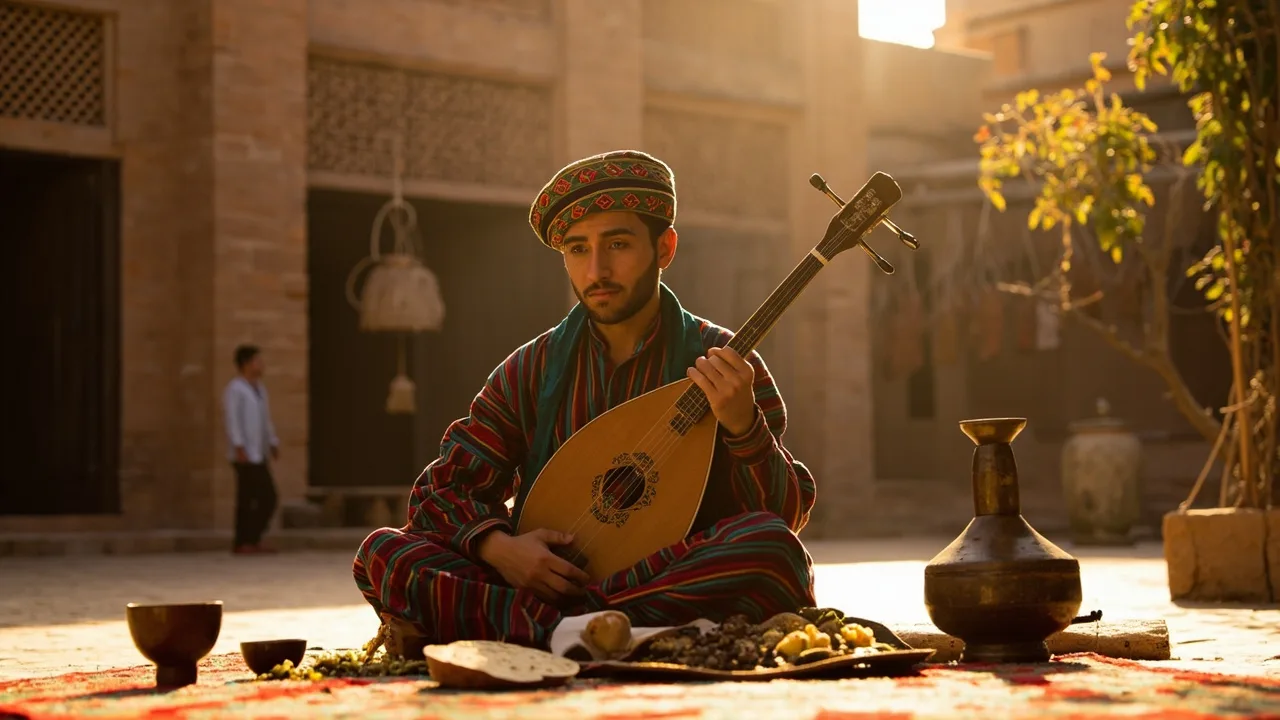
The instruments that anchor the Twelve Muqam are the dutar (a two-stringed long-necked lute), the tanbur (a longer-necked cousin), the rawap (a plucked spike fiddle), the ghijak (a bowed fiddle), and various drums. Together they create a sound that’s distinctly Central Asian — Persian in its modal sensibility, Turkic in its melodic ornament, and uniquely Uyghur in its combination.
Listening to a complete Twelve Muqam cycle is a serious undertaking — you don’t pop it on for background music — but even short excerpts show what makes the tradition extraordinary. There’s a depth and patience to it that reminds me more of a Bach partita than of Western popular music, and a passionate improvisatory freedom that lets individual singers make each performance their own.
Dance: The Sanam
The companion to the Twelve Muqam in Uyghur performance is the Sanam dance (赛乃姆, sainam), a graceful, expressive form typically performed by women at weddings and festivals. The Sanam is characterized by upright posture, delicate hand gestures, and small, controlled steps that emphasize the upper body’s expressiveness. The dancer’s hands tell the story — they’re used to mime plucking flowers, threading needles, pouring tea, or touching the cheek in expressions of longing.
Sanam is usually performed to the instrumental sections of the Muqam, with the dancer interpreting the modal mood of the music. Different regions have their own Sanam variants: Kashgar Sanam tends to be more dramatic, with larger arm movements and a faster tempo; Yarkand Sanam is more subdued; Dolan Sanam (from the Dolan region) is fiercer, with shoulder shimmies that echo the dance traditions of the mountain peoples.
In diaspora communities, Sanam dance classes have become a way for younger Uyghurs — many of whom may not grow up in Xinjiang — to maintain a connection to the cultural heritage of their grandparents. You can find Uyghur dance troupes in Istanbul, Sydney, Washington D.C., and Almaty.
Faith: Islamic Practice with Cultural Fusion
Uyghur religious practice is overwhelmingly Sunni Muslim, with a strong Sufi devotional tradition. Sufism — the mystical, poetry-loving branch of Islamic practice — has been particularly influential in Uyghur regions. The Naqshbandi order, which originated in Central Asia, has deep roots among Uyghur communities, and Sufi shrines (麻扎, mazar) dedicated to local saints are major pilgrimage sites.
Religious practice is interwoven with cultural custom in ways that distinguish Uyghur Islam from neighboring forms. Uyghur mosques often use carpets and wooden ornament rather than the tilework of Iranian mosques. Uyghur religious poetry draws on Chagatai Turkic, a literary language descended from Old Uyghur, alongside Arabic. Wedding traditions combine Islamic ritual with pre-Islamic Turkic customs (bride-stealing ceremonies, dowry negotiations, multiple-day feasts). Uyghur cuisine has absorbed foods — like polo — that are shared with non-Muslim Central Asian peoples.
The result is a religious practice that’s recognizably Islamic but visually, musically, and socially distinctive. A Uyghur Friday prayer, a Uyghur wedding, a Uyghur funeral — all draw on shared Islamic structures, but each expresses them in ways that are unmistakably Uyghur.
Uyghur Cultural Centers: Beijing and Beyond
There’s a Uyghur diaspora, and it has built institutions. In Beijing, the Xinjiang ethnic restaurants and cultural centers are concentrated in areas like Sijiqing and the older Uyghur quarters of the city — places where Uyghur migrants and their descendants have lived for generations. Theatrical performances, music recordings, and Uyghur-language publishing all happen through these networks.
Overseas, Uyghur diaspora communities have built cultural centers in major cities. The Uyghur Association of New York, the East Turkistan Cultural Center in Tokyo, Uyghur associations in Almaty (which has the largest Uyghur diaspora population), Munich, Istanbul, and Washington D.C. These centers host language classes, music performances, dance classes, and religious holidays, keeping Uyghur cultural practice alive outside Xinjiang.
Whether you eat at a Uyghur restaurant in your own city, listen to a Twelve Muqam recording, or plan a trip to Kashgar’s Sunday Bazaar (the largest traditional market in Central Asia), the Uyghur world is more accessible than it might seem. The food is the easiest entry — almost any Chinese city has an Uyghur-run noodle house where the laghman noodles are pulled by hand and the lamb skewers are grilled over real coals. Start there. The rest of the culture unfolds around it.