Most people are exactly what they appear to be. The nervous student stays nervous. The hot-tempered officer stays hot-tempered. The man who never learned to read as a child grows old without ever picking up a book. These are not failures — they are simply the ordinary way that human beings work. We develop habits, we accept our limitations, and we find ways to function within the boundaries of what we already know. It takes something unusual — a decision, a crisis, a moment of clarity — to break through the surface of who we think we are and become someone genuinely different.
Lu Meng was one of those unusual people. He started his military career as exactly what he appeared to be: a brave but uneducated warrior from a humble background who had risen through the ranks on the basis of physical courage and nothing more. He could fight. He could lead soldiers in battle. He could inspire loyalty through personal bravery. What he could not do was read, could not engage with strategic theory, could not participate in the kind of intellectual discussion that the educated officers around him took for granted. And then, in middle age, he decided to change that. The idiom that emerged from his transformation — 刮目相看 — has been used for nearly two thousand years to describe exactly this kind of fundamental, visible change in a person’s capabilities or character.
The Warrior Who Could Not Read
Lu Meng was born in the late second century CE in the southern region of China that would eventually become the territory of the Wu kingdom. His family was poor — not quite at the bottom of the social scale, but close enough that formal education was never an option. As a young man, he joined the military service of the warlord Sun Quan, and he quickly established a reputation as a soldier of exceptional physical courage. He was not particularly interested in tactics or strategy. He was interested in fighting, in leading charges, in demonstrating through action what he was capable of in the moment of combat.
This reputation served him well in the early years. Bravery was valued in the chaotic environment of late Han Dynasty China, and Lu Meng rose steadily through the officer ranks, eventually becoming a middle-ranking commander with a contingent of troops under his direct leadership. He was good at his job — his soldiers were well-trained and well-led, and he had a gift for maintaining their loyalty and morale. But everyone who knew him understood the limits of what he could become. Without education, without the ability to engage with the intellectual side of military command, he would top out at a certain level and go no further.
The people who told him this were not being cruel. They were being realistic. The most prestigious command positions required cultural literacy, the ability to read orders and reports, the capacity to understand historical precedents and strategic theories. Lu Meng had none of these, and in the cultural context of the time, there was no expectation that he ever would. Warriors who could not read simply accepted that fact and worked within it.
The Challenge That Changed Everything
The catalyst for Lu Meng’s transformation came from an unexpected direction: his lord, Sun Quan.
Sun Quan was one of the more unusual rulers of the Three Kingdoms period. He was young — he was only in his early twenties when he assumed leadership of the Wu state — but he had a quality that distinguished him from many of his contemporaries: a genuine desire to see the people around him grow and improve. He did not simply use his subordinates as tools. He invested in developing them, pushing them to become more capable than they currently were. And he had noticed that Lu Meng, despite his limitations, had qualities that suggested he could become something more than a simple warrior.
One day, Sun Quan called Lu Meng aside and told him something that must have been both flattering and uncomfortable to hear. He said that Lu Meng, despite his current limitations, had the potential to become a great commander — but only if he was willing to do something he had never done before. He needed to study. He needed to learn to read, to understand history, to engage with the strategic theories that separated good officers from truly exceptional ones.
The conversation is described in the historical records as a turning point. Lu Meng could have reacted the way most people in his position would have: he could have explained that he was too old, that old habits could not be changed, that the limits of his education were simply the way things were. Instead, he made a different choice. He decided to prove that the limits other people saw in him were not actually limits at all. He would learn to read. He would study history and strategy. He would become the kind of officer that Sun Quan believed he could be.
The Warrior Who Became a Scholar
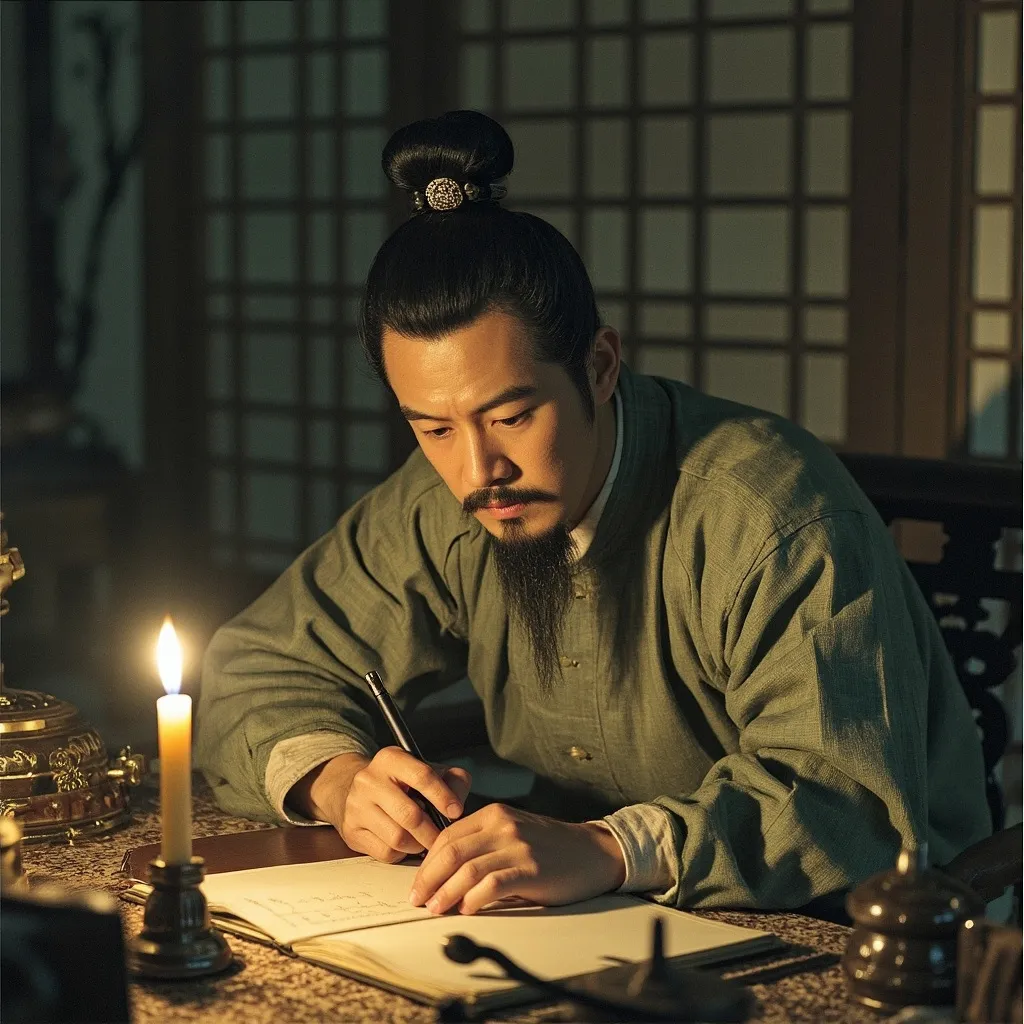
What Lu Meng did next was remarkable, and the historical accounts emphasize it repeatedly: he dedicated himself to learning with the same intensity that he had previously devoted to military training. He started with basic literacy — learning characters, practicing writing, building the foundation that most educated people had acquired in childhood. Then he moved on to history, reading accounts of previous military campaigns and analyzing the decisions that had led to victory or defeat. He studied the strategies of earlier Chinese military thinkers, absorbing the frameworks that had been used by the greatest commanders of previous generations.
The change did not happen overnight. Lu Meng worked at it consistently, day after day, month after month. He carried books with him on campaigns, reading whenever there was a moment of free time. He asked the educated officers around him for explanations and guidance, swallowing his pride and accepting that there were things he needed to learn from people who had backgrounds he did not share. He applied the same discipline to his intellectual development that he had always applied to his physical training.
The people around him noticed. The transformation was visible not just in his increasing ability to participate in strategic discussions, but in the quality of his decision-making. A man who had previously relied purely on instinct and courage was now incorporating analysis, historical precedent, and careful planning into his command decisions. His campaigns began to show a sophistication that his earlier operations had lacked entirely.
The story that is most often cited from this period involves Lu Meng’s response when someone questioned whether he was old enough and experienced enough to handle a particular military command. Lu Meng replied not with an appeal to his battlefield record — the argument he would have made a few years earlier — but with a specific reference to a historical example from the Spring and Autumn period, explaining how a previous commander had handled a similar situation. The person asking the question was stunned. This was not the Lu Meng they thought they knew.
The Transformation That Earned the Idiom
The phrase 刮目相看 — literally “scraping the eyes to look anew” or “viewing with new eyes” — captures exactly what Sun Quan said to Lu Meng when he observed the extent of his transformation. In some versions of the story, Sun Quan uses the phrase directly, telling his officers that they must now look at Lu Meng with entirely fresh eyes because the man standing before them was no longer the same person they had dismissed as limited. In other versions, the phrase is applied more broadly to describe the reaction that anyone would have upon seeing Lu Meng after his period of intense study.
The imagery is vivid. It is as if a film had formed over someone’s eyes — the accumulated assumptions and fixed judgments of years — and it had to be scraped away before the true picture could be seen. Lu Meng was not merely a warrior who had learned some new skills. He had fundamentally changed the kind of person he was. The limits that everyone had accepted as permanent were gone.
What makes this story so enduring is not just the fact of Lu Meng’s transformation, but the quality of mind it demonstrates. Lu Meng could have accepted the verdict that he was simply not the kind of person who could become educated. He was, by this point in his life, in his late thirties or early forties — an age when most people have long since stopped making fundamental changes to their core capabilities. Instead, he chose to prove that the verdict was wrong. He chose to demonstrate that the boundaries others saw in him were artificial — limits imposed by assumption rather than by actual constraint.
The Broader Lesson About Human Potential
The idiom 刮目相看 entered common usage not merely to describe Lu Meng’s specific transformation, but to capture a broader truth about human potential that extends well beyond military contexts. The phrase is used whenever someone who was previously dismissed or underestimated demonstrates capabilities that nobody expected. It is a reminder that the judgments we make about other people — including ourselves — are always provisional, always subject to revision in the face of new evidence.
This lesson is genuinely difficult to apply consistently. Human beings are pattern-recognition machines, and one of the most useful patterns we recognize is the correlation between someone’s background and their capabilities. A person who grew up without education is statistically less likely to demonstrate scholarly capabilities than someone who attended fine schools. But statistics are not destinies, and the people who achieve the most remarkable things are often precisely those who refuse to be constrained by what the statistics would predict.
Lu Meng’s transformation had a concrete military dimension as well. Within a relatively short period of completing his education, he was promoted to one of the highest command positions in the Wu military — commander of the eastern defense forces. In this role, he implemented strategic and organizational improvements that strengthened Wu’s position significantly. His educated analysis of enemy capabilities, his sophisticated understanding of terrain and logistics, and his ability to communicate his plans clearly to subordinates were all products of the transformation he had undergone in middle age.
Modern Tools for Personal Transformation
The spirit of 刮目相看 — the willingness to scrap your existing assumptions about your own limits and commit to genuine growth — is as relevant today as it was in Lu Meng’s time. Whether you’re learning a new skill, changing careers, or simply trying to become more capable in your current role, the following tools can support the kind of sustained effort that transformation requires:
1. Complete Chinese Character Workbook — Like Lu Meng, you might need to build foundational skills that others acquired earlier in life. This comprehensive workbook takes you from basic characters to advanced vocabulary, following a structured approach that makes gradual improvement possible.
2. Premium Brush Pen Set for Calligraphy Practice — Chinese character practice is not just about literacy — it’s about connecting with a cultural tradition that Lu Meng himself would have valued. These brush pens offer the authentic feel of traditional calligraphy without the mess of ink and paper.
3. Audiobook Subscription — History and Strategy — Lu Meng studied history obsessively. Today’s equivalent is an audiobook subscription that lets you absorb strategic thinking, military history, and leadership lessons during commutes, workouts, or any other dead time.
4. Personal Development Journal with Goal Tracking — Transformation requires intentionality — knowing where you’re starting, where you’re going, and whether you’re making progress. This journal provides structured frameworks for tracking your growth across multiple dimensions.
5. Premium Reading Lamp with Warm Light — Lu Meng read by lamplight during campaign marches. Your reading sessions deserve the same quality illumination — warm, adjustable light that reduces eye strain during long study sessions.
The Eyes That Must Be Scraped Clean
There is a version of this story that gets at something deeper than personal transformation alone. Lu Meng’s change was not just about becoming more capable — it was about proving that the original judgment of his limitations had been wrong. The people who had assumed he could not become educated had made a reasonable prediction based on available evidence. They were not foolish for believing what they believed. But they were limited by the very act of believing it, because their assumptions prevented them from seeing what was actually possible.
This is the trap that 刮目相看 is meant to help us avoid. When we decide that someone is a certain way — when we fix our judgment and stop updating it — we lose the ability to see what they might actually become. Lu Meng needed Sun Quan to scrape away his assumptions and look freshly at what was actually there: potential that had not yet been developed, capabilities that had not yet been demonstrated. Sun Quan’s willingness to do this was itself a form of wisdom, because most rulers would have written Lu Meng off as a useful but limited soldier and never discovered what he could actually become.
The idiom works in both directions. It is a challenge to the person who has been dismissed: prove them wrong, as Lu Meng did. And it is a challenge to everyone else: do not be too quick to assume that you have seen everything a person has to offer. The most remarkable growth often happens in exactly the places where it seemed least possible.