The Fool Who Waited for Rabbits: A Chinese Idiom Story
Every language has its proverbs and idioms—those colorful expressions that pack centuries of wisdom into a handful of words. Chinese is particularly rich in these linguistic gems, with each idiom often rooted in a specific story that brings the expression to life.
One of the most vivid and memorable of these is “shou zhu dai tu”—守株待兔—the story of the fool who waited for rabbits. It’s a tale that has been told in China for over two thousand years, a simple fable with a message that remains remarkably relevant today. Let’s explore this classic Chinese idiom and discover why it continues to resonate across the centuries.
The Origin: A Farmer’s Lucky Accident
The story of “shou zhu dai tu” comes from one of China’s earliest philosophical texts, the Han Feizi (韩非子), a work compiled in the 3rd century BC by the philosopher Han Fei. Han Fei was a Legalist philosopher who used parables and anecdotes to illustrate his arguments about governance and human nature, and this story has become one of his most famous.
Here’s how the story goes. Long ago, in the Spring and Autumn period (roughly 771-476 BC) or perhaps the early Warring States period, there was a farmer who worked diligently on his small plot of land. He plowed his fields, planted his seeds, tended his crops, and did everything that a good farmer should do. But despite his hard work, times were hard, and he never seemed to get ahead.
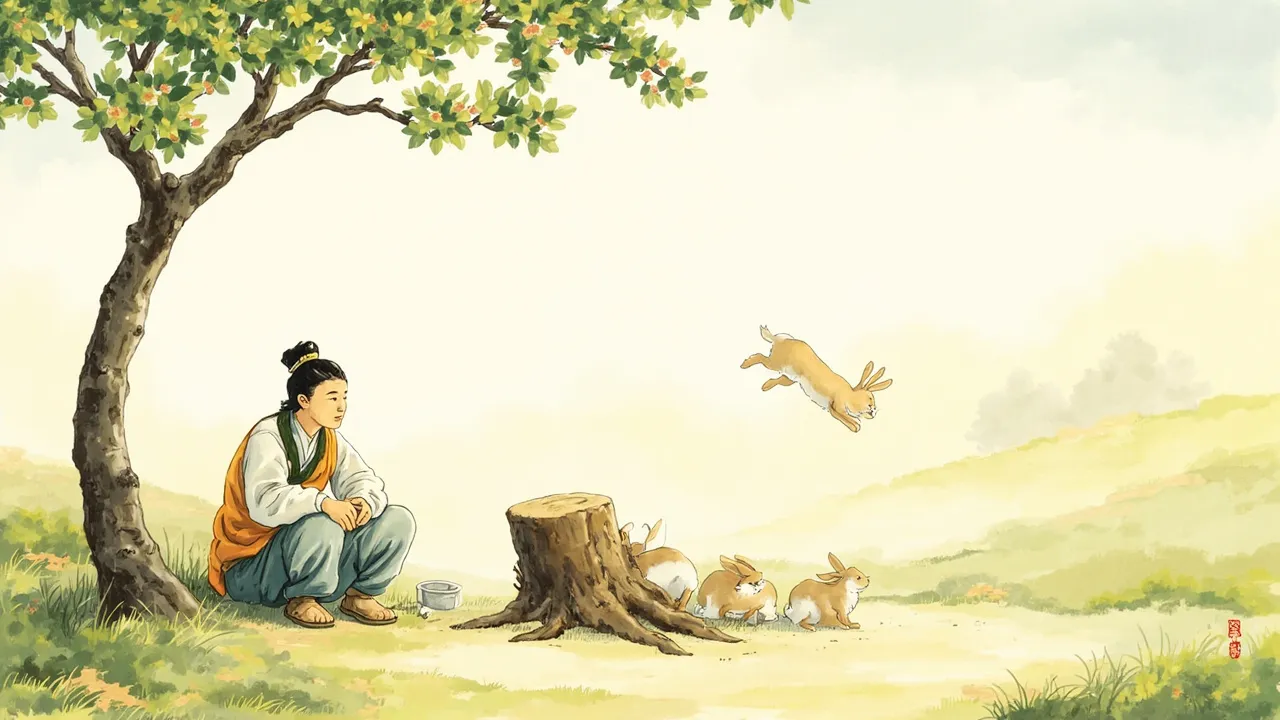
One day, as the farmer was working in his field, something remarkable happened. A rabbit, perhaps fleeing from a predator or simply running carelessly, came dashing across the farmland. It was moving so fast that it didn’t see the old tree stump at the edge of the field. Crash! The rabbit slammed into the stump, broke its neck, and died instantly.
The farmer was astonished. He ran to the spot, picked up the rabbit, and couldn’t believe his good fortune. Here was a whole rabbit—perfectly good meat—that had literally fallen into his hands without any effort at all. He brought it home, and his family enjoyed a delicious meal of fresh rabbit meat.
For the next few days, the farmer couldn’t stop thinking about his lucky find. He went back to the field each day, but no more rabbits appeared. This didn’t discourage him, though. Instead, he began to think: why should I work so hard in my fields when I could just wait by this tree stump for another rabbit to come crashing into it?
So that’s exactly what he did. He abandoned his plow. He stopped tending his crops. Every day, he sat by the old tree stump, waiting for another rabbit to be so clumsy as to kill itself for his convenience.
Day after day passed. The farmer waited. The seasons changed. His fields grew over with weeds. His crops withered and died. And no more rabbits came.
This, of course, is the moral of the story—a moral that Han Fei used to illustrate a point about governance and human nature. The farmer had learned the wrong lesson from his lucky accident. He thought he had discovered a shortcut to success, a way to get something for nothing. But what he had actually experienced was a one-time fluke, not a reliable method for getting ahead.
The Meaning: Opportunity and Effort
In modern Chinese, “shou zhu dai tu” (守株待兔) literally means “guarding the stump and waiting for rabbits.” It describes someone who, after experiencing a lucky break, abandons their normal efforts in favor of waiting for similar lucky opportunities to come to them.
The idiom is used to criticize people who are:
- Lazy or lacking in initiative
- Hoping for windfalls instead of working diligently
- Misunderstanding the nature of success
- Failing to learn the right lesson from their experiences
You might use this idiom when you see someone who:
- Quit their job expecting to easily find a better one
- Stopped studying thinking they’d get lucky on the exam
- Abandoned a business that required effort in favor of “get rich quick” schemes
- Keeps replaying their past success instead of moving forward
The story is often told to children in China as a lesson about the importance of hard work. Parents and teachers use it to illustrate that real success comes from sustained effort, not from waiting for fortune to smile upon you. It’s a remarkably effective parable because it combines a memorable narrative with a clear moral that’s easy to understand.
The idiom has become so embedded in Chinese culture that it’s commonly used in political speeches, business advice, and everyday conversation. When someone is criticized for being unrealistic or hoping for success without putting in effort, they’re likely to hear this phrase.
The Historical Context: Han Fei and Legalist Philosophy
To fully appreciate this story, it helps to understand something about its original context. Han Fei was a philosopher who lived in the 3rd century BC, during the tumultuous late Warring States period. China at this time was divided into seven major states, all fighting for survival and dominance. It was an era of warfare, political intrigue, and rapid change.
Han Fei was a proponent of Legalism (法家), a philosophy that emphasized strict laws, efficient administration, and practical governance over ethical idealism. He believed that good governance required clear incentives and punishments, not rely on the moral improvement of rulers or subjects.
The story of the rabbit-loving farmer was part of Han Fei’s argument about human nature. He observed that people often:
- Overgeneralize from limited experience
- Seek shortcuts to success
- Are attracted to lazy solutions
- Miss the true lessons of their experiences
In the original context of Han Fei’s writing, the story was aimed at rulers who might be tempted by easy solutions to the problems of governing. It served as a warning against:
- Trusting in luck rather than solid policies
- Following fads rather than proven methods
- Neglecting fundamental duties in favor of flashy projects
- Misinterpreting accidental successes as reliable strategies
The story’s power comes from its recognition of a universal human weakness—the desire to get something for nothing. We all, to some degree, entertain fantasies of lucky breaks and windfall gains. The rabbit story reminds us that such fantasies rarely lead to lasting success.
Han Fei wrote the Han Feizi as a collection of寓言 (fables or parables), using stories like this one to illustrate his philosophical points. The book became one of the foundational texts of Legalist thought and was studied by Chinese rulers for centuries. Though Legalism as an official ideology fell out of favor after the Han Dynasty, its practical wisdom continued to influence Chinese political thought.
Modern Applications: Lessons for Today
Though the story is over two thousand years old, its message feels remarkably contemporary. In many ways, we’re surrounded by “rabbit waiting” thinking—in ourselves, in our culture, and in the advice we’re given.
Consider the world of finance and investment. Every so often, someone gets rich quickly through a lucky investment, and suddenly everyone wants to find the next big thing. People abandon their boring but reliable retirement accounts in favor of chasing the latest cryptocurrency or “can’t miss” startup. They see someone else’s lucky break and think: why can’t that be me?
Or consider the world of career and work. How many people change jobs constantly, looking for the perfect opportunity that will fall into their laps? How many abandon their skills and experience in favor of waiting for someone to “discover” them? The rabbit farmer’s mistake is to mistake one lucky event for a reliable strategy.
The story also applies to more subtle forms of waiting. How many people spend their time waiting for the “right moment” to start a project? Waiting for the perfect conditions? Waiting until they feel inspired? These are all variations on the same theme—substituting waiting for action, hoping that opportunity will come to you rather than going out to meet it.
The alternative, of course, is to be like the farmer was before his lucky accident—to work diligently at your chosen task, to develop your skills, to put in the time and effort that real achievement requires. This isn’t glamorous, and it doesn’t generate exciting stories to tell at parties. But it’s the only reliable path to success.
Chinese culture has always valued hard work and practical effort, and the story of the rabbit farmer fits squarely into this tradition. The idiom “shou zhu dai tu” has become a standard way of pointing out this kind of mistaken thinking, a shorthand for “don’t count on getting something for nothing.”
In modern Chinese business and education, this idiom is frequently invoked. Students are reminded not to expect success without effort. Entrepreneurs are warned against chasing fads instead of building solid businesses. And employees are encouraged to develop real skills rather than simply waiting for promotion.
Related Expressions and Cultural Connections
The story of the rabbit farmer is part of a rich tradition of Chinese idioms and fables that teach practical wisdom through memorable narratives. Here are some related expressions that share similar themes:
“Yi fen tian xia” (一分耕耘,一分收获) means “no pain, no gain”—literally, one part of cultivation yields one part of harvest. This expression directly contradicts the rabbit farmer’s logic, emphasizing that reward is directly proportional to effort.
“Jin shan shan you lu” (金山银山,不如绿水青山) is a more modern saying about mountains of gold and silver being less valuable than green mountains and clear waters—essentially, don’t sacrifice what matters most for quick gains.
“Tian dao酬勤” (天道酬勤) means “heaven rewards the diligent”—the idea that those who work hard will eventually be rewarded. This is almost the exact opposite of the rabbit farmer’s philosophy.
Chinese schoolchildren learn these expressions early, and they’re reinforced through repetition in textbooks, classroom discussions, and parental advice. The value of hard work is so deeply embedded in Chinese culture that it’s almost impossible to separate from the culture itself.
The rabbit story also appears in modern popular culture. It’s referenced in Chinese movies and television shows, used in business advice books, and referenced in political speeches. In 2021, Chinese leader Xi Jinping referenced the story in a speech about economic development, using it to warn against complacency and the temptation to rely on past successes rather than continuing to work hard.
Chinese idioms like this one offer a window into the values and priorities of Chinese culture. They’re not just linguistic curiosities but carriers of accumulated wisdom—lessons learned through generations of observation about human nature and the world.
What the Story Teaches Us
At its core, the story of “shou zhu dai tu” teaches us about the nature of opportunity. True opportunity isn’t something that just happens to you—it’s something you create through your own efforts, skills, and readiness. The farmer in the story had an opportunity—the rabbit literally fell into his hands. But he misinterpreted what had happened and made the wrong assumption about how to create more opportunities.
Real success comes from:
- Consistent effort over time
- Developing skills and expertise
- Being prepared when opportunity arises
- Learning the right lessons from both success and failure
The farmer failed because he confused a lucky accident with a reliable method. He stopped doing the things that had made him successful (working hard on his farm) and started doing the thing that had been a one-time fluke (waiting by the tree).
In our own lives, it’s worth asking: are we waiting for rabbits, or are we doing the real work that leads to genuine success? Are we putting in the effort that creates opportunities, or are we hoping for windfalls? The answer, of course, isn’t to never hope for good fortune—it’s to not let hope for good fortune replace the work that actually creates success.
The next time you hear someone talk about their big break or lucky break, you might think of the rabbit farmer. And the next time you’re tempted to stop working and start waiting, remember what happened to that farmer in his field—the weeds grew up, his crops died, and no more rabbits ever came.