Wang Wei: The Tang Dynasty Poet Who Turned Buddhist Mountains into Verse
In the year 701, in the small town of Qi (祁) in what is now Shanxi, a woman named Lady Cui (崔氏) gave birth to a son and named him 王维 (Wáng Wéi, “Wang the Preserver”). The name was not an accident. She had been a practicing Buddhist for years, and “Wei” was a single character pulled out of the name of her favorite sutra. The full name she gave him, which she kept writing into his childhood notebooks, was 维摩诘 — Vimalakirti — the wise layman of Indian legend who argued with the Buddha himself and won. She wanted her son to grow up the way she imagined that layman: in the world, not a monk; devout, not clerical; living among officials, painters, and merchants, but somehow already elsewhere.
She got her wish. More than twelve centuries later, when Chinese readers rank the great poets of the Tang, they reach for three-character titles. Li Bai is 诗仙, the Poet Immortal — wine, moon, wandering. Du Fu is 诗圣, the Poet Sage — war, hunger, conscience. Wang Wei 王维 (701–761) is 诗佛, the Poet Buddha. The title was coined by Su Shi 苏轼 (Su Dongpo, 苏东坡) of the Song dynasty, a poet not given to flattery. Su thought Wang Wei’s work had crossed into something Li Bai and Du Fu had not touched: a quiet, exact kind of seeing that pointed, without argument, toward emptiness. That is the Wang Wei story. A painter who drew mountains the way a monk breathes. A prime minister who wrote five-character poems about deer.
A Man in Three Bodies
Most Tang poets wore one hat. Li Bai wrote; he also drank and wandered. Du Fu wrote; he also failed at office. Wang Wei held three careers in one lifetime, and he held them seriously.
As a court official, he passed the jinshi exam, the highest level of the imperial civil service, at the unusually young age of twenty-two in 723. Within ten years he had been promoted to the rank of bie jiao (给校), an inspection post that put him in the company of scholars advising the throne directly. By the 750s he had risen to 右丞 (Yòu Chéng), Right Vice Minister of the Department of Rites — a post that put him among the highest-ranked officials in the empire. He held real political power.
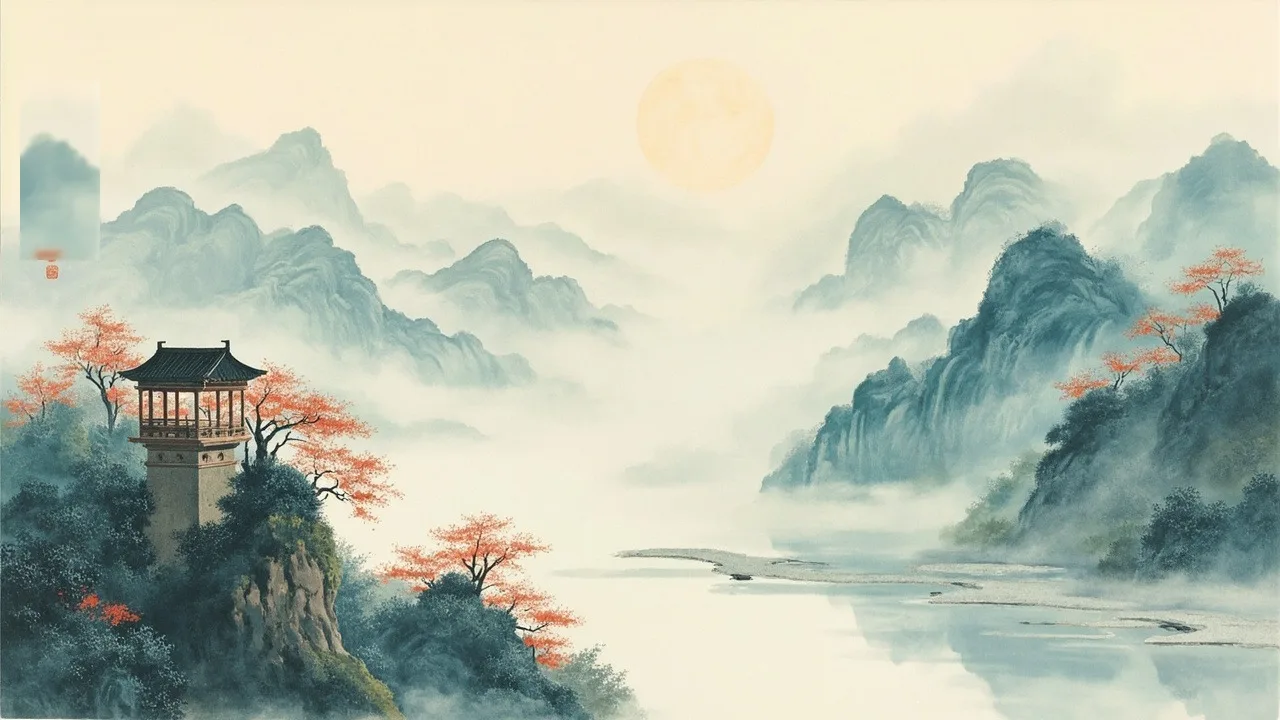
He was also, in the long Chinese tradition, a painter. None of his original paintings survive; the pigments and silk of early Tang work simply do not last. But contemporary records describe him as a master of landscape, and later critics named him the founder of the 南方山水画派 (Nánfāng shānshuǐ huàpài), the Southern School of landscape painting. The Southern School is the branch of Chinese landscape art that favors ink wash, soft contour, and what later critics called xieyi 写意 — “writing the idea” — over the careful line-by-line detail of the Northern School. The dividing line between these two styles is still used in Chinese art history, and Wang Wei sits at its origin.
And then there was the poetry. Almost six hundred of his poems have survived, more than Li Bai’s friend Du Fu can claim in proportion to the length of his career. His poems won the famous Tang poetry anthology of the 18th century, the 御定唐诗三百首 (Three Hundred Tang Poems), with a presence rivaled only by Li Bai and Du Fu. The anthology opens with a Wang Wei poem — Thoughts in the Still Night (《静夜思》is Li Bai, but the very first poem in some editions is Wang Wei’s 山中送别). A reader who picks up the most popular Tang anthology in the world is, in many cases, opening with Wang Wei.
How did one man hold all three? The honest answer is that in Tang China, they were not separate. Painting a mountain was a way of seeing it. Seeing a mountain was a way of being quiet in it. Being quiet in a mountain was, for a Buddhist, a way of training the mind. Wang Wei did not balance three careers. He practiced one vocation in three forms.
The Wang River Estate (辋川别业)
Around the year 744, when Wang Wei was in his early forties, he bought a country estate about forty li west of Chang’an, the Tang capital, in the foothills of the 终南山 (Zhōngnán shān), the Zhongnan Mountains. He called the place 辋川别业 (Wǎngchuān biéyè), the Wang River Estate, after the small 辋河 (Wǎng hé) that curved through it. The site had once belonged to the poet Song Zhiwen 宋之问; Wang Wei restored the buildings and added pavilions named after the places he loved.
The estate was a real estate. It sat in a long valley cut by the Wang River, with named scenes at every bend: 鹿柴 (Lùzhài, the Deer Enclosure), 木兰柴 (Mùlánchài, Magnolia Ridge), 茱萸沜 (Zhūyúfàn, Dogwood Shore), 文杏馆 (Wénxìng guǎn, the Apricot Pavilion), 金屑泉 (Jīnxiè quán, Gold-Dust Spring). Wang Wei wrote a poem for each one, then bound the twenty poems and a matching set of twenty paintings into a small book called the 《辋川集》 (Wǎngchuān jí), the Wang River Collection. His friend Pei Di 裴迪 wrote a matching poem for each scene, and the two circulated together.
The book’s most famous poem is the one set at the Deer Enclosure. In a translation that tries to keep Wang Wei’s short, four-character lines:
空山不见人, 但闻人语响。 返景入深林, 复照青苔上。
Deer Enclosure
Empty mountain — no one to be seen. Yet — listen — human voices echo back. Returning light slips into the deep wood, Falls once more on the green moss.
Five lines. Twenty characters in the original. In English it has the plainness of a haiku. In Chinese it has something harder to name: a moment of stillness where you can hear that someone was just here, and now isn’t. The “empty mountain” is not empty. The voices are not the point. The light landing on the moss is.
The Deer Enclosure poem is one of the most quoted pieces of Chinese poetry ever. Ezra Pound, working from a Japanese scholar’s notes, made it famous in the West in 1915 as “The Deer Park”:
“Empty mountains: no more to be seen; only the sound of someone talking Hard to imagine how, in Tang China, anything that spare could mean so much.”
Wang Wei did not compose these poems in a mountain hut alone. He had a household. He had officials visiting. The estate was a place to retreat to, not a place to hide in. He would come out from Chang’an after the spring planting, paint and write, then ride back when the court called. The poems of the Wang River Collection are addressed to a friend — Pei Di is named in the preface — and they are written to the estate, not away from it. The stillness is intentional, not earned.
The estate was eventually sold. It changed hands, fell into ruin, was partially restored, and the river was dammed in the twentieth century. Today the area is called 蓝田县 (Lántián xiàn) in Shaanxi, and there is a Wang Wei memorial site there — a small museum, restored pavilions, a path that follows his old walks. Travelers who want to walk the same valley he walked can still find it.
Why “Poet Buddha” (诗佛)
Su Shi’s coinage, 诗佛 “poet buddha,” is one of the most-quoted one-line literary judgments in Chinese criticism. Su wrote it as part of a triad: 味摩诘之诗,诗中有画;观摩诘之画,画中有诗 — “Tasting Wang Wei’s poems, inside the poems are paintings. Looking at Wang Wei’s paintings, inside the paintings are poems.” That is the famous couplet. The triad — Li Bai the immortal, Du Fu the sage, Wang Wei the buddha — is the larger framework around it.
What did Su mean by “buddha”?
The first thing is the 空 (kōng), emptiness. In Chan Buddhism, the school of Chinese Buddhism later exported to Japan as Zen, emptiness is not nothingness. It is the open quality of things before we have labeled them. A mountain seen before the word “mountain” arrives. Wang Wei’s poems almost always clear the human out of the scene. People speak and leave. Animals appear and vanish. A deer is in the enclosure one moment and the next you only hear its bell. The poem ends in the empty space where you, the reader, are now standing.
The second is the direct pointing. Chan teaching rejects elaborate metaphysics. A master points at the moon; the student looks up. Wang Wei’s poems refuse to explain. The Deer Enclosure does not tell you what the voices mean. They just are. The light on the moss is what the light on the moss does. Meaning is left for the reader to complete — which is, in Chan terms, exactly the right place for it.
The third is the silence. Read the twenty Wang River poems back to back and you notice how often the lines end on a sound — a bird, a bell, water — and then trail off. Wang Wei was a trained musician (one of his early court posts was 太乐丞, Director of the Imperial Music Office), and he knew that silence is not the absence of music; it is the frame that lets the music exist. His poems are built around that frame.
A poem from later in his life, 山中 (Shān zhōng, In the Mountains), shows the same instinct:
荆溪白石出, 天寒红叶稀。 山路元无雨, 空翠湿人衣。
From Jingxi the white stones emerge. Cold day — the red leaves thin out. The mountain path, it never rained. Yet the green of it wets your clothes.
You walk a dry mountain path and come back with dew on your sleeves. The air is so saturated it feels wet. Nothing happens in the poem except a walk. Nothing is explained. The reader finishes it quieter than they started.
Legacy: How One Quiet Voice Shaped a Thousand Years
Wang Wei died in 761, in the last years of the Tang, the dynasty already fraying at the edges. He left a will asking to be buried at the foot of the Zhongnan Mountains, near his Wang River estate, dressed in the simple robes of a monk. His friends honored the wish.
The shape of what came after is hard to overstate.
In Chinese painting, the Southern School lineage runs from Wang Wei through a line of monk-painters — 董源 (Dǒng Yuán), 巨然 (Jù Rán), 米芾 (Mì Fú), 米友仁 (Mǐ Yǒurén) — into the Song dynasty and on through the Yuan masters. The famous landscape scroll 谿山行旅图 (Travelers Among Mountains and Streams), sometimes attributed to the Northern School master Fan Kuan 范宽, exists as a kind of counter-example; what Wang Wei is said to have begun is the other tradition, the one where the brushwork itself becomes the meaning. To this day, when a Chinese ink painter talks about catching qi (气, breath, vital energy) on paper, they are talking about a tradition Wang Wei is credited with founding.
In poetry, the Wang River Collection set the template for the landscape sequence. Su Shi wrote his own. The Yuan dynasty masters built theirs around Wang Wei’s. Modern Chinese poets still measure themselves against his restraint.
In Buddhism, Wang Wei is remembered not as a theologian but as a practitioner. He sat for years in his private chapel at the Wang River estate, kept a vegetarian diet, and is said to have recited the Lotus Sutra in full on his deathbed. He gave money to monasteries. His lay-Buddhist example — serving the state fully, but keeping the mind elsewhere — became a pattern that Chinese officials would imitate for centuries. The phrase 居士 (jūshì, lay devotee) in Chinese almost inevitably brings Wang Wei to mind.
For Western readers, Wang Wei is also one of the most approachable Tang poets. The poems are short, plain, image-led, and largely free of the classical allusions that make Li Bai and Du Fu dense in translation. The Zen garden aesthetic — empty, still, mossy, slightly misty — already speaks to readers familiar with Japanese tea culture or with contemporary minimalism. He is in many college anthologies. The Pulitzer-winning American poet Gary Snyder has cited him as an influence. His poems sit comfortably next to haiku and to the spare American landscape poetry of Wendell Berry.
That last connection matters. The Wang River estate is a place you can still visit, about an hour and a half by road south of Xi’an. The mountains are still there, the river still curves, the deer park is marked on the local maps. Travelers who want to walk the path in Deer Enclosure — to feel, as Wang Wei wrote, that the cold green of the air “wets your clothes” — can still do it. Most Western visitors to China see the Terracotta Army and the city wall and leave. A small detour into the Zhongnan foothills is a quieter kind of trip, and one that lets you stand inside the line of a poem you may have been reading for years.
Wang Wei was a man who held three offices — official, painter, poet — and answered one calling. He turned Buddhist mountains into verse. He turned verse into paintings. He turned paintings back into the stillness they came from. Twelve centuries later, the poems still wait, still short, still quiet, still pointing at the moon.