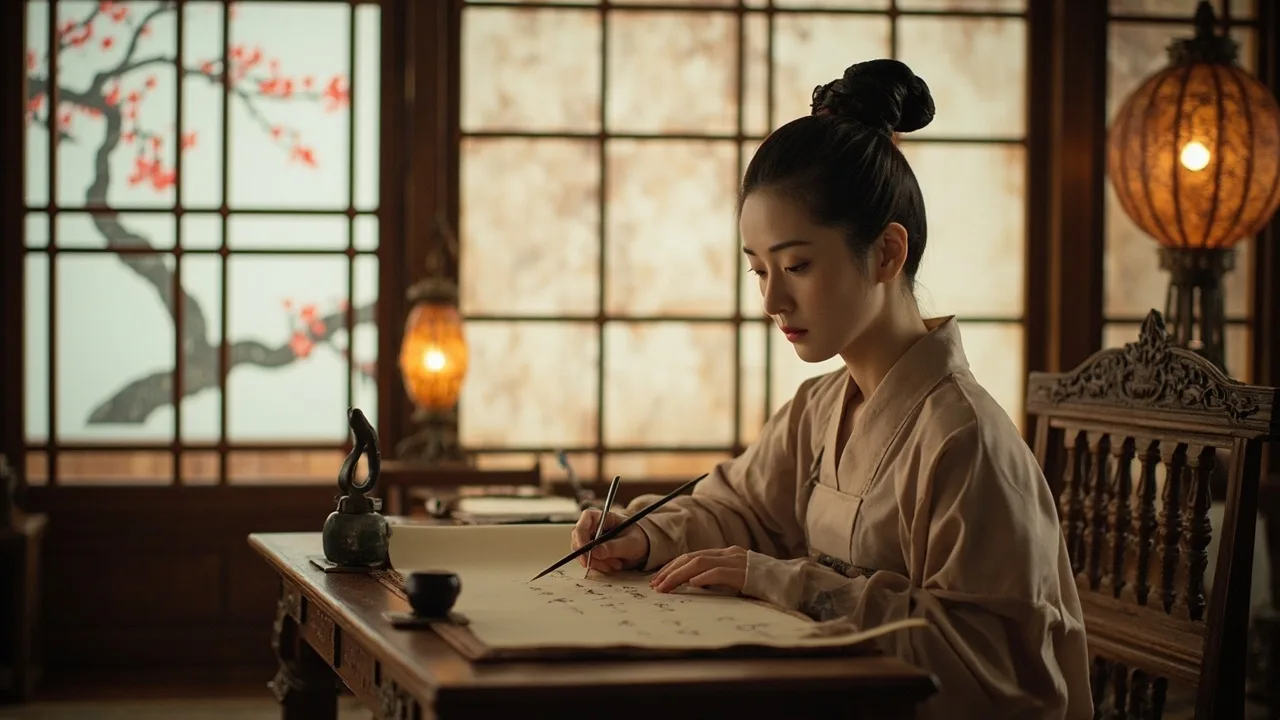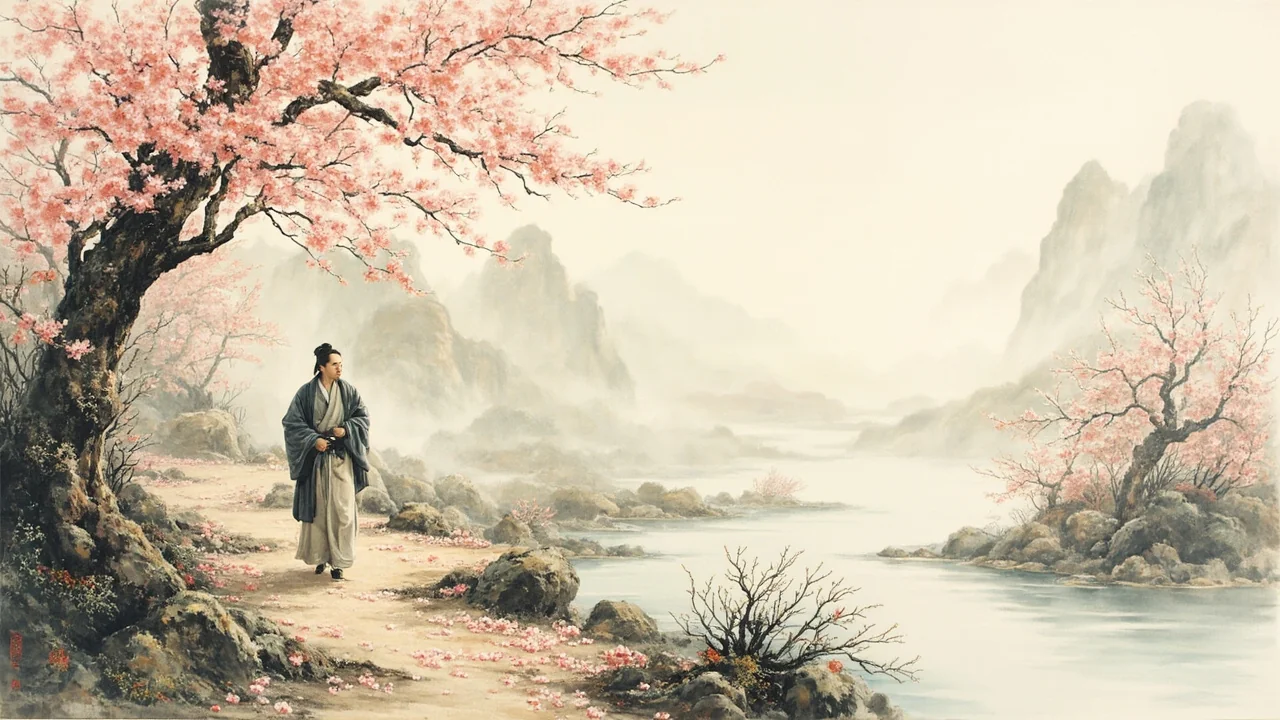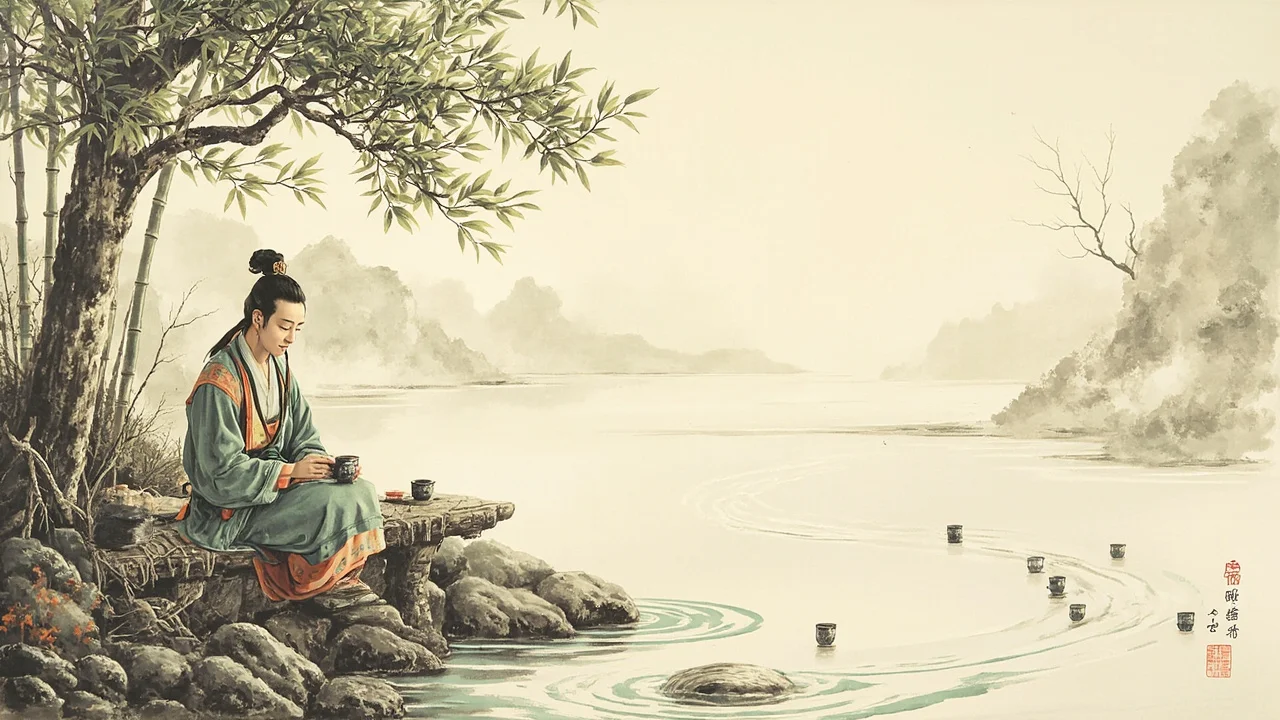
In the third month of the year 353 CE, on the third day of the third lunar month — a date the Chinese still call the Qingming Festival’s quieter neighbor, the Shangsi Festival — a forty-nine-year-old calligrapher named Wang Xizhi gathered forty-two friends, family members, and literati colleagues at a place called the Orchid Pavilion (Lanting, 兰亭). It was a springtime outing, the kind scholars loved: wine, poetry, a stream, wine cups floated down the current so each drinker had to compose a verse before the cup reached him. They wrote twenty-six poems that day. Wang Xizhi, asked to write a preface to the resulting collection, sat down with brush and ink and produced 324 Chinese characters in 28 lines of running script that would come to be regarded as the single finest piece of calligraphy in the entire Chinese tradition.
We call it the Lantingji Xu — the Orchid Pavilion Preface. If you have spent any time in a Chinese art museum, leafed through a Chinese calligraphy book, or stared at a wall scroll in a tea shop, you have almost certainly seen something that traces its lineage back to this one afternoon. The piece is lost. But the rubbings of it, the copies made by emperor-calligraphers and monk-calligraphers and bored court officials over the past 1,673 years, are themselves some of the most treasured objects in Chinese art history.
Let me tell you who Wang Xizhi was, what exactly happened that day, what the preface actually says (because the words matter as much as the brushwork), and why — sixteen centuries later — Chinese calligraphy students still begin by copying the Lantingji Xu.
The Man: Wang Xizhi (303–361 CE)
Wang Xizhi was born in 303 CE, in what is now Linyi in Shandong province, into one of the great aristocratic clans of the Eastern Jin dynasty (317–420 CE). The Jin had retreated south after the fall of Luoyang and the sacking of north China in the early 300s, and Wang Xizhi spent most of his life in the southern capital region — first at Jiankang (modern Nanjing), later at Kuaiji (modern Shaoxing in Zhejiang). His father, Wang Xiong, was a senior official; his uncle, Wang Xian, was a noted calligrapher; one of his cousins, Wang Xianzhi, would later become famous enough on his own to be remembered as the “Little Xiang” to Wang Xizhi’s “Great Xiang.”
The Eastern Jin was a strange period. Politically unstable, militarily weak, often openly mocked by later dynasties for letting its generals do the actual governing while aristocratic families competed for prestige at court. But culturally it was one of the most fertile periods in Chinese history. It produced the famous painter Gu Kaizhi; the great calligraphers we are about to meet; the poet Tao Yuanming, who retired from office to farm; and a whole cohort of “pure conversation” philosophers (the Xuanxue, 玄学玄学, the “mysterious learning”) who spent their evenings debating whether Zhuangzi or Confucius had a better theory of the good life.
Calligraphy in the fourth century was going through its biggest identity crisis. The old ways — bronze inscriptions, large seal script, the formal clerical script of the Han dynasty bureaucracy — were giving way to looser, faster, more expressive hands. Two script styles in particular were being invented in real time: xingshu (行书), the running script, somewhere between formal regular script and pure cursive; and caoshu (草书), cursive script proper, almost a personal shorthand. Wang Xizhi did not invent either of them. But historians from the Tang dynasty onward agreed, almost without exception, that he perfected running script, and that his Lantingji Xu was its supreme example.
He was not a particularly powerful or famous man in his own time. He served in several middle-ranking posts — including a stint as governor of Kuaiji, where the Orchid Pavilion gathering took place — and was known among his circle as a skilled calligrapher, an excellent conversationalist, and a generous host. He retired from official life in his late forties to focus on calligraphy and Daoist self-cultivation. He died in 361 CE at the age of fifty-eight. By the time of the Tang dynasty (618–907), roughly 270 years after his death, he had become the Sage of Calligraphy (书圣, shusheng) — the name that has stuck ever since.
The Orchid Pavilion: An Afternoon in the Ninth Year of Yonghe
The preface itself opens with a meticulous description of what happened that day. Translation matters here, because Wang Xizhi’s writing is so elegant that even Chinese readers slow down at the opening paragraphs:
In the ninth year of Yonghe [353 CE], in the season of late spring, we gathered at the Orchid Pavilion in the north of Kuaiji for the ritual of purification. All the great men of the district came together — the young and the old, the noble and the humble. It was a place with high mountains and lofty peaks, dense forests and tall bamboo, and a clear stream that flashed and reflected on either side. We sat in turn along its bank, and though there was no music, the wine and poetry were sufficient to relieve our feelings.
On that day the sky was clear, the air was fresh, and a warm breeze blew softly. Looking up, we saw the immensity of the universe; looking down, we saw the myriad things at our feet. We let our eyes wander and our hearts expand, and we were satisfied with what we saw and felt. The pleasures of the eye and ear passed over us like a single breath, never to return.
Then Wang Xizhi does something unexpected. He shifts from this pure, almost meditative joy into reflection, then into melancholy. He notes that past and present alike, people have always gathered, written, drunk wine — and that every pleasure, however real, is impermanent. “When force of feeling exhausts itself,” he writes, “change enters; where there is change there is sorrow.” He thinks about the people he has known in his life, some already dead, and finishes:
So it is — for every man who records what he feels at a given moment, and looks back upon the grief of what once was, he will find that the thing he grieves has not yet arrived, and that what he mourns has already become the past. Was there ever a moment when the heart was not moved by this?
I record what the company has said. And even though the reasons for our gathering will differ from age to age, the feelings we felt at this moment were, in the end, the same.
If you have ever reread something you wrote years ago and felt the small shock of realizing the person who wrote it is not quite the same person you are now — that is the feeling the piece is built around. It is a meditation on time, change, and the impossibility of holding still.
Theodore Huters, in his translation The Origins of Chinese Literary Thought, has argued that the Lantingji Xu is in many ways the founding text of a specifically Chinese theory of personal expression in writing: the idea that calligraphy is not decoration but a direct record of a person’s spiritual state at a given moment, indistinguishable from their mood. That idea would dominate Chinese aesthetic theory for the next fifteen hundred years.
The Calligraphy: Why the Brushwork Matters
The words of the Lantingji Xu are exquisite. But what Chinese calligraphers and connoisseurs revere is the brushwork. Each of the 324 characters is written in a slightly different hand — not because Wang Xizhi was inconsistent, but because, by most accounts, he was capturing in real time the slight variation that comes with each successive brush stroke. Twenty-eight different rhythms, twenty-eight different emotional states, all of them subtle.
If you look at a good rubbing, even without knowing anything about calligraphy, you notice a few things immediately:
- The same character appears multiple times and never quite looks the same. The character 仰 (yang, “to look up”) appears in the text several times. In each version, the strokes differ slightly — heavier, lighter, more upright, more tilted.
- The line density changes within each line. Wang Xizhi’s brush pressure and speed shifted continuously, so the strokes gather and spread across each row, never quite evenly spaced.
- There is a moment of damage near the end. Tradition records that after the gathering, Wang Xizhi tried to write the piece a second time and could not match it. He tried again, and the third attempt was worse. The character 不 (bu, “not”) about two-thirds of the way through the surviving version was repaired by him with a kind of crosshatched “patch” because he was unhappy with how the brush had run. Even the patch is treasured.
The art critic Huang Tingjian of the Song dynasty, on encountering the calligraphy for the first time, reportedly spent an entire night drinking wine and reciting it aloud. Emperor Qianlong, who owned one of the most important imperial Tang copies for a few hundred years and enshrined it in the Stone Pavilions of the Forbidden City, called the Lantingji Xu “the supreme masterpiece of all calligraphy under heaven.”
The Lost Original and the Copies We Have
Here is the central tragedy of the Lantingji Xu’s history. The original is gone. Wang Xizhi is believed to have kept it, or to have passed it down to his descendants. By the Tang dynasty, when calligraphic collecting became an imperial obsession, the original had reached a Tang prince. It then passed into the collection of Emperor Taizong (r. 626–649), who adored it. On his deathbed in 649 CE, Taizong famously ordered that the Lantingji Xu be buried with him in the Zhaoling tomb outside Chang’an (modern Xi’an).
That is the end of the original. The version Taizong buried is gone, presumably decayed. None of the rubbings you can see in museums today are from the original — they are from copies.
But the copies are themselves masterpieces. The most famous is the so-called Shengjiao version (神龍本, Shenlong ben), now in the Palace Museum in Beijing. It is generally attributed to the Tang court calligrapher Feng Chengsu, said to have transcribed the piece onto a piece of palace silk sometime around 670 CE using imperial copies as models. The fiber-by-fiber analysis of that scroll, carried out in the early 2000s, suggested it had been reworked repeatedly over the centuries — patched, colored, possibly partially remounted — but the core strokes do appear to match characteristics one would expect of a mid-Tang imperial copy. Other important versions in circulation include the Mingguo version at the Palace Museum in Taipei (attributed traditionally to the Tang calligrapher Chu Suiliang), the Yu Lifeng version, and a number of Song and later engraved-stone versions whose rubbings are the standard references.
Practicing calligraphers today still work from rubbings of these copies, especially the Shengjiao version. The “twentieth of the third month” — the date of the original gathering — is sometimes called, affectionately, Calligraphy’s Birthday.
Wang Xizhi’s Wider Work, the Lost-and-Found Tradition, and How to Try It Yourself
The Lantingji Xu is so famous that it can obscure how prolific Wang Xizhi actually was. Tang dynasty cataloguers list dozens of his surviving letters, prefaces, copies of classical texts, and postscripts to his friends’ works. The titles survive even when the actual pieces do not — Letter to Boyuan, Mid-Autumn Letter, Kuaiji Postscript, Yellow-Stalk Letter. All in running script, all in a personal, easy style that mid-fourth-century readers would have recognized as a break from the heavier clerical hands that preceded them. His influence on later Chinese calligraphy is hard to overstate. Practically every major calligrapher of the Tang, Song, Yuan, Ming, and Qing dynasties — and there were many — wrote essays or made explicit copies defending or extending his style. Ouyang Xun, Yan Zhenqing, Liu Gongquan in the Tang; Su Shi, Huang Tingjian, Mi Fu in the Song; Zhao Mengfu in the Yuan; the Wang family of the Ming — each in their own way worked out a position relative to Wang Xizhi. There is no parallel case in Western art history. It would be like saying every important Western painter for fifteen centuries was measuring themselves against a single Raphael drawing. That is roughly the gravity Wang Xizhi exerts in Chinese calligraphy.
For ordinary Chinese calligraphy students today, the path usually goes something like: begin by copying regular script from Tang dynasty models (Yan, Liu, Ouyang). Then graduate to running script. And the first running-script text you copy, almost universally, is the Lantingji Xu.
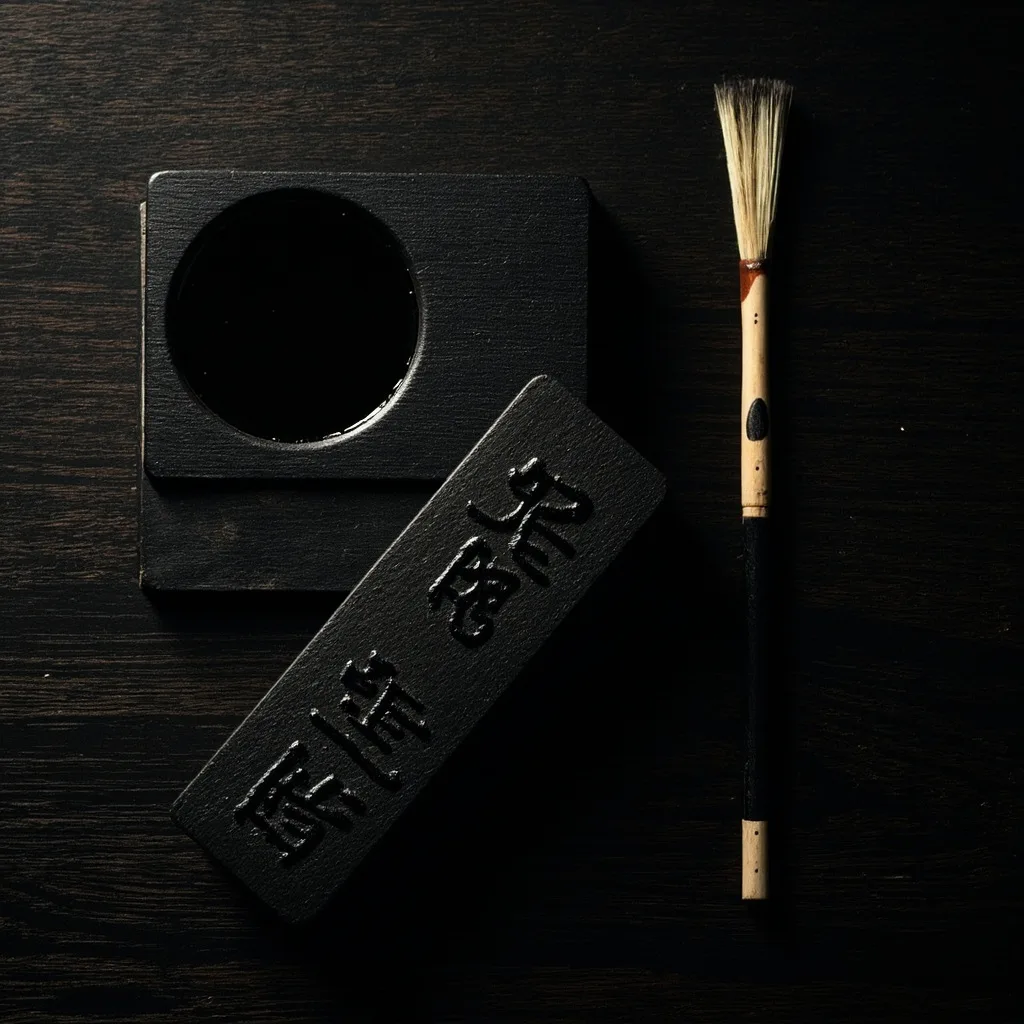
If this article has made you curious, here are a few places to start. A workable Chinese calligraphy setup requires four traditional items — collectively called the Four Treasures of the Study (文房四宝, wenfang sibao): brush, ink, paper, and inkstone. Modern students also use a felt mat and a water dish. None of these have to be expensive to begin with.
- Beginner’s Chinese Calligraphy Brush Set — A decent starter kit will include a wolf-hair brush for regular and running script (the kind Wang Xizhi would have used) and a softer goat-hair brush for thinner strokes. Sizes between 3 and 5 cm tip length work for the Lantingji Xu.
- Sumi Ink Stick (Suzhou or She ink) — The traditional form is a solid stick you grind against an inkstone with water. The stick-vs-liquid choice is a personal one; sticks produce deeper, more controllable black, and the grinding itself is meditative.
- Xuan Paper (rice paper) for calligraphy — The other half of the materials puzzle. Xuan paper absorbs ink in a particular way that determines the look of your strokes. For beginners, the medium-absorption “shu xuan” (熟宣) gives a clean line and is forgiving.
- Chinese Inkstone for grinding sumi ink — Inkstones are simple, last basically forever, and improve with use. A small round one is sufficient for practice.
- Felt Mat for Calligraphy (35x70cm or larger) — Protects your table, holds a tiny bit of moisture under the paper, and gives your arm a softer surface to write on. Not strictly traditional but every modern studio uses one.
When you are ready to copy the Lantingji Xu itself, you’ll want a good reproduction of a single-character calligraphy dictionary that includes it, or — better — a full-length high-quality image of the Shengjiao version. Search for “兰亭序 Shengjiao” and you will find museum reproductions at most large calligraphy-supply shops. Then you do what Chinese students have done for fifteen centuries: copy the first character, then the second, then the third. Take your time. Wang Xizhi did it in one sitting. You are allowed to take months.