There’s a famous story about a Chinese emperor so obsessed with a particular piece of calligraphy that he had his court clerks make copies of it obsessively — not for administrative purposes, but because the original was considered too precious to handle. The document in question was written by a man named Wang Xizhi (王羲之, 303–361), and the emperor was trying to get as many versions of it into circulation as possible, as if spreading copies around could somehow preserve the original. This was the kind of reverence Chinese culture has long reserved for works that combine technical mastery with something harder to define — personality, breath, aliveness.
Wang Xizhi is called the Sage of Calligraphy (书圣), which sounds like a formal honorific but actually reflects how genuinely astonished Chinese scholars have been by his work for seventeen centuries. He didn’t invent Chinese writing, obviously. But he did something that scholars compare to what Shakespeare did for English: he found forms within existing structures that felt both natural and inevitable, and everyone who came after him either imitated him or defined themselves in opposition to him.
A Life Lived Near the Water
Wang Xizhi grew up in the town of Luyang, in present-day Zhejiang province, during the Eastern Jin period — a time when the great Chinese empires had fractured and the capital had moved south, to what is now Nanjing. His family was aristocratic and well-connected: his father was a calligrapher, his uncle had been a famous official, and the household was full of people who cared about brushwork, literature, and the proper way to hold a conversation.
As a boy, Wang Xizhi practiced calligraphy obsessively. The story goes that he would practice in the morning, at lunch, and in the evening — at the river, under a tree, in his study — and that his family eventually ran out of paper because he had used so much of it. He studied the work of earlier calligraphers, particularly a famous Han dynasty writer named Zhong Yao, whose style was precise and angular. Wang Xizhi absorbed that foundation, then slowly moved away from it, developing something more flowing and expressive.
He became a minor government official and later served as a right general in the Jin army — posts that didn’t particularly interest him compared to calligraphy and Daoist philosophy. He was known for being quiet and somewhat melancholy, the kind of person who preferred a walk in the mountains to a banquet. He also famously refused to write calligraphy on command, which sounds like diva behavior but was actually considered a mark of artistic integrity: he wrote when he was moved to, not when someone demanded it.
The Orchid Pavilion and the Most Important Calligraphy Ever Written
In 353 AD, Wang Xizhi hosted a gathering at the Orchid Pavilion (兰亭), a scenic spot near present-day Shaoxing, Zhejiang, where forty-two scholars had come together for what’s called the Orchid Pavilion Gathering. This was a literary event: the group would drink wine, write poems, and discuss Daoism. To make things more interesting, Wang Xizhi had cups of wine float downstream, and whenever a cup stopped in front of someone, that person had to write a poem or drink a penalty. By the end of the day, thirty-seven poems had been composed.
Wang Xizhi was so moved by the event that he wrote a preface to the poetry collection — a short piece of text that he calligraphed onto the manuscript. This preface, known as the Orchid Pavilion Preface (兰亭序), is considered the single greatest work of Chinese calligraphy ever produced. It’s the piece that the emperor was so desperate to preserve.
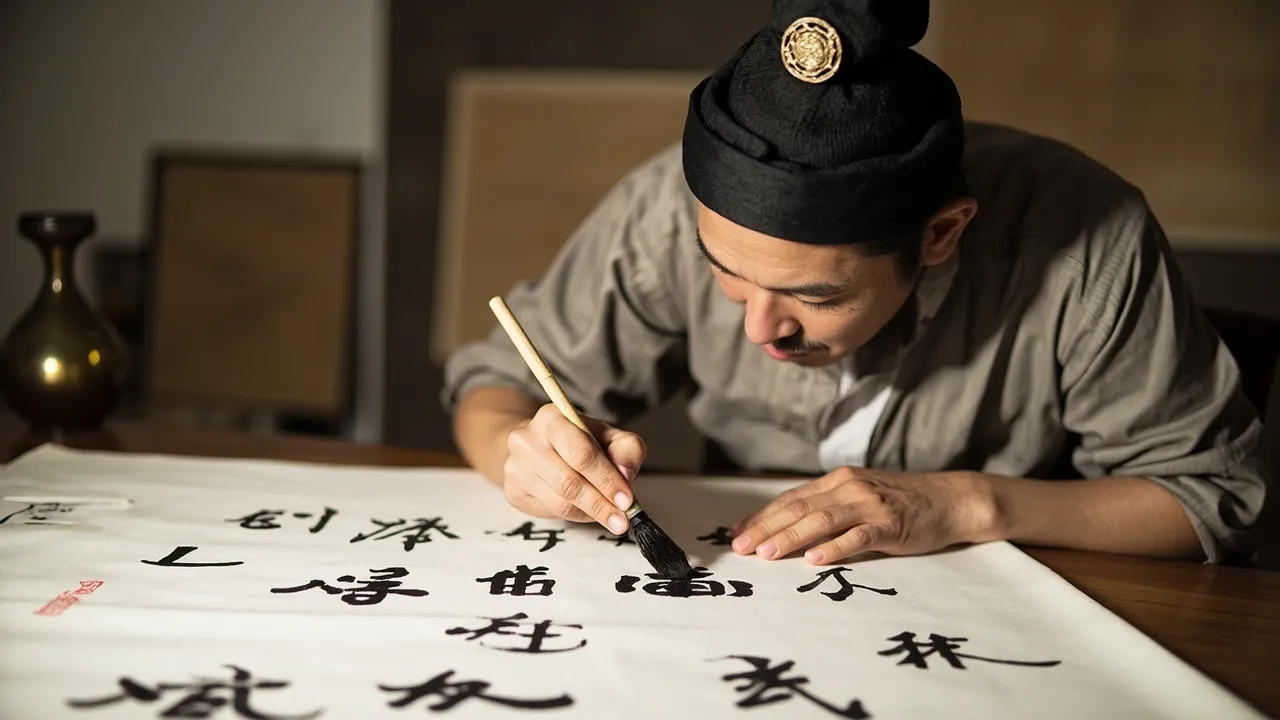
The story behind its creation is part of why it’s so revered. Wang Xizhi reportedly wrote it in a single sitting, slightly drunk, and when he woke up the next morning and tried to copy it again, he couldn’t match the original. The famous characters “之” (zhī, meaning “of” or the grammatical particle) appear in the text twenty times, and no two look alike — each one has a slightly different energy, a different weight, a different relationship to the paper. This is what calligraphers mean when they talk about a piece having qi (breath, spirit): not uniformity, but vitality.
Why His Work Changed Everything
Before Wang Xizhi, Chinese calligraphy was understood primarily as a way of recording language clearly and attractively. The best practitioners were those who could produce neat, regulated characters efficiently. After Wang Xizhi, the standard changed: the goal became expressing the calligrapher’s inner state through the movement of the brush. His characters are not perfectly uniform. They lean and stretch, open and close, accelerate and slow down. You can feel the moment of the brush on paper, the hesitation, the release.
This sounds abstract, but it’s exactly what happened with his influence. Later calligraphers — and there were many, all the way down to the Qing dynasty and beyond — organized themselves largely in relation to him. Some tried to reproduce his style exactly, building entire careers around copying the Orchid Pavilion Preface. Others reacted against him, preferring something more angular or more austere. But everyone started from the question he seemed to raise: what should calligraphy express, and how?
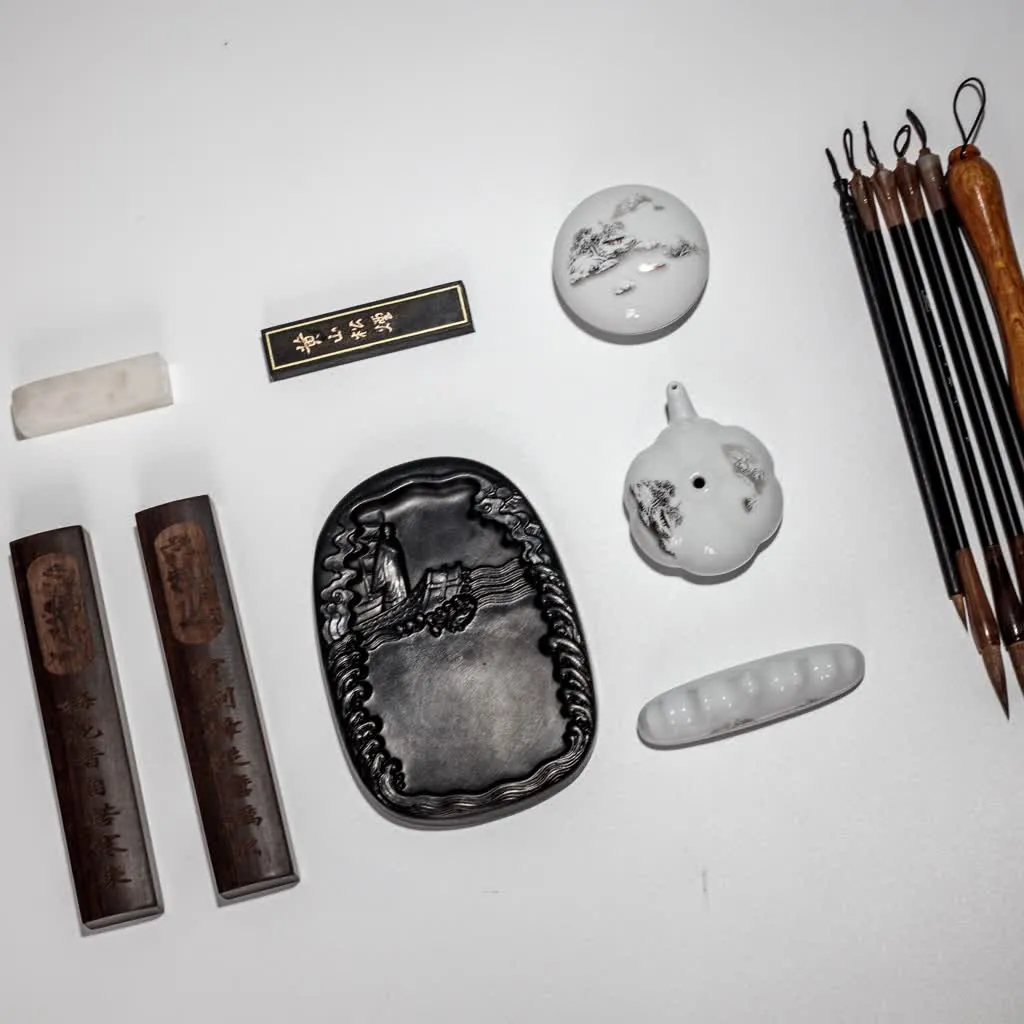
The Four Treasures of the Study — the brush, ink, paper, and inkstone that Chinese scholars used — became central to Chinese culture partly because of figures like Wang Xizhi. When the tools matter that much, and when the act of using them can produce something as transcendent as the Orchid Pavilion Preface, the entire practice takes on a different weight. Calligraphy wasn’t just writing. It was philosophy, meditation, and self-expression rolled into a single gesture.
What Survives Today
Few original Wang Xizhi works survive. Most of what we have are Tang dynasty copies made by skilled artisans who dedicated their lives to preserving his style. The Orchid Pavilion Preface exists in several versions, the most famous of which is attributed to Feng Chengsu, a Tang dynasty calligrapher who made a version so faithful to the original that scholars argue about whether it or a slightly different version is closer to Wang Xizhi’s actual hand.
The original preface, whatever it looked like exactly, was reportedly buried with a Chinese emperor — one of several emperors who were so reverential toward Wang Xizhi’s work that they refused to let it circulate. This is both flattering and frustrating: flattering because it shows how seriously they took calligraphy as an art, frustrating because the world will never know exactly what the original looked like.
Wang Xizhi’s seventh son, Wang Xianzhi, also became a celebrated calligrapher, and the tradition of father-to-son transmission in Chinese calligraphy — a kind of informal guild within families — runs directly from Wang Xizhi through subsequent generations. Several families claimed descent from him specifically because that lineage implied access to a living tradition of his style.
The Museum That Remembers Him
In Shaoxing, Zhejiang, you can visit the former site of the Orchid Pavilion. The original pavilion is long gone, but a reconstruction stands near a river, surrounded by bamboo and plum trees. The area is deliberately tranquil — the kind of place where you can imagine forty-two scholars drinking wine, writing poems, and occasionally looking up from their work to watch the river move. There’s a museum nearby with reproductions of the Orchid Pavilion Preface, and visitors who know calligraphy well sometimes stand in front of them for a very long time, reading not just the characters but the space between them.
It’s one of those places where history presses close. Everything else in Chinese culture — the poetry, the painting, the emphasis on mastery and transmission — seems to flow through a moment like the one Wang Xizhi described in his preface: people gathered, wine shared, poems written, youth fading, the mountain remains, the water flows, and somehow, briefly, everything feels complete.