The White Snake Legend: Love, Betrayal, and the Path to Redemption
Few stories in Chinese mythology carry the emotional weight of the White Snake Legend (白蛇传). Over the course of this epic tale — which unfolds across multiple lifetimes, involves demonic powers, romantic devotion, and a prison that seems to have no bottom — we follow a snake spirit who chooses to become human for love, and who must pay an almost incomprehensible price for that choice. It’s a story about what it means to want something so badly that you’re willing to become someone else entirely to get it, and about whether that kind of transformation can ever truly be complete.
The White Snake, known as Bai Suzhen (白素贞) in most versions, is one of the most complex figures in Chinese folklore. She’s not a hero in the traditional sense — she’s a demon who has learned to love, a predator who has chosen to protect, and a woman who discovers that being human means feeling things that no amount of ancient wisdom can prepare you for. Her story asks uncomfortable questions about the nature of identity, the possibility of change, and whether those who have done terrible things can ever truly be forgiven.
The Snake Spirit Who Wanted to Be Human
The story begins on Mount Emei, one of the Four Sacred Buddhist Mountains of China, where two snake spirits had lived for a thousand years, cultivating their powers and aspiring to something more than their serpentine existence. The white snake, known simply as White Snake (白蛇), was the elder and more powerful of the two. The green snake, called Xiao Qing (小青) or Small Green, was her faithful companion and sworn sister.
These weren’t ordinary snakes. Through centuries of meditation and spiritual practice, they had developed remarkable abilities — the power to shapeshift, to fly, to command certain elemental forces. White Snake in particular had grown so powerful that she could assume fully human form, complete with all the appearance and behavior of a mortal woman. She had also, according to some versions of the tale, developed something far more dangerous: genuine human emotions.
One day, White Snake and Small Green descended from their mountain to experience the mortal world below. They took human form — White Snake as a beautiful young woman in white robes, Small Green as her maid — and wandered into the city of Hangzhou, one of the most beautiful cities in ancient China. What they found there changed everything.
At a place called Broken Bridge (断桥), White Snake encountered a young scholar named Xu Xian (许仙). He was handsome, kind, and utterly ordinary — the kind of man you’d walk past without a second glance if you passed him on the street. But something about him caught White Snake’s attention. Perhaps it was his gentle manner, his obvious kindness to others, or simply the fact that he treated the world with a warmth that White Snake, for all her centuries of existence, had never quite encountered before.
The two began to talk. White Snake, using her powers of persuasion and her newly awakened capacity for genuine human connection, arranged to meet Xu Xian again. Within weeks, they had fallen deeply in love. Within months, they were married.
A Love Built on Secrets
For a time, the marriage was everything White Snake could have hoped for. She and Xu Xian settled in Hangzhou, where Xu Xian established a modest medical practice with his friend and fellow doctor. White Snake proved to be an exceptional wife — gracious, intelligent, and deeply devoted to her husband. She managed the household with supernatural efficiency, entertained guests with supernatural grace, and loved Xu Xian with an intensity that, for all her centuries of existence, she had never felt before.
The only thing standing between them was White Snake’s secret. She had never told Xu Xian what she really was. She had presented herself as a noblewoman whose family had fallen on hard times, and Xu Xian, trusting and in love, had accepted this story without question. The lie hung over their marriage like a cloud, but White Snake told herself that it didn’t matter — she loved him, she would protect him, and surely that was what counted.
But secrets in Chinese mythology have a way of surfacing, and this one was no exception.
The trouble began when White Snake and Xu Xian encountered a Buddhist monk named Fahai (法海) at a temple festival. Fahai was a monk of extraordinary spiritual power, and the moment he laid eyes on White Snake, he recognized what she was. A snake spirit, living among mortals, married to a human man — to Fahai’s mind, this was an abomination that could not be allowed to continue.
Fahai began to watch the couple. He observed White Snake’s supernatural abilities — the way she could summon servants from thin air, the way she seemed to know things she couldn’t possibly know. He collected evidence, biding his time, waiting for the right moment to expose her.
The Truth Revealed
That moment came during the famous Duanwu Festival (端午节), the Dragon Boat Festival, when the Chinese tradition of驱邪 — expelling evil spirits — reached its annual peak. Families burned special herbs and performed rituals designed to drive away demons and malevolent spirits. The air was thick with the smell of realgar wine, a traditional protective drink that, in the mythology of the story, was toxic to snake spirits.
White Snake, trying to maintain appearances, sat down to dinner with Xu Xian and drank some of the realgar wine. Almost immediately, she began to feel the effects — centuries of spiritual power couldn’t fully protect her from the concentrated anti-demonic properties of the traditional remedy. She became dizzy, sick, and eventually collapsed.
Xu Xian, terrified for his wife, did what any devoted husband would do: he sent for the best doctors he could find. When they couldn’t help, he became desperate. In his desperation, he remembered the monk Fahai, who had seemed so knowledgeable about spiritual matters. He went to Fahai and begged him to help his wife.
Fahai saw his opportunity. He told Xu Xian that his wife was not a woman at all, but a snake spirit in human form. He showed Xu Xian a vision of White Snake’s true serpentine nature, and he gave the young scholar a magical fan to use against her.
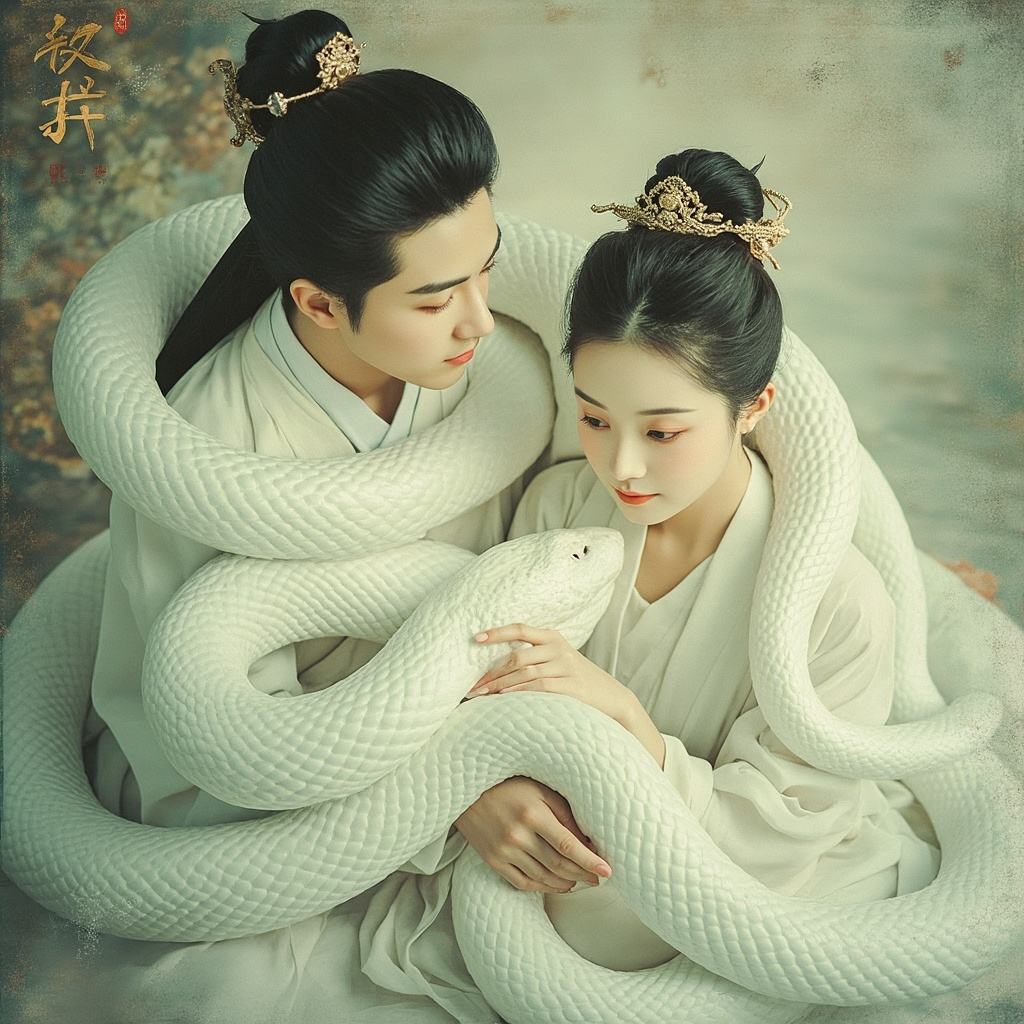
When Xu Xian returned home and saw his wife struggling with the effects of the realgar wine, he hesitated for only a moment. Then, following Fahai’s instructions, he raised the fan and fanned his wife with it. The magical power struck White Snake like a thunderbolt, and in her weakened state, she was forced to reveal her true form — a massive white python that coiled around the room, terrifying Xu Xian into a dead faint.
The Imprisonment Under the Leifeng Pagoda
What happened next depends on which version of the story you’re reading, but the broad strokes are consistent across all versions. White Snake, having been exposed and defeated, was captured by Fahai and imprisoned. The location of her imprisonment varies — in some versions, it’s under a lake; in others, it’s in a cave beneath a mountain. But the most famous version places her under Leifeng Pagoda (雷峰塔) — the Thunder Peak Pagoda — on the shore of West Lake in Hangzhou.
Leifeng Pagoda became one of the most iconic symbols of the White Snake legend. In the story, Fahai sealed White Snake beneath the pagoda, where she would remain imprisoned for thousands of years. The pagoda itself was said to have been built specifically for this purpose — a magical prison designed to hold a creature of White Snake’s power.
But the story doesn’t end with White Snake’s imprisonment. There’s still Xu Xian, and there’s still Small Green.
Xu Xian, after his shock and terror faded, found that he couldn’t stop loving his wife. The revelation of her true nature didn’t change what they had shared — the kindness, the companionship, the genuine love that had grown between them over years of marriage. He had children with her before her imprisonment, and those children — particularly a son named Xu Huilian (许翰林) who grew up to become a scholar-official — kept the memory of White Snake alive even as the years passed.
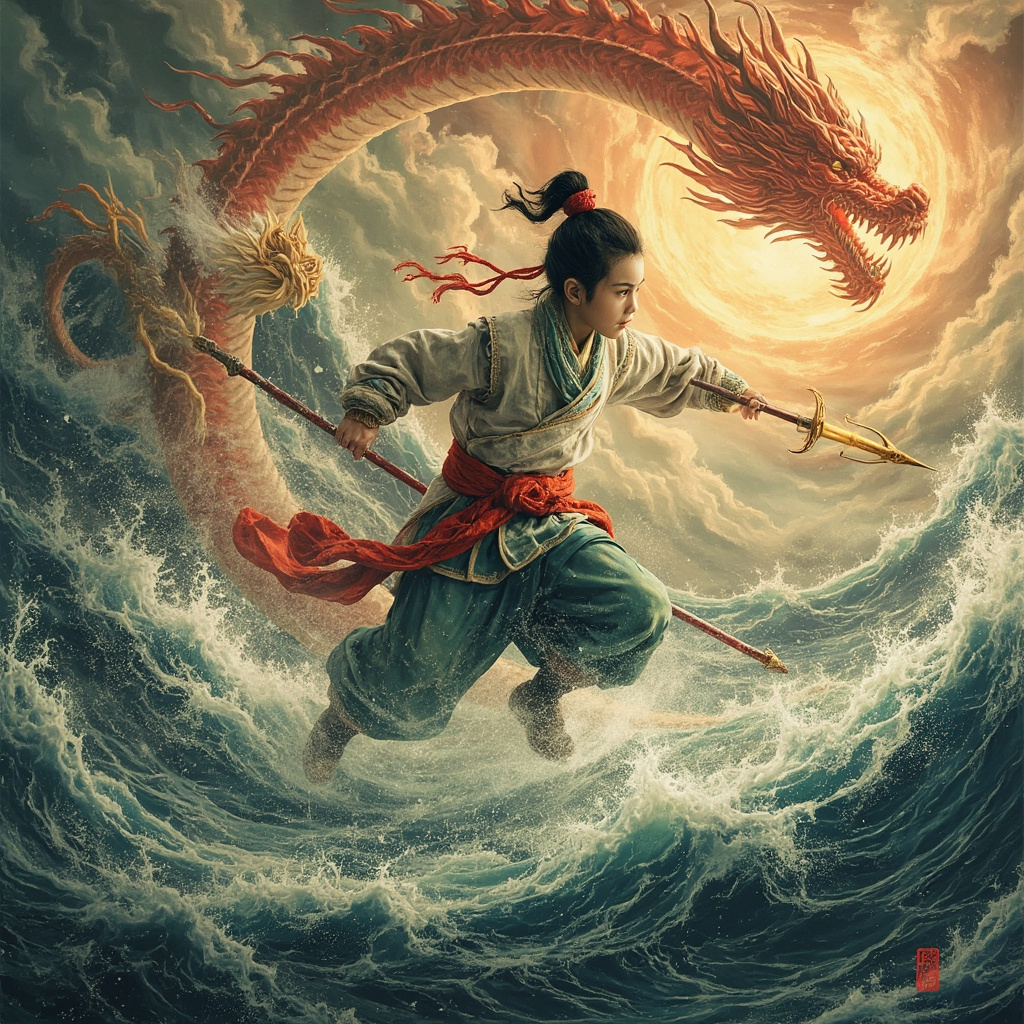
And then there was Small Green. The green snake spirit, who had been White Snake’s companion and confidante for centuries, was furious at Fahai’s betrayal and at the imprisonment of her sworn sister. She threw herself into martial training, developing her supernatural powers to their absolute maximum. Eventually, she returned to challenge Fahai directly, fighting him in an epic battle that shook the heavens.
The Final Reckoning and Redemption
The White Snake legend has been told in so many different versions over the centuries that its ending varies significantly depending on which tradition you follow. In some versions, Small Green defeats Fahai and frees her sister. In others, White Snake is eventually released through a combination of her own spiritual progress and the accumulated merit of her descendants. In some versions, the story ends tragically, with White Snake remaining imprisoned forever, a cautionary tale about the dangers of loving mortals.
But perhaps the most satisfying version is the one where redemption comes — not easily, and not without cost, but genuinely. In this version, White Snake’s centuries of imprisonment are finally ended when her son Xu Huilian, now a high-ranking official, discovers the truth about his mother’s history and her unjust imprisonment. He appeals to the Buddha himself, arguing that his mother had repented of her demonic origins and had lived a genuinely virtuous life as a human being. His appeal is supported by the accumulated merit of her good deeds — her kindness, her charity, her genuine love for her husband and children.
The Buddha, moved by this argument, agrees to release White Snake from her imprisonment. The Leifeng Pagoda collapses, and White Snake emerges — not as a snake spirit, but as a fully realized human soul, transformed by centuries of suffering and contemplation into something entirely new. She is reunited with Xu Xian, who has been waiting for her in the afterlife, and together they ascend to a higher realm, no longer mortal but no longer demonic either — something in between, something that the rigid categories of Chinese cosmology had never quite anticipated.
Why the White Snake Legend Endures
The White Snake’s story has resonated with Chinese audiences for centuries precisely because it grapples with questions that remain relevant regardless of when or where you live. Can someone change who they truly are? Can a being born into one identity — whether that identity is “demon,” “outcast,” or simply “person from the wrong side of the tracks” — truly become something else through the force of love and will? And if they can, does society have an obligation to accept that transformation, or is the original identity always waiting to reclaim them?
White Snake chooses to become human, and she pays an almost unimaginable price for that choice. But she never backs down, never asks to be returned to her former state, never regrets the love that led her down this path. She is, in her own way, one of the most feminist figures in Chinese mythology — a woman who makes an impossible choice and then spends centuries defending it.
At the same time, the story doesn’t pretend that her choice was without consequences for others. Xu Xian’s life is upended by the revelation of her true nature. Their children grow up with a mother in prison. The cost of White Snake’s transformation ripples outward in ways she couldn’t have anticipated, and the story is honest about that weight.
Products Related to the White Snake Legend
If this story has captured your imagination, here are some ways to explore the White Snake legend further:
1. The Legend of the White Snake (Bai She Zhuan) — The original Chinese literary version of the story, available in both classical Chinese and modern translations.
2. White Snake Feng Shui Ornament — A decorative piece featuring the iconic White Snake imagery, popular in Feng Shui traditions for its associations with transformation and renewal.
3. Chinese Fantasy Romance Novels — A collection of novels in the tradition of the White Snake story, exploring love between humans and supernatural beings.
4. Serpent Dragon Statue Collection — Handcrafted statues depicting serpent-dragon figures from Chinese mythology, including the White Snake in her majestic true form.
5. Traditional Chinese Medicine and Mythology Book — An exploration of the connection between Chinese medical traditions and mythological beliefs, including the realgar wine and spiritual remedies mentioned in the White Snake story.
Last updated: 2026-01-20