Wing Chun: The Scientific Art of Close-Quarter Combat
When Bruce Lee burst onto the Hollywood scene, millions of viewers wanted to know about the martial art that had shaped his devastatingly efficient fighting style. That art was Wing Chun (also spelled Ving Tsun), a Chinese fighting system that emphasizes efficiency, economy of motion, and directness. Though it lacks the flashy kicks or spinning techniques of some other styles, Wing Chun has proven itself remarkably effective in real confrontations.
What makes Wing Chun special lies in its underlying philosophy: why waste energy on elaborate movements when a simple, direct technique will work better? This pragmatic approach attracts practitioners who prefer substance over style—and it has produced some of the most feared fighters in martial arts history.
The Origins and Legend
The founding story of Wing Chun involves a woman named Yim Wing Chun, who supposedly lived during the Ming Dynasty (around the seventeenth century). According to legend, a warlord was forcing young women to marry him, and Yim Wing Chun refused. A Buddhist nun named Ng Mui took pity on her and taught her a special fighting system, which Yim Wing Chun used to defeat the warlord’s champion. She then passed the system to her descendants, eventually establishing the name “Wing Chun.”
While modern historians debate these exact details, they generally agree that Wing Chun emerged from the southern Chinese martial arts tradition, likely in the Guangdong region. The system passed down through generations of dedicated practitioners until it gained worldwide attention through Grandmaster Ip Man, who taught it in Hong Kong and eventually spread it globally through his famous student Bruce Lee.
Centerline Theory: The Heart of Wing Chun
Understanding Wing Chun requires grasping one fundamental concept: the centerline. This invisible vertical line runs from the top of your head straight down through your body to the ground. Every important target on an opponent’s body—eyes, nose, throat, chest, solar plexus, groin—lies along or very close to this line.
Wing Chun practitioners obsessively protect their own centerline while aggressively attacking their opponent’s. The hands never cross this line unnecessarily, and every technique aims to control or destroy the opponent’s centerline. This principle simplifies decision-making during combat: forget about elaborate combinations—just control the centerline and strike down it.
From this single concept flows much of Wing Chun’s distinctive structure. The stance is narrow and upright rather than wide and rooted, allowing quick forward movement along the centerline. The hands maintain a high guard position protecting the face and chest, with elbows kept close to the body. Everything supports rapid, direct attacks along the shortest path between you and your opponent.
The First Form: Siu Nim Tao
Every Wing Chun student begins with Siu Nim Tao (sometimes spelled Siu Lim Tao), which translates roughly as “Little Idea Form” or “Small Beginning Form.” This deceptively simple exercise—comprising just a few basic movements performed repeatedly—forms the foundation of the entire system.
At first glance, Siu Nim Tao appears almost too basic to matter. Students stand in a particular stance, keep their arms in specific positions, and perform a simple forward “punch” called a “tan sau” with minimal apparent movement. Yet experienced teachers spend months, sometimes years, on this form before allowing students to progress. The form develops proper structure, builds the specific muscles used in Wing Chun, and trains the “sticky hands” sensitivity that advanced practitioners develop.
The drilling movements in Siu Nim Tao teach the body to move efficiently without telegraphing intentions. The wrist stays straight, the shoulder remains relaxed, and the power generates from the legs and core rather than the arm. Bad habits learned here will plague practitioners forever, which is why serious schools emphasize this form so thoroughly.
As students advance, they discover hidden depths within Siu Nim Tao. What seemed like a simple punch contains complex power generation. The “lat sao” (pulling hand) teaches simultaneous attack and defense. The stationary movements prepare the body for dynamic application. Teachers often say that even masters continue discovering new insights in this first form—there’s always another layer to explore.
Chi Sau and the Development of Reflexes
After mastering Siu Nim Tao, students move on to Chi Sau (literally “sticky hands”), a paired drilling exercise that develops the reflexes essential to Wing Chun’s close-range fighting. Unlike sparring, which often devolves into exchanged blows, Chi Sau trains specific responses to specific situations while developing sensitivity to an opponent’s intentions.
During Chi Sau, practitioners stand in contact and continuously exchange techniques. One person attacks, the other defends and counters, then roles reverse. The goal isn’t to “win” but to develop automatic responses. A well-trained Wing Chun practitioner’s hands seem to have their own intelligence—they find openings, deflect attacks, and counter without conscious thought.
The “rolling hands” drill represents the core Chi Sau exercise. Partners alternate controlling each other’s arms in a circular motion while searching for opportunities to strike. The contact allows reading the opponent’s intentions through pressure, tension, and movement. Advanced practitioners can determine where an opponent will strike before they even initiate the movement—sensing the intention through physical contact.
This sensitivity training separates Wing Chun from purely physical martial arts. The goal isn’t stronger muscles or faster reflexes (though those develop too) but rather an intuitive understanding of combat that transcends conscious thought. In a real confrontation, there’s no time to think—only time to react. Chi Sau builds those lightning-fast, accurate reactions.
Practical Application and Training Methods
Wing Chun’s training progression moves systematically from forms to drills to sparring. After Siu Nim Tao comes Chum Kiu (the “seeking form”), which introduces movement, turning, and the concept of “center bridging”—closing the distance to an opponent. The third form, Biu Jee (the “throwing fingers form”), deals with recovery from compromised positions and extreme close-range combat.
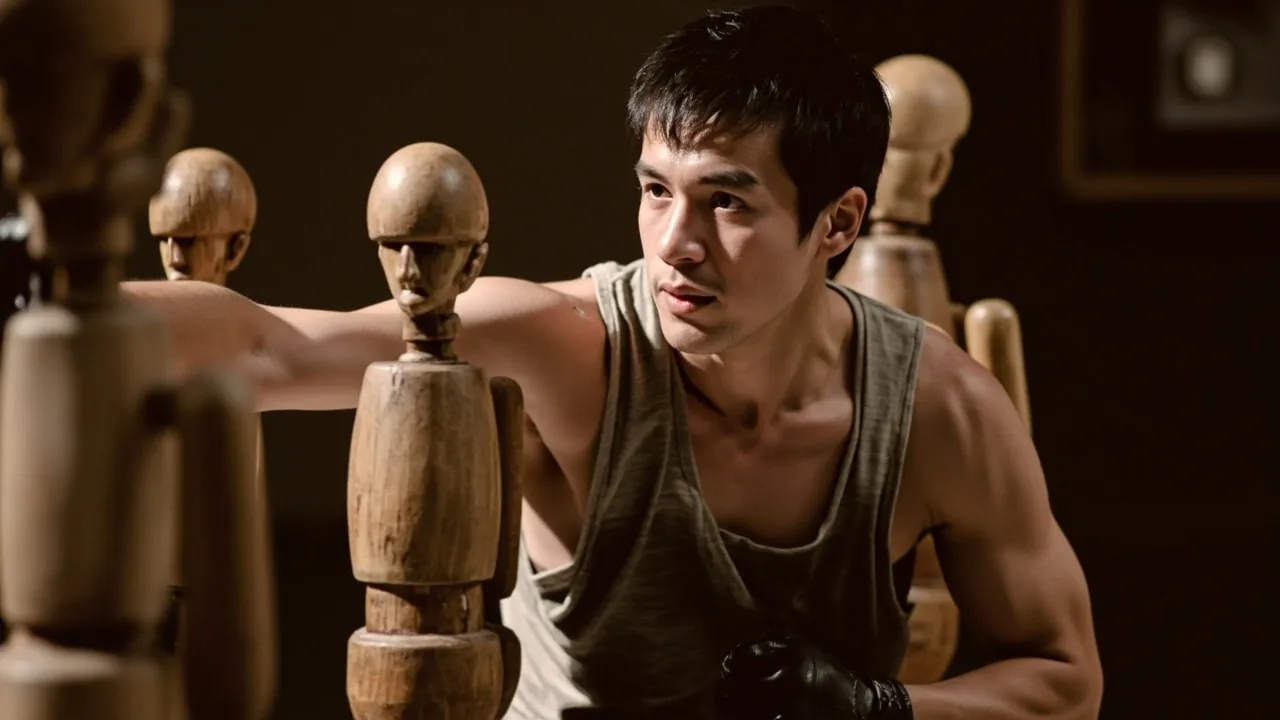
Luk Dim Boon Gwan (the “six-and-a-half point pole”) trains with a wooden dummy, developing power, accuracy, and timing. The single-ended wooden stick (butterfly swords) trains blade handling principles. Each training tool reinforces principles learned in the forms while adding practical combat application.
Sparring in Wing Chun focuses on close-range work. Practitioners wear minimal protective gear and engage in controlled exchanges emphasizing the techniques learned through Chi Sau. The goal isn’t knockout power but rather developing the ability to flow seamlessly between defense and offense at contact range.
Modern Wing Chun schools vary considerably in their training emphasis. Some focus primarily on the forms and Chi Sau, viewing combat application as a natural extension. Others incorporate kickboxing, wrestling, or other arts to prepare students for mixed-range encounters. Still others maintain the traditional approach, trusting that the core principles, properly mastered, handle any situation.
Why Modern Fighters Choose Wing Chun
In an era of mixed martial arts competitions and practical self-defense concerns, Wing Chun attracts practitioners seeking demonstrably effective techniques. The art’s emphasis on economy—minimum effort for maximum effect—appeals to people who don’t want to spend decades developing physical attributes they may not naturally possess.
The close-range focus addresses a reality that many martial arts ignore: most real fights happen at very close distance, often ending up in grappling range within seconds. Wing Chun specifically trains for this scenario, developing skills that transfer directly to these encounters. The “pak sau” (slapping block), “tan sau” (palm up block), and continuous punching combinations become automatic under pressure.
Bruce Lee’s success brought attention to Wing Chun, but it was his demonstration of the art’s effectiveness that convinced skeptics. His speed, power, and economy of movement reflected Wing Chun principles taken to their logical conclusion. Modern MMA fighters have incorporated Wing Chun concepts—particularly the centerline theory and close-range trapping—into their arsenals, further validating the system’s practical value.
Whether your interest lies in effective self-defense, competitive fighting, or simply exploring a fascinating martial tradition, Wing Chun offers a uniquely practical approach. The path demands patience and dedicated practice, but the rewards include genuine combat capability developed through scientifically sound training principles.