Wu Gang Felling the Osmanthus: The Man Condemned to Eternal Labor on the Moon
Look up at the full moon on a clear night, and if you squint just right, you might make out a dark shape on its surface — a tree, the old stories say, with a single figure moving around it in endless, futile motion. That figure is Wu Gang (吴刚), a man who made one terrible mistake so long ago that even the mountains have changed shape since, and who has spent eternity paying for it in the loneliest workplace in the cosmos.
The legend of Wu Gang Felling the Osmanthus (吴刚伐桂) is one of Chinese mythology’s most quietly devastating tales. Unlike stories of great battles, cosmic wars, or heroic sacrifices, this is a story about the weight of a single choice and how the universe can make you live with it forever. There are no villains to defeat, no princesses to rescue, no treasure to win. Just a man, a tree, and an axe that will never finish its work.
The Man Who Wanted Immortality
Wu Gang was, by most accounts, a woodcutter who lived during the Xia Dynasty — one of the earliest periods in Chinese legendary history, roughly four thousand years ago. He was a skilled forester who made his living in the mountains, cutting timber and firewood for the villages below. He was also, according to some versions of the story, something of a braggart, a man who liked to boast about his strength and his ability to fell any tree with a single stroke.
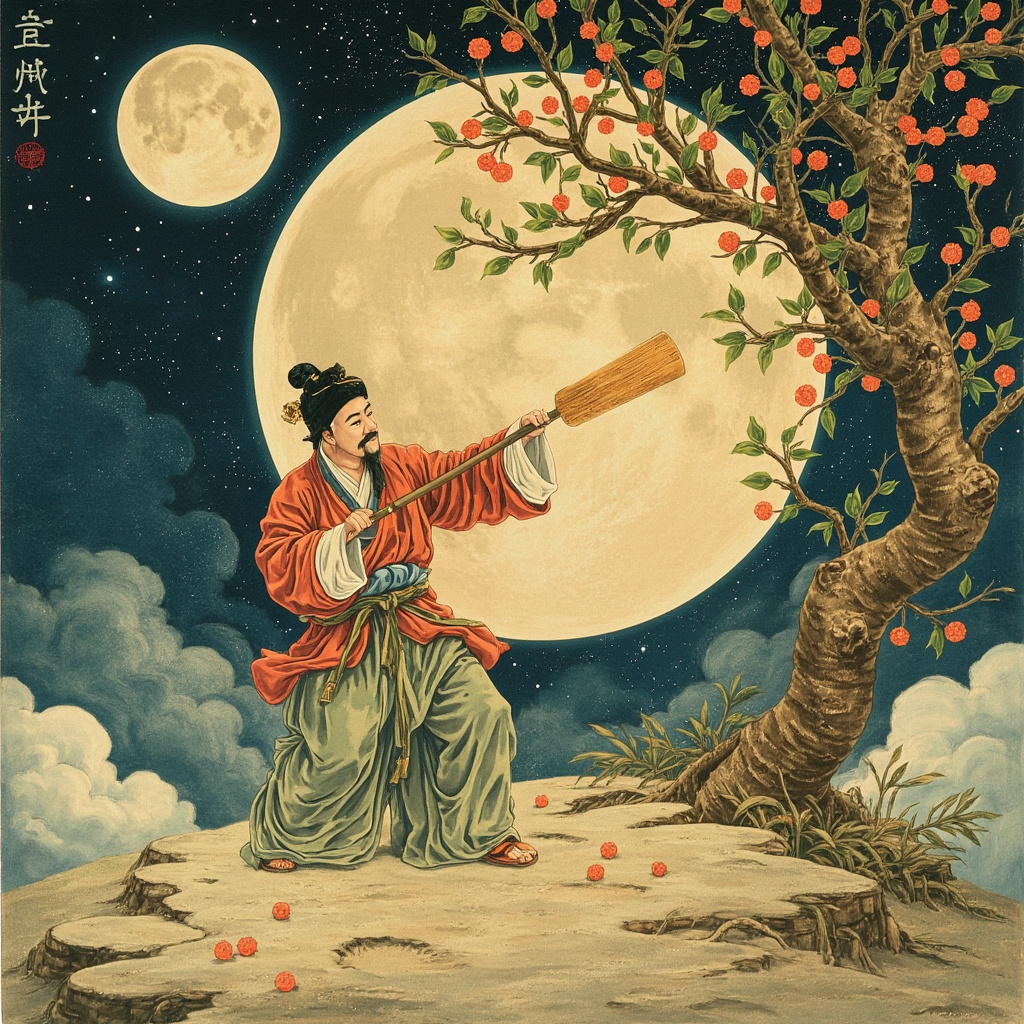
One day, while gathering wood in a remote mountain valley, Wu Gang encountered something extraordinary: an osmanthus tree of impossible size and beauty, its trunk wider than a house and its branches stretching toward the sky like grasping arms. The tree smelled extraordinary — its blossoms released a fragrance that seemed to carry the essence of autumn itself, sweet and melancholic all at once. Wu Gang, never one to pass up a challenge, raised his axe and swung with all his might.
The axe bit deep into the trunk. But when Wu Gang pulled it out to strike again, something astonishing happened: the wound had already healed. The osmanthus tree was already knitting itself back together, as if Wu Gang’s axe strike had never happened at all.
Wu Gang, being Wu Gang, didn’t give up. He swung again. And again. Day after day, he returned to the tree and swung his axe, watching the wounds seal themselves shut the moment his blade left the bark. He was, in a sense, the world’s first fool caught in an eternal loop — too stubborn to quit, too strong to fail, but caught in a task that could never be completed.
The Immortal Tree and the Divine Punishment
What Wu Gang didn’t know — what he couldn’t have known — was that this wasn’t an ordinary tree. The osmanthus tree of the moon (月桂) was a divine creation, planted by the goddess Chang’e herself, or in some versions by the great cosmic architect Lu Ban. It was one of the most sacred objects in the heavens, a tree whose roots reached down into the very fabric of the cosmos and whose branches held up the silver light of the moon itself.
The tree was designed to be unkillable. Every time an axe bit into it, a mysterious divine energy closed the wound before the next blow landed. The tree could be wounded, but it could never be felled. Its wood was infused with the essence of the moon — the same cool, silver light that poured down on the world each night — and that essence made it eternally regenerative.
Wu Gang’s persistence caught the attention of the celestial court. The Jade Emperor, ruler of the heavens, looked down from his jade throne and observed this mortal woodcutter attacking the most sacred tree in existence with a determination that bordered on madness. Most mortals would have given up after the first day. Wu Gang had been at it for what seemed like weeks, never stopping, never resting, his arms aching and his pride refusing to let him quit.
The Jade Emperor saw something useful in Wu Gang’s stubbornness. Rather than simply zapping the woodcutter into oblivion for his transgression — which would have been the conventional divine punishment — the Emperor devised something far more cruel and creative. He would give Wu Gang exactly what he claimed to want: a chance to cut down the osmanthus tree. But he would make it impossible.
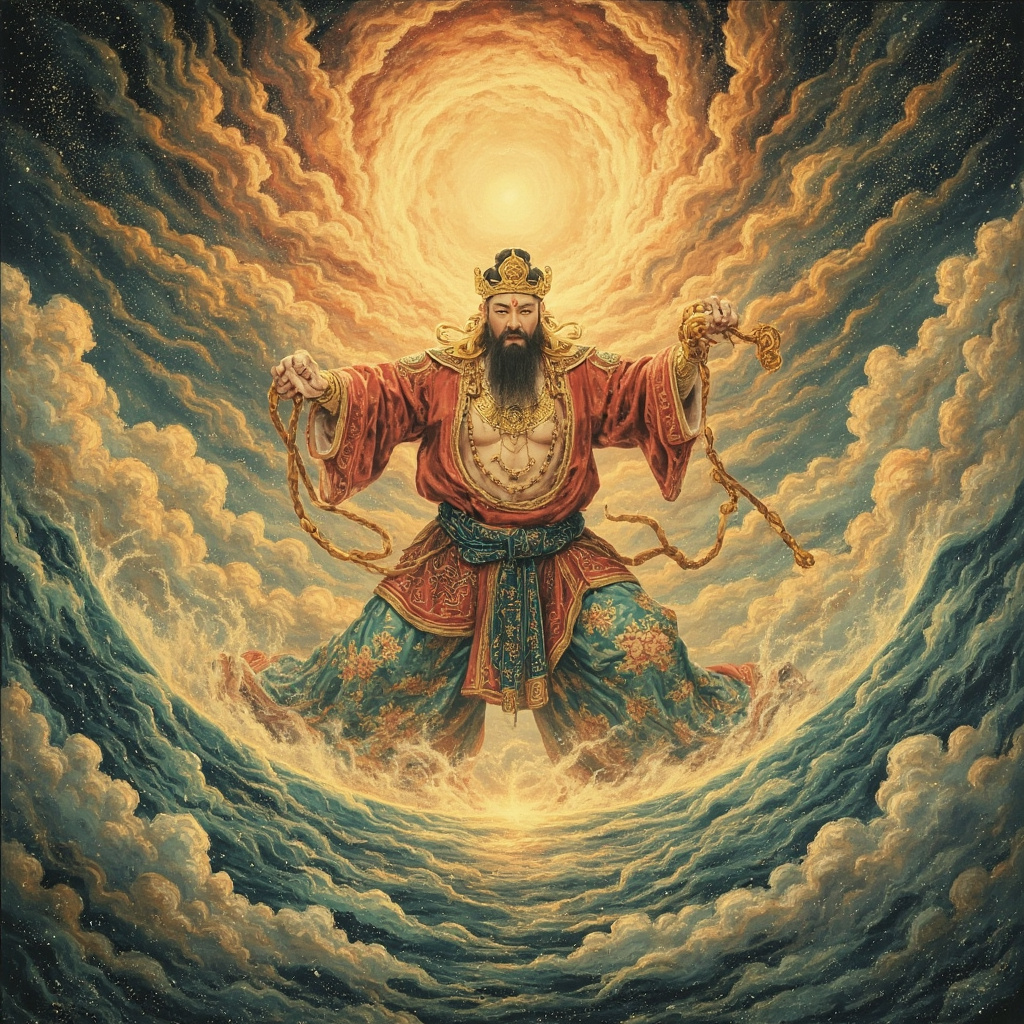
The Emperor summoned Wu Gang to the heavens and appeared before him in all his cosmic majesty. He informed Wu Gang that his axe strikes against the sacred osmanthus were an act of sacrilege punishable by death. However, the Emperor offered him an alternative: he could avoid death by successfully felling the osmanthus tree on the moon.
Wu Gang, never the smartest man in any room, accepted the challenge immediately. He didn’t realize he was walking into an eternal prison disguised as a task.
The Eternal Swing
From that day forward, Wu Gang was transported to the moon and set to work on the great osmanthus tree. He swung his axe with all the strength that had made him legendary among the mountain villages. He struck the trunk once, twice, a hundred times, a thousand times. Each time, the wound healed before his next swing. The tree stood as strong as ever, its silver leaves rustling in the moon’s eternal silence.
The punishment was elegant in its cruelty. Wu Gang wasn’t being asked to do the impossible — he was being forced to do the eternally incomplete. There was no end point, no moment of triumph when he could finally put down his axe and declare victory. Every swing was productive in the sense that it bit deep into the trunk, but every swing was also meaningless because the tree simply regrew what had been taken.
Some versions of the legend add a secondary punishment: every time Wu Gang gets close to felling the tree — close enough that a few more swings might actually do it — a magical bird appears and sharpens the axe, making it more effective for a moment, but then the tree heals faster than before. Wu Gang is never allowed to get ahead. He’s trapped in a race where the finish line moves every time he approaches it.
This is the cosmic joke the Jade Emperor played on a mortal woodcutter who claimed he could fell any tree. In a sense, Wu Gang got exactly what he wanted: he became the greatest woodcutter who ever lived, but his masterpiece would never exist. His legend grew precisely because he would never finish the thing that made him famous.
Chang’e and the Lonely Moon Palace
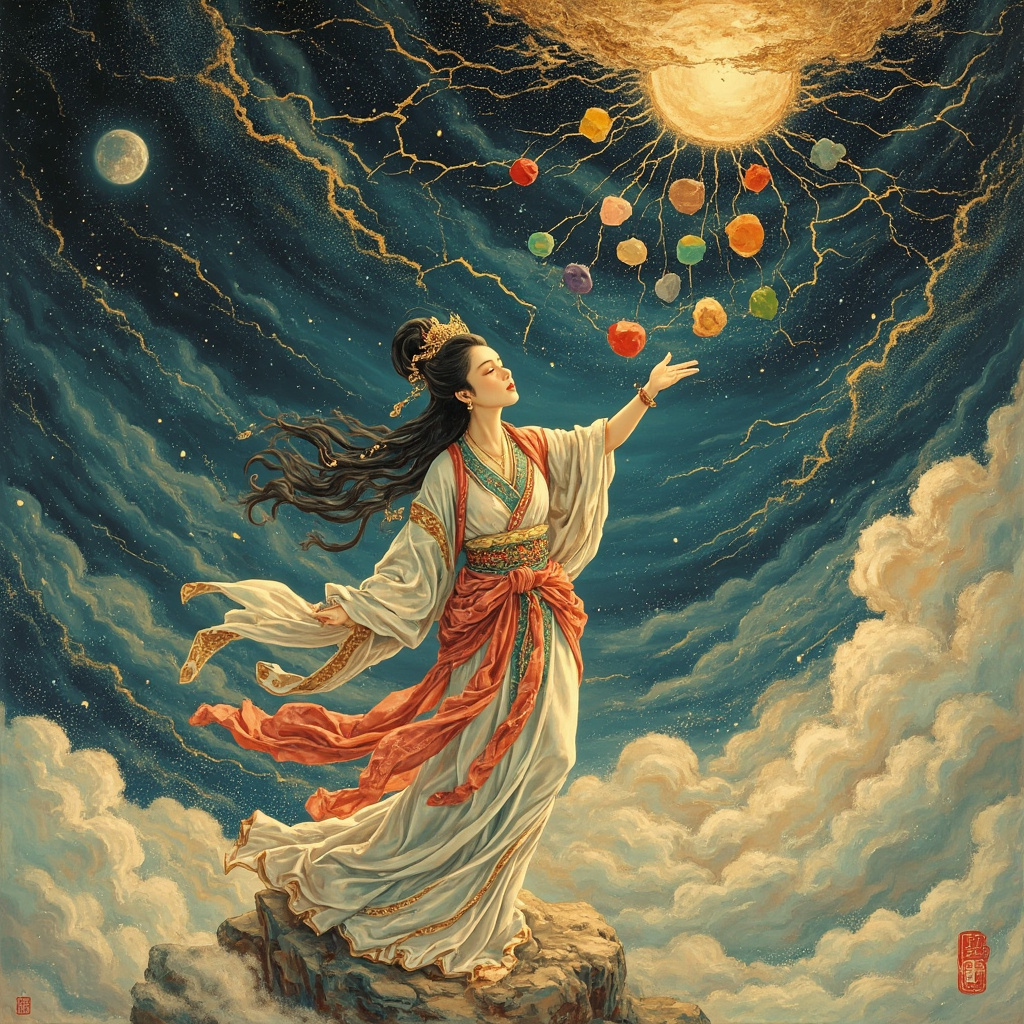
Wu Gang wasn’t the only inhabitant of the moon. According to Chinese mythology, the moon was home to the goddess Chang’e, who had flown there after drinking the immortality elixir meant for her husband, the archer Hou Yi. Chang’e lived in the Moon Palace (广寒宫), a beautiful but cold and lonely palace that the osmanthus tree was said to shade.
The Moon Palace was everything its name implied: vast, silver, and profoundly isolating. Chang’e was attended by a small group of rabbit familiars who spent their days pounding the elixir of immortality in a giant mortar — an image so iconic that it has become synonymous with the Mid-Autumn Festival across East Asia. The palace was beautiful, but it was a beauty that came with a price: the coldness of the moon meant that nothing ever truly warmed it, and Chang’e herself was said to spend her days wandering its empty halls, beautiful and alone.
Wu Gang’s presence on the moon added another layer of melancholy to this already tragic landscape. Here was another being condemned to the moon for transgressions against divine order — Chang’e for her accidental immortality, Wu Gang for his hubris — and neither of them could leave. They were neighbors in loneliness, separated not just from the world of mortals but from each other by the nature of their respective punishments.
Some folk traditions hold that Chang’e occasionally looked out from her palace window and watched Wu Gang swinging his axe in the eternal moonlight, and that his determination moved her even as it reminded her of the permanence of her own exile. Others say Wu Gang and Chang’e became friends over the millennia, two outcasts finding companionship in the most unlikely of places. These softer interpretations add humanity to a legend that could easily become nothing more than a morality tale about the dangers of pride.
The Legend’s Connection to the Mid-Autumn Festival
Today, the legend of Wu Gang and the osmanthus tree is most closely associated with the Mid-Autumn Festival (中秋节), one of the most important holidays in the Chinese cultural calendar. The festival is held on the 15th day of the 8th lunar month, when the moon is at its fullest and brightest. Families gather to eat moon cakes, light lanterns, and gaze at the full moon — and many of them, whether they realize it or not, are looking at Wu Gang’s workplace.
Moon cakes, the festival’s signature food, often feature elaborate designs depicting the osmanthus tree, Chang’e floating through the Moon Palace, or Wu Gang himself swinging his axe beneath the silver branches. The osmanthus flower (桂花) is particularly associated with this time of year — its fragrance is said to be strongest in autumn, and osmanthus-flavored sweets and wines are traditional festival treats.
For many Chinese families, the Mid-Autumn Festival is a time of reunion and togetherness, a moment to appreciate the fullness of life and the beauty of the natural world. But the stories that underpin the celebration are, at their core, stories of separation and longing. Chang’e is separated from her husband. Wu Gang is separated from the world he knew. Even the moon itself is separated from the earth, hanging in the sky as the closest celestial object yet forever out of reach.
This tension between beauty and sadness, between celebration and longing, is part of what makes the Wu Gang legend so enduring. It’s not just a story about punishment and labor — it’s a story about finding meaning in the meaningless, about continuing to swing the axe even when the tree will never fall.
Products for Exploring the Wu Gang Legend
If the story of Wu Gang and the moon’s osmanthus tree has captured your imagination, here are some ways to bring this legend into your life:
1. Chinese Moon Festival: Traditions and Legends — A beautifully illustrated guide to the Mid-Autumn Festival’s history, stories, and customs, with detailed chapters on the Wu Gang and Chang’e legends.
2. Wu Gang Moon Ornament — A handcrafted decorative piece depicting Wu Gang beneath the osmanthus tree, perfect for garden displays or as a unique collector’s item.
3. Osmanthus Moon Cake Recipe Book — Traditional and modern recipes for the beloved festival treats, including osmanthus-flavored delicacies that connect you to this legend’s culinary heritage.
4. Chinese Mythology Complete Collection — A comprehensive anthology of classic Chinese myths, including Wu Gang’s story alongside Nezha, Chang’e, and dozens of other legendary figures.
5. Moon Gazing Telescope for Beginners — A beginner-friendly telescope perfect for observing the moon’s surface and contemplating Wu Gang’s eternal workplace under the night sky.
Last updated: 2026-01-10