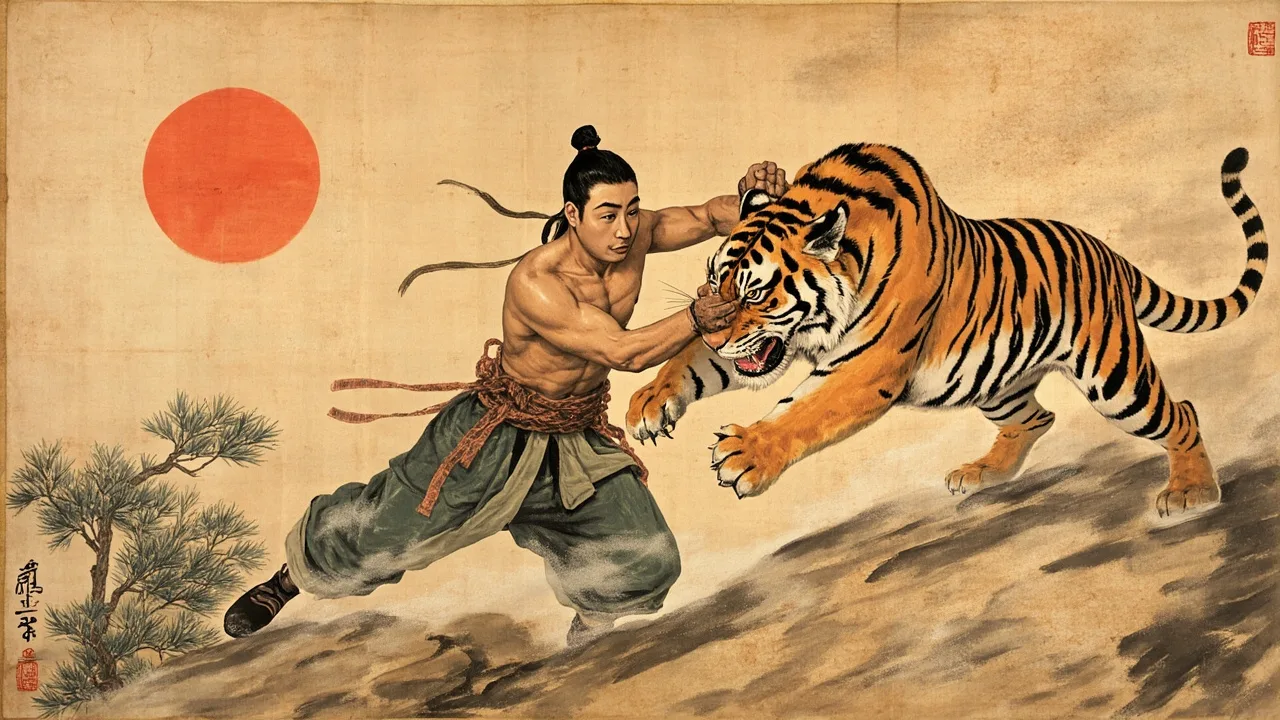
The night a drunk walked up a mountain and killed a tiger
Somewhere around the year 1500, a Chinese author — most scholars now believe it was Shi Nai’an, though that has been debated for centuries — finished a book about 108 outlaws who rob the rich and flee to a swamp called Liangshan Marsh. The book is called Shui Hu Zhuan (水浒传), usually translated as Water Margin or Outlaws of the Marsh. It is one of the Four Great Classical Novels of Chinese literature, alongside Romance of the Three Kingdoms, Journey to the West, and Dream of the Red Chamber.
Of the 108 heroes, one stands above the rest. His name is Wu Song (武松). His story, in particular a single scene — the night he kills a tiger with his bare hands on Jingyang Ridge — has been retold, illustrated, filmed, and shouted in teahouses for about 600 years.
If you’ve watched enough Chinese martial arts movies, you’ve seen him. He shows up in Crouching Tiger, Hidden Dragon in spirit, in dozens of Hong Kong wuxia films as a model character, in the Water Margin TV series of 1998 as the brooding long-haired fighter played by Zhu Yan. He is a folk hero in the same way that Robin Hood or Paul Bunyan is a folk hero in the West — a character whose real existence is irrelevant to his cultural weight.
Here’s the thing, though. Wu Song is not a clean hero. He is brash, often violent, sometimes a killer for reasons that don’t bear close moral examination. The story behind the tiger fight is also the story behind the ugliest subplot in Chinese classical fiction. To understand why Wu Song matters, you have to take in both halves.
The tavern at Jingyang Ridge
Wu Song is from Qinghe, in what is now Shandong province. He has an older brother, Wu Dalang, who is short, plain, and earns his living selling flatbread in the town of Yanggu. Dalang marries a local woman named Pan Jinlian, who — by all accounts in the novel and the centuries of commentary that followed — is dissatisfied. The Pan Jinlian subplot is one of the most analyzed passages in Chinese literature, and I’ll come back to it, because you cannot understand Wu Song without it.
The tiger fight is set up differently. Wu Song has been traveling. After a stay in the city of Mengzhou, he walks toward his brother’s home in Yanggu. It’s late autumn, probably the 9th lunar month (October-ish in the Western calendar). He has been drinking. He stops at an inn at the foot of a mountain called Jingyang Ridge.
The innkeeper warns him. Don’t go up the ridge after dark, he says. There is a tiger. It has killed dozens of people in the last few weeks. Travelers have abandoned the road. The local government has even put up a bounty.
Wu Song is not the listening type. He laughs, asks for more wine, and heads up the mountain anyway. He thinks it’s a ghost story to keep travelers spending money at the inn.
He walks. The wine makes him drowsy. He sees a painted plaque on a temple near the top, warning of the tiger. He drags it to a stone by the path and lies down on it, thinking he’ll rest for a moment.
Then the tiger comes.
The fight, as described in the novel, takes about five full pages. It is brutal, methodical, and very specific in its violence. The tiger pounces. Wu Song dodges. The tiger lunges again. Wu Song jumps to its side and jams his fist into its eye. The tiger roars and thrashes. Wu Song grabs it by the ear and slams it down. He tries to pin it with one hand; the tiger claws him. He drops the ear, jumps on the tiger’s back, finds its skull, and beats it with his fists. After a long struggle the tiger stops moving.
Wu Song picks up its body, walks it down the mountain to the inn, and drops it on the floor.
That is the scene. It has been drawn by Chinese artists for six centuries. The image — Wu Song, fist raised, the dead tiger at his feet — appears on porcelain plates, woodblock prints, New Year paintings (年画), opera posters, and every adaptation of the novel since.
Why this scene became a cultural icon
A few things are happening at once in this scene, and that’s why it lasted.
First, it is a hero’s initiation. Before the tiger fight, Wu Song is a man with a bad temper who has killed someone (a local bully named Ximen Qing’s associate, in self-defense, after the bully tried to push him around). After the tiger fight, he is the man who killed a tiger. He becomes famous overnight. The local magistrate gives him a job as a constable. The story makes him.
Second, it is a Sun Wukong moment. The Monkey King fights demons; Wu Song fights a tiger. In a Chinese literary universe full of supernatural heroes, Wu Song does it with fists. He is the human scale of the heroic tradition. Anyone reading the novel can imagine themselves doing the same thing. (Whether they could is a different question.)
Third, the tiger has obvious symbolic weight. A tiger in Chinese folklore is a yin force — a wild, untamable mountain spirit, a thing that lives outside civilization. Wu Song defeating it is a metaphor for humanity taming the wild. This is why in Chinese opera and folk ritual, the tiger-slaying scene is treated almost as a secular religious moment: Wu Song is the man who stood between the village and chaos.
Fourth, and I think this is underrated, it is a really good fight scene. Shi Nai’an (or whoever wrote it) wrote the scene with specific tactical detail — where the tiger jumps, where Wu Song dodges, where the fists land. It reads like a movie in prose. Wu Song is described as if the camera is on him the whole time. That is unusual for a 600-year-old novel.
When the Chinese film and TV industry got going, the Jingyang Ridge scene was an obvious showcase. The 1998 CCTV Water Margin version directed by Zhang Jizhong played the scene almost shot-for-shot from the novel. Every Chinese person of a certain age can describe it from memory.
The other Wu Song story: Pan Jinlian and Ximen Qing
I have to write this part because skipping it makes the rest of Wu Song incomprehensible.
While Wu Song was away traveling, his sister-in-law Pan Jinlian began an affair with a local rich man named Ximen Qing. The novel spells out what happens next in unusually blunt terms. Pan Jinlian and Ximen Qing conspire to kill Wu Dalang. They poison him. They burn him. They try to make it look like a heart attack. Wu Dalang dies.
Wu Song comes home. He suspects. He investigates. He confronts Pan Jinlian. He confronts Ximen Qing. Eventually — and the novel does not flinch from this — he takes revenge himself. He kills Pan Jinlian and Ximen Qing in a way the original Chinese text describes without euphemism. He parades the bodies through the street. He turns himself in to the magistrate. He is exiled.
There is a thousand-year argument in Chinese literary scholarship about whether Wu Song is right to do this. Modern readers tend to come down hard on him; classical Chinese readers, especially in earlier dynasties, often saw it as filial piety at its purest — your brother is dead, you avenge him, even if it costs your life. The 17th-century playwrights who picked up this subplot (most famously in the play The Golden Lotus, 金瓶梅) focused on Pan Jinlian as a cautionary figure, not as a character.
If you’ve seen the story “Pan Jinlian” treated as if it were a single name — which it is, in some Western film adaptations — it’s because Chinese literature kept returning to her across a thousand years. There’s a 2021 Chinese film called A Writer’s Odyssey that opens on the Wu Song story; there’s a whole sub-genre of so-called “Pan Jinlian operas” (潘金莲戏) that retell the tale from her perspective. The Chinese phrase “Pan Jinlian” has become, in casual speech, an insult for a woman who has many affairs. (This is not a usage I recommend repeating.)
The point for understanding Wu Song: the tiger fight is what made him famous, but the Pan Jinlian revenge is what made him a real character. Both halves are in every adaptation.
Wu Song and Liangshan: the brotherhood of outlaws
After the killing of Pan Jinlian and Ximen Qing, Wu Song is exiled. While in exile, he becomes entangled with another of the novel’s great characters, Song Jiang (宋江), who is eventually the leader of the 108 outlaws at Liangshan Marsh. Song Jiang is the moral heart of the book. Wu Song is the sword arm.
The two meet, bond, and eventually become brothers under a strange ritual called the “sworn brotherhood.” In Chinese culture, this is a serious bond — closer, in some traditional readings, than blood ties. You write your names in the same book. You drink from the same cup. You share each other’s fortunes, including death.
The brotherhood is the spine of Water Margin. The 108 outlaws are organized into 36 “Heavenly Spirits” and 72 “Earthly Fiends,” divided by their level of skill, but they are all brothers. They rob convoys and give to the poor. They shelter refugees. They fight petty tyrants and corrupt officials. Eventually — and this is the tragic end of the novel — they accept amnesty from the emperor and ride off to die in battles against rebels and foreigners, almost all of them killed.
Wu Song himself dies in the campaign against the rebel Fang La. He is captured, imprisoned, and the novel says he died in captivity. (Later folk stories sometimes soften this, with Wu Song becoming a deity.)
That’s the shape of the character: he kills a tiger with his fists, becomes famous, kills again to avenge his brother, joins a band of outlaws, and dies in a war he didn’t want. It is not a clean arc. It is a 14th-century Chinese arc — full of loyalty, full of brutality, full of brotherhood, full of loss.
Why this character has lasted 600 years
A few reasons I think Wu Song endures, beyond the obvious “killing a tiger is memorable” one:
He is a working-class hero. Wu Song has no aristocratic background. He is a migrant worker. He is poor. He gets a job as a constable because of the tiger, but he is not born to power. In a Chinese folk tradition that sometimes tilts toward scholarly heroes, Wu Song is the hero of the common man. He is the guy you drink with in the tavern, who turns out to be able to fight.
He is loyal in a way Chinese culture values. His revenge for Wu Dalang is brutal, but it fits the Confucian ideal of xiao (孝), filial piety. His brotherhood with Song Jiang is the yi (义) that Chinese novels idealize. He is what an older Chinese reader would call “a good man of the rivers and lakes” (江湖好汉).
He is on a lot of stuff. Wu Song appears on Chinese liquor bottles, cigarette packaging, traditional toys, ink paintings, and the famous Jingyang Ridge scene is reproduced on calendars. Every Chinese New Year there is at least one print shop selling Wu Song and the Tiger. He’s on television at least once a year in some adaptation.
He is the kind of hero you can play with. Modern adaptations have rewritten Wu Song as a romantic lead, a tragic loner, an anti-hero, a Buddhist monk, and a brooding martial arts master. The 1972 Shaw Brothers film The Water Margin and the 1998 CCTV series play him as stoic. Wong Kar-wai’s 1998 Ashes of Time treats him as melancholy. A 2014 Hong Kong film reimagines him as a stranger in a small town. He bends without breaking.
If you want to read the original story yourself, Water Margin is in print in many English translations. The most readable modern English version is Pearl S. Buck’s 1933 translation (still in print and arguably still the best), though the J. & R. McGowan translation and the 2020 edition translated by Alex Volkov are also worth a look. Set aside a long weekend — the novel is over a thousand pages, depending on the edition, and it’s a page-turner once you start.
For a more accessible entry point, the 1998 CCTV Water Margin series is on YouTube with English subtitles in places, and the Jingyang Ridge episode is around episode 4. Just be aware going in that you will also be watching the Pan Jinlian subplot, which is not comfortable viewing by modern standards, and which is part of why Chinese literary scholars have been arguing about this novel for centuries.
It is, in the end, a Chinese book about Chinese questions. How far does brotherhood go? When is revenge righteous? What do you owe your family? What do you owe your country? When Wu Song kills the tiger, those questions get to wait a few pages. When he comes home from the mountain, they don’t.