Wudang Martial Arts: The Taoist Path to Inner Power
If Shaolin Kung Fu represents the hard, external approach to Chinese martial arts, then Wudang represents everything soft and internal. While the Shaolin monks were developing powerful striking and grappling techniques, Taoist hermits on Wudang Mountain were quietly perfecting an entirely different approach to combat — one that would eventually give birth to styles like Tai Chi and Xing Yi that have spread worldwide.
Let’s explore what makes Wudang martial arts so unique and why they continue to captivate martial artists around the world.
The Taoist Sanctuary: Wudang Mountain
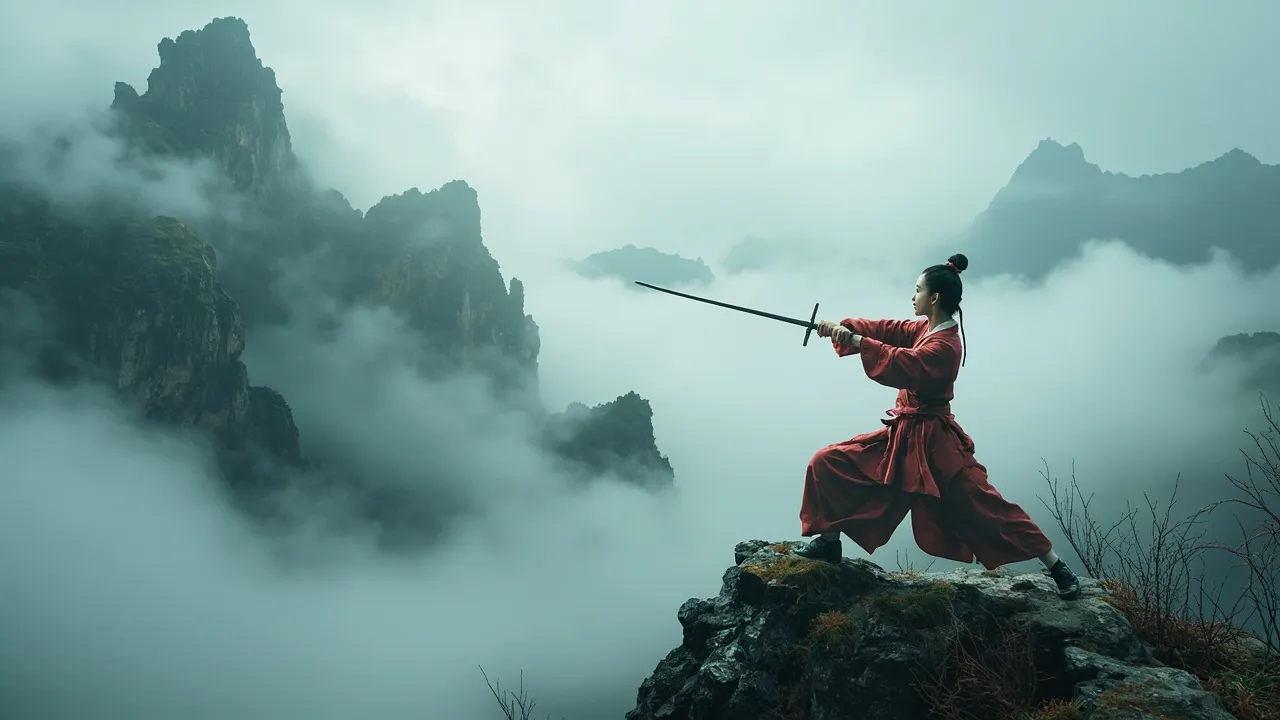
Wudang Mountain rises from the Hubei province of central China, a series of peaks covered in ancient forests and shrouded in mist. The main peak, Tianzhu (Heavenly Pillar), reaches over 1,600 meters, and the entire mountain range has been sacred Taoist territory for over a thousand years.
For centuries, this has been a sacred place — Taoist monks came here to seek immortality through meditation, alchemy, and the cultivation of internal energy. Unlike the Buddhist Shaolin Temple, which was often involved in the political and military affairs of China, Wudang remained more isolated, focused on the mystical and spiritual pursuits that define Taoist practice.
The mountain’s temples housed monks who weren’t interested in the worldly business of fighting. They were pursuing something deeper: the cultivation of “qi” (life energy) and the attainment of supernatural abilities through rigorous physical and spiritual practice. These monks sought longevity, health, and ultimately transcendence of ordinary human limitations.
The martial arts that developed on Wudang weren’t designed for battlefields or street fights. They were tools for health, longevity, and spiritual cultivation. The goal wasn’t to become a better fighter — it was to become a more complete human being. The fighting ability was almost a side effect of the deeper training, a demonstration of the power that comes from proper cultivation.
This doesn’t mean Wudang martial arts are ineffective in combat. Quite the opposite. The internal power developed through Wudang training can be devastating when applied. It’s just that the philosophy and purpose differ fundamentally from external styles like Shaolin. The same techniques that improve health and extend life can also be devastating when used for combat.
The Three Internal Masters
Wudang martial arts are often grouped into what practitioners call the “three internal arts” — Tai Chi (T’ai Chi Ch’uan), Xing Yi (Hsing I), and Ba Gua (Pa Kua). Each emphasizes different principles but all share the common foundation of internal cultivation. Together, they represent the core of what Chinese martial artists call the “neijia” or internal family.
Tai Chi is perhaps the most famous worldwide, known for its slow, flowing movements practiced by millions for health. Originally called “long fist” or “13 postures,” Tai Chi was developed as a comprehensive martial art despite its reputation today as a gentle health practice. The slow forms develop the sensitivity and body awareness needed for real combat, while the push-hands training teaches practitioners to redirect force rather than meet it head-on.
The origins of Tai Chi are shrouded in legend, with the most famous attributing its creation to Zhang Sanfeng, a Taoist monk who is said to have created the style after dreaming of a crane and a snake fighting. Whether this story is literally true, it captures an essential truth: Tai Chi emerged from the Taoist tradition on Wudang Mountain, combining internal cultivation with effective combat technique.
Xing Yi takes a different approach, emphasizing direct, powerful attacks. Practitioners learn to “penetrate like an arrow,” delivering explosive force through coordinated body movement. The art is known for its simplicity — relatively few forms compared to other styles — but what it lacks in variety it makes up for in devastating effectiveness. Xing Yi develops the “explosive jin” that distinguishes internal power.
Ba Gua uses constant, circular walking as its foundation. Practitioners walk in circles around their opponent, changing angles continuously while delivering strikes from unexpected directions. The style develops extraordinary agility and the ability to flow around attacks rather than blocking them directly. The constant movement makes Ba Gua practitioners extremely difficult to target.
All three arts emphasize “neijia” — internal family — training that develops what Chinese martial artists call “jin” or internal power. This isn’t mystical; it’s a specific physical skill involving coordinated breathing, proper body alignment, and the use of the whole body to generate force rather than just arms or legs. The internal power, properly developed, can be far more devastating than external muscular force.
Philosophy in Motion: Taoist Principles in Combat
What makes Wudang truly different isn’t just the techniques — it’s the underlying philosophy that permeates every aspect of the training. Where external styles might focus on defeating an opponent, Wudang training seeks to develop the practitioner’s complete potential as a human being.
The principle of “wu wei” — non-action or effortless action — runs through Wudang training. Instead of muscling through techniques, students learn to relax into movements, letting natural body mechanics do the work. This sounds simple but takes years to develop. The tension most people carry in their shoulders and chest becomes the first obstacle to overcome. Learning to relax while generating power is the fundamental skill.
The concept of “yin and yang” appears everywhere in Wudang training. Every technique has its counter-technique. Every force can be redirected. Rather than meeting strength with strength, Wudang practitioners learn to yield to incoming force and use that energy against their opponent. This is the famous “四两拨千斤” — using four ounces to deflect a thousand pounds. The soft overcomes the hard; the yielding defeats the aggressive.
Breathing is fundamental to Wudang practice. Internal training coordinates breath with movement in specific ways that develop internal strength. Students learn to breathe deeply into the “dan tian” — the area below the navel — rather than breathing superficially in the chest. This “dan tian breathing” becomes the foundation for generating internal power. The breath becomes the bridge between mind and body, consciousness and action.
The Taoist emphasis on naturalness also shapes training. Wudang forms are designed to flow naturally with the body’s structure rather than forcing it into unnatural positions. The goal is to develop the body to its fullest natural potential, not to create artificial fighting positions that look impressive but lack real power.
The Wudang Sword: Grace and Deadly Precision
Of all Wudang weapons, the sword holds special significance. The straight sword (jian) is considered the embodiment of the martial ideal — straight, true, and cutting without hesitation. Wudang sword forms are legendary for their beauty and their practical combat applications.
The sword occupies a special place in Chinese martial culture, associated with scholars and gentlemen as much as warriors. The Wudang sword represents the union of martial skill and spiritual cultivation, the warrior-scholar ideal that Taoist practitioners aspired to achieve.
The training starts with basic cuts and parries, but quickly evolves into complex forms that challenge balance, coordination, and mental focus. Wudang sword forms often involve the full body — stepping, turning, and cutting in flowing sequences that can take years to master. The forms combine offensive and defensive elements, teaching practitioners to respond naturally to any attack.
What’s remarkable about Wudang sword work is how little effort it requires at the highest levels. Advanced practitioners move with apparent casualness, yet their cuts arrive with surprising power. The secret lies in internal coordination — using the whole body to deliver the blade rather than just arm strength. The sword becomes an extension of the body, guided by the same internal power that underlies empty-hand practice.
For students interested in weapons training, Wudang offers a complete curriculum beyond the sword: the spear (qiang) emphasizes range and thrusting power; the saber (dao) provides cutting-focused techniques; the staff (gun) develops sweeping and striking abilities. But the sword remains the jewel — the weapon of scholars and Taoist immortals alike.
Modern Wudang: Ancient Wisdom for Today’s World
Today, Wudang martial arts have spread worldwide. Temples on the mountain have reopened, training monks and accepting foreign students. Masters who spent decades in secret training have come forward to share their knowledge. And practitioners everywhere are discovering what Taoist monks have known for centuries: internal training develops power that external training alone cannot match.
The modern Wudang temple complex has been restored and expanded, with facilities that accommodate both monks and visitors. Foreign students can now study at the source, spending weeks or months learning directly from masters who have devoted their lives to the art. This accessibility has transformed Wudang from a hidden tradition into a global phenomenon.
The health benefits of Wudang training are well-documented in modern research. Studies have shown that Tai Chi practice improves balance, reduces fall risk in older adults, lowers blood pressure, reduces stress, and provides numerous other health benefits. But beyond these measurable benefits, practitioners often report improved mental clarity, emotional balance, and a sense of connection to something larger than themselves.
Wudang training is particularly valuable for those who’ve exhausted other martial arts without finding what they sought. If you’ve trained in striking arts and want to develop the subtle sensitivity that comes with internal power, or if you’re looking for a martial art that integrates philosophy and physical practice, Wudang offers a compelling path.
The training is demanding in different ways than external arts. You’ll spend less time developing visible muscles and more time developing invisible qualities — sensitivity, coordination, and the ability to generate power from your center. Progress may feel slower at first, but the results are worth the patience. The power developed through internal training often exceeds what external training can produce.
For those new to internal arts, starting with Tai Chi is often the best approach. Its slow movements provide an accessible entry point while still teaching fundamental principles. Once basic competence is developed, practitioners can explore Xing Yi or Ba Gua based on their interests. Many serious practitioners eventually study all three, finding that each illuminates different aspects of internal power.