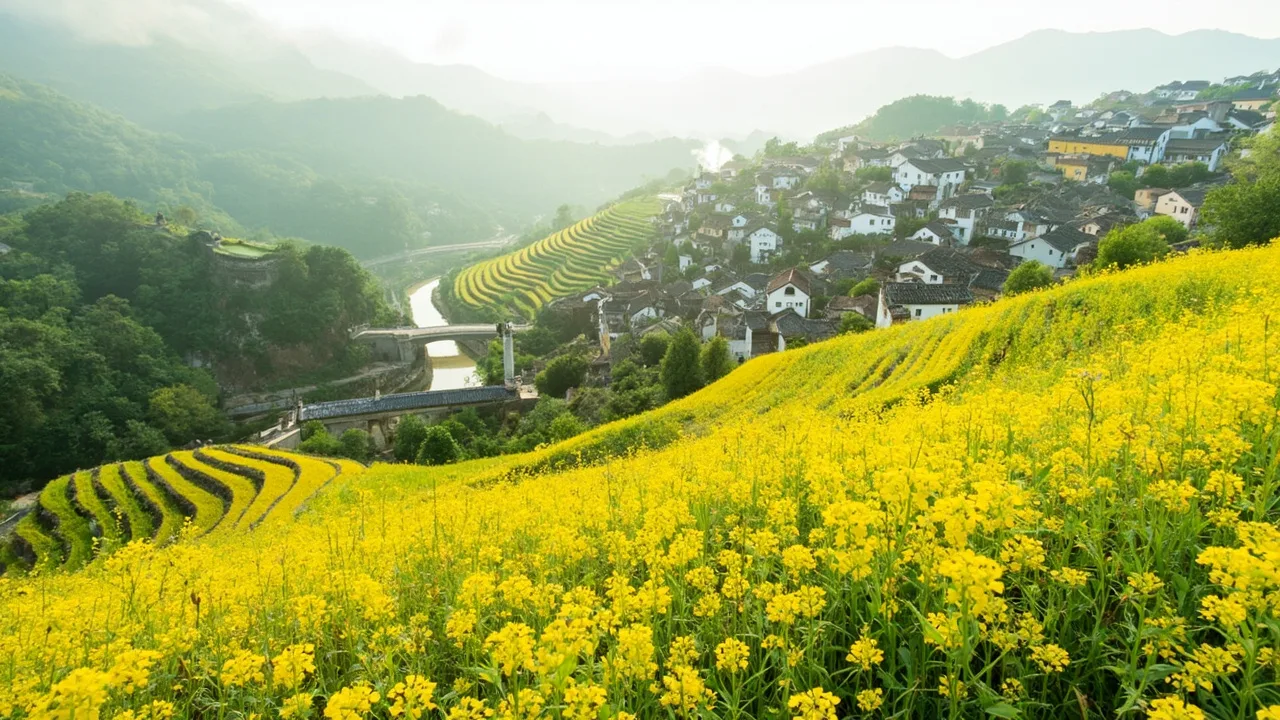
A Place That Doesn’t Look Real
Every March, something extraordinary happens in a small corner of Jiangxi Province. The rapeseed fields — millions of them — turn gold all at once. They cascade down terraced hillsides, flood the valleys between ancient villages, and turn the entire landscape into something that looks assembled by a very serious art director for a very serious period drama.
This is Wuyuan — a county of about 350,000 people that has somehow become one of the most photographed places in China, even though almost no Americans have ever heard of it. The Chinese have a phrase for it: “中国最美乡村” — China’s most beautiful countryside. They mean it literally.
I first saw Wuyuan in a photograph taken by a friend who had been living in Shanghai for two years. The photo was of a stone bridge over a quiet river, with white-walled houses on the far bank and the whole scene framed by mountains that looked like they belonged in a traditional ink painting. I assumed it was heavily filtered. Then I went, and the real thing was better.
The reason Wuyuan looks so different from most of rural China is geography. Wuyuan sits in a basin surrounded by mountains on three sides, which physically shielded it from the worst of 20th-century industrialization. The mountains kept the roads difficult, the cities distant, and the old patterns of life more intact. You can drive two hours in any direction from Wuyuan and find villages that look essentially the way rural China looked in the Ming Dynasty — terraced rice fields, stone bridges, old women hauling water from wells. It’s a kind of living museum, except the curators are the farmers who never stopped farming the same way their great-great-grandfathers did.
Where Is Wuyuan and How Do You Get There?
Wuyuan is in northeastern Jiangxi Province, about 80 kilometers from the famous ceramic city of Jingdezhen. It sits in a basin surrounded by mountains on three sides, which is why the area escaped the worst of China’s rapid modernization. The mountains kept the roads difficult and the cities distant. The result is a patchwork of villages, terraced fields, and rivers that look essentially the way rural China looked fifty years ago.
Getting there requires some effort from the United States. The nearest major airport is in Nanchang, Jiangxi’s capital, about a four-hour drive from Wuyuan. The nearest high-speed rail station is 婺源 (Wuyuan) on the line connecting Shanghai and Nanchang — so the most sensible approach for international visitors is to take the high-speed train from Shanghai (about 3.5 hours, $50–60) or from Hangzhou (about 2.5 hours).
The Rape Blossom Season and Year-Round Beauty
The reason most people come to Wuyuan is the 油菜花 (rapeseed flowers) — specifically, the two to three weeks in March and early April when the entire county turns yellow. The flowers grow in three different settings, each with a completely different character:
Terraced fields: The mountains around Wuyuan are terraced for rice cultivation, and when the rapeseed flowers bloom, the terraces become a staircase of gold extending from the valley floor to the ridgeline. The best examples are around 江湾 (Jiangwan) and 篁岭 (Huangling). The Huangling terraces are particularly famous because the cable car to the village gives you a bird’s-eye view of the entire flower carpet from above — no hiking required. The sight from the cable car window as you descend into Huangling in peak bloom season is one of the most photographed things in China.
River valleys: Small rivers wind through the Wuyuan countryside, and along their banks, the flowers grow at water level, creating reflections in the still water that double the color. The most photographed spot is 月亮湾 (Moon Bay) near 思口 (Sikou) — a crescent-shaped river bend where the flowers come right down to the water’s edge. The best time to photograph Moon Bay is early morning, before 7 AM, when the air is still and the water is a perfect mirror. After 9 AM, wind chop disturbs the reflection. The shot from the small hill overlooking the bay takes about ten minutes to climb but rewards you with the full crescent in one frame.
Ancient villages: The Hui-style white-walled buildings that characterize Wuyuan’s architecture sit in the middle of the flower fields, so that walking through a village in March means being surrounded by gold on three sides and white walls on the fourth. The village of 樟山村 (Zhangshancun) is particularly photogenic — a small Ming Dynasty village backed directly against the terraced flower fields, with an ancient camphor tree at its entrance that is estimated to be 800 years old.
But Wuyuan has something to offer in every season. Summer brings green terraced fields and cool mountain rivers, perfect for hiking between villages. The rivers are clean enough to swim in — a genuine treat after a summer hike. Autumn is harvest season — the famous sky ladders appear with red peppers, yellow corn, and white radishes, a favorite time for serious photographers. The 篁岭晒秋 (Huangling Autumn Harvest Drying) spectacle is what autumn photographers come for — the villagers spread their crops on baskets and screens on every available surface, turning the whole village into a color-coded geometric composition. Winter is almost empty, with a stark ink-painting quality to the villages and prices at their lowest. A winter visit to Wuyuan in snow is a completely different experience from spring — the white snow on the black roof tiles, the empty fields, the frozen river — like visiting a Chinese landscape painting that has been translated into real life.
The Villages — Each One a Different China
Wuyuan is not a one-scenic-view destination. It is a county with dozens of villages, each with its own character.
篁岭 (Huangling) sits on a mountainside reached by a cable car. It is a huizhou-style village — white walls, dark grey tile roofs, elaborate马头墙 (horse-head walls) rising above the roofline in decorative stepped shapes. Huangling is famous for its 晾晒 (sky ladders) — villagers dry crops on rooftops and terraces that cascade down the mountain, creating colorful geometric patterns. In autumn, the baskets of red peppers and yellow corn create a different kind of beauty from the spring rapeseed. The village is somewhat commercialized — it was extensively renovated before being opened as a tourist site — but the architecture is genuine and the setting is extraordinary. The cable car ride up is worth taking in both directions: the descent gives you the full view of the terraced hillside that has become the signature Wuyuan image.
思溪延村 (Siji Yan Village) is where the professional photographers come. The 彩虹桥 (Rainbow Bridge) is here, though the most iconic single-frame shot is from a smaller covered bridge in the same area. The villages are quiet. On a weekday morning in March, with the flower fields in bloom and no tour buses yet, you can walk the river path and feel like the only person in a 14th-century painting. The name “Siji Yan Village” actually refers to two villages — 思口 (Sikou) and 延村 (Yan Village) — separated by about a 20-minute walk through the flower fields. Don’t skip the walk between them.
虹关 (Hongguan) was historically one of the centers of the 徽墨 (Hui ink) industry. The village has a 1,000-year-old camphor tree at its entrance and an ancient path that was once part of the trade route connecting the region to the rest of China. Hongguan is less visited than Huangling and Sikou, and the village retains a rawness that the more polished tourist villages have lost. The ink-making tradition here dates to the Tang Dynasty — Wuyuan’s Hui ink was historically considered among the finest in China, used by calligraphers and painters across the empire. A few families may still make ink using traditional methods; ask locally.
理坑 (Likeng) produced over forty jinshi — the highest level of the imperial examination — during the Ming and Qing dynasties. The village is full of scholar’s gardens, elaborate ancestral halls, and carved wooden details that make you realize why traditional Chinese craftsmanship took decades to master. Likeng is also famous for the 朱熹 (Zhu Xi) connection — the great Song Dynasty philosopher visited the village and taught here, giving the village a scholarly pedigree that locals still take pride in. The village has a small museum in one of the old scholar’s houses with displays on the imperial examination system — fascinating context for American visitors who know nothing about this system that dominated Chinese intellectual life for 1,300 years.
Zhu Xi’s connection to Wuyuan is actually deeper than a single visit. The philosopher — whose family originated in Jiangxi — spent part of his youth in the Wuyuan region, and his 理学 (School of Principle) school of Neo-Confucianism became the official state ideology of the Chinese imperial examination for the next 700 years. The fact that Likeng produced forty-plus jinshi degree holders is directly connected to this philosophical tradition, which placed enormous emphasis on education as the path to social advancement. The village’s elaborate ancestral halls are physical expressions of this philosophy — each hall documents the scholarly achievements of the family line going back generations, with the names and examination years of successful candidates carved into the door frames.
For American visitors, the imperial examination system is one of China’s most historically significant institutions, and it has a direct parallel in American experience. The civil service exams in the United States were, in part, inspired by the Chinese imperial examination system. The idea — that government positions should be filled based on merit rather than birth or connection — was radical when China developed it over a thousand years ago, and it influenced Enlightenment thinkers in Europe who were studying Chinese governance. Walking through Likeng, you’re walking through a village that produced the scholar-officials who passed the most difficult exam system in the pre-modern world.
The Bottom Line
Wuyuan represents something that is becoming genuinely rare in China: a rural landscape that has not been swallowed by development. The villages are not museums, they are working communities. Farmers still plant the same crops in the same fields using methods not radically different from their ancestors. The old covered bridges are still crossed daily by villagers going to market.
For Americans, Wuyuan offers something different from China’s famous monuments. The Great Wall is spectacular, but it is also a preserved and managed tourist experience. Wuyuan is still a place where people live, and the scenery is the backdrop to daily life rather than the product being sold.
There’s also a deeper connection for American visitors: Wuyuan is one of the few places in China where you can see landscape painting conventions applied to real landscape. The famous Song Dynasty landscape paintings — the misty mountains, the tiny figures in boats, the ink-wash waterfalls — were not imaginary. They were observations. When you stand at Moon Bay in early morning mist, watching a farmer cross the stone bridge with a load of hay on his shoulder, with mountains fading into fog behind him, you are inside a painting that was painted 900 years ago. The landscape hasn’t changed that much. That’s a remarkable thing to feel as an American visitor.
Wuyuan is not easy. This is not Beijing or Shanghai. Transportation within the area is difficult — the villages are spread across a large area, the roads narrow and poorly signed. Hire a car and driver for the day ($60–80). Language barriers are significant — Wuyuan is firmly in domestic Chinese tourism territory. The spring weather is unpredictable — pack layers and rain gear regardless of what the forecast says. The food is nothing like American Chinese restaurants — expect steamed fish, bitter mountain greens, and glutinous rice wine that’s 10% alcohol and dangerously easy to drink.
That said, Wuyuan is already changing. The high-speed rail station brought more visitors. The boutique hotels are expanding. The tour buses come in larger numbers every year.
Go now, if you want to see a China that feels like the China that inspired the Song Dynasty landscape painters — green mountains, white walls, golden fields, and the sound of a river running under a bridge that has stood for five hundred years.
Why This Matters for Western Travelers: For American visitors, Wuyuan offers something genuinely rare — the opportunity to see the landscape paintings of the Song Dynasty alive and working. The famous Chinese ink wash paintings — misty mountains, tiny figures on bridges, waterfalls disappearing into fog — were not imaginary. They were observations of real places. Standing at Moon Bay before 7 AM in March, watching a farmer cross the ancient stone bridge with a bundle of hay on his shoulder, with mountains fading into morning mist behind him, you are inside a painting that was made 900 years ago. The landscape has not changed that much. This is one of the few places on Earth where you can feel the aesthetic continuity between pre-modern art and the living landscape that inspired it.
There is also a direct connection to the American Midwest. The rapeseed flower fields of Wuyuan, which cascade down terraced hillsides in March, are visually analogous to the rapeseed (canola) fields of the American Great Plains — the yellow carpet effect, the way the color floods entire valleys, the bee-filled air. If you’ve driven through Kansas or Oklahoma in April and remember the yellow fields stretching to the horizon, Wuyuan in spring will feel uncannily familiar, despite being 7,000 miles away. Food crops and their landscapes travel as surely as trade routes do, and the rapeseed is one of the world’s great agricultural landscapes, whether in Jiangxi or Kansas.
Accommodation note: The best boutique hotels in Wuyuan are converted old huizhou merchant houses — stone-and-wood structures that are 200–300 years old, restored with modern bathrooms and heating. These are worth the splurge. Book during rapeseed season at least three months in advance — they fill up fast. A good option is the Wuyuan Kamalou Hotel in the Sikou area — converted old house with courtyard views, breakfast included, English—speaking staff. For a luxury option, the Wuyuan Interlaken Hotel ($150–250/night) near Huangling features a mountaintop view over the terraced fields, particularly spectacular during the harvest drying season in autumn.