A Town Built on Water
The first thing you notice is the smell — river water and old wood, the scent of a place that has been waterlogged for thirteen centuries. Then the second thing: the sound of oars hitting water. Then the third: the sight of a stone bridge arcing over a canal so still that a passing boat leaves a wake that takes twenty seconds to disappear.
This is Wuzhen — one of the most famous ancient water towns in the Jiangnan region of China, and the destination that appears in approximately 80% of all photographs Americans have seen of “old China” without necessarily knowing what they were looking at. The black-tiled roofs, the whitewashed walls, the narrow stone paths along the water’s edge — this is the visual shorthand for Chinese antiquity that appears on travel posters from Beijing to Bangkok.
Wuzhen sits in the flat alluvial plain of Zhejiang Province, about 83 kilometers from Shanghai, in the jurisdiction of Tongxiang City. It is technically six separate villages connected by canals and bridges — an area of about 73 square kilometers. The town has been continuously inhabited for over 1,300 years, which means the stone you are standing on was walked on by people living in the Tang Dynasty.
What makes Wuzhen’s 1,300-year history particularly vivid is how tangible it remains. The canal system is not reconstructed — it is the original water network dug during the Tang Dynasty and maintained continuously. The bridges include specimens from the Song Dynasty (960–1279), the Yuan Dynasty (1271–1368), the Ming Dynasty (1368–1644), and the Qing Dynasty (1644–1912) — you can literally walk across a bridge built during the Song Dynasty and then thirty meters later cross one built in the Qing. The buildings along the canals are mostly Ming and Qing in date, but the oldest elements — the stone gate bases, the original timber frames — date to earlier periods. Layer upon layer of history is visible in the architecture if you know how to look.
For American visitors who have been to Venice: Wuzhen is not Venice. The comparison is lazy but understandable — both are water towns with canals and boats and old stone. But Venice is a city of grand palazzos and vast public spaces; Wuzhen is a network of intimate lanes and small merchant houses. Venice feels like a museum; Wuzhen still feels like someone’s home. The better comparison for Americans might be a living version of colonial Williamsburg — preserved in amber but with real people going about real lives inside the preserved architecture.
The smell of the water is also different from Venice — Wuzhen’s canals are not salt water but fresh river water, with the distinctive mineral quality of the Yangtze Delta. In the early morning, before the boats start moving, the canal water is so still it becomes a mirror. Standing on one of the smaller stone bridges at 6 AM, watching the reflection of the black roof tiles double perfectly below, you understand why Wuzhen has been photographed so many times.
Why Wuzhen Became Famous and How It’s Laid Out
Water towns are not unique to China — Venice exists, after all — but the Jiangnan water towns represent a distinct phenomenon. The region south of the Yangtze River is flat, crisscrossed by rivers and canals, and historically too wet and flood-prone for easy overland travel. So for centuries, the primary transportation network in Jiangnan was water.
Wuzhen sat at the intersection of the Beijing-Hangzhou Grand Canal and several local river systems, making it a commercial hub for silk, cotton, tea, and grain. At its peak in the Ming and Qing dynasties, Wuzhen was a wealthy market town with over a thousand shops and a population that dwarfed many European cities of the same era. What makes Wuzhen unique among surviving water towns is its completeness — a significant portion of its original architecture and living community is preserved. This is not a museum. Real people live here. Real silk is still woven on real looms.
The town is divided into four main tourist areas and two residential zones. 西栅 (Western Scenic Area) is Wuzhen’s crown jewel — the oldest architecture, the most iconic canal views, and the famous Triple-Lanelet Corridor, a 400-meter covered walkway built over the water on stilts. Best visited in the evening when the buildings are illuminated and the crowds thin out. 东栅 (Eastern Scenic Area) is older, smaller, and more residential — better for early-morning photography before the tour buses arrive. 北栅 and 南栅 are the residential zones where most casual visitors never go, but worth a walk if you want to see the town as a functioning community.
What to See and Do
The Stone Bridges — Wuzhen has 120 stone bridges, ranging from tiny footbridges barely wider than a person to the grand 永安桥 (Yong’an Bridge) with its single arch spanning the main canal. Each bridge was built in a different era — some from the Song Dynasty, most from the Ming and Qing — and each has its own character. Walking the stone paths and crossing the bridges is really the point of Wuzhen. There is no single monument or must-see artifact. The town itself is the attraction.
The oldest surviving bridge in Wuzhen is the 唐单孔石桥 (Tang Single-Arch Stone Bridge) in the northern residential zone — a small, narrow bridge that dates to the Tang Dynasty (618–907 CE). It is easy to miss, tucked behind a tea shop and not grand enough to attract tour groups. But standing on it, you are standing in exactly the same place where a person stood during the reign of Emperor Xuanzong, when the Tang capital at Chang’an was the largest city in the world. The continuity is not metaphor — it is stone and water.
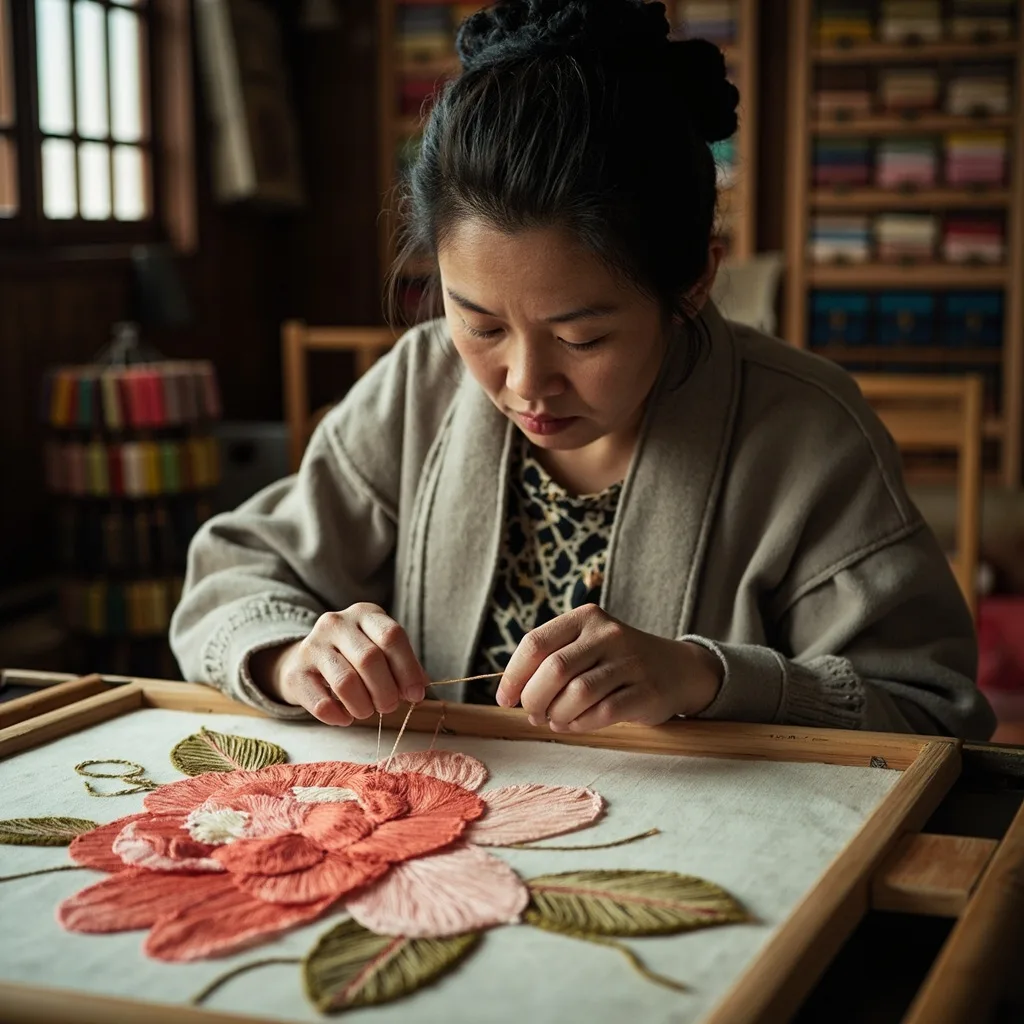
The Traditional Workshops — One of the things that distinguishes Wuzhen is the preservation of actual craft traditions. The 蓝印花布 (Indigo Calico) process — dyeing cotton fabric with indigo through a stencil technique — has been practiced in Wuzhen for centuries. The process involves carving patterns into木板 (wooden boards), then using those boards to stamp resist-dye patterns onto cotton fabric before immersing it in the indigo vat. A quality piece costs $20–40 and will last a lifetime with proper care. The indigo dye is made from the same plant that gave its name to the Blue Man Group’s signature color — the same pigment that traveled the Silk Road from India to Europe, used in everything from Roman dyeing to Levi’s denim.
Tongxiang has been famous for silk production since the Tang Dynasty — in Wuzhen’s workshops, you can see old wooden looms still being operated by workers who have spent their lives at the loom. For American visitors familiar with silk prices at home, the quality-to-price ratio is eye-opening. A meter of high-quality Wuzhen silk costs roughly $15–30 at the workshop — the same silk that would sell for $50–80 per meter in a New York fabric store. Buy directly from the workshop rather than the tourist shops for the best prices and the freshest products.
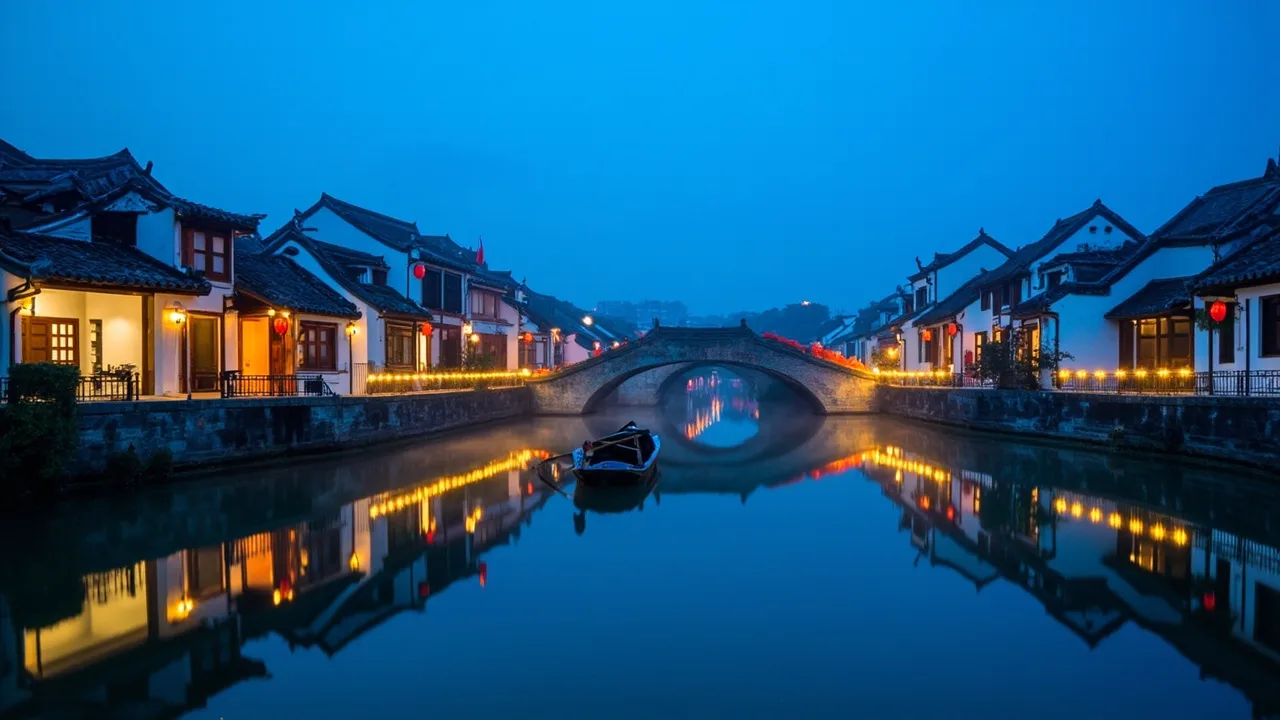
The Night Views — Wuzhen at night is genuinely one of the most beautiful urban nightscapes in China. The black-tiled roofs, whitewashed walls, and red lanterns are all reflected in the still canal water. Walking the stone paths at 10 PM, when the day-trippers have left and the boutique hotels are serving their last customers, Wuzhen feels like a place out of time. The night view from the 桥上桥 (Qiaoshang Qiao) — “bridge on bridge,” where one bridge passes over another — is one of those images that is better in person than in any photograph.
Practical Guide — When to Go, How to Get There, What to Eat
When to Go: Spring (March to May) is peak season and peak beauty. Autumn (September to November) offers the best combination of good weather and manageable crowds. Summer is hot and humid — visit early in the morning or in the evening. Winter is the quietest season; the stone paths can be icy, the canal misty in the early morning, and prices significantly lower.
Getting There from Shanghai: Wuzhen is about 83 kilometers, roughly a 90-minute drive. By bus: direct buses from Shanghai South Bus Station, about 2 hours, $12–15 USD. By train: high-speed train from Shanghai Hongqiao to Tongxiang (25 minutes), then a 20-minute taxi — the fastest route.
Stay overnight. This is not optional advice. The difference between Wuzhen as a day trip and Wuzhen as an overnight experience is the difference between a photograph and the actual place. The west scenic area has the best boutique accommodation — converted old merchant houses with modern amenities and canal-view rooms. Prices range from $80–200 per night depending on the property and season. The overnight ticket grants re-entry access.
What to Eat: The Wuzhen culinary tradition is anchored in the Jiangnan palate — sweet, subtle, delicately seasoned. 红烧羊肉 (red-braised lamb) — cooked slowly in soy sauce and rice wine until the meat is falling-off-the-bone tender — is a winter specialty. 书院酱鸭 (Academy Duck) — a pressed and braised duck with a sweet-savory glaze — was historically carried by scholars traveling to imperial examination sites. 粯子粉 — a rice noodle dish in garlic-chili broth — costs less than $2 per bowl at the small noodle stands that open at 6 AM. In autumn, 大闸蟹 (hairy crab) from the local lake are considered among China’s finest — a pair of good ones costs $30–50 at a mid-range restaurant.
Best time to photograph Wuzhen: For photographers, the single best time is the hour after sunset when the buildings are illuminated but the sky still has blue in it — roughly 17:30–18:30 depending on season. The illuminated reflections in the canal at this time are the shots that appear on travel posters. The second-best time is 6–7 AM, when the canal is mirror-still, the boats haven’t started, and the locals are doing their morning routines — washing clothes, hauling water, sweeping the stone paths. Tour buses begin arriving at 9 AM; by 10 AM the main lanes are crowded.
Where to Stay: The Wuzhen Zhaofeng Hotel ($60–90/night) in the western scenic area is a converted old merchant house with canal-view rooms and excellent breakfast — book during peak season at least two months ahead. For luxury, the Wuzhen Tongxiang Intl Hotel ($130–200/night) offers Western-chain standards with a prime location between the east and west scenic areas. Staying inside the scenic area requires a combined entry ticket ($25–35/day) but grants re-entry access for overnight guests — confirm this policy at the gate before purchasing.
The Bottom Line
Wuzhen is not undiscovered. On a Chinese public holiday, it can feel挤 (jǐ) — crowded to the point of being unpleasant. The commercialization of the main tourist areas is real, and anyone who tells you it’s “authentic old China” is selling you something.
But Wuzhen is also not a fraud. The water is real. The stone bridges are 500 years old. The silk weavers are working real looms. The town has been continuously inhabited for 1,300 years and still functions as a real community. When you walk across the Yong’an Bridge in the early morning, before the tour buses arrive, and the canal is perfectly still and the only sound is someone drawing water from the well, you are standing in a town that is genuinely old.
Stay overnight. Wake up early. Walk the stone paths before anyone else does. Buy some blue printed cotton and a bottle of rice wine and a length of silk. Then find a bowl of noodles at one of the tiny stand-up counters along the canal, eat it standing up because that’s how the locals do it, and try to imagine what this street looked like in the Ming Dynasty.
Some things don’t change. The river still runs. The boats still pass under the bridges. The smell of the water is the same smell.
Why This Matters for Western Travelers: There is a direct connection between Wuzhen’s craft traditions and the history of global trade that American visitors may find surprising. The indigo calico fabric made in Wuzhen’s workshops is part of the same global history as American blue jeans. Indigo was one of the most traded commodities in the early modern world — it was the pigment that gave blue to Levi’s denim, and the plant was cultivated in India, West Africa, the Caribbean, and China simultaneously. When you buy a piece of Wuzhen indigo fabric, you are buying into a commodity chain that linked Zhejiang Province to Calcutta to Liverpool to San Francisco. Similarly, the silk produced in Tongxiang and woven on Wuzhen’s wooden looms is the same silk that was traded along the Maritime Silk Road — carried by Portuguese, Dutch, and British ships to European markets where it became the foundation of the European luxury textile trade.
The connection that may resonate most for American visitors, however, is the one between Wuzhen and the idea of preserving the past in the present. The tension between Wuzhen as a living community and Wuzhen as a tourist attraction mirrors a debate that every historic town in America grapples with — Charleston, Savannah, Santa Fe, Newport. How do you preserve the authentic fabric of a place while making it accessible to visitors? Wuzhen’s answer — keeping the residents in the old houses, maintaining the workshops, letting the boats run — is one that American preservationists have been arguing about for fifty years. Walking through Wuzhen as an American gives you a new perspective on your own country’s relationship with historic preservation. The Chinese approach is messier, less curated, and more authentic for it.