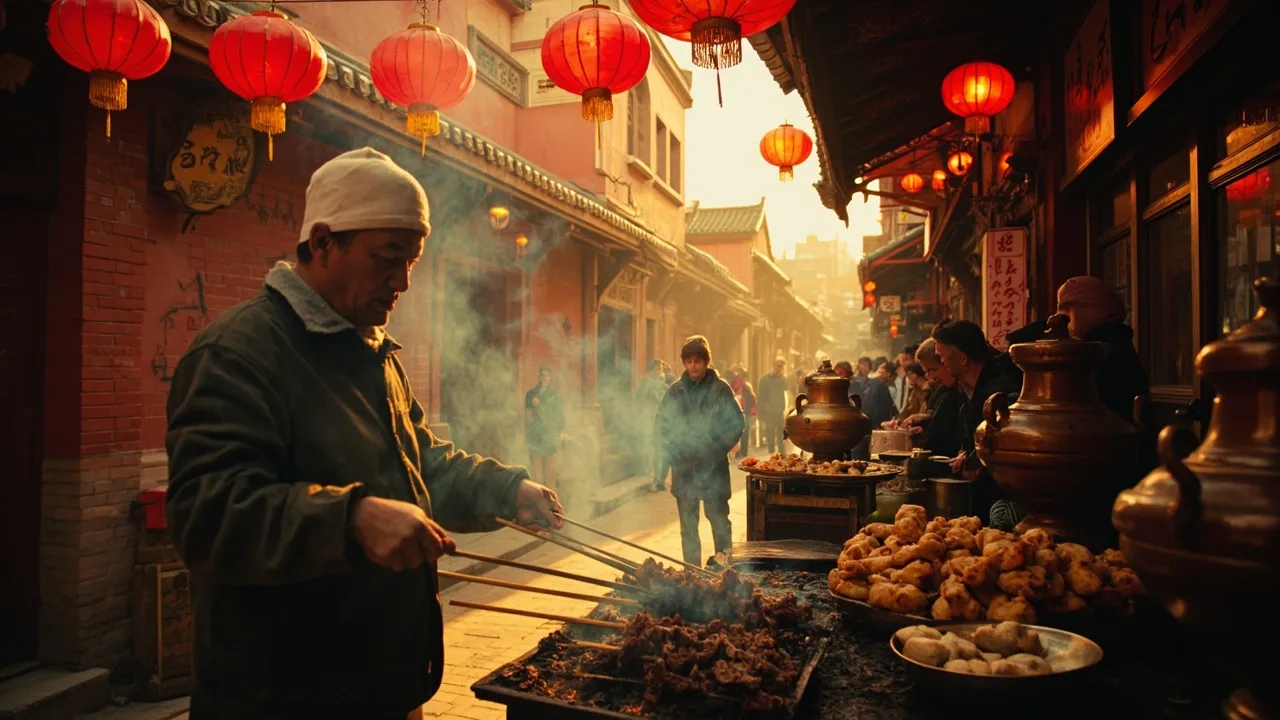
A Street That Feels Like Traveling Back in Time
The smell hits you first — a wall of char and spice as you squeeze through a crowd moving both ways down a narrow lane barely wider than a dining table. Giant sesame buns are being pulled from clay ovens. Skewers of lamb sizzle on open grills. A vendor hammers dough into paper-thin sheets for a snack that takes fifteen minutes to make and thirty seconds to devour.
This is the Huajue Xiang — the Xi’an Muslim Quarter — and it is one of the most electrifying food streets on the planet. No reservations, no menus in English, no tipping. Just push in, point, eat, and pay.
For American visitors, it feels like stepping into a night market in Istanbul crossed with a Chinatown that somehow ended up in central China. The Muslim community here — the Hui people, ethnic Chinese who practice Islam — has been feeding travelers on this exact spot for over a thousand years.
What makes the street feel genuinely ancient is not just its age but its continuity. The layout of Huajue Xiang hasn’t changed dramatically in centuries — the same narrow lane structure, the same orientation relative to the Great Mosque a few blocks away. Walk the street at 6 AM before the vendors fully set up, and you can see the clay ovens being fired, the same way they were fired in the Song Dynasty. There’s something almost archaeological about the whole scene.
For American food lovers, the closest comparison might be the grand covered markets of Istanbul’s Grand Bazaar — but Huajue Xiang is rawer, louder, and less curated for foreign palates. There’s no tourist menu with prices in English. Your best strategy is to watch what locals are buying and point at that. A smile and a pointing finger communicate across every language barrier.
The Hui People — Who They Are and How They Got Here
To understand the Xi’an Muslim Quarter, you need five minutes of context. The Hui are Chinese citizens who follow Islam. Unlike the Uyghur people of Xinjiang, the Hui are largely indistinguishable from their Han Chinese neighbors in language and daily dress — they speak Mandarin, wear the same clothes, go to the same schools. The difference is dietary: no pork, no alcohol, no blood in cooking. Lamb, beef, and flatbreads are the backbone of their cuisine.
How did a Muslim community end up in the ancient Chinese capital? Silk Road merchants. Starting in the 7th and 8th centuries, traders from Persia, Arabia, and Central Asia made their way east along the great trade routes, and many settled in Xi’an — China’s capital for thirteen dynasties. They married locally, adopted Mandarin, and passed their faith and food traditions down through generations. The Great Mosque of Xi’an has stood on this site since the Tang Dynasty.
The mosque was founded during the Tang Dynasty in the year 742 CE, when an Arab merchant named En Ci brought Islam to Chang’an (Xi’an’s ancient name, meaning “Long Peace”). The current mosque dates from the early Ming Dynasty, rebuilt in 1392 under the patronage of the Ming court. Unlike mosques in the Middle East, it was built in a Chinese architectural style — pagoda-style minarets, stone archways inscribed with Quranic verses in both Arabic and Chinese, courtyards with traditional Chinese stone carvings. Walking through the mosque’s gates feels like stepping into a building that exists in two civilizations at once.
What makes the Great Mosque’s history particularly fascinating is how it illustrates the tolerance of Tang Dynasty China. Emperor Xuanzong (712–756 CE) welcomed Persian and Arab merchants to Chang’an — the world’s largest city at the time, with a population exceeding one million. These merchants were permitted to practice their faith openly, build mosques, and intermarry with local families. This was not unusual for the Tang Dynasty, which was one of the most cosmopolitan periods in Chinese history. Chang’an had Zoroastrian temples, Nestorian Christian churches, and Manichean shrines alongside Buddhist monasteries and Taoist temples. Islam was simply one more faith in a city full of them.
The mosque’s physical layout reflects this cross-cultural synthesis. The 遥感石 (Yaogan Stone) — a free-standing stone marker in the mosque’s second courtyard — is carved with both Quranic calligraphy in Arabic and Chinese Buddhist-inspired cloud motifs. The mingling of decorative traditions is subtle but unmistakable to a careful observer. The minaret, which in Middle Eastern mosques serves to call the faithful to prayer, was here adapted into a pagoda-style tower — visually similar to Buddhist pagodas that Xi’an’s predominantly Buddhist population would have immediately recognized. This architectural translation made the mosque feel familiar rather than foreign to its neighbors, and may explain why it survived the various upheavals of Chinese history largely intact.
During the Song Dynasty (960–1279 CE), the Muslim community of Chang’an was officially recognized and given a degree of autonomy under the 回回司 (Huíhuí Si) — a government bureau that administered non-Buddhist religious communities. This administrative recognition gave the Hui merchants a formal structure that helped preserve their identity through the chaos of the Mongol conquest (when Marco Polo passed through in the 13th century) and into the Ming Dynasty. The Ming court under Zhu Yuanzhang actively recruited Muslim merchants as traders and diplomats, and several prominent Muslim families intermarried with the imperial lineage itself — the most famous being Zheng He, the great Ming admiral whose Muslim family served the court for generations. The Xi’an Muslim community thus has a direct historical connection to the same era that produced one of history’s greatest seafaring explorers.
The mosque compound covers about 12,000 square meters and contains five courtyards in the traditional Chinese 四合院 (sìhéyuàn) — courtyard house — arrangement. Each courtyard serves a different function: the first for ablution, the second for Quranic study, the third for prayer, the fourth for the imam’s residence, and the fifth for the mosque’s school. The oldest surviving elements are the 敕建碑 (Chi Jian Bei) — an imperial inscription stone tablet from 1392 — and a pair of massive bronze incense burners in the main prayer hall. Non-Muslim visitors are welcome during specific hours (typically 8–17:00) but should dress modestly and remove shoes at the entrance. Photography is permitted in the courtyards but not inside the prayer hall. Allow 45 minutes to an hour to explore properly. A small donation for maintenance is appropriate.
The mosque’s location, several blocks north of the main market street, is itself historically significant. The Muslim Quarter grew up in the lanes between the mosque and the old city walls. The relationship between the Hui community and the mosque was always the center of the neighborhood — not just a religious center but a community anchor in a city that was, for most of Chinese history, predominantly Buddhist and Taoist.
Xi’an’s Muslim community today numbers around 50,000 people, centered around the area south of the Bell Tower. The community maintained its distinct identity through Mongol rule (when Marco Polo passed through Chang’an in the 13th century), through the Ming Dynasty, through the Qing Dynasty’s occasional anti-Muslim tensions, and through the rapid modernization of 20th-century China. The food culture of the Muslim Quarter is the most visible expression of that continuity — a thousand-year-old culinary tradition that has not been homogenized into generic “Chinese food.”
What to Eat — Must-Try Dishes
The Muslim Quarter is not a place for picky eaters. It’s a place for people who want to taste history one skewer at a time.
Yang Rou Pao Mo — this is the dish that will ruin you for all other lamb dishes back home. A pit-fired flatbread — slightly charred, almost black at the edges — gets torn into irregular pieces and dropped into a bowl of rich lamb bone broth. Shredded lamb, cilantro, and green onions go on top. You tear the bread yourself, push it into the broth with your chopsticks, and eat it while it’s still fighting back against the soup. The bread soaks up the broth until it’s half dissolved — chewy, salty, intensely savory. Americans who try this often describe it as “lamb French onion soup meets a burrito.” It costs about $3.
Here’s something most travel guides skip: the best Yang Rou Pao Mo in the Muslim Quarter is not at the most famous stalls — it’s at the smaller shops two or three lanes off the main street where only locals go. Ask your hotel concierge (or a local food blogger’s recommendation) and follow the locals. The difference between good and great is the depth of the broth, and some shops have been simmering their bones for three days straight.
Da Za Gao — jumbo sesame bread the size of a human head. Steamed and loaded with red bean paste or sesame paste, it looks like a volleyball. You tear it apart with both hands. The texture is spongy and slightly sweet. You’ll see people walking down the street with a whole one tucked under their arm like a football. Pro tip: buy one in the morning when it’s freshest, and eat it plain — the sweetness of the paste doesn’t need any embellishment.
Lamb Skewers — every food show in China visits the lamb skewer stalls for good reason. The lamb is cubed, threaded on metal skewers, and grilled over charcoal with a dusting of cumin and chili flakes. The fat renders down until the outside has a slight char. A dozen skewers costs less than a fancy coffee in New York. Look for the older vendors — they’ve been grilling the same way for decades. Some of the most famous skewer stalls have been run by the same family for three generations. The old guy at the corner of the main lane has been grilling lamb since 1982. He doesn’t speak English, but he knows exactly how Americans react to his food, and he’ll smile when you reach for your second skewer.
This is actually a useful tip for navigating the skewer stalls: the most popular skewer vendors in the Muslim Quarter have facebook pages and WeChat official accounts that show their location and hours. Search “回民街羊肉串” (Huajue Xiang lamb skewers) on Baidu Maps before you go, and you can often find the specific stall rather than just the general area. The difference between a good skewer and a great one is the quality of the lamb and the age of the charcoal fire — both of which improve at the family-run stalls that have been running for decades.
How This Connects to American Culture: If you’ve eaten at a halal cart in New York City — the lamb over rice carts that are a New York institution — you are already tasting a food lineage that runs through the Xi’an Muslim Quarter. The cumin-and-chili-spiced grilled lamb that became a New York street food was brought by Chinese Muslim immigrants, many of them Hui, who opened restaurants in American Chinatowns starting in the early 20th century. The lamb skewer at Huajue Xiang is the original version of something you’ve probably eaten in Queens or Flushing. When you taste the charcoal char and the cumin dust on a skewer in Xi’an, you’re tasting a food that traveled 7,000 miles and stayed essentially the same.
Biang Biang Noodles — wide, thick, hand-pulled noodles in a garlic-chili-soy broth, topped with diced potato, chilis, and cilantro. Named for the sound the dough makes when it’s slapped against the counter. One bowl is a meal. It’s spicy, sour, and deeply savory all at once. The best version of this dish in the Muslim Quarter comes from a tiny shop near the north entrance where the owner makes the noodles by hand in full view of customers — you can watch the dough being slapped, stretched, and cut right before your eyes.
Giant Sesame Seed Cake (Shaobing) — a flatbread covered in sesame seeds, baked in a clay oven until the exterior is golden and slightly charred. Unlike the steamed Da Za Gao, shaobing is crispy on the outside and dense and chewy inside. It’s the most portable snack on the street — perfect for taking back to your hotel or eating while walking. Some vendors make a sweet version with lotus paste; others make a savory version with minced lamb. Both are worth trying.
For Americans with food allergies or dietary restrictions: the Muslim Quarter is one of the easier places in China to navigate for halal concerns. Every vendor can tell you exactly what’s in their food, and the Muslim community takes dietary laws seriously — cross-contamination with pork is not something you need to worry about here the way you might at a general Chinese restaurant.
Practical Information for American Visitors
Xi’an is served by Xi’an Xianyang International Airport with direct flights from Beijing, Shanghai, and other major hubs. From downtown, the Muslim Quarter is a short taxi ride or a fifteen-minute walk from the Bell Tower — the central landmark of the old city.
Hours: The street is liveliest from mid-afternoon until midnight. Morning is quiet; evening is chaos in the best possible way. If you want to photograph the street at its most atmospheric without the crowds, arrive at 7 AM — the vendors are setting up, the ovens are being lit, and the light is beautiful.
Cost: You can eat spectacularly for $10–15 per person. High-end restaurants in the area charge $20–30 per person. Neither is expensive by American standards. The most expensive thing on the street is a full sit-down meal at one of the restaurant’s second floors overlooking the market — still under $40 per person with drinks.
Language: Virtually no English menus. Download a photo translation app (Google Translate’s camera mode works adequately), or do what experienced travelers do — point at what the person next to you is eating. A pointing finger and a smile work across every language barrier. If you’re serious about the food, learn three phrases: “多少钱” (how much), “好吃” (delicious), and “再来一个” (one more).
Dress code: Modest dress is appreciated out of respect for the Muslim community. Cover your shoulders and knees, especially if you plan to visit the Great Mosque. This is not a religious police situation — it’s about basic respect. You’ll see local Hui women in hijabs and long coats, and you’ll see tourists in T-shirts. The key word is “respect.”
Cash: Many small vendors do not accept mobile payment or cards. Bring small bills and change. The vendors prefer paper RMB — wrinkled bills are fine, they don’t care. ATM machines are plentiful near the Bell Tower.
Best time to visit: October through April offers the most comfortable temperatures for walking and eating outdoors. July and August are brutally hot — the narrow lane becomes a heat trap with all the clay ovens going. Chinese public holidays (National Day Week in early October, Chinese New Year in January/February) bring enormous crowds. Avoid if possible; if you can’t avoid, go early morning.
Photography tip: The Muslim Quarter is most photogenic at two very different times of day. Early morning (6–8 AM) captures the vendors setting up, the ovens being lit, and the lane in quiet working mode — the best light is roughly 20 minutes after sunrise when the lane faces east and gets golden light. The evening (7–9 PM) captures the full chaos of dinner service — the grills are blazing, the lanterns are lit, and the crowd is at its densest. For a photographer’s eye view of the lane, the small pedestrian bridge near the south entrance gives you an elevated vantage point over the main flow of foot traffic without blocking anyone’s path.
Where to stay: For first-time visitors, the best base is the area within walking distance of the Bell Tower — the center of Xi’an’s old city and a short walk from the Muslim Quarter’s south entrance. The Sofitel Xi’an (Bell Tower area, $120–180/night) offers French-chain luxury within easy striking distance of both the Muslim Quarter and the City Walls. Budget travelers should consider the Citadines Central Hotel Xi’an ($50–80/night) near the Bell Tower with excellent breakfast included. For a boutique experience, the Hana Hotel ($90–130/night) is a converted courtyard property with Muslim Quarter atmosphere but quiet nights. All three have English-speaking staff and can arrange airport transfers.
Why Every Traveler Should Go
Here’s the thing about the Xi’an Muslim Quarter that most travel guides skip over: it’s not a tourist trap. Yes, it’s famous. Yes, there are other tourists. But the food is not performance — it’s daily life. These vendors have been feeding their neighbors for generations. The recipes haven’t been gentrified or sanitized for foreign palates. The lamb skewer that costs $0.50 is the same lamb skewer a Xi’an university student buys after class.
If you’ve been to China before and only saw the Great Wall and the Forbidden City, you’ve seen the China that tourists are shown. The Muslim Quarter is the China that people actually live in — historic, flavorful, loud, a little chaotic, and absolutely unforgettable.
American visitors often ask if this is “authentic” Chinese food. It is — just not the Chinese food you’re imagining. China has fifty-six recognized ethnic groups, and the Hui are one of the largest. This is as real as it gets.
What makes the Muslim Quarter particularly fascinating for American visitors is how it challenges the simplified “Chinese food” narrative that most Americans arrive with. You’ve probably eaten “Chinese food” at malls across America — orange chicken, fried rice, generic stir-fry. The Muslim Quarter is what Chinese food actually is when it comes from a specific community with a specific history and a specific faith tradition. It’s regional, ethnic, and deeply contextual in a way that the Americanized version deliberately obscures.
There’s also a practical connection for American food culture: the lamb skewer has already crossed over. Walk through any night market in American cities with a significant Asian population — Flushing, Queens; Monterey Park, California; Houston’s Midtown — and you’ll find lamb skewers grilled the same way, with the same cumin and chili dust. The Xi’an Muslim Quarter is the origin point for a food that has already become part of American food culture’s broader Asian landscape. When you eat a lamb skewer in Queens, you’re tasting a lineage that runs through Huajue Xiang.
Skip the chain restaurants near the tourist sites. Walk twenty minutes south of the Bell Tower, follow the smell of charcoal and cumin, and push into the Huajue Xiang. Buy a lamb skewer. Tear open a sesame bun. Sit on a plastic stool if you have to.
The Xi’an Muslim Quarter is not pretty. It is not quiet. It is not easy to navigate if you don’t read Chinese. But it is one of the great street food experiences in the world, and you will remember the taste of that lamb broth long after you’ve forgotten the line at the Terracotta Warriors.
For American visitors, there is a particular connection that many don’t expect: the Hui Muslim community of Xi’an represents one of the oldest continuous Muslim populations in the world outside the Middle East, predating the Muslim communities of Western Europe by several centuries. When you walk through the Huajue Xiang, you are walking through a community that has been practicing Islam in China for over 1,200 years — longer than Islam has existed in most of the Western world. That historical weight gives the food a gravity that a typical street market elsewhere simply doesn’t have. Every clay oven in the lane is, in a small way, a monument to the resilience of a community that found a way to be both Chinese and Muslim, maintaining a distinct identity through some of the most turbulent centuries in human history.
There is also a direct food connection worth noting for American palates. The flavor profile of the Muslim Quarter — cumin, chili, lamb, and fermented wheat — traveled along the Silk Road in both directions. Cumin and coriander, which are fundamental to the flavor of both Xi’an lamb skewers and tacos al pastor in Los Angeles, are the same spices that moved east from the Mediterranean and West from South Asia along these ancient trade routes. The skewer you eat in Huajue Xiang and the one you might eat at a Los Angeles food truck share a spice ancestry that runs back to the same camel caravans. Food, like culture, is never as isolated as political borders suggest. The Muslim Quarter makes that argument plate by plate.