Yellow River: China’s Ancient Cradle of Civilization
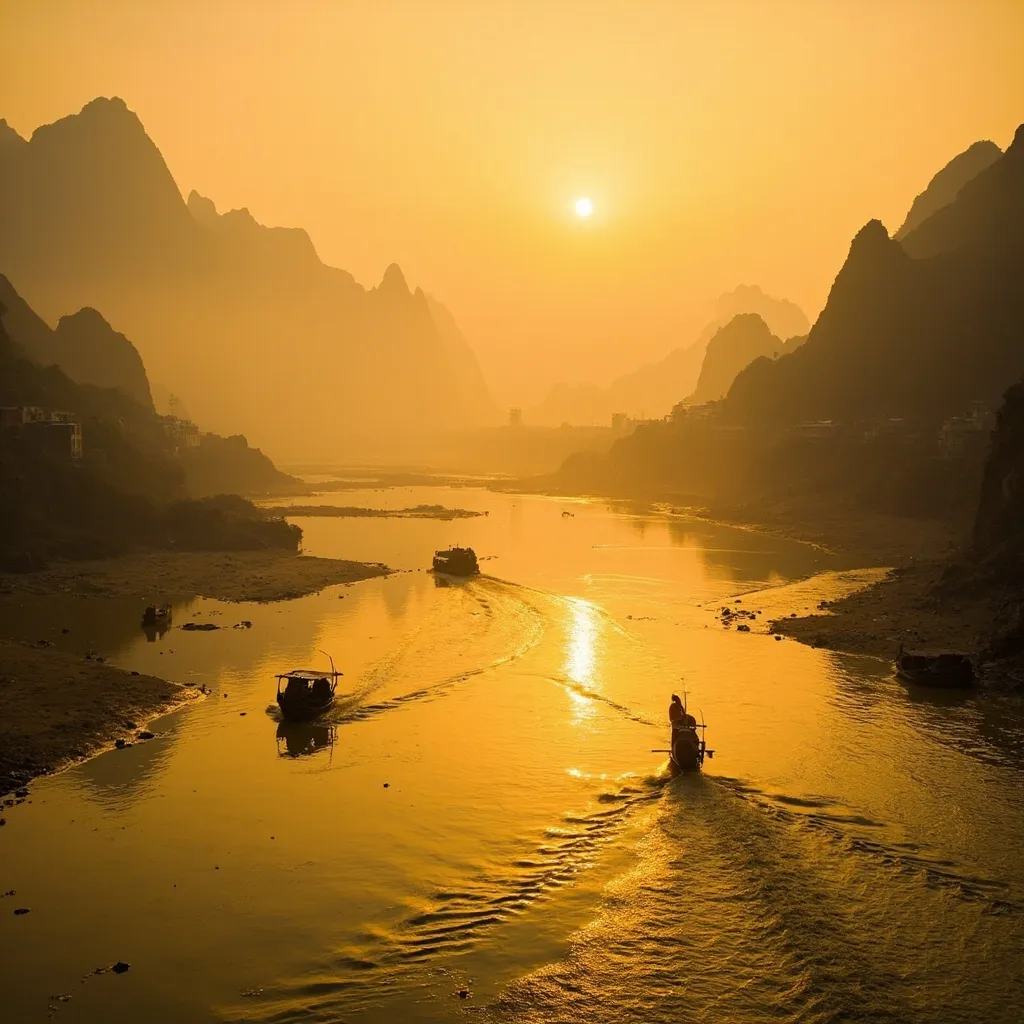
The Yellow River cuts through the heart of China like a great brown vein, carrying with it the sediment of millennia and the weight of an entire civilization’s memory. Known in Chinese as Huang He, this magnificent waterway stretches over 5,400 kilometers from the Tibetan Plateau to the Bohai Sea, passing through some of the most historically significant terrain on Earth. The river takes its name from the enormous quantities of loess soil—pale yellow silt—that it carries downstream, giving the water a distinctive muddy appearance that has inspired poets, frightened peasants, and shaped dynasties for more than five thousand years.
There is something almost mythic about the Yellow River’s role in Chinese history. Ancient texts describe the sage rulers Yu the Great and Fuxi emerging from regions watered by this river, and archaeological discoveries over the past century have largely confirmed what Chinese tradition always claimed: this was the birthplace of Chinese civilization. The settlements that grew along its banks were among the earliest urban centers in China, and the agricultural surplus they generated allowed for the development of writing, bronze metallurgy, and the complex political structures that would eventually become the Chinese imperial system.
Yet the Yellow River has never been a gentle provider. Its tendency toward catastrophic flooding earned it names like “China’s Sorrow,” and the river’s behavior shaped not only where cities were built but also which dynasties survived and which fell. Managing the Yellow River was perhaps the greatest engineering challenge facing Chinese governments throughout history, and the success or failure of flood control efforts often determined the fate of emperors and the stability of the state.
Origins on the Tibetan Plateau
The Yellow River begins its epic journey on the Tibetan Plateau, one of the most remote and inhospitable regions on Earth. Its two main source streams, the Gyaring Lake and Ngöring Lake in the Bayan Har Mountains of central China’s western territory, emerge from glacial snowmelt at an elevation exceeding 4,500 meters above sea level. The cold, clear water in these high altitude marshes seems almost disconnected from the muddy torrent the river eventually becomes downstream, yet the connection is already evident in the pale color of the water from its very beginning.
From these modest origins, the Yellow River flows first eastward through the grasslands of the Tibetan plateau, then turns sharply northward to describe a great arc through Inner Mongolia. This northern section was historically important for another reason: it passes through the Ordos Desert, where the river picks up the vast quantities of loess sediment that give it its characteristic yellow color. The loess, fine windblown dust deposited during the last ice age, is incredibly soft and easily eroded. When rain and snowmelt rush into the Yellow River’s tributaries from the surrounding hillsides, they carry enormous loads of this pale sediment into the main channel.
The river’s behavior through this upper section established patterns that would persist throughout its journey. The gradient is steep, the current is swift, and the water carries enormous energy and sediment. These characteristics make the upper Yellow River powerful but relatively stable—it is only when the river reaches the flat plains of central and eastern China that the real trouble begins. There, the river slows dramatically, deposits its sediment, raises its bed above the surrounding countryside, and becomes the unpredictable and dangerous force that has shaped Chinese history.
The Loess Plateau: Fertile Soil and Ancient Cultures
South of the great northern bend, the Yellow River flows through what geographers call the Loess Plateau, a vast region of yellow-brown soil covering parts of Shanxi, Shaanxi, and Henan provinces. This is one of the most distinctive landscapes on Earth, where thick layers of windblown silt have accumulated over millions of years to create a terrain of gently rolling hills and steep-sided valleys. The soil is extraordinarily fertile when properly watered, which is why this region supported some of China’s earliest agricultural communities.
The ancient city of Xi’an, now famous worldwide for the Terracotta Army of Emperor Qin Shi Huang, lies at the eastern edge of the Loess Plateau. The surrounding region was home to numerous Neolithic cultures dating back seven or eight thousand years, including the famous Yangshao culture known for its painted pottery. These early farmers cultivated millet in the rich loess soil, domesticating plants and animals that would become central to Chinese civilization. The surplus generated by this productive agriculture allowed populations to grow, settlements to expand, and eventually the complex urban centers of the Bronze Age to emerge.
The loess terrain presented both opportunities and challenges to ancient settlers. The soil was indeed fertile and relatively easy to work with simple wooden tools, making agricultural expansion relatively straightforward. But the same softness that made the soil easy to cultivate also made it vulnerable to erosion. When vegetation was cleared for farming and the dry loess hills were exposed to summer rainstorms, the consequences could be devastating. Flash floods carved deep gullies into the hillsides, creating the distinctive huang tu (yellow earth) landscapes that characterize the region. This erosion contributed enormous quantities of additional sediment to the Yellow River below, accelerating the river’s tendency to aggrade and raise its bed in the eastern plains.
Archaeological investigations in the Loess Plateau have revealed layers of ancient flood deposits, burnt remains of early settlements, and evidence of climate fluctuations that shaped human settlement patterns over thousands of years. The relationship between environmental change and cultural development is written in these soil layers, telling stories of periods when the climate was wetter and populations expanded, alternating with drier periods when settlements were abandoned and populations contracted. Pollen analysis and sediment core studies have allowed scientists to reconstruct the environmental history of the region, revealing patterns of drought and humidity that correlate with major transitions in Chinese prehistory. These scientific investigations have confirmed what oral traditions and historical records suggest: the Loess Plateau has always been a challenging but rewarding environment, and human societies here have developed sophisticated strategies for surviving and thriving in this marginal but fertile landscape.
Ancient Capitals Along the Yellow River
The Yellow River basin was not merely an agricultural heartland but also the political and cultural center of early China. The earliest historical capitals of the Chinese civilization rose along its banks, establishing patterns of imperial geography that persisted for over two thousand years. Understanding why ancient rulers chose this region for their capitals requires understanding both the river’s resources and its symbolic significance.
The city of Luoyang was perhaps the most important of these early capitals. Situated at the confluence of the Luo and Yellow Rivers in present-day Henan Province, Luoyang served as capital during numerous dynasties, including the Eastern Zhou, Eastern Han, Cao Wei, and Northern Wei. Its position at the junction of north and south China made it a natural choice for rulers seeking to control the Heartland. The famous Longmen Grottoes, containing thousands of Buddhist sculptures carved into limestone cliffs, attest to Luoyang’s cultural significance during the Tang Dynasty.
Kaifeng, further east on the banks of the Yellow River, represents another important capital. During the Northern Song Dynasty (960–1127 CE), Kaifeng was the largest city in the world, with a population exceeding one million inhabitants. The Song Dynasty’s commercial revolution, featuring the development of printing, gunpowder, and paper money, occurred largely in this Yellow River basin region. Marco Polo visited Kaifeng and left descriptions of its magnificent temples, bustling markets, and sophisticated urban infrastructure—evidence of the wealth and complexity that the Yellow River’s agricultural surplus had made possible.
The city of Anyang, further still to the northeast, holds special significance as the last capital of the Shang Dynasty and the site where modern archaeologists first confirmed the existence of Chinese urban civilization dating to the second millennium BCE. The Anyang excavations revealed royal tombs, bronze workshops, and the earliest examples of Chinese writing on oracle bones—discoveries that transformed understanding of Chinese prehistory. These archaeological findings demonstrated that the Yellow River basin was indeed the cradle of Chinese civilization, as Chinese tradition had always claimed.
The selection of these capital sites was never arbitrary. Rulers sought locations that could be defended against military threat, that had access to the river for transportation and irrigation, and that commanded the agricultural heartland of the nation. The Yellow River fulfilled all these requirements, and its symbolic importance as the source of civilization and imperial legitimacy added spiritual weight to the political and strategic considerations. To rule from the Yellow River was to connect oneself with the deepest roots of Chinese civilization.
The Yellow River in Chinese History and Culture
The Yellow River’s influence on Chinese history extended far beyond agriculture and geography into the realms of philosophy, art, and national identity. The river’s dual nature—as both a generous provider and a terrifying destroyer—became a central metaphor in Chinese cultural discourse about the relationship between humans and nature, between the ruler and the people, and between tradition and change.
Chinese political philosophy developed in direct response to the river’s challenges. The ancient idea that a sage ruler should govern through moral virtue rather than coercion was partly rooted in observations of how the river behaved. When rulers were just and responsible, the logic went, the river would flow calmly and the harvests would be abundant. When rulers were corrupt or negligent, the river would flood and disaster would follow. This symbolic connection between political legitimacy and natural order gave the Yellow River an almost sacred character in Chinese political thought.
The great floods of the Yellow River repeatedly reshaped Chinese history in tangible ways. In 1853, a massive flood changed the river’s lower course dramatically, driving millions of refugees from their homes and contributing to the social chaos that undermined the Qing Dynasty. Earlier floods during the Yuan and Ming Dynasties killed hundreds of thousands and forced the relocation of populations on a scale that would have severe political consequences. Managing flood risk was not merely an engineering challenge but a political imperative that could make or break dynasties.
The river also features prominently in Chinese literature and art, from classical poems describing its majesty to paintings showing the yellow water rushing through dramatic landscapes. The river’s color, somewhere between gold and mud depending on light and season, inspired associations with imperial power and the fertile earth. The Yellow River Elegy, a traditional folk song, memorialized the river’s power over human life and became an unexpected anthem of political dissent during the 1970s and 1980s, demonstrating how deeply the river had penetrated Chinese cultural consciousness.
Today, the Yellow River remains vital to northern China’s economic development. Massive dams and reservoirs generate hydroelectric power, irrigation projects draw water to agricultural fields throughout the region, and the river’s basin supports hundreds of millions of people. The environmental challenges are severe—water scarcity due to upstream diversions, industrial and agricultural pollution, and the ongoing threat of flooding in the lower reaches—but the river that birthed Chinese civilization continues to sustain the people who have always called its banks home. The Yellow River’s story is far from over; if anything, it is entering a new chapter in which human ingenuity must find ways to preserve this ancient resource while meeting the demands of a modern industrial economy. The lessons learned from millennia of human-river interaction along the Yellow River may prove essential not just for China but for all civilizations grappling with the challenges of climate change and sustainable development.
The environmental challenges facing the Yellow River today are unprecedented in the river’s history. Water tables throughout the basin have dropped dramatically as cities and farms draw more water than the river can replenish. The lower reaches have experienced chronic drying, with the river bed sometimes going completely dry for months at a time. Industrial pollution from factories along the river’s course has created serious water quality problems, affecting both human health and aquatic ecosystems. Yet Chinese engineers and policymakers are working on solutions, from massive South-North Water Transfer projects that divert water from the Yangtze to the Yellow River basin, to environmental restoration programs that aim to replant vegetation on the degraded Loess Plateau. The river’s future will depend on whether these efforts succeed in balancing human needs with ecological sustainability.
Recommended Products
Explore the rich history and culture of China’s Yellow River region with these carefully selected affiliate recommendations:
Yellow River: Environment and Civilization – Historical Documentary – A comprehensive documentary exploring the Yellow River’s role in Chinese civilization from ancient times to the present day.
Loess Plateau Photography Book – Stunning visual journey through the Loess Plateau landscape, featuring interviews with local communities and archaeological sites.
Ancient Chinese Capital Bronze Replica Set – Museum-quality bronze replicas inspired by artifacts found at Yellow River basin archaeological sites, including Shang Dynasty designs.
Yellow River Tea Set Collection – Traditional Chinese tea set featuring designs inspired by Yellow River regional art and natural motifs.
Terracotta Army Museum Quality Figurine Set – Detailed collector’s replicas of the famous Terracotta Warriors discovered near Xi’an in the Yellow River basin.
The Yellow River remains a powerful symbol of Chinese civilization’s resilience and ingenuity. Its history reflects both the challenges of living with a powerful natural force and the human capacity to adapt, innovate, and thrive.