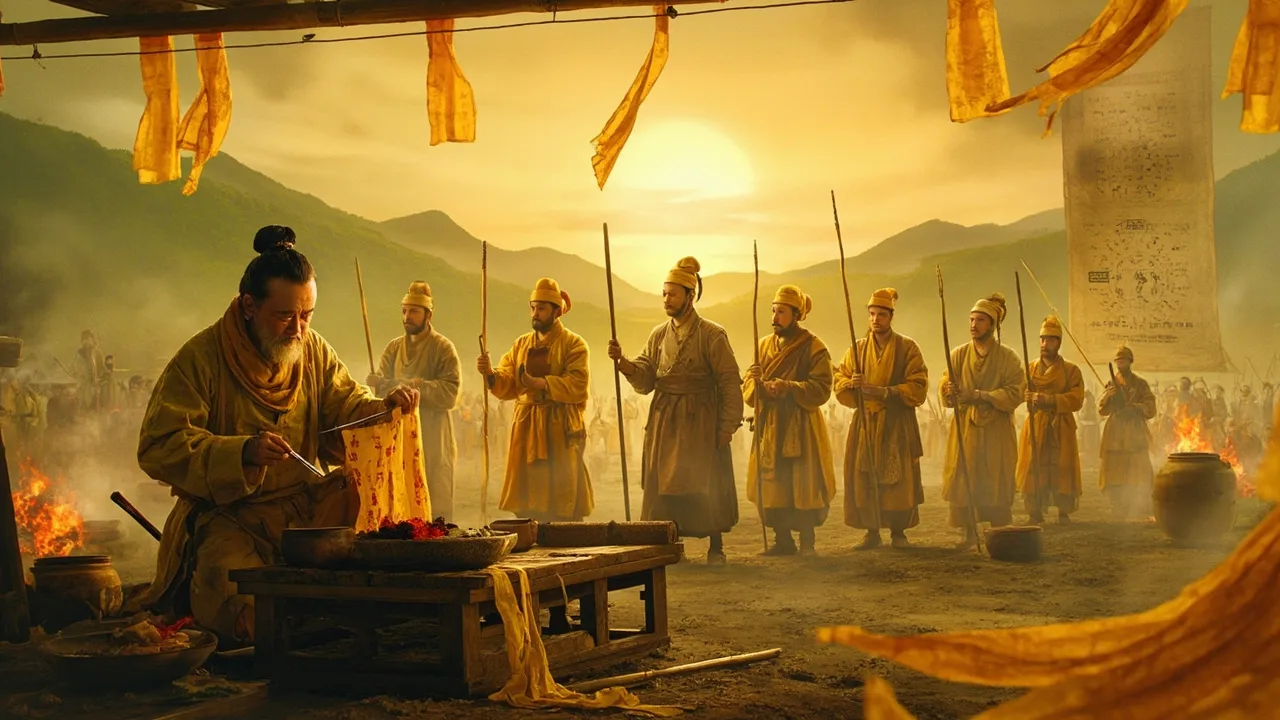
In the second year of the Yellow Turban Rebellion, a young cavalry officer named Cao Cao was given command of five thousand imperial horsemen and told to crush a peasant army that, a few months earlier, had been nothing more than a circle of villagers chanting prayers over a jar of yellow water. He was twenty-nine years old. He had not yet become the warlord of the north. He had not yet forced Emperor Xian to abdicate in his favor. He had not yet said, “I’d rather betray the world than let the world betray me.” All of that came later. What came first was yellow scarves, talisman water, and a slogan that said the sky itself was about to change.
The Yellow Turban Rebellion of 184 CE did not by itself destroy the Han Dynasty—Han lasted, on paper, another thirty-six years. But it broke the spine of the central government. Once the court in Luoyang released the reins of military power to the provinces to fight the rebels, those reins never came back. The warlords who raised armies to suppress the rebellion—He Jin, Dong Zhuo, Cao Cao, Yuan Shao, Sun Jian, Liu Bei—became the players of the Three Kingdoms era (220–280 CE). The Yellow Turban Rebellion, in other words, is not a side story. It is the bang before the long, clattering fall.
What the Yellow Turbans Actually Believed
Most popular retellings get this part wrong. The Yellow Turbans were not Buddhist. They were not a generic peasant mob. They were Taoist millenarians—the followers of a specific mystical current called the Way of Supreme Peace, or Taiping Dao (太平道), a popular branch of late-Han religious Taoism that taught the cosmos moved through great cosmic ages, each ruled by a differently colored “Heaven.” Their leader, Zhang Jiao (张角), was a charismatic healer from Julu in present-day Hebei. He had a younger brother, Zhang Bao, and another, Zhang Liang, both of whom served as his lieutenants.
Zhang Jiao’s practice was simple and effective. He would gather sick and suffering villagers, bow nine times over a jar of water, and chant prayers over ash to make talisman water (符水). Villagers drank the water believing it would cure disease. Sometimes it did, because the placebo effect is real, and because Zhang Jiao’s movement organized charitable care that the bankrupt imperial government could no longer provide. Word spread. By the late 170s, Zhang Jiao’s network—the Way of Supreme Peace—claimed somewhere between 100,000 and 400,000 followers across eight provinces, organized into thirty-six “fang” (方), or regional divisions, each led by a “generalissimo” (渠帅).
The slogan that terrified the Han court was a four-line prophecy written in doggerel verse, easy to memorize and impossible to forget:
苍天已死,黄天当立,岁在甲子,天下大吉 “The Blue Sky is dead. The Yellow Sky will rise. The year is Jiazi. The world will be blessed.”
In Han cosmology, the Blue Sky (苍天) represented the ruling Han dynasty itself—the Han emperors were said to rule under the cosmological mandate of the blue heaven. The Yellow Sky (黄天) was the coming new age. The Jiazi year was 184 CE in the sexagenary cycle, the year the cosmic turnover would happen. Combine a population groaning under tax collectors, a charismatic faith healer, a believable prophecy, and a specific date, and you have a revolutionary movement. The Yellow Turbans—a name that came from the yellow headscarves (头巾) members wore as a uniform—chose that year to rise.
The superstition cut both ways. The court in Luoyang, predictably, panicked. The emperor at the time was Emperor Ling (汉灵帝), a man more interested in selling offices to fund his palace concubines than in governing. When a palace eunuch named Tang Zhou reported the coming uprising, the court had the chance to act. Instead, the courts’ reaction was to blame the messenger. Tang Zhou was executed; the rebellion was not preempted. Later, Tang Zhou would be remembered as a martyr to the dynasty’s incompetence.
Why the Han Was Already Crumbling Long Before 184
The rebellion’s speed and reach only makes sense if you understand how rotten the late Han court had already become. The dynasty was not toppled in 184; it was already toppled in slow motion for at least two decades before.
The first crack came in 166 CE and 169 CE, in a series of events called the Disasters of Partisan Prohibition (党锢之祸). Confucian student protesters and reformist officials had begun demanding that the imperial court root out the corruption of the eunuch faction—the same court insiders who had murdered Tang Zhou. The eunuchs responded by accusing the students of forming a seditious clique. Emperor Ling, ever the tool of his inner circle, agreed. Across two purges, hundreds of Confucian scholars and reformist officials were arrested, killed, or forced into hiding. Their leader, the famous Li Ying (李膺) and the “Eight Gentlemen of the Era” (八顾), were either executed or imprisoned for life. The lesson was clear: anyone in the Confucian gentry who tried to clean up the government would be silenced. The court then stopped even pretending to govern.
The second crack was fiscal. Emperor Ling, desperate for cash to fund his pleasures—his private gardens, his host of palace women, his exotic pets—began auctioning official posts (卖官). Civil offices, including county magistrate and provincial governor, could be purchased outright. Buyers, of course, wanted to recoup their investment, so they squeezed the rural population with arbitrary taxes. Local grievances piled up. Few people had faith in the imperial system. When Zhang Jiao’s healers arrived offering free care and a cosmic promise, the peasants had no reason to refuse.
By the time the Yellow Turbans rose, the Han state had three big problems: it had neutered its own Confucian reformers, it had delegated local administration to the highest bidder, and it had lost the moral authority to claim the Mandate of Heaven. The Millenarian slogan “the Blue Sky is dead” was not a threat. It was an observation.
The floods that broke the Yellow River’s dikes in 170 CE and again in 184 CE made the picture worse. Displaced peasants, ruined harvests, and the slow death of the granary system turned the central plains into a tinderbox. Tax collectors from the new breed of auction-purchased magistrates moved through villages that had nothing left to give. When Zhang Jiao’s disciples walked those same roads with a jar of talisman water and a promise that heaven itself was about to change colors, the villagers had no reason to turn them away. The rebellion did not need to convert skeptics. It only needed to give the desperate somewhere to walk.
The Rebellion Itself
The planned date for the uprising was the third month of 184 CE. A conspiracy of palace eunuchs, defected to the rebels, leaked the plan. The imperial court finally awoke. They arrested and executed one of Zhang Jiao’s disciples in Luoyang, and the Yellow Turbans, warned, launched the revolt a month early.
What followed was chaos. Across the eastern provinces, Yellow Turban columns attacked local government offices, killed corrupt officials, and looted granaries. Some of the rebels were disciplined and organized—their early victories included the capture of regional capitals. The famous Battle of Changshe (长社之战) saw Zhang Jiao’s main army besiege the strategic city of Changshe in Henan. Another column under Bo Cai (波才) trapped imperial forces under Huangfu Song (皇甫嵩) and Cao Cao in a grass field that the rebels set alight. The wind, by luck, turned; the flames swept back into the Yellow Turban ranks. Huangfu Song and Cao Cao counterattacked and won.
The imperial court scrambled to name generals. Three names became synonymous with the suppression campaign: Lu Zhi (卢植), a stern Confucian scholar-general who led the first main army against Zhang Jiao; Huangfu Song (皇甫嵩), the decisive strategist who broke the main Yellow Turban force; and a young Cao Cao (曹操), then a minor cavalry commander, who cut his teeth on the eastern front. Within the year, the empire’s trained armies had killed most of the large Yellow Turban columns.
Zhang Jiao himself, however, never saw most of this. He had been ill for some time before the uprising. He died of disease near the city of Julu in the autumn of 184, while his brothers were still fighting. His younger brother Zhang Bao took over, only to be killed by Huangfu Song at the Battle of Quyang. The third brother, Zhang Liang, survived a few months longer before being killed by Cao Cao at the Battle of Yangxia. The Taiping Dao’s central leadership was gone within a year of the uprising it had spent a decade building.
The mistake popular histories make is putting Zhang Jiao on the battlefield. He wasn’t there. He was a religious leader with a fever, surrounded by burning talismans and dying followers. The charismatic figure who organized the rebellion died of illness, as frail as any of the peasants he had once healed. The rebellion outlived him by only months. The reckoning it unleashed would last four centuries.
What Came After: The Warlord Era
The Yellow Turban Rebellion was suppressed. The Han Dynasty survived. In every meaningful sense, however, the rebellion had already won.
The first structural change was military. To crush the uprising, the imperial court had released the commanderies to raise their own armies and appoint their own generals. Once those armies and generals existed, the court had no way to disband them. Provincial governors, generals, and clan leaders became de facto autonomous rulers. The most powerful warlords of the late Han—He Jin (何进), the general and regent who tried to purge the eunuchs in 189 CE and was murdered in his own palace; Cao Cao, who rose from the Yellow Turban campaign to dominate the north; Yuan Shao (袁绍), whose family had squandered four generations of political capital; Dong Zhuo (董卓), the brutal frontier general who burned Luoyang and moved the capital to Chang’an—were all products of the military decentralization that the Yellow Turban Rebellion made necessary.
The second change was cultural. The Han cosmological order—Han heaven, Han emperor, Han peace—had been publicly contested by a Taoist prophecy claiming heaven itself was changing colors. Even after the rebellion was crushed, the prophecy did not go away. Local millenarian cults, including the Yellow Turbans’ spiritual successors such as the Five Pecks of Rice (五斗米道), the western Taoist movement that would evolve into the organized religious Taoism of later centuries, continued to flourish in the uplands of Sichuan and the Hanzhong basin. The Han emperors had lost the monopoly on legitimacy.
The final change was the rise of the Three Kingdoms (220 CE). When the last Han emperor, Emperor Xian, formally abdicated in 220 CE, the dynasty had been hollow for decades. The actual handover was almost an afterthought—the last rites of a body that had stopped breathing in 184 but had been kept on its feet for thirty-six years by generals, eunuchs, and inertia. The Three Kingdoms that followed is one of the most mythologized periods in Chinese history: the heroes of the period—Liu Bei of Shu, Cao Cao of Wei, Sun Quan of Wu—became the central characters of the Romance of the Three Kingdoms (三国演义), the fourteenth-century historical novel that has shaped Chinese popular memory for six hundred years.
The Yellow Turban Rebellion, in this sense, is the inciting incident of everything else. The charismatic healer with the yellow scarves. The collapse of imperial legitimacy. The rise of the warlords. The centuries of civil war. The eventual reunification under the Jin, and then the fragmentation again. The long, slow slide from a unified Han golden age into the disunion of the medieval period. To understand the Three Kingdoms, you have to start with the Yellow Turbans.
Reading and Seeing the Era
If you want to read further into this period, the obvious starting point is the Romance of the Three Kingdoms (三国演义) by Luo Guanzhong, the Ming-dynasty novel that turned the historical Three Kingdoms into legend. It is a romance, not a history, but it has shaped how Chinese readers imagine Cao Cao, Liu Bei, and Zhuge Liang for centuries. For a more sober historical account, the Records of the Three Kingdoms (三国志) by Chen Shou, written in the third century CE, is the canonical primary source. Modern historians like Rafe de Crichton and Tian Yuqing have also written accessible English-language treatments of the late Han and the road to the Three Kingdoms.
If you want to feel the era, the Battle of Red Cliffs—the 208–209 CE naval showdown where Cao Cao’s northern empire was stopped by a coalition of Wu and Shu—is the natural follow-up. It is the true beginning of the Three Kingdoms period, and it is the moment where Zhang Jiao’s failed rebellion finally pays its long-delayed dividend. For the other half of the story, the strategist Zhuge Liang—the sleeping dragon of Wuhou, who kept the state of Shu alive for decades against impossible odds—is the figure whose quiet, scholarly Taoism embodies the very religious tradition that the Yellow Turban movement had tried to weaponize.
Continue reading: