Yin Yang and Five Elements: The Cosmic Framework Behind Chinese Thought
Look at a taijitu—the famous symbol with swirling black and white halves—and you’ve encountered one of the most recognizable images from Chinese culture. This yin yang symbol represents a vision of reality that has shaped Chinese thought for over three thousand years. Beneath this elegant simplicity lies a sophisticated framework for understanding change, balance, and the relationships between all things. The complementary forces of yin and yang, together with the dynamic interactions of the Five Elements, provide a lens for interpreting everything from imperial politics to personal health, from the timing of weddings to the arrangement of furniture. For anyone seeking to understand Chinese culture at a deeper level, grasping these foundational concepts opens doors to art, medicine, philosophy, and worldview that might otherwise remain opaque.
The Philosophy of Yin and Yang: Unity of Opposites
The concept of yin and yang offers perhaps the most fundamental framework in Chinese thought. These terms, originally referring to the shady and sunny sides of a mountain, evolved into a comprehensive philosophy describing how complementary opposites interact to create the world we experience. Far from simple dualism, this framework understands opposing forces as interdependent, transforming into each other, and containing seeds of their opposites.
Yin represents the receptive, still, dark, cold, interior, and feminine aspects of reality. Yang represents the active, moving, bright, warm, exterior, and masculine aspects. Yet defining either term completely requires reference to its complement. Day is yang compared to night (yin), but winter is yin compared to summer (yang). The same quality can be yin or yang depending on what it’s being compared to—a lake is yang relative to the deep earth but yin relative to the air above it. This relativity reflects a worldview that understands all things in relationship rather than as isolated entities.
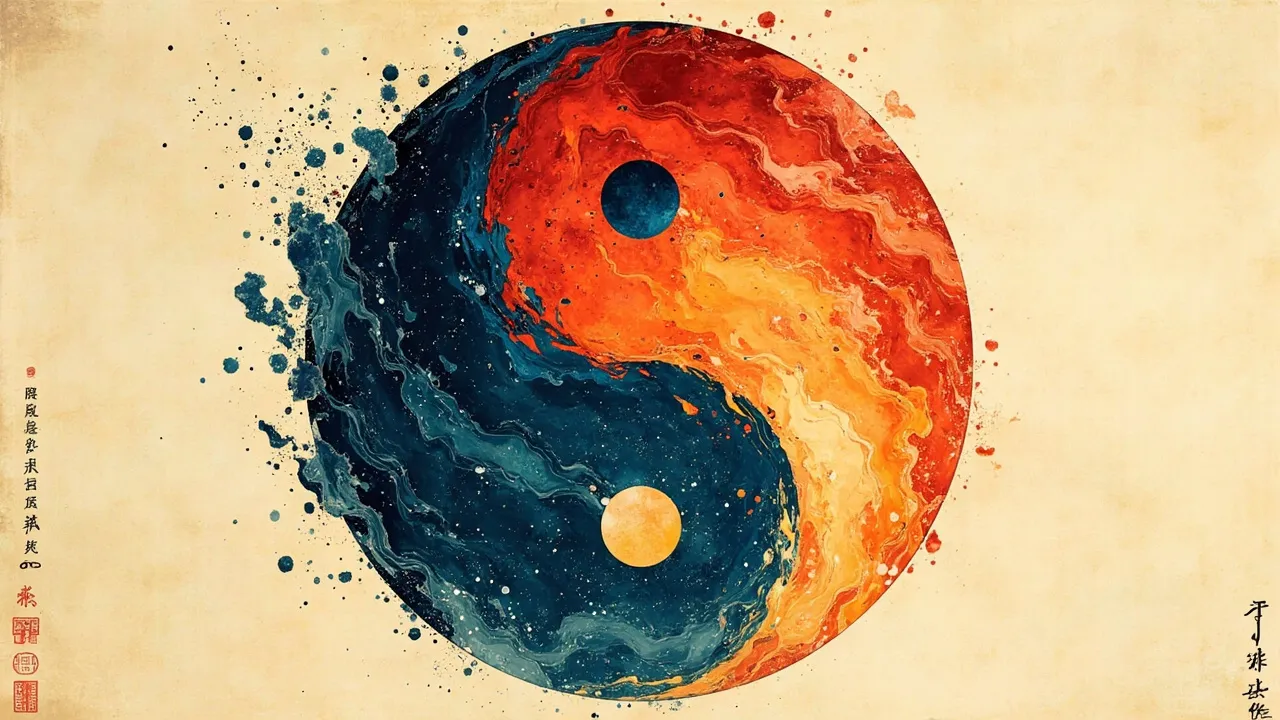
The central insight of yin yang philosophy is that these opposites aren’t simply opposed—they’re mutually generating. Yin contains the seed of yang; yang contains the seed of yin. The classic symbol shows this beautifully: within the black (yin) area there’s a white dot, and within the white (yang) area there’s a black dot. This isn’t decorative—it represents the truth that at the peak of any extreme, the opposite force begins to arise. The hottest part of summer contains the seeds of autumn’s cooling; the darkest moment of winter contains the seeds of spring’s renewal.
The dynamic interaction between yin and yang produces all change and transformation. Stagnation—complete absence of either force—represents not balance but death. True harmony comes from appropriate relationship between the opposites, with each supporting and containing the other. Too much yang produces chaos, hyperactivity, burnout. Too much yin produces depression, stagnation, paralysis. Health, in this framework, means the dynamic flow between opposites, each appropriately expressed according to circumstances.
This understanding has profound practical implications. In Chinese medicine, illness often results from inappropriate balance between yin and yang in the body or in the relationship between body and environment. Treatment aims to restore proper flow and balance rather than simply eliminating symptoms. In warfare, the great strategist Sun Tzu taught that successful generals understand when to be yin (passive, defensive, yielding) and when to be yang (active, aggressive, taking the initiative). In business and personal life, wisdom involves recognizing which quality the situation requires.
The Five Elements: A Dynamic System of Relationships
If yin and yang describes the fundamental polarity of reality, the Five Elements (wuxing) provides a framework for understanding the patterns of transformation and relationship that structure the world. The elements aren’t simply physical substances—they’re dynamic processes representing categories of change and interaction.
The five elements are wood, fire, earth, metal, and water. Each has associated seasons, directions, colors, organs, emotions, and countless other correspondences. Wood corresponds to spring, east, green, the liver, anger, and growth energy. Fire corresponds to summer, south, red, the heart, joy, and expansive energy. Earth corresponds to late summer (or transitional periods), center, yellow, the spleen, worry, and stabilizing energy. Metal corresponds to autumn, west, white, the lungs, grief, and contracting energy. Water corresponds to winter, north, black, the kidneys, fear, and storing energy.
The relationships between elements follow two patterns: generation (sheng) and control (ke). The generating cycle flows in order: wood feeds fire, fire creates earth (ash), earth bears metal, metal collects water, water nurtures wood. This represents supporting, nourishing relationships—wood helps fire burn, fire warms the earth, earth contains metal deposits, metal condenses water vapor, water nourishes plants. In this cycle, each element helps the next flourish.
The controlling cycle presents a different relationship: wood parts earth, earth absorbs water, water extinguishes fire, fire melts metal, metal chops wood. This represents boundaries, limits, checks and balances. Without controlling relationships, elements would grow without restraint—fire would eventually consume everything, water would flood uncontrollably. The control cycle provides necessary constraints, keeping systems in balance.
This framework applies to everything under the sun. In traditional Chinese medicine, each organ belongs to an element, and health requires proper relationships between them. The liver (wood) should neither overact on the spleen (earth) nor be insufficiently controlled by it. In the arts, different instruments, scales, and compositional approaches correspond to elements, and master artists understand how to balance them for desired effects. In personal relationships, understanding someone’s element helps predict their tendencies and appropriate ways to interact with them.
The Five Elements system also operates through time. Each year, month, day, and even hour has an elemental quality, and understanding these cycles helps explain why certain things happen when they do. The cycle of seasons represents the basic temporal operation of the elements—wood springs, fire summerizes, earth transitions, metal autumnizes, water winterizes. But this pattern repeats at every scale: your day has elemental phases, your life has elemental seasons, and even historical eras can be understood through elemental analysis.
Applications in Chinese Medicine and the Arts
The yin yang and Five Elements frameworks aren’t abstract philosophies—they’ve shaped practical disciplines for millennia. Understanding how these concepts apply to medicine and the arts reveals their power as tools for analysis and practice.
Traditional Chinese medicine (TCM) relies fundamentally on these frameworks. The human body is understood as a system of energies that must be balanced for health. Yin represents the material basis of the body—blood, fluids, the solid organs. Yang represents the functional energy that animates them. Disease results from imbalance: too much or too little of either, or improper flow between them. Diagnosis involves assessing the yin yang status of different organs and the overall system, then prescribing treatments—herbs, acupuncture, diet, exercise—that restore appropriate balance.
The Five Elements add diagnostic sophistication. Each organ belongs to an element: liver and gallbladder to wood, heart and small intestine to fire, spleen and stomach to earth, lung and large intestine to metal, kidney and bladder to water. Symptoms in one organ can indicate problems in others according to the generating and controlling relationships. A TCM practitioner might treat a heart condition (fire) by addressing the liver (wood) because wood feeds fire—perhaps the root cause involves excessive wood (anger) overwhelming the fire element.
Chinese medicine also applies these frameworks to lifestyle and prevention. Understanding your constitutional element helps guide diet, exercise, and daily patterns. Someone with a wood constitution (strong liver energy, tendency toward anger) should avoid excessive酸味 (sour taste, associated with wood) and emphasize bitter flavors (associated with fire, which controls wood). This isn’t mystical—it’s a sophisticated system of understanding individual differences and appropriate adjustments.
The arts in China similarly developed under the influence of these frameworks. Classical Chinese painting aims not merely to represent appearance but to capture qi, the vital energy of the subject. Artists work to understand the elemental correspondences of their subjects—the bamboo (wood) they paint, the mountains (earth) they render, the water (water) they depict. The successful painting balances elements in composition, color, and brushwork to create a harmonious whole that resonates with natural forces.
Music theory in traditional China connects to the Five Elements through the concept of pentatonic scales. The five notes of the Chinese pentatonic scale correspond to elements: jue (wood), zhi (fire), gong (earth), shang (metal), yu (water). Different modes (the order of these notes) carry different emotional qualities. Court music balanced these modes to create appropriate atmosphere for different occasions—the military mode for martial occasions, the civil mode for peaceful governance. Even today, Chinese composers and listeners respond to these elemental qualities even if they couldn’t articulate them theoretically.
Feng shui, the art of placement discussed in the previous article, directly applies yin yang and Five Elements principles. A space that’s too yin (dark, still, damp) needs yang additions (light, movement, warmth). An area lacking a particular element can be enhanced by adding colors, shapes, or materials corresponding to that element. The bagua map itself derives from the Eight Trigrams, which are combinations of yin and yang lines, themselves derived from the fundamental creative principles the Chinese saw operating throughout the universe.
Contemporary Relevance: Ancient Wisdom in Modern Contexts
How do these ancient frameworks apply to twenty-first century life? While we may not think in terms of qi and elemental correspondences, the underlying insights continue to resonate and offer practical value.
The yin yang insight about complementary opposites and dynamic balance applies to modern concerns about work-life balance, sustainability, and holistic health. The recognition that opposite qualities must be held in dynamic tension—that rest requires work and work requires rest, that activity requires stillness and stillness enables activity—remains psychologically valid whether or not one accepts the traditional energy framework. The extreme yang lifestyle of constant productivity eventually collapses into yin exhaustion. The extreme yin lifestyle of complete passivity atrophies the capacities needed for meaningful engagement. Balance isn’t static equilibrium but dynamic adaptation.
The Five Elements system offers a sophisticated alternative to linear causal thinking. Rather than simple A-causes-B thinking, it emphasizes network relationships and multiple interacting factors. Health problems might result from imbalance in one area affecting another; business challenges might stem from overemphasis in one domain neglecting others; personal difficulties might reflect elemental excess or deficiency that’s creating cascading effects. This systems thinking predates Western systems theory by millennia.
Contemporary psychology recognizes that personality differences matter and that understanding these differences helps predict behavior and improve relationships. The Five Elements provide a Chinese approach to personality typing, with distinct strengths and challenges associated with each element. Wood types tend toward ambition, planning, and frustration when blocked. Fire types shine socially, inspire others, but may burn out. Earth types create stability and community but may become worried. Metal types appreciate structure and quality but can become judgmental. Water types adapt and flow but may lack direction. Understanding your element and others’ elements offers practical insight for personal development and relationship harmony.
Critics reasonably note that these frameworks originated in pre-scientific worldviews and include elements that modern science doesn’t validate. The concept of qi doesn’t map neatly onto anything in Western biology. The elemental correspondences—liver to anger, for instance—seem arbitrary without detailed explanation of the underlying rationale. Some observers treat these systems as cultural artifacts interesting for historical understanding but not useful for contemporary practice.
Others take a more pragmatic view: these frameworks have persisted for thousands of years because they work, at least in the sense of providing coherent explanation and practical guidance. Whether qi is “really” there or whether the Five Elements are “really” fundamental forces of nature, people who apply these frameworks report meaningful results. Medical research has validated some traditional Chinese medicine treatments even while rejecting others. Practitioners who use Five Elements for personal guidance often find the insights valuable. The ultimate test is practical utility, not metaphysical certainty.
Incorporating These Concepts: Practical Guidance
For Americans curious about applying yin yang and Five Elements thinking to their own lives, several entry points offer accessible starting points.
Begin noticing the yin yang pattern in daily life. Each day has yin periods (rest, sleep, quiet) and yang periods (activity, work, social interaction). Each activity has aspects of both—the stillness that makes movement possible, the movement that makes stillness meaningful. Watch for moments when you’ve overbalanced toward one extreme and notice the resulting difficulties. Practice adjusting: when you’ve been too yang (overworked, overstimulated), consciously introduce yin (rest, quiet, slower pace). When you’ve been too yin (depressed, unmotivated, isolated), deliberately add yang (exercise, social connection, new activity).
Explore your elemental constitutional type. Various online resources offer simple quizzes to identify whether you lean toward wood, fire, earth, metal, or water personality tendencies. This isn’t about rigid typing but general tendencies that can guide self-understanding. A wood type might benefit from recognizing their tendency toward frustration and practicing patience. A fire type might notice their tendency toward enthusiasm that burns out and build sustainability. A metal type might work on flexibility alongside their natural appreciation for quality and structure.
Apply seasonal awareness to your lifestyle. The Five Elements framework organizes around natural cycles, and modern research confirms what the ancient Chinese observed: humans operate differently in different seasons. Winter (water) naturally calls for consolidation and rest; spring (wood) invites new beginnings and growth; summer (fire) supports expansion and celebration; late summer (earth) brings harvest and reflection; autumn (metal) suggests letting go and organizing. Fighting these natural tendencies creates unnecessary struggle. Aligning with seasonal energy supports flourishing.
Consider your environment through elemental awareness. The spaces we inhabit affect us whether we notice it or not. A space with excessive wood element (too many plants, chaotic arrangement, unresolved anger) feels different from a space with excessive fire element (too much red, excessive heat, constant activity). If you feel stuck in your home or office, consider whether elemental imbalance might be contributing. Adding elements that are lacking—more water features, earth tones, metal accents—might transform the feeling of a space.
The yin yang and Five Elements frameworks offer something increasingly rare: a comprehensive alternative to fragmented, mechanistic thinking about reality. These systems understand everything in relationship to everything else, emphasize dynamic balance over static equilibrium, and recognize that opposite qualities are ultimately complementary rather than simply opposed. Whether one accepts them as literally true or treats them as useful metaphors, they provide conceptual tools for understanding the complexity of life. The ancient Chinese spent millennia refining these frameworks; anyone can benefit from exploring what they’ve to offer.