Most American students learn about the Lincoln Memorial as a place where a president tried to hold the nation together during its darkest chapter. They understand that the physical structure is inseparable from the ideals it represents. The same logic applies to Yueyang Tower in Hunan Province, China. This lakeside pavilion has stood for over a thousand years, yet it is not the architecture that made it famous. It is one essay, written by a Song Dynasty official named Fan Zhongyan, that transformed a regional watchtower into a monument of civic conscience.
When Fan composed “Yueyang Tower Record” in 1046, he was not trying to build a cultural landmark. He was responding to a friend’s disappointment. His colleague Yu (岳阳) had been demoted and sent to govern the region around Dongting Lake. Most people would have sent a sympathy card. Fan sent something far more lasting: a 368-character essay that reframed the entire concept of public service.
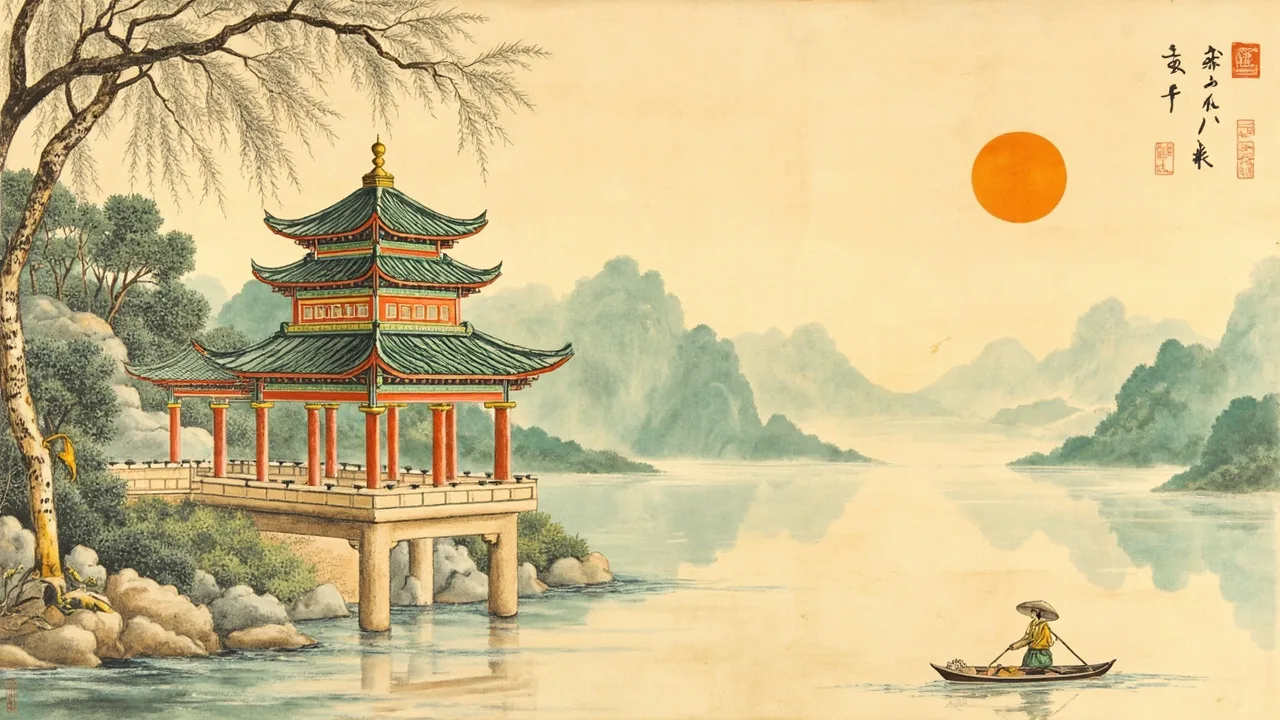
The opening lines describe the tower’s location with striking precision. From its vantage point, you can watch boats crossing the lake, hear wind whistle through reeds, and see the vast sky meet the water at the horizon. It is beautiful and slightly melancholy, the kind of landscape that makes you feel small. Many writers before Fan had attempted to capture this view. None of them achieved what he did in the final paragraph.
That paragraph contains two phrases so famous that Chinese children still memorize them in school: “先天下之忧而忧,后天下之乐而乐” — “Be the first to worry about the troubles of the world, and the last to enjoy its pleasures.” This is not empty political rhetoric. Fan meant it. He lived it.
Fan Zhongyan: The Scholar-Official Who Refused Easy Answers
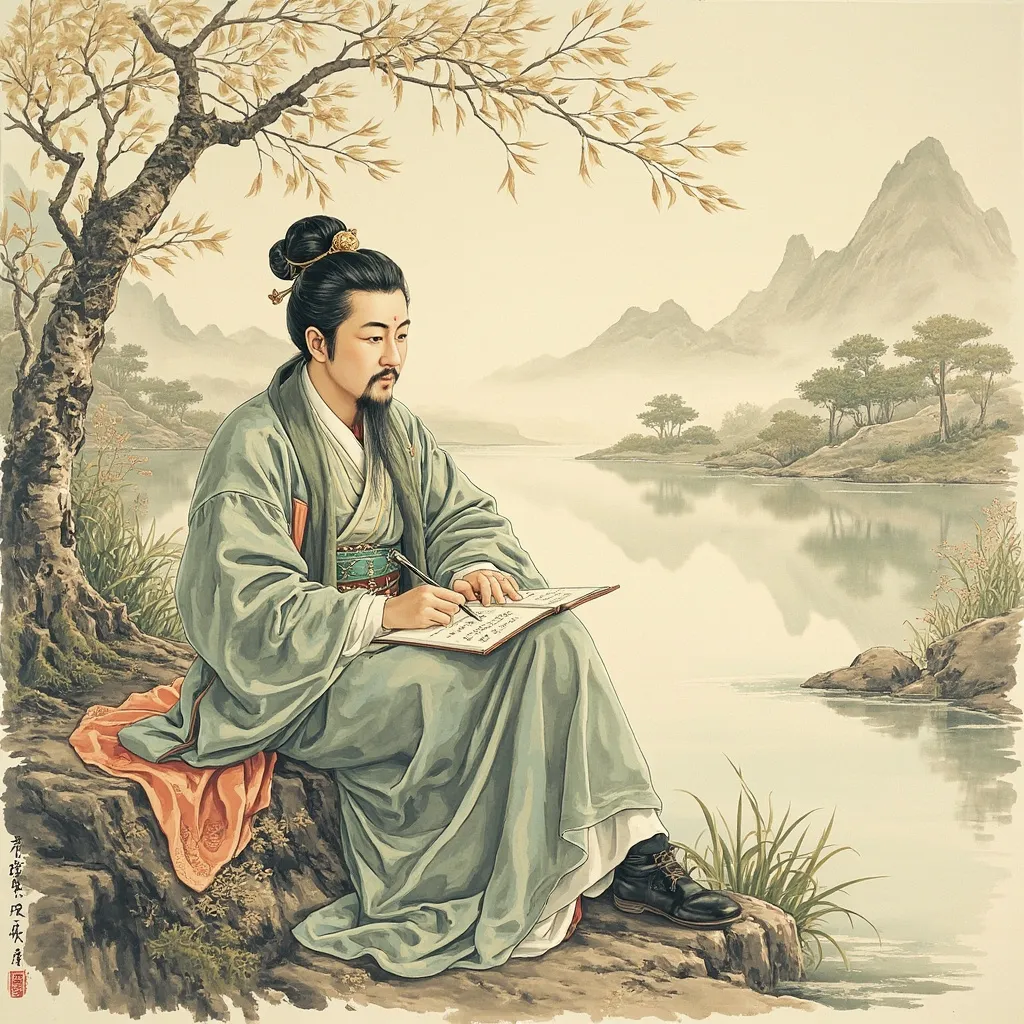
To understand why this essay hits so hard, you need to know who Fan Zhongyan was. He was born in 989 in what is now Suzhou, into a family that had lost most of its wealth. His childhood was marked by poverty so severe that he sometimes could not afford candles for night study. Rather than complain, he used this as fuel. He aced the imperial civil service examinations and entered government with a reputation for intelligence and stubborn integrity.
That stubbornness would define his career. As an official in the Song Dynasty, Fan consistently ranked second-tier in the emperor’s favor. He had a habit of writing memoranda that criticized powerful people. He recommended reforms that made court insiders uncomfortable. He refused to stay quiet when he saw injustice, even when staying quiet would have advanced his career.
The Song Dynasty during Fan’s time was a remarkable period for Chinese civilization. It was an era when the civil service examination system fully matured, when printing technology made books affordable, and when Chinese culture spread across East Asia. But it was also a time when the empire faced pressure from nomadic powers to the north and when wealth gaps within Chinese society widened. Fan saw these problems clearly and said so, repeatedly.
His most significant reform effort came in 1043 when he and his allies pushed for what historians call the “New Policies” — changes to how officials were evaluated, how military recruitment worked, and how government finances were managed. The goal was to reduce corruption and improve governance. The result was fierce political opposition. Fan’s enemies at court successfully painted him as a troublemaker, and he was reassigned to various posts away from the capital.
It was during one of these reassignments that his friend Yu (the one the tower is named for) sent word from Yueyang. Yu was depressed about his demotion. Fan sat down and wrote the essay that would outlive both of them.
The Essay Structure: What Fan Actually Said
The essay moves in three movements. First, Fan describes the geography of Dongting Lake and the tower’s position within it. He credits the tower’s original builder, Li Yi, for choosing such a strategic location. He notes how the lake swells and shrinks with the seasons, how fishing boats dot its surface, and how on clear days the mountains on the southern shore appear like a painted scroll.
Second, the essay shifts tone. Fan writes about the different emotions that the same landscape can evoke. When storms roll across the lake, he says, the scene feels heroic and tragic. When the weather is gentle, the scene feels romantic and nostalgic. He is setting up his central argument: that how you feel about a place depends on what is happening inside you at the time.
This is where Fan’s genius appears. He uses the landscape as a mirror for human psychology. The beauty of Yueyang Tower is not fixed. It changes based on who is looking at it and why.
Third, and most importantly, Fan turns to the people who have written about Yueyang before. He mentions the poet Du Fu, who passed through the region and wrote verses of his own. He notes that most writers who describe beautiful places are really writing about their own sadness. They see a sunset and think about lost love. They hear wind through trees and think about death. Their personal sorrow transforms the scenery into something melancholy.
Fan does not reject this impulse. Instead, he distinguishes between two types of people who would look at this tower after a setback. There are those who feel sorry for themselves. They arrive upset, they see the scenery through tears, and they leave more depressed than when they came. Then there are those who see the same scenery and feel a renewed sense of purpose. They understand that personal disappointment is insignificant compared to the weight of public responsibility.
The essay’s famous closing argues that only the second type of person deserves to stand on Yueyang Tower. Only someone who can set aside personal gain to serve others has earned the right to be there.
Why This Matters to Americans and a Practical Takeaway
The concepts Fan articulated in 1046 sound remarkably like themes Americans wrestle with today. “Public service” as a concept, the tension between self-interest and collective good, the question of whether leaders should prioritize their own comfort or the welfare of those they govern — these are not uniquely Chinese concerns. They are universal.
Fan also wrote his essay during a period of political gridlock. The Song Dynasty court was divided between reformers and conservatives, each faction more interested in defeating the other than solving the empire’s problems. Fan found himself caught between these factions, criticized from all sides. Sound familiar?
The difference is that Fan responded to his marginalization by producing something that transcended politics. He did not write a manifesto for his faction or a rebuttal to his critics. He wrote about responsibility, and he made it beautiful enough that people would remember it 1,000 years later.
American readers might find a parallel in the writing of Frederick Douglass or Abraham Lincoln. Both used the power of language to articulate ideals that outlasted the political circumstances of their time. Fan belongs in that same conversation.
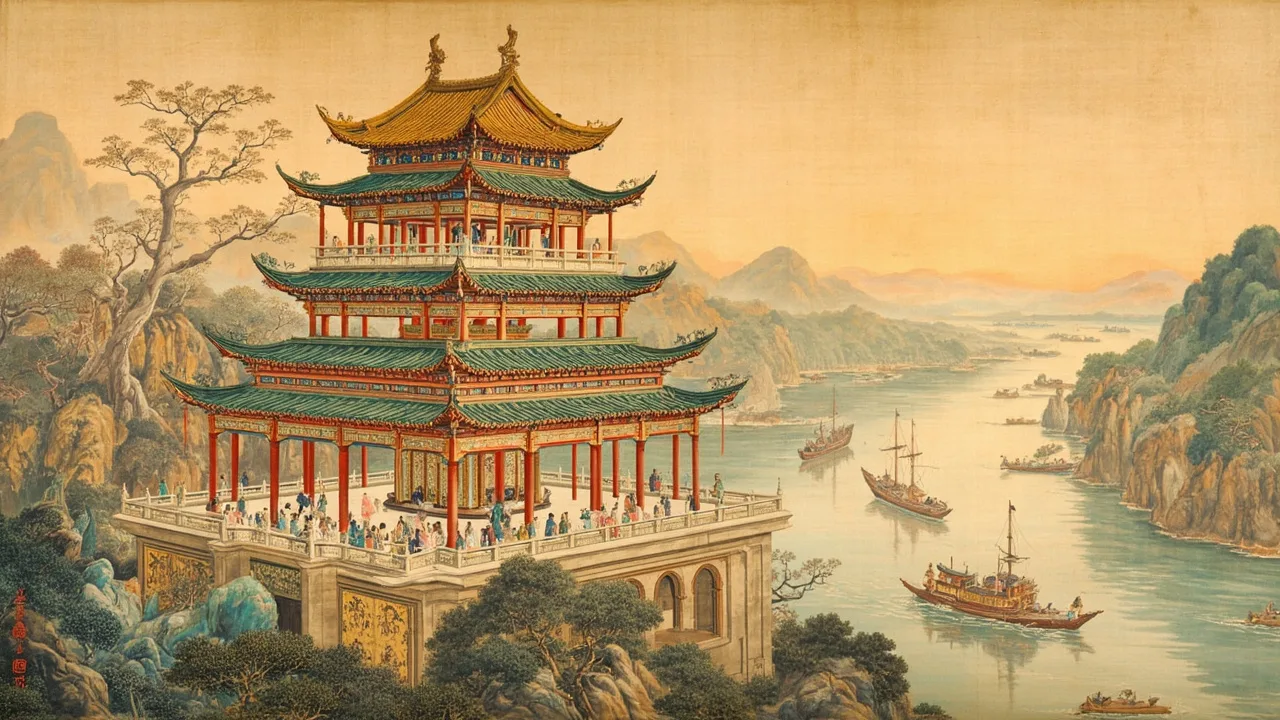
There is also something practical here for Americans who visit China. Yueyang Tower is a real place you can travel to. It sits on the shores of Dongting Lake, the second-largest freshwater lake in China. The current structure dates to 1864, rebuilt after a fire, but the site itself has been continuous for over a millennium. When you stand there, you are standing where Fan stood. The words he wrote will be displayed on plaques around the tower, in Chinese calligraphy, waiting for you to translate them in your head. After reading “Yueyang Tower Record,” you will understand why this structure is treated as a shrine.
The Architecture of Duty
What makes the “Yueyang Tower Record” particularly interesting from a cross-cultural perspective is how it transformed the meaning of a physical space. Before Fan wrote his essay, Yueyang Tower was just one of several lakeside pavilions in China. After the essay was circulated, it became the most famous. Today it is listed alongside the Penglai Pavilion and the Yellow Crane Tower as one of China’s three great cultural towers.
This happened because Fan gave the tower a moral dimension. It was no longer just a nice view. It became a symbol of what public service should look like. Every Chinese official who studied for the civil service examinations read Fan’s essay. It shaped their expectations of themselves and of each other. The tower became a reminder of what they owed to the people they governed.
This is a concept that Americans can appreciate. Think about how the White House or the Lincoln Memorial carries meaning beyond its physical structure. The buildings are symbols of ideals that Americans hold collectively. Yueyang Tower works the same way for Chinese culture, and Fan Zhongyan is the reason why.
If you are an American interested in Chinese culture, “Yueyang Tower Record” is one of those texts that rewards even a basic understanding. The full essay is short enough to read in twenty minutes. You can find English translations online, though the poetic beauty of Fan’s original Chinese does not translate perfectly into any other language.
When you visit Yueyang Tower, you will see Chinese visitors reading the plaques and taking photographs. Understanding the essay transforms the experience from a scenic photo stop into something closer to a pilgrimage. Fan wanted readers to feel a sense of obligation when they stood where he stood. The essay still delivers that feeling, a thousand years later.
The phrase “first to worry, last to enjoy” has become a cornerstone of how Chinese society talks about public service. It shows up in political speeches, in school textbooks, and in discussions about what makes a good leader. Understanding its origins gives Americans a window into how Chinese political culture thinks about duty and governance. No, the specific contexts are different. But the underlying tension between personal interest and public responsibility is exactly what American civic education wrestles with too.
For further exploration, look into the Song Dynasty reforms of the 1040s and the political battles that surrounded them. The story of how Fan Zhongyan fought for change, got pushed out, and then produced his most enduring work in exile is a lesson in the long-term value of principle over short-term comfort.
The Tower Through the Centuries and Its Global Legacy
Yueyang Tower has survived fires, wars, and political upheavals that would have destroyed a less symbolically charged structure. The original tower was built in 858 during the Tang Dynasty, during a period of relative stability and cultural flowering. When Fan wrote his essay almost two centuries later in 1046, he was already describing a place with deep historical resonance. The tower he knew had accumulated meaning from generations of visitors before him.
After the Tang Dynasty collapsed, China entered a turbulent period known as the Five Dynasties and Ten Kingdoms era, when the country fragmented into competing states. Yueyang changed hands multiple times during this period. The tower itself was likely damaged or neglected during these decades of conflict. When Fan visited, the structure was old and somewhat dilapidated, which may have contributed to the melancholy atmosphere he described in his opening passages.
The current tower standing today dates to 1864, rebuilt during the Qing Dynasty after multiple earlier reconstructions. The Qing Dynasty, China’s last imperial dynasty, maintained a policy of preserving major cultural monuments across the empire. When the old tower collapsed or deteriorated, local officials typically organized reconstructions using traditional techniques and materials. The 1864 rebuilding used brick and wood in the traditional Chinese architectural style, with the characteristic curved roof eaves that give the structure its distinctive silhouette.
What is remarkable is not that the tower was rebuilt, but that the essay survived intact through every reconstruction. When new wood was installed, new plaques were carved with Fan’s text. When new walls were raised, new calligraphy was hung. The physical structure has been renewed many times, but the words have remained constant. This is a pattern you see across Chinese cultural monuments: the physical artifact is secondary to the textual tradition that gives it meaning.
The influence of “Yueyang Tower Record” extends beyond China. In Japan, Korea, and Vietnam, scholars who studied classical Chinese texts encountered Fan’s essay as part of their education. The civil service examination systems in these countries borrowed heavily from Chinese models, and Fan’s essay was included in the standard reading curriculum for anyone preparing for government service.
This means that in East Asia, the themes Fan articulated about duty, service, and public responsibility circulated widely and shaped political culture across multiple societies. The concept of a leader prioritizing collective worry over personal comfort is not uniquely Chinese. Versions of this idea appear in Japanese bushido philosophy, in Korean Confucian scholarship, and in Vietnamese imperial administration.
Americans who want to understand East Asian political culture benefit from understanding texts like this one. It is easy to assume that Chinese concepts of governance are alien and incomprehensible to Western minds. The reality is more interesting. Fan’s essay articulates ideas about public service that overlap significantly with American concepts of civic virtue, even if the specific institutional contexts differ.
The essay also serves as a reminder that Chinese civilization produced sophisticated thinking about political ethics long before European contact. This does not mean Chinese and Western political systems are equivalent, or that Chinese history should be read as a straightforward march toward modern values. It does mean that the human questions Fan grappled with — how should those in power behave, what do leaders owe to the people they govern, how do you stay principled in a corrupt system — are universal questions that every civilization has had to answer in its own way.
Standing at Yueyang Tower, watching the sun set over Dongting Lake, you are not just looking at scenery. You are standing at the intersection of landscape, literature, and political philosophy, a place where one man’s words created meaning that outlasted his political career, his demotions, and even the physical structure he wrote about.
[AFFILIATE: “A Reader’s History of Ancient China” by Jonathan Spence - Provides detailed context on the Song Dynasty reforms and Fan Zhongyan’s era]
[AFFILIATE: Portable Chinese Calligraphy Brush Set - Useful for anyone wanting to practice writing Chinese characters in the style of Fan Zhongyan’s famous plaques]
[AFFILIATE: Illustrated Map of China’s UNESCO Heritage Sites - Includes Yueyang Tower and helps plan travel to other Song Dynasty cultural landmarks]