Yum Cha and Dim Sum: A Cantonese Morning Tea Guide
There’s a sound that hits you about three seconds after you walk into a real Cantonese teahouse on a Sunday morning, and it’s not the clatter of carts or the hiss of bamboo steamers. It’s the conversation. Six decades of regulars leaning toward each other across a tablecloth the color of old parchment, the clink of porcelain lids being lifted off teacups, somebody’s grandfather asking the cart lady whether the chicken feet are fresh this week. That’s the part nobody photographs. That’s the part that makes yum cha worth getting up for.
Yum cha (飲茶, literally “drink tea”) is the Cantonese habit of going out for tea and small bites, usually on weekend mornings, and dim sum (點心, “touch the heart”) is the food itself. The two terms get tangled in English all the time. Strictly speaking, you can yum cha without dim sum (just tea and a pastry) and you can eat dim sum without calling it yum cha (many restaurants serve it all day without the ceremony). But in practice, in a Hong Kong cha chaan teng or a Guangdong tea restaurant on a Saturday morning, they’re the same event.
This is the guide I wish someone had handed me before my first yum cha in Hong Kong a few years back. It covers where the tradition came from, how to navigate the trolley service if you’ve never seen it, what to actually order, and the small etiquette bits that save you from embarrassing yourself in front of someone’s grandmother.
Where Yum Cha Came From, and Why It’s Still Going
Yum cha is old. Older than most people realize. The Silk Road tea caravans that moved compressed bricks of tea across Yunnan and into the Guangdong lowlands had been stopping at roadside inns for centuries, and by the Tang dynasty those inns were already serving travelers a pot of tea with something to eat alongside. The “yum cha” name in Cantonese, and the Mandarin cousin “yin cha,” show up in Song dynasty texts from the eleventh and twelfth centuries.
What we now think of as dim sum — the small steamed, fried, and baked dishes — took longer to crystallize. The Cantonese port cities of the Pearl River Delta grew wealthy on foreign trade in the eighteenth and nineteenth centuries, and along with wealth came a leisure culture. Teahouses expanded their offerings, first into simple buns and dumplings, then into an increasingly elaborate repertoire. By the time the twentieth century rolled around, yum cha had become the weekend ritual it still is: families in clean clothes, three generations at one round table, an hour or two of gossip lubricated by pot after pot of tea.
Hong Kong refined the format further. The trolley service — those elderly aunties pushing metal carts loaded with stacked bamboo steamers through the dining room — is a Hong Kong innovation from the mid-twentieth century, born out of high-volume lunch service when restaurants needed to move dim sum fast to packed crowds. The mainland trend now is toward written order sheets (点心纸, dim sum chei) where you mark what you want from a menu, and the kitchen sends it out. Both work. Both are yum cha. Don’t be a snob about which one you got.
A few cultural notes that matter:
The whole thing is fundamentally a weekend family event. If you show up at 7:30 a.m. on a Tuesday, you’ll find mostly retirees and the occasional foreign tourist. If you show up at 10:00 on a Sunday, you’ll find entire extended families in their best clothes, kids running around the floor, and a noise level that would get a restaurant in midtown Manhattan shut down by the health department.
Yum cha is also one of the most egalitarian food traditions in Chinese culture. Expensive hotels serve it. Street-side joints with plastic stools serve it. The food is roughly the same at both ends. You don’t need to dress up, you don’t need to know wine pairings, and you don’t need a reservation unless you’re going somewhere famous on a Sunday. You just need to know how to ask for the things you want and how to pour tea for the people at your table.
How to Eat at a Cantonese Teahouse Without Making a Fool of Yourself
Here’s the sequence, end to end, from arrival to leaving.
Getting seated. At a busy place, you’ll either be given a number ticket at the door or pointed straight to a table. Round tables are traditional and seat more people. Square tables seat four. If you’re solo or a couple, you’ll probably get a square table and that’s fine. Don’t be the person who hovers near the host stand for ten minutes; they’ll get to you.
Ordering tea first. The first thing you do, before any food, is order tea. At trolley-service places, a staff member will come by with a tea menu or just ask what you want. At order-sheet places, you mark your tea on the sheet along with the food. The three classic choices are:
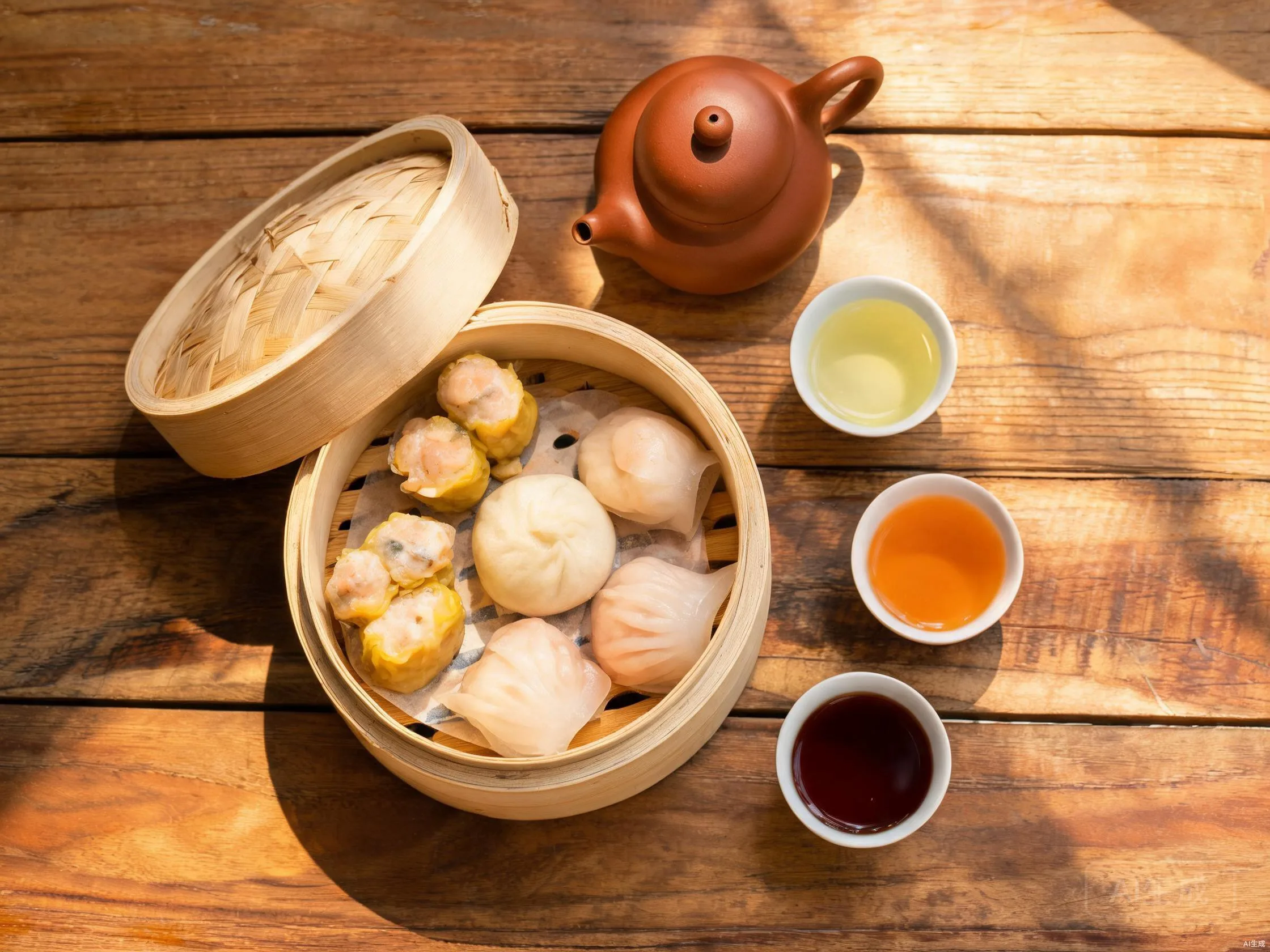
- Bo lei (普洱, pu-erh) — fermented, dark, earthy, the default for a reason. Pairs with everything fatty.
- Seung ping (香片, jasmine) — green tea scented with jasmine blossoms, lighter and floral.
- Dai fei (大葉, “big leaf”) — sometimes just labeled “Ceylon” or “Hong Kong-style milk tea base,” a robust black tea.
Don’t overthink this on your first visit. Pu-erh is the safe answer. If you want to be a tiny bit fancy, ask for a 1/3 mix: pu-erh base with jasmine on top, or a half-and-half of any two. Mixed teas are common and nobody will look at you strangely.
The pour. When the tea arrives, the first pour goes to the eldest person at the table. If you’re hosting, you pour. If you’re a guest and someone pours for you, tap two fingers on the table — this is the universal shorthand for “thank you.” It’s a Qing dynasty holdover from when an emperor traveling incognito would have his subjects pour tea for him and they needed a gesture that wouldn’t give him away. Today it’s just polite.
Refilling the pot is free at most places, or charged by the person. If the pot is empty and nobody has noticed, wave slightly and say “sui” (水) or just make eye contact with any passing server. They’ll take the pot and bring it back in two minutes.
Ordering food. If you’ve got an order sheet, mark your choices with the pencil attached to the clipboard. If you’ve got trolley service, wait for the cart to come by and flag it down. The cart aunties will lift lids and show you what’s inside. Point at what you want. They’ll stamp your sheet or mark it down. Don’t wave frantically or chase the cart; just a clear point and a nod.
The dish etiquette. A few ground rules that actually matter:
- Don’t stab your chopsticks into a dumpling to fish it out of the steamer. Tip the steamer basket or use chopsticks.
- Don’t take the last piece from a steamer without offering it to the table first. One round of “do you want it?” is enough.
- Soy sauce goes in the small dish, not poured straight on the food. Same with chili oil.
- If you’re using chopsticks to share from a communal plate, turn them around and use the clean ends to pick up food to put on someone’s plate. The used ends go back to your mouth only.
- Bones, shells, tea leaves, and orange seeds go on the table or in the small waste plate, not back on your serving dish.
None of this is enforced. Nobody will kick you out for doing it wrong. But you’ll feel the difference between a table that knows the rhythm and one that doesn’t, and you’ll want to be on the right side of that.
The Dishes That Matter: A Working Dim Sum Menu
I’ve eaten dim sum in Hong Kong, Guangzhou, Vancouver, San Francisco, and New York’s Chinatown, and the same dozen dishes keep showing up on every cart. Here’s the working list, roughly in the order I’d order them for a first-timer.
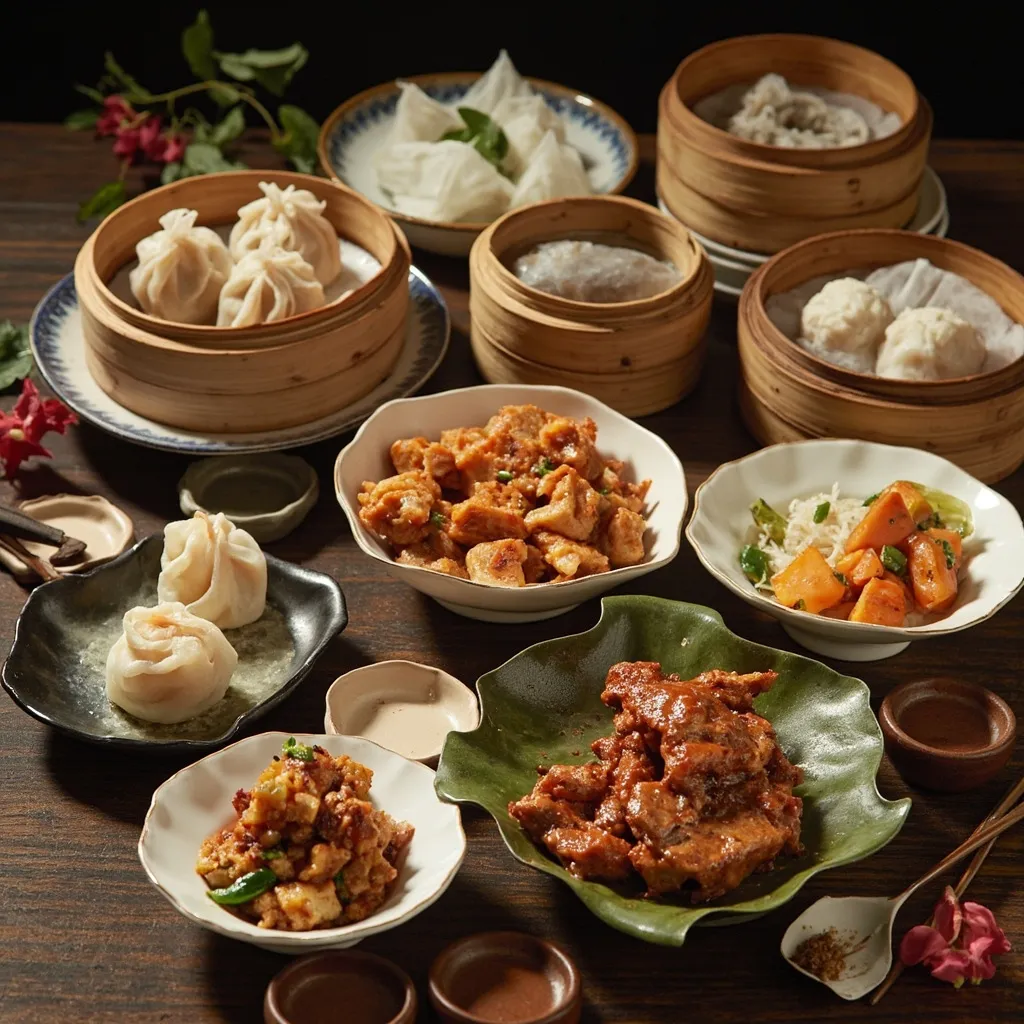
Har gow (蝦餃) — steamed crystal shrimp dumplings, the iconic dim sum piece. Translucent wheat-starch skin, four or five whole shrimp inside, eaten with a tiny splash of soy sauce. A good har gow has a thin skin that you can almost see through, snaps cleanly when you bite it, and a filling that tastes like shrimp rather than a paste. If I had to pick one dish to judge a dim sum kitchen by, this is it.
Siu mai (燒賣) — open-top pork and shrimp dumplings, served in yellow wrappers, usually topped with a single orange roe or pea. Less delicate than har gow, more savory, with a slightly chewy bite. The Cantonese version is mild and porky. Northern Chinese restaurants often make a spicier, oilier version that’s a different animal.
Char siu bao (叉燒包) — steamed barbecue-pork buns, soft and white with a split top that blooms open as they cook. The filling is diced char siu pork in a sticky, sweet-savory sauce. There’s also a baked version (酥皮叉燒包) with a crackly sugar-butter top that you see at more upscale places. Both are good. The steamed one is the classic.
Cheung fun (腸粉) — rice noodle rolls, wide and slippery, wrapped around shrimp or beef or pork, doused in a sweet soy sauce. This is the dish most likely to confuse first-timers because it doesn’t look like much on the plate. Don’t be fooled. Good cheung fun is one of the most texturally satisfying things in Chinese cooking, and the rice noodle itself should taste like fresh rice, not glue.
Lo mai gai (糯米雞) — sticky rice wrapped in a lotus leaf with chicken, Chinese sausage, mushrooms, and sometimes a salted egg yolk. Steamed until the lotus leaf perfume has soaked into the rice. The presentation is underwhelming — it arrives looking like a damp green parcel — but the smell when you peel the leaf is the whole point.
Juk (粥) — congee, the Cantonese breakfast porridge. Plain or loaded with pork and preserved egg (皮蛋瘦肉粥, “pei dan shou rou juk,” which sounds grim but is the most beloved version). Congee at a good yum cha is silkier than what you’ll get at a coffee shop; the rice has cooked for hours. Order a bowl if you’re not sure what else to try; it’s gentle, it’s filling, and it pairs with everything.
Dan tat (蛋撻) — egg tarts, flaky pastry shell with a custard center. The Hong Kong style (Portuguese-derived, brought over by Macanese refugees in the mid-twentieth century) has a buttery, almost shortbread-like crust and a custard that’s just barely set in the middle. The Macau style is similar but with a slightly browned, caramelized top. Eat one warm.
Jin deui (煎堆) — sesame seed balls, deep-fried, hollow inside with a smear of sweet lotus paste. They’re dangerous because they’re easy to pop three or four in a row and then realize you’ve eaten nothing of substance. The best ones crackle on first bite and then collapse.
Fun guo (粉果) — steamed dumplings with a translucent tapioca starch wrapper, usually filled with pork, shrimp, bamboo shoots, and peanuts. The wrapper is chewy in a way that’s unique to this dish. Often comes in a half-moon shape, sometimes a little purse.
Chee cheong fun, pai gwat, fu zho yook, gwoh dai gao — and a dozen more I’m leaving out. The point of a working menu is to know what to do when the cart comes by. If you see something you don’t recognize, point at it and ask the cart lady. The Cantonese word for “what is this” is “mat jeh a?” (也嘢啊). She’ll tell you. You might love it. You might hate it. That’s the yum cha deal.
A practical tip on pacing: order three to four dishes per person as a starting point, then add more as you go. The carts come around frequently, the kitchen sends fresh steamers all morning, and there’s no penalty for ordering more. Most tables end up with five to seven dishes per person by the end, plus tea. That’s normal.
Tea Drinking Is the Whole Point
It would be a mistake to treat the tea as a beverage you happen to be drinking while you eat dim sum. In a Cantonese teahouse the tea is the event, and the dim sum is what you eat while you’re doing the event.
A few things worth knowing:
First-flush rule. The first brew of any tea is the cleanest. When the pot arrives, pour a small amount into everyone’s cups to wash them, swirl, and discard (or drink it yourself; nobody will mind). Then pour the real round. This isn’t strictly required, and the waitstaff won’t judge you if you skip it, but it makes the second pour taste noticeably better.
Don’t let the pot sit. As soon as it’s empty, ask for a refill. Pu-erh especially turns bitter and flat when it over-steeps. A pot of pu-erh should be drunk within twenty minutes of arriving, or it goes from earthy and warm to muddy and harsh.
The wash-and-pour ritual. At a proper table, the host handles the pouring. Guests don’t pour for themselves unless they’re explicitly told to. If you’re at a table of acquaintances and nobody is volunteering to pour, take the job. It’s a small social gesture that smooths everything else.
Tea pairings actually matter. Strong teas (pu-erh, black tea) handle fatty dishes beautifully — they cut through pork fat and cleanse the palate between dumplings. Light teas (jasmine, green tea) work better with delicate shrimp dishes and steamed vegetables. A long-pour oolong sits between the two and is the most flexible single choice. If you’re ordering one pot for the whole table and aren’t sure what people want, oolong is the safe move.
Snack food for the tea. The very cheapest dim sum dishes — small plates of preserved peanuts, pickled radish, orange segments, sometimes a tiny bowl of steamed buns — are sometimes brought to the table automatically and charged at the end. Don’t be alarmed. These are “tea snacks,” not a mistake. They exist to give the table something to nibble while the kitchen prepares the main order. Eat them.
There’s also the question of leaving. Cantonese teahouses don’t rush you. Once the food stops, you’re expected to sit a while, finish your tea, talk. The bill usually comes when you wave for it, not automatically. When it does come, check it carefully. Some places still charge per steamer basket and there’s an old Cantonese trick of swapping a “filled” stamp for an “empty” one on your sheet to charge you for dishes you didn’t actually order. It happens less than it used to, but it still happens.
Where to Go From Here
If you’re going to Hong Kong, the classics are still doing it right: Lin Heung (蓮香) in Central for the old-school cart service, Maxim’s Palace in City Hall for the harbor view and the relentless variety, Tim Ho Wan (添好運) anywhere in the city for the Michelin-starred budget option. In Guangzhou, the old Lian Xiang Lou (蓮香樓) on Dishifu Road is the ancestral home of the whole tradition, and a trip there is worth it even if the service is chaotic.
In the United States, the dim sum scene in the Bay Area (particularly the Richmond district and Daly City) and in Vancouver’s Chinatown is genuinely excellent and still uses the trolley format in some places. New York’s Chinatown has hundreds of options, though the trolleys are mostly gone in favor of order sheets. Los Angeles has the San Gabriel Valley, where you’ll find a younger, more inventive dim sum scene that bends the rules with things like truffle har gow and custard-baked bao. Both traditions are worth experiencing.
But the honest truth is that yum cha works anywhere the conditions are right: a pot of hot tea, a couple of bamboo steamers, somebody at the table willing to pour, and an hour or two where nobody needs to be anywhere else. That’s the whole tradition. That’s the part that has survived dynasties, revolutions, two World Wars, and the entire invention of brunch. If you can build that at home — which you absolutely can with the right equipment — you don’t need a plane ticket.
That’s the real point of yum cha, anyway. It was never about the food. It was about giving people a reason to sit down together on a Sunday morning, drink something warm, and eat small things slowly. That recipe still works. It works in Cantonese, it works in English, and it’ll work at your kitchen table next weekend if you let it.