Yun Jin: The Cloud Brocade of Nanjing
Let me ask you something: what’s the most expensive fabric you can name? Silk, maybe. Velvet. Egyptian cotton. But I’ll bet “cloud brocade” isn’t on your list—and that’s exactly why you’re about to find it fascinating. Yun Jin (云锦), literally “cloud brocade,” is one of China’s most extraordinary textile traditions, a fabric so lavish that for centuries it was reserved exclusively for emperors, Buddhist temples, and the most powerful noble families in the land.
The name says it all. When light hits real Yun Jin, the woven patterns—often depicting clouds, dragons, phoenixes, and lotus flowers—seem to shimmer and shift like clouds drifting across a sunset sky. The effect isn’t accidental. The weaving technique, developed over centuries in the city of Nanjing in Jiangsu Province, is specifically designed to catch and play with light in ways that ordinary silk simply cannot. The result is a fabric that looks almost alive.
Today, Yun Jin is recognized as one of China’s national treasures, protected by cultural heritage laws and produced by a handful of master craftspeople who keep the tradition alive in a small workshop district on the outskirts of Nanjing. If you ever visit Nanjing (and you should), one of the most extraordinary things you can do is watch these weavers at work—moving shuttle by shuttle, creating patterns that take months to complete. It’s one of those experiences that makes you realize how much human skill and patience goes into the objects we take for granted.
What Is Yun Jin, Exactly?
Let’s get specific. Yun Jin is a type of jin (锦), which is the Chinese word for brocade—a richly decorative woven fabric, usually with raised patterns, often involving gold or silver threads. The term “brocade” exists in English because European traders were so impressed by these fabrics when they arrived along the Silk Road that they borrowed the Italian word broccato to describe them.
But Yun Jin isn’t just any brocade. It’s specifically characterized by the use of yuan jing (纬锦) weaving—the weft threads, which run horizontally across the fabric, carry the colored pattern, while the warp threads (the vertical ones) form the foundation. This allows for extraordinarily complex, multi-layered patterns that give the fabric its characteristic three-dimensional, almost sculptural quality.
The other thing that defines Yun Jin is its use of gold and silver threads. Traditional Yun Jin often incorporates jin si (金丝)—real gold leaf wrapped around silk threads—and yin si (银丝), silver threads treated to resist tarnishing. These metallic threads catch the light in a way that makes the fabric appear to glow from within, which is where the “cloud” in “cloud brocade” comes from. The patterns seem to float on the surface of the fabric, lit from below by the metallic shimmer of the underlying threads.
The colors are another defining feature. Traditional Yun Jin uses a restricted but intense palette—deep crimson, imperial yellow, midnight blue, jade green, and of course gold and silver. The combinations are always harmonious, following principles of classical Chinese color theory that date back to the Zhou Dynasty. There’s a reason these colors look right to our eyes: they’re not random. They’re the product of centuries of refinement.
A History Woven in Gold
The history of Yun Jin stretches back to the Ming Dynasty (1368–1644), when Nanjing was chosen as one of the imperial weaving centers. The Ming emperors, who built the Forbidden City in Beijing, needed enormous quantities of the finest silk for their courts, their ceremonies, and their tombs. Nanjing’s combination of access to high-quality raw silk from the Jiangsu and Zhejiang regions, its position as a major commercial hub, and its concentration of skilled artisans made it the natural choice for the imperial weaving workshops.
These workshops, called ju ju (织局), were run directly by the imperial household and employed hundreds of weavers at their peak. The best craftspeople in China were recruited, often with their families, to work in conditions that were both prestigious and demanding. Working for the emperor meant producing fabric of absolute perfection—any flaws could mean punishment for the weavers.
The products from the Nanjing workshops were extraordinary. Imperial Yun Jin was used for dragon robes (long pao), the formal robes worn by the emperor on ceremonial occasions, which featured the five-clawed dragon (long) as the central motif, surrounded by the twelve imperial symbols: the sun, moon, stars, mountains, dragons, flames, grain, ax, vase, fu symbol, and燎 (ritual vessel). These robes were not just clothing—they were visual manifestos of cosmic authority.
Yun Jin was also used for temple hangings, imperial banners, and the elaborate burial shrouds that surrounded the emperors in their tombs. When the Ming Tomb of the Hongwu Emperor was excavated, it contained fragments of Yun Jin that had survived nearly 600 years in underground chambers. The colors were still vivid. The gold was still bright.
After the Ming Dynasty fell, the Qing Dynasty (1644–1912) continued to patronize the Nanjing workshops, and the quality actually reached new heights during this period. Qing imperial Yun Jin is considered by many textile historians to be the absolute pinnacle of the tradition—the patterns became more complex, the metallic threads more elaborately woven, the color combinations more sophisticated.
The Weaving Process: Months of Human Hands
Here’s what really gets you about Yun Jin when you see it in person: it takes a single skilled weaver anywhere from several weeks to several months to complete one piece, depending on the complexity. A large imperial-style hanging might represent six months of daily work by a single person.
The basic tool is the hua jiang (花楼) loom—a large, two-person floor loom that can be up to two stories tall in some historical examples. The traditional setup requires two weavers working in coordination: one (the duan jiang, or “pattern weaver”) sits at the top of the loom reading the pattern charts and controlling the heddles that raise and lower the warp threads, while the other (the da jiang, or “pulling weaver”) sits below and passes the shuttle carrying the weft threads across the loom.
The coordination between the two is mesmerizing to watch. The pattern weaver calls out instructions in a rhythmic chant—a tradition called hua hao (花喊)—that tells the pulling weaver which colored threads to use and when. The rhythm of the work, the creak of the wooden frame, and the call-and-response between the two weavers creates something almost musical.
The pattern charts themselves are works of art. They’re written in a specialized notation system that has been used for Yun Jin weaving for centuries—pictographic symbols representing each colored thread and its position in the pattern. Learning to read and write these charts is a specialized skill that takes years to master, and the charts from historical workshops are now valuable archival documents.
The metallic threads deserve special mention. Jin si—gold thread—is made by hammering pure gold into paper-thin sheets, then cutting the sheets into narrow strips and wrapping them around a core of silk thread using a hand-powered spindle. The result is a thread that looks like solid gold to the naked eye but is actually a composite material with a silk heart for strength. Silver threads are made the same way, with silver replacing gold. Because these threads are so precious, the weavers are often given exact quotas—too much gold thread used, and the workshop loses money; too little, and the quality suffers.
Iconic Patterns and Their Meanings
Yun Jin patterns are never random. Every motif carries symbolic meaning, and the combinations follow rules that date back centuries.
Dragon and phoenix (long feng) is the most imperial of combinations, representing the emperor and empress in union. The dragon (long) was reserved exclusively for the emperor; anyone else who used it faced execution. The phoenix (feng) represented the empress. Together, they symbolized marital harmony and the continuity of imperial power.
Cloud patterns (yun wen) are the namesake of the fabric and appear in virtually every piece. Clouds in Chinese cosmology represent the breath of heaven—divine blessings descending to earth. Different cloud formations have different meanings: gong yun (palace clouds) are the most formal, reserved for imperial use; jun yun (military clouds) were used on generals’ banners; and xiang yun (auspicious clouds) are the most common in everyday decorative textiles.
The lotus (he) appears constantly, representing spiritual purity and enlightenment in Buddhist contexts, but also fertility and rebirth in secular ones. The lotus grows from mud at the bottom of a pond but emerges pristine and beautiful above the waterline—a perfect metaphor for spiritual transcendence.
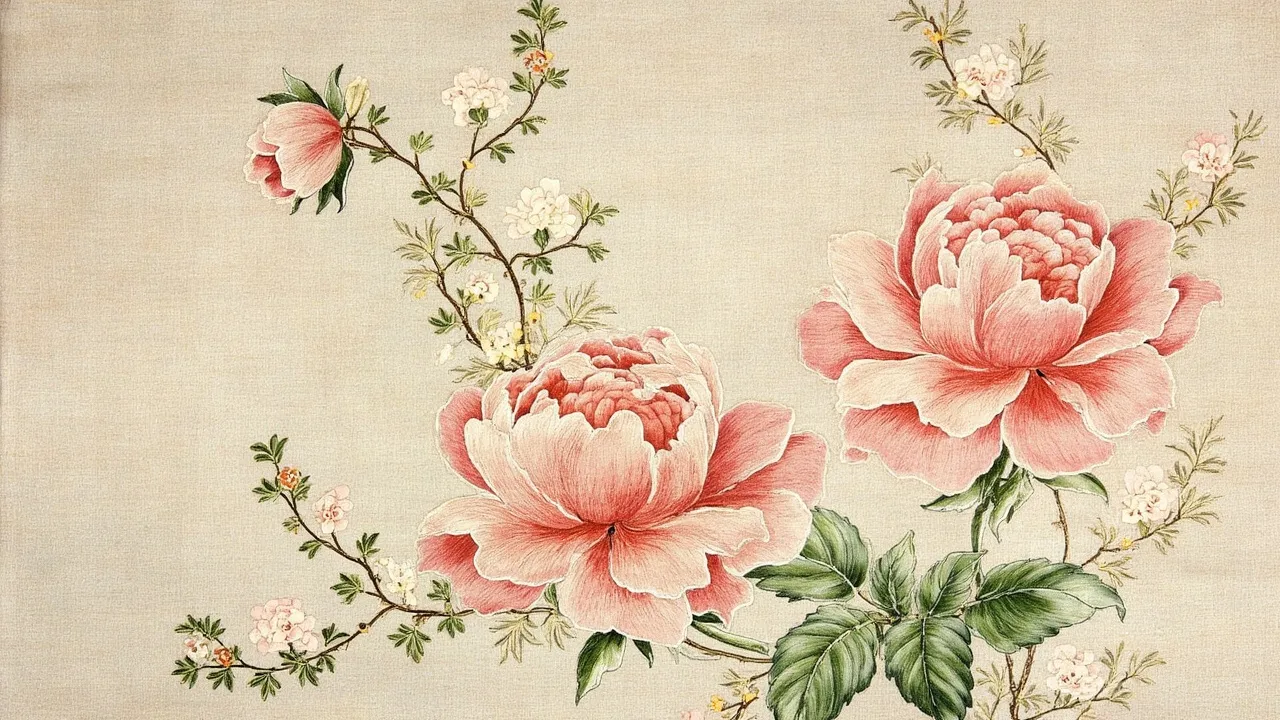
The peony (mu dan) is the flower of wealth and honor. Often combined with ling zhi (reishi mushroom), which represents immortality, the peony was a favorite motif for noble families who wanted to signal both their prosperity and their aspirations.
Bat patterns (fu) might raise eyebrows in the West, but in Chinese culture, bats are profoundly lucky. The word for bat (fu) is a homophone for the word fu meaning “good fortune.” Five bats together (wu fu or “five blessings”) represent longevity, wealth, health, virtue, and a natural death—the five things a traditional Chinese person might wish for.
Yun Jin Today: A Living Tradition
The Nanjing Yun Jin Research Institute (南京云锦研究所), established in 1957, is the primary institution keeping the tradition alive. It maintains a workshop where master weavers produce Yun Jin using traditional methods, conducts research into historical techniques, and trains the next generation of weavers. The institute has been instrumental in reconstructing patterns from historical samples, many of which were found in the imperial tombs or in temple collections.
The Institute’s museum, located in Nanjing’s Yuhuatai district, is well worth visiting if you find yourself in the city. You can watch live demonstrations of the hua jiang loom, see rare historical pieces up close, and sometimes even try your hand at a very basic weaving technique (prepare to fail—it’s harder than it looks).
In 2006, Yun Jin was listed as one of China’s firstbatch of Intangible Cultural Heritage (feiwuzhi wenhua yichan) items, giving it the same protected status as Peking Opera, acupuncture, and Chinese calligraphy. This recognition came with government funding for the research institute and subsidies for master weavers, which has helped keep the tradition alive during a period when traditional crafts were struggling across China.
The market for genuine Yun Jin is, frankly, extremely limited. A single piece of high-quality traditional Yun Jin can cost tens of thousands of dollars, reflecting the hundreds of hours of skilled labor involved. Most production today is either museum-quality reproduction work (commissioned by cultural institutions) or lower-grade items that use simplified versions of the traditional patterns and techniques.
That said, there’s been a small but growing market for contemporary designer pieces that incorporate Yun Jin techniques in new ways—wall hangings, fashion accessories, and home décor items that use traditional materials and methods but in modern designs. The Nanjing government has actively promoted this as a way to make the craft economically sustainable while maintaining the traditional techniques.
Experiencing Yun Jin for Yourself
The best way to experience Yun Jin is in person, in Nanjing. The city has several locations where you can see the fabric and watch it being made:
The Nanjing Museum’s textile gallery holds one of the finest collections of historical Chinese textiles in the world, including several pieces of imperial Yun Jin. The quality of preservation is remarkable—colors that still look vivid after hundreds of years. This is the best place to understand the breadth of the tradition.
The Yun Jin Research Institute offers workshop tours by appointment, where you can watch master weavers at work and see the pattern charts and historical samples that aren’t on public display.
If you’re shopping for Yun Jin-inspired items, be extremely cautious. The market is flooded with machine-made imitations that use the name “Yun Jin” but bear no relationship to the traditional craft. Real hand-woven Yun Jin is identifiable by its weight (heavier than it looks), the slight irregularity of the hand (no machine-made fabric is perfectly regular), and the three-dimensional quality of the patterns. If the price seems too good to be true, it is.
Related Products
To bring a piece of this extraordinary tradition into your life, consider these options:
Yun Jin-inspired Silk Scarf – These hand-printed scarves draw on traditional Yun Jin patterns in a more accessible format. Beautiful enough to frame, practical enough to wear. (View on Amazon)
Chinese Silk Brocade Fabric (半码) – If you’re a crafter or designer, you can find contemporary brocade fabric inspired by traditional patterns. Perfect for home décor projects, bags, or framing. (View on Amazon)
“The Textile of China: Silk, Brocade, and Embroidery” – A beautifully illustrated academic book that covers the history of Chinese silk weaving, with substantial chapters on Yun Jin and other major brocade traditions. (View on Amazon)