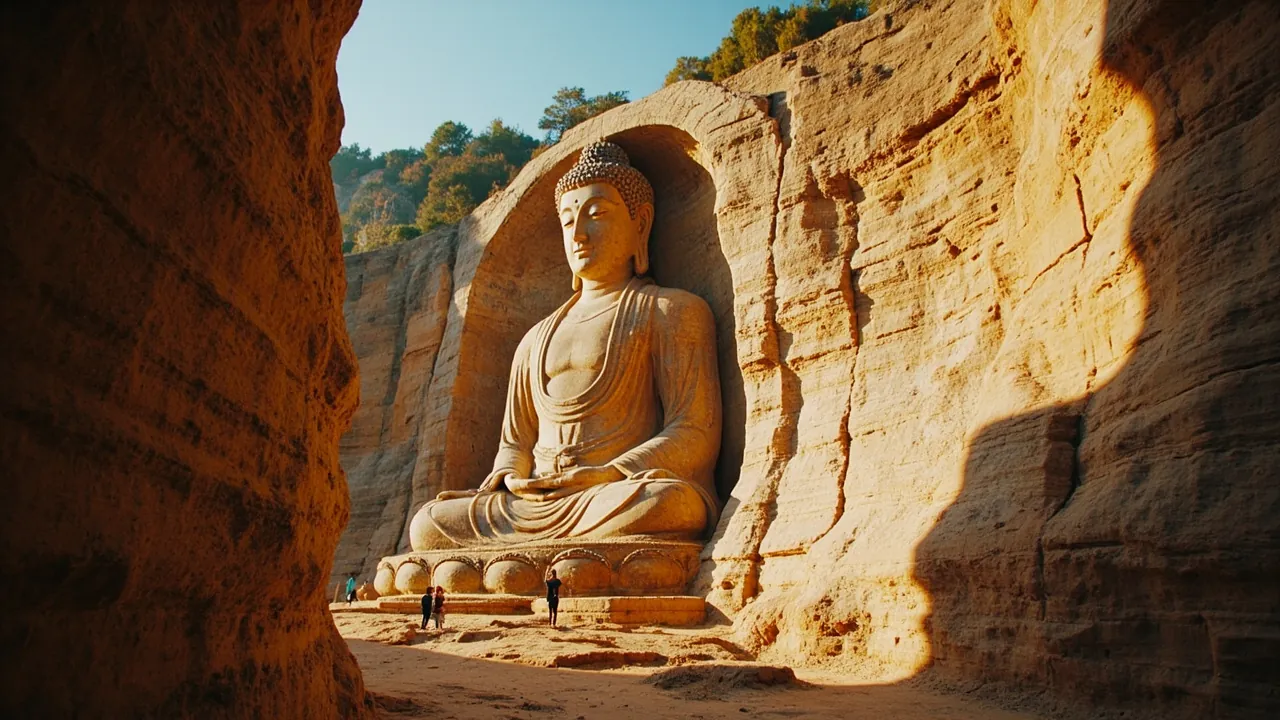
About twelve miles west of the industrial city of Datong in Shanxi province, there is a sandstone cliff face that does something to your sense of proportion when you stand in front of it. Cut into that cliff, in 252 separate grottoes, are roughly 51,000 carved stone Buddhist statues. The largest of them is a seated Buddha just over 55 feet tall, big enough to fit a small school bus in his lap. The smallest are tiny devotional figures only a few inches high, tucked into niches you can miss if you walk past without looking.
This is the Yungang Grottoes (云冈石窟). It is, depending on which historian you ask, one of the four great Buddhist cave-temple complexes of China — alongside the Mogao caves at Dunhuang, the Longmen caves outside Luoyang, and the Maijishan caves in Gansu — and the earliest of them to be carved at anything approaching an imperial scale. It is also one of the most revealing monuments anywhere on the Silk Road, because the figures there show, in stone, exactly what happens when a Central Asian religious art begins to slowly transmute into a distinctly Chinese one.
If you are interested in Chinese history, in Buddhist culture, in the Silk Road, or in monumental sculpture, you owe yourself a slow visit to Yungang. The stone does the work.
The Northern Wei Dynasty, and Why They Built This
To understand Yungang, you have to understand who built it, because the figures were not just religious art. They were political theology carved in sandstone.
The dynasty responsible was the Northern Wei (北魏), which ruled northern China — the lower half of the Yellow River valley and the territories north of it — from 386 to 534 CE. The Northern Wei were not Han Chinese. They were Xianbei, a steppe people of Inner Asian origin, who had built their state on the ruins of much older polities and were one of the most successful non-Han dynasties of the early medieval period. They survived by being shrewd adapters. They adopted Chinese bureaucratic styles, moved their capital (eventually) into the Han heartland, took up Han surnames, and — crucially for our story — adopted Buddhism as one of the great legitimating forces of their rule.
The capital from 398 to 494 CE was Pingcheng, present-day Datong. So when a Northern Wei emperor wanted to carve an imperial monument, he did it here, on the cliff face west of the city.
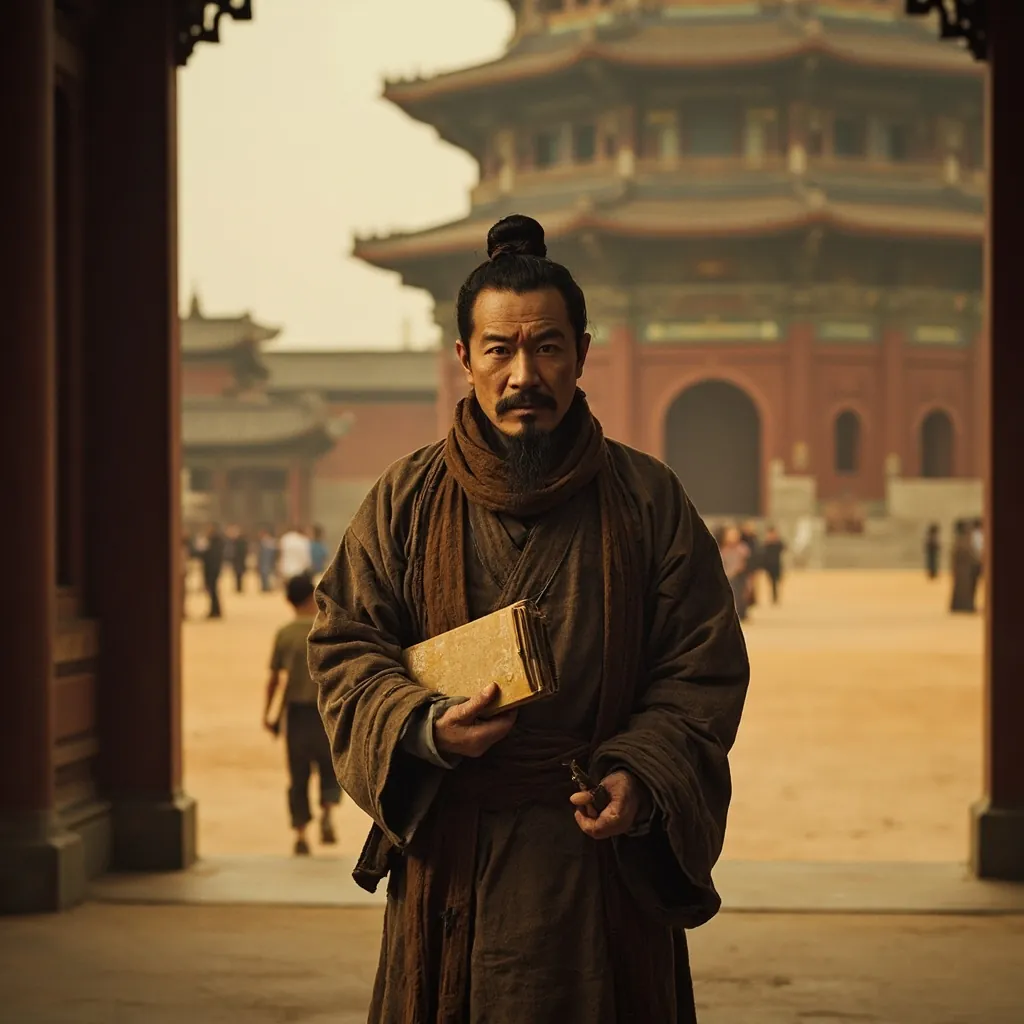
The decision to build Yungang was the work of one monk, named Tanyao (昙曜), who proposed the project to Emperor Wencheng (文成帝) around 460 CE. Tanyao’s argument, as best we can reconstruct it, was that imperial support for Buddhism would bestow political legitimacy on the regime, that Buddhism’s universalism helped the Xianbei-led state communicate with its diverse population, and that the cliff itself — a sandstone seam about half a mile long with good natural shelter — was a perfect canvas.
Wencheng agreed. Construction began. By the time the major patronage phase ended somewhere in the 490s, around 65 years later, the cliff held the 252 grottoes and roughly 51,000 statues we still have today (most in fragmentary condition; many, astonishingly, intact; some, sadly, destroyed over the centuries).
It’s hard to overstate how much labor that represents. There are no easy units for medieval stone carving, but rough estimates suggest hundreds of sculptors at peak times, possibly thousands, working across most of the second half of the fifth century. Each major grotto would have taken teams of skilled carvers several years. Many smaller side niches are clearly the work of modest donors — local officials, merchants, religious enthusiasts — paying for a few figures in available space.
The Tanyao Five: Where the Emperor Becomes the Buddha
The most important section of Yungang is the western cliff face’s first five grottoes, often called the Tanyao Five (昙曜五窟) or simply the Five Caves. They are grottoes 16 through 20 in the modern cave numbering system, and they are the oldest at Yungang — the earliest state-sponsored carvings, with construction starting almost immediately after Wencheng’s approval.
What makes them so unusual is that each of the five caves contains a single colossal standing or seated Buddha, and each of those five Buddhas is believed to represent a Northern Wei emperor in Buddha form.
This was not subtle. There is even a contemporary source explaining the symbolism: the five emperors of the dynasty that ruled before Wencheng, plus Wencheng himself, carved as the five Buddhas of the present world cycle in Vajrasana position (the seated Buddha posture in Indian Buddhist iconography). The political theology is openly claimed in the historical record: the emperor is not just a patron of Buddhism. The emperor is the Buddha.
Cave 20 is the most iconic. It contains the most famous single Yungang figure, the seated Buddha approximately 13.7 meters tall, facing outward in what is sometimes called the most striking pose in Chinese Buddhist cave art. The Buddha’s right arm is raised in the abhaya mudra (gesture of fearlessness and protection); the left rests in his lap. His robe cascades in tightly packed, finely modeled folds. His face is broad, frontal, and calmly hieratic. The proportions are slightly elongated but unmistakably human beneath the supernatural smoothness.
Cave 19 contains another famous colossus, slightly larger than Cave 20. Cave 18 is famous for a standing Buddha flanked by bodhisattvas, each figure over 8 meters tall. Cave 17 has the famous Princely Triad (太子出游像) inside a small side niche — a different compositional model that prefigures later Chinese Buddhist grouping. Cave 16 also contains a colossal Buddha.
The scale matters. When Tanyao conceived these caves, he was not just paying for religious art. He was building a permanent proclamation that the Northern Wei state was itself Buddhist in character, and that the act of ruling was a sacred one.
The Gandharan Roots, and Why the Figures Look the Way They Do
Now comes the visual art-history part, which is the part that makes Yungang so important to anyone interested in the Silk Road.
The early Yungang figures — especially the Tanyao Five — show very clearly that their sculptors were aware of, and influenced by, Gandharan style. Gandhara was the region of what is now northern Pakistan and eastern Afghanistan, where Buddhism had been at its creative peak for several centuries before the Northern Wei began carving at Yungang. Gandharan Buddhist sculpture — to oversimplify — was where Greek and Greco-Roman artistic conventions met Buddhist iconography. Hellenistic realism in the face, toga-like robes rendered with the famous “wet” drapery folds of Greek sculpture, contrapposto stances, naturalistic proportions.
Look at a Yungang Buddha from the Tanyao Five and you can see Gandharan DNA. The Buddha wears a robe with a clearly Greek-derived “toga” cut, gathered at the left shoulder, falling in heavy cascades down the body. The drapery is rendered in rhythmic, repeating folds descended from Hellenistic models. The figure is robust and physically substantial in a way that feels more classical than East Asian. Even the hairstyle — the famous tight snail-shell curls covering the Buddha’s head — is an iconographic convention that came into Buddhism from Mediterranean models.
This is exactly what you’d expect. The Northern Wei were standing astride the eastern Silk Road at a moment when visual ideas from the Mediterranean, Iran, India, and Central Asia were flowing into China together. Datong was a major waystation on the route. Monks who had studied in Gandhara, Bamiyan, Khotan, or Kashmir came through. They brought artwork, drawings, ideas, and craftworkers. By the time Tanyao began carving at Yungang, the Gandharan visual vocabulary had been filtering into Chinese Buddhism for nearly two centuries.
But the Yungang sculptors did not just copy Gandharan models. They adapted them. The drapery gradually loosens as you walk east through the cave sequence (caves 16-20, then 9-13, then on into the later caves). The figures become more linear, more calligraphic, more Chinese. By the time you reach the later grottoes — particularly the sixth century caves — the drapery folds have become stylized diagonal lines, the figures have elongated into slender Tang-style proportions, and the faces are no longer robust Mediterrean types but slimmer, more refined, and unmistakably Chinese in feeling.
Yungang is therefore a perfect visual essay in cultural transmission. You can walk through it and watch the Hellenistic style be digested, absorbed, and gradually transformed into something Chinese.
The Long Transition: From Cave 6 Onward
After the Tanyao Five (caves 16-20), the next major phase of Yungang extends roughly from the late 470s through the 520s. Caves 5 through 13 are the most visited of these, and they show the gradual stylistic transformation I described above.
Cave 6 is particularly famous for its elaborate narrative relief carvings running around the walls in long horizontal bands. These reliefs — depicting the life of Shakyamuni, jataka tales of his previous lives, donor figures, processions — are among the finest narrative reliefs in Chinese Buddhist cave art. They tell stories in continuous, almost cinematic sequence. They prefigure later Tang developments in storytelling visual art.
The middle caves, particularly Cave 7 and Cave 8, contain a mix of figural grouping and architectural carving — pavilions, columns, and miniature pagodas — that show an increasing taste for complex architectural settings.
The later caves — 1, 2, 3, 4, 14, 15 — show stylistic decisions that no longer look Gandharan at all. They are graceful, linear, closer to what we associate with the much later Tang dynasty style. Robes flow in calligraphic folds. Faces are elongated, more elegant, less physical. Decorative elements dominate. This is Chinese Buddhist sculpture becoming itself, no longer in dialogue with Central Asian styles but drawing on a distinctly East Asian visual vocabulary.
This stylistic trajectory — Indian/Gandharan → Chinese/Tang — is the single most legible story the Yungang caves tell, and it is the reason art historians consider Yungang so important. Yungang is a captured moment in the conversion of Buddhist art from a Mediterranean-Central Asian style into an East Asian one.
Yungang and Its Cousins: Longmen, Mogao, Maijishan
You almost never read about Yungang without the names of the other great Chinese Buddhist cave sites appearing close behind. The most important comparison is with the Longmen Grottoes (龙门石窟), about 400 miles south of Yungang, near Luoyang in Henan province.
Longmen was carved after Yungang. The Northern Wei — under Emperor Xiaowen (孝文帝), one of the most aggressive sinicizers in Chinese history — moved the Northern Wei capital from Datong to Luoyang in 494 CE. Almost as soon as they arrived in Luoyang, they began carving Longmen. So Longmen is in many ways the natural continuation of Yungang — same dynastic tradition, but carved in a new location after the capital moved.
The differences are revealing. Yungang feels muscular and sculptural. Longmen feels more refined and lyrical. Some of the most famous Longmen figures — the Vairocana Buddha of Fengxiansi Temple, the Empress Wu period colossi — were carved by later dynasties, but the Northern Wei Longmen caves already show the move toward Tang elegance that Yungang never quite reaches.
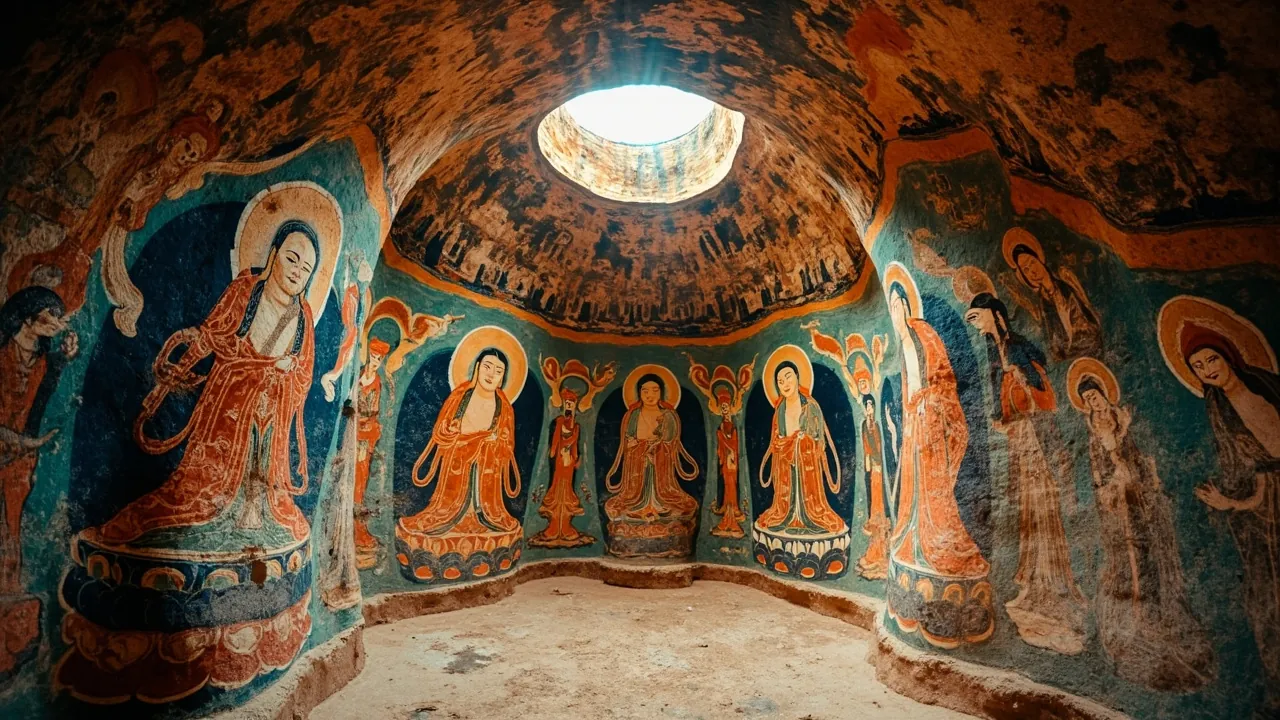
The comparison with Mogao is even more striking. The Mogao Caves (莫高窟) at Dunhuang are in Gansu, far to the west, almost on the edge of the Gobi. They were carved from the late 4th century onward and produced roughly 2,000 painted caves — most containing painted murals rather than carved sculpture, which immediately tells you something about regional resources and tastes. Yungang is sculpture first and foremost; Mogao is painting. Both are stunning; they are not quite the same conversation.
Maijishan (麦积山), in Gansu, is sculpture again, in a different geological setting — clay sculptures in mudstone cliff faces rather than stone carvings in sandstone. Maijishan is smaller than Yungang but visually rich. Visiting all four would be the dream Silk Road tour.
How Yungang Survived (and How It Almost Didn’t)
If you visit Yungang today, the first thing to know is that what you are looking at is a fraction of the original. The caves we walk through are largely intact, but the surface decoration has been heavily weathered. Many figures are missing faces, hands, or arms. The famous painted finishes — Yungang was originally a polychrome site, with red, blue, gold, and pigmented surfaces over the carved stone — are mostly gone.
The site also suffered from deliberate damage at several points. In the late Ming and Qing dynasties, when imperial patronage of Buddhism had declined and banditry was common in northern China, many caves were stripped of decorative sculpture, metalwork, and religious imagery. Some figures ended up in overseas collections, including major holdings in Western museums. The famous Yungang Bodhisattva heads you can see in major art museums from New York to Tokyo are part of this dispersal.
There is also significant weather damage. Northern China is dry, and Datong is dry, but the cliff face still erodes. The biggest conservation challenge today is water infiltration during the rainy season, which cracks sculpture and loosens overhangs. Modern Chinese authorities have done substantial work to slow erosion.
In 2001, UNESCO inscribed Yungang on its World Heritage List, recognizing both the artistic significance and the technical achievement of the carving. UNESCO’s description emphasizes that Yungang is “an outstanding example of the Buddhist cave art of the fifth and sixth centuries,” and that the site represents “the classical perfection of the gateway of art.” That last phrase is essentially UNESCO’s way of saying what I said above: Yungang is where the conversation between Gandhara and China begins to fully resolve, and where we can see one half turning into the other.
Why You Should Care About Yungang in 2026
If you’ve ever looked at a Tang dynasty Buddhist sculpture in a museum and admired its graceful linear elegance, you might want to go back in your mind to a sandstone cliff in Shanxi and look at the figures from which that Tang style eventually emerged. Yungang is the parent style. It’s where the long conversation that produced Tang Chinese Buddhist sculpture first really landed on Chinese soil and started to evolve on its own terms.
If you’re interested in the Silk Road, Yungang is one of the very few places where you can literally walk through what the Silk Road actually did. It is the visible proof that Buddhist visual ideas traveled from Central Asia to China and were remade in the moving. You’re not just reading about cultural transmission in a textbook. You’re looking at it in stone.
If you’re interested in the political history of Buddhism, Yungang is where you see the most explicit medieval example of rulers claiming that they, themselves, are the Buddha. That’s a striking bit of imperial political theology, and it’s carved into stone in five different figures at the western end of the cliff.
If you visit, plan at least a half day. Walk the path east to west so you experience the stylistic transition in its proper sequence. Bring water and sun protection. The site’s significance doesn’t announce itself; it accumulates.
And if you can’t visit, the museums that hold Yungang fragments — the Palace Museum in Beijing, major international collections in Paris, Berlin, and New York — are next-best options. Take your time. The stone has been patient for fifteen centuries. It can wait for you to be patient too.
Recommended Products for Yungang Grottoes Cultural Exploration
1. “The Yungang Grottoes and Buddhist Art of the Northern Wei Dynasty” (Art Reference Book) An English-language art-history reference book covering Yungang’s place in global Buddhist visual culture, with detailed discussion of individual caves, sculptures, and the famous Gandharan stylistic inheritance. Includes comparative plates showing similar figures at other cave sites (Bamiyan, Kizil, Ajanta, Longmen) for cross-cultural context. Most useful for readers who want to go beyond a tourist-level introduction to the caves’ art-historical significance. Look for editions published by university or museum press for accurate scholarship.
2. “Chinese Buddhist Sculpture: Northern Dynasties to Tang” (Specialized Survey) A scholarly but accessibly written survey of Chinese Buddhist sculpture, including a major section on Northern Wei carving at Yungang and Longmen. Combines art-historical analysis with photographs of major museum-held pieces. Helpful for understanding how Yungang fits into the longer story of Chinese Buddhist visual culture, especially when comparing its muscular early-fifth-century figures with the more lyrical sixth-century Tang sculpture. Useful both as a reference and as a coffee-table book for anyone interested in this period.
3. “Cave Temples of the Silk Road: Carved in Stone, Painted in Faith” (Comparative Cave Art Book) A photographic and scholarly survey of the great Buddhist cave temple sites along the Silk Road — Bamiyan, Kizil, Dunhuang, Yungang, Longmen, Maijishan. Compares carving techniques, stylistic choices, and donor cultures across each site. For Yungang readers, the most useful sections are those that compare Yungang to its Central Asian predecessors, illustrating how Chinese and Gandharan stylistic choices interacted. Excellent photography throughout.
4. Replica Seated Buddha Statue (Resin, Cave-Yungang Style) A modest-sized replica statue — typically resin or bonded marble, around 25-40 centimeters tall — modeled after the seated Buddha from Cave 20 at Yungang. These are widely available from Asian import retailers, museum gift shops, and specialty Buddhist-art suppliers. Not a substitute for seeing the original, obviously, but a useful visual reference and a pleasant decorative object for a home library or meditation corner. Look for reproductions that match the actual proportions of the Cave 20 figure rather than generic “Asian Buddha” stylings.
5. “Sculpture of the Buddhist World: Asia and Beyond” Regional Asian Sculpture Cookbook A wide-ranging reference covering sculpture from across the Buddhist world — Gandharan, Indian, Sri Lankan, Southeast Asian, Korean, Japanese, and Chinese. While not specifically about Yungang, the Gandharan and early Chinese sections provide useful context for how Yungang’s Gandharan-influenced style sits in a broader Asian Buddhist sculptural tradition. Includes suggestions for further reading and museum collections of interest. A useful general reference if you’re interested in the larger world Buddhist art history.