Yunnan Cuisine: Mushroom Kingdom and the Legend of Crossing-Bridge Noodles
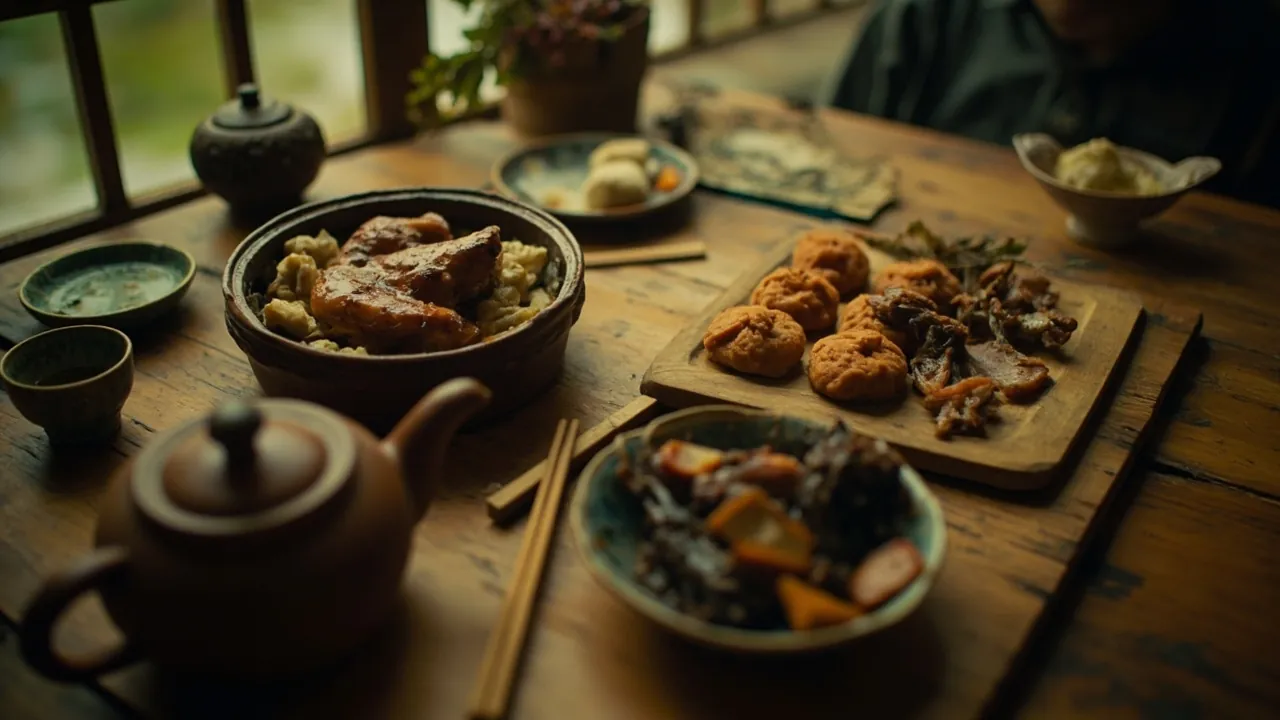
Every summer, a particular ritual plays out at Kunming’s Mushrooms Market, a covered emporium near the old train station. Trucks pull in overnight from villages high in the mountains, and by dawn the concrete aisles are stacked with piles of fungi that look like they wandered out of a storybook: blue-capped matsutake with their pale stalks poking up like thumbs, glossy black boletus arranged in glossy pyramids, brilliant purple-pink sporeless “russula” varieties that change color on the plate. Locals sift through like kids in a candy store. The smart ones smell everything and buy in bulk.
Yunnan Province, in southwest China bordering Vietnam, Laos, and Burma, is the kingdom of mushrooms. The numbers are staggering — over 900 edible species grow here, including about 250 that are commercial staples — and they’re consumed with a kind of regional devotion that has no real American equivalent. People in Kunming care about wild mushrooms the way French people care about truffles: not as a luxury, but as a season. The matsutake window is August-September. Boletus season starts a little earlier and runs through fall. If you live in Yunnan, you wait for the rain, and when the rain comes, you cook.
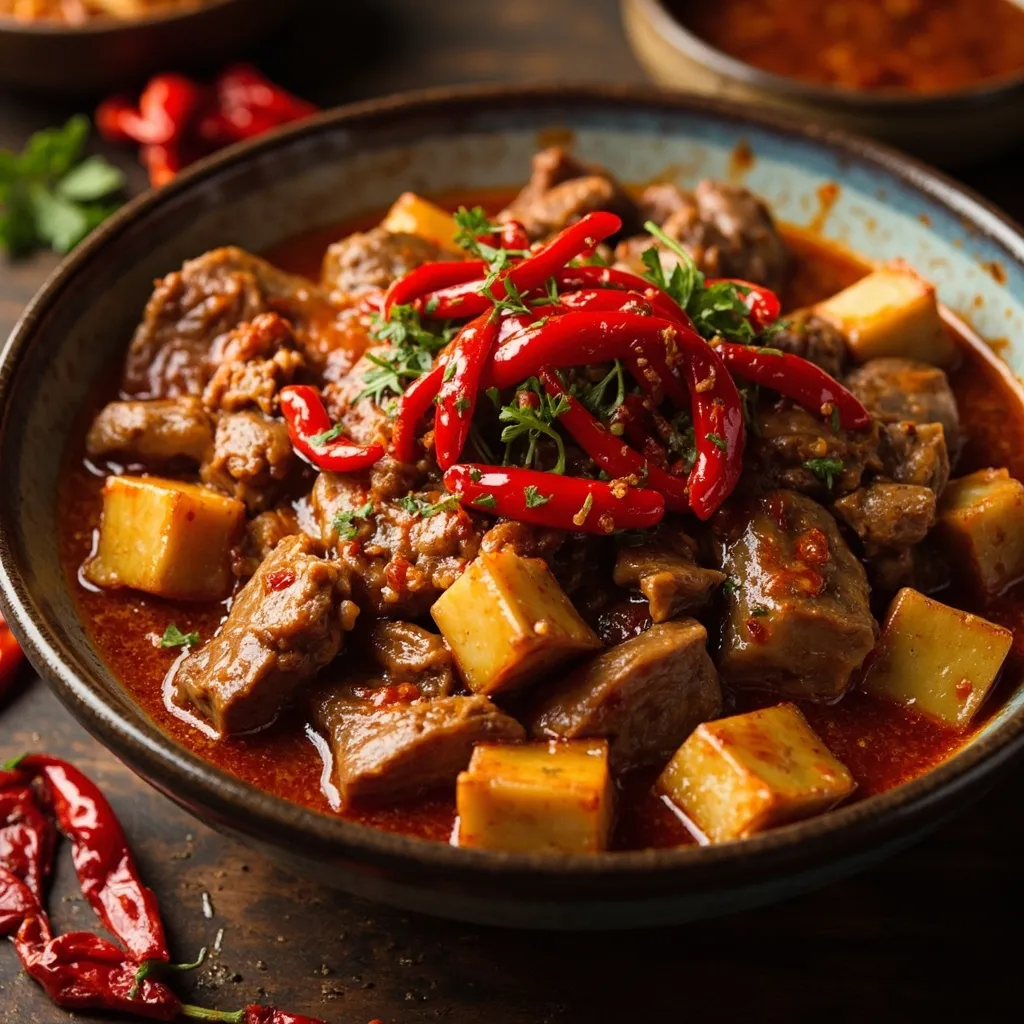
But Yunnan cuisine is bigger than mushrooms. It’s the most biodiverse regional food in China, the product of a province with 25 recognized ethnic minorities, an enormous range of altitudes, and a location on the old Tea Horse Road that gave it constant contact with the food cultures of Burma, Tibet, Vietnam, and Southeast Asia. If you only know Sichuan’s fire or Cantonese refinement or Shanghainese sweetness, Yunnan will surprise you — it tends toward brighter, cleaner, more herbal flavors, with chili heat that builds slowly rather than flooding in up front.
A Province of Many Tables
To talk about Yunnan food as a single cuisine is a bit of a stretch. The Han majority in Kunming cooks one way, the Dai people in Xishuangbanna cook another, the Yi people in the northeast mountains cook yet another. Even within a single city, you’ll find a Yunnan rice noodle shop serving a thin soup noodle and a Muslim quarter kebab house serving cumin-spiced lamb skewers that taste unmistakably Uyghur. Most of what you’d call “Yunnan cuisine” in a U.S. restaurant collapses this variety into a few shapes: crossing-bridge noodles, mushroom hot pots, steam-pot chicken, and a clutch of snack foods like flower cakes and grilled cheese.
What ties it together is the underlying basket of ingredients. Yunnan has more edible plants than almost any comparable region on earth, partly because of altitude range. The province varies from tropical valleys below 500 meters to alpine meadows above 4,500 meters, so anything you can think of — mushrooms, flowers, herbs, fruit, vegetables — has somewhere to grow. Yunnan is also the historic source of several foods Americans know well but probably didn’t know were from there: walnuts, kiwifruit (originally Chinese gooseberry), the bak choy of stir-fry fame, and several major tea types including pu-erh.
This matters because the cooking style, when Yunnan cooks let their ingredients shine, tends toward the light, the herbal, the gently spiced. A cook in Kunming treats a single matsutake mushroom with the same reverent simplicity a Japanese kaiseki cook treats a piece of seasonal fish. The mushroom arrives, the mushroom gets cleaned carefully with a wet cloth (never washed, since mushrooms absorb water like sponges), the mushroom gets a little butter or a little chicken broth or just a few minutes in a dry pan with salt and white pepper. That’s it. The mushroom does the work.
If you try one Yunnan dish on your trip to Kunming, by the way, make it the simple stir-fried matsutake. It’s the most direct route to understanding what the local ingredients can do, and outside Yunnan you almost never get matsutake this good.
Crossing-Bridge Noodles (过桥米线): A Love Story You Can Eat
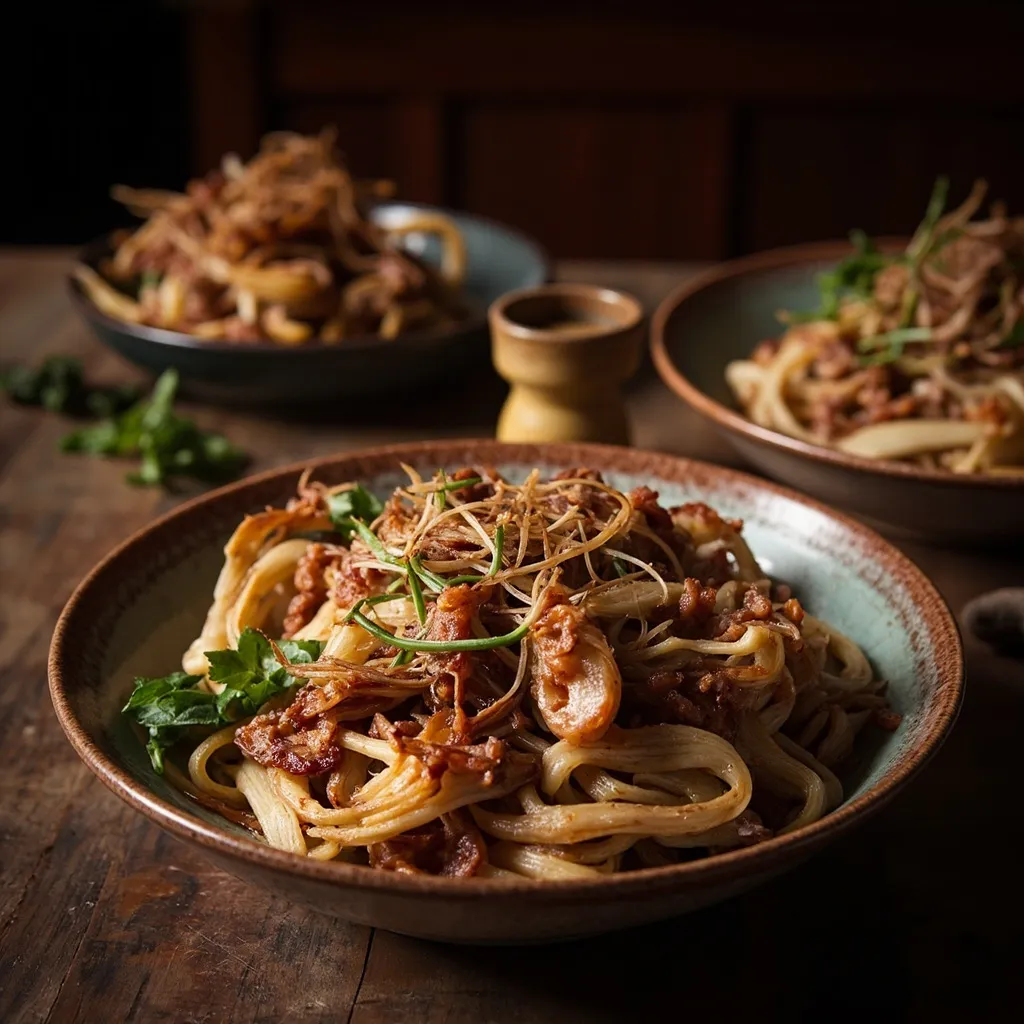
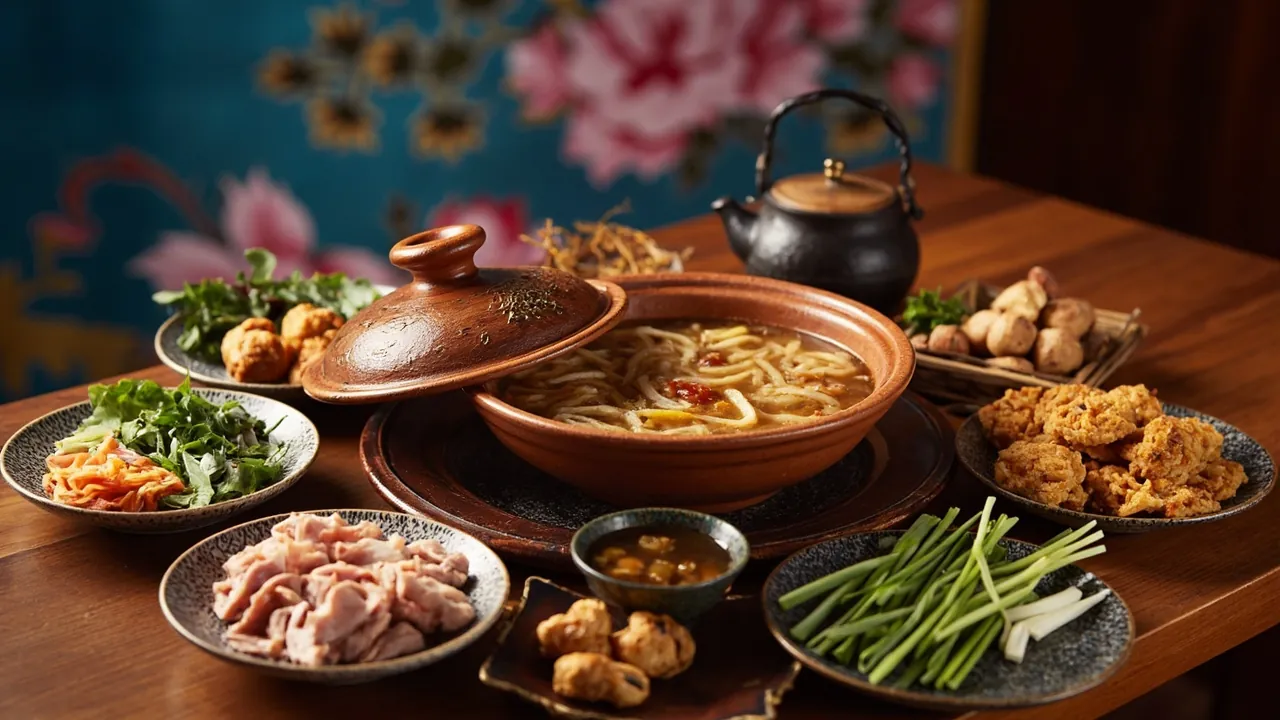
Crossing-bridge noodles — guoqiao mixian (过桥米线) — are the single most famous dish in Yunnan cuisine and one of the easiest dishes anywhere in China to remember once someone explains why it’s called that. It’s served as an immersive performance rather than a plated dish: a giant bowl of steaming broth comes to the table with a tray of raw thinly sliced ingredients on the side, and the diner adds them one by one.
The broth is the heart. Made from pork and chicken bones simmered for hours, often with a whole chicken and a layer of skin-on pork fat that floats on top, it’s served boiling hot — so hot that the oily surface skin holds in the heat. This is what lets you cook raw ingredients at the table safely. A thin slice of raw pork dropped into the bowl cooks almost instantly in that bath. Same with a quail egg, a bit of squid, some sliced black mushroom, a handful of scallion. Thin rice noodles are added last, given a moment to soften, then everything is spooned into a personal bowl or eaten directly from the large one.
According to the popular legend, a scholar’s wife in the eighteenth century used to cross a bridge each day to bring her husband his lunch at the study where he was preparing for the imperial exams. To keep his food warm she wrapped it in oiled paper and packed the broth separately, but he was always working when she arrived and the broth had gone cold. One day she figured out a faster way: she layered raw meat and vegetables over the still-hot broth and let the heat cook everything to order. The scholars in the study never had to wait. The bridge that she crossed daily is the bridge in the name.
Whether or not the legend is true, the dish itself has been refined into an art. In Kunming you can find guoqiao mixian that takes twenty minutes to construct and use eight or more toppings. Some shops add small silver puffs of fried Yunnan goat cheese, edible flowers, or the day’s freshest greens. Others stick to pork, chicken, and quail egg and let the broth carry the show.
For an American cook trying crossing-bridge noodles at home, the hard part is not the assembly — that part is fun and forgiving — it’s the broth. Make it ahead, in volume, and reduce it, since the broth must hold a rolling boil as you drop things in. The thin rice noodles dry in a pantry for months; the suggested topping list above is a starting point but not a rule. The point of crossing-bridge noodles is exactly the point of the legend: making a meal for someone else, with care.
Steam-Pot Chicken (汽锅鸡) and the Question of Where Soup Ends
Steam-pot chicken, or qiguo ji (汽锅鸡), is one of those rare dishes that’s both delicious and a small piece of physics. The traditional vessel is a clay pot with a hollow central chimney that rises from the inside of the pot up through the lid. Raw chicken pieces, ginger, salt, and sometimes a few herbs go in around the chimney. The pot is sealed, dropped into a pot of boiling water, and steamed for three to four hours. During that time steam rises into the pot, condenses around the chicken and the inner chimney, drips back down through the chimney channel, and collects in the bottom of the pot as broth.
What’s astonishing is that no water is added directly. The broth is made entirely from condensation. The result is cloudy, milky, slightly gelatinous when cold and silky when hot, with a pure chicken flavor that’s deeper than most soups you can buy. The chicken itself, sometimes served alongside the broth, is almost a secondary character — tender and unseasoned in comparison to the broth’s power.
Steam-pot chicken is beloved in Yunnan partly because it’s one of the few “clear” soups in Chinese cuisine. Most Chinese soups are simmered in the broth from the start, so the broth and the meat share the same liquid. The steam-pot method is different: it’s a soup that arrives in the dish, drawn out of the meat itself by gentle steam. For a cook trying to understand why Chinese cuisines treat soup so differently from Western ones, qiguo ji is a useful reminder that the techniques vary widely even within what we call “Chinese soup.”
At home in America, you can buy qiguo ji pots online or at Chinese kitchen-supply stores in larger Chinatowns. They’re a one-trick kind of pot but a wonderful trick. Otherwise, you can fake a version using a double boiler set up cleverly. Just don’t expect the broth to be as pure as the real thing.
The Flower Cakes, Goat Cheese, and Other Things You Don’t Expect
Outside the three signature dishes above, Yunnan food has a shelf of snacks and side dishes that often surprise first-time visitors.
Flower cakes (鲜花饼) are the best place to start. They look like a small round pastry with a flaky, laminated crust, similar in shape to a Portuguese pastel de nata but bigger and more delicate. Inside is a paste made from fresh edible rose petals, typically Rosa chinensis or Rosa rugosa, sugared and slightly reduced during cooking. The result is floral without being soapy, sweet without being cloying, and unlike anything American bakeries routinely produce. Yunnan is the largest producer of edible roses in China, which is why flower cakes are so dense in Kunming bakeries — they’re the thing everyone takes home as a souvenir.
Yunnan goat cheese (乳饼, rubing) is another signature. It’s a fresh, white, slightly elastic cheese that’s somewhere between a halloumi and a fresh mozzarella in texture. Made by coagulating goat or cow milk with sour juice — the Yunnan method typically uses papaya leaf or lemon juice — it has a tangy, milky flavor that’s unique. Most famously, it gets pan-fried with chili, mint, and salt, which turns it melty and crisps the outside into a kind of savory pancake. If you can find it in a Chinatown, by all means try the pan-fried version; it’s one of the most unexpectedly good bites in Chinese cooking.
Wild chili sauces (蘸水, dian shui) are the Yunnan’s answer to table-side condiments. Every family and every small restaurant makes their own blend of dried chilies, charred salt, lemon zest, mint, and crushed toasted peanuts. Diners sprinkle this over grilled fish, noodles, rice, or pretty much anything. Different regions of Yunnan have signature variants: the Lijiang version (CuShuXiang) is more spicy and herby, the Dai version is more citrus and fresh, and the Dehong version is fermented and funky.
Yunnan ham (宣威火腿, Xuanwei ham) is one of the great Chinese hams, alongside Jinhua and Rugao. It has a deep red color, a complex, almost sweet umami flavor, and a long curing period that lets the texture of the meat become almost silken. Yunnan ham shows up sliced thinly in breakfast congee, in stir-fried vegetables, and in cold-cut platters. Outside Yunnan you won’t find it often — Xuanwei ham is usually described as “more delicate” than the bigger-name Jinhua — but if you see it, especially a whole leg, buy.
Pu-erh tea (普洱茶) is not technically a cuisine, but no Yunnan food tour is complete without it. Grown in the tropical forests around Xishuangbanna and aged sometimes for decades, pu-erh is a fermented tea with deep, woody, almost savory flavor — closer to a green tea that’s traveled a long time and came back changed. Yunnan locals sip pu-erh with rich meals because the tannins and the cooling, slightly earthy character offset oily food. The best pu-erh is a slow afternoon pleasure that drifts between sweet and earthy as the leaves open in a clay teapot.
How Yunnan Food Compares to What Americans Already Know
If most of what Americans call “Chinese food” comes from one regional kitchen (Cantonese, plus a sprinkling of Sichuan), Yunnan is a useful perspective-shifter. Three points worth pressing:
Yunnan is not Sichuan. Yunnan food uses chili and seasonings familiar across southwest China, but the heat tends to be slow, herbal, and backed by other flavors rather than the immediate numbing-cum-fire of Sichuan peppercorns and dried chilies. If Sichuan is heavy metal, Yunnan is more like layered folk, with the spiciness arriving gradually and never quite dominating.
Yunnan is not Cantonese. Yunnan’s inland geography means it’s not a seafood cuisine, and the cooking style — even at its most refined in Kunming — emphasizes bold contrasts and herbal brightness more than Cantonese restraint. Both cuisines treat vegetables and textures with care, but a Yunnan steamed fish will come with herbs and chili oil that a Cantonese chef wouldn’t think to use.
Yunnan is closer to Southeast Asian food than most Chinese cuisines. The southern half of the province shares climate and trade history with Burma, Laos, and Thailand, and you’ll find dishes — fresh herb salads, sticky rice with sour fermented pork, lemongrass-heavy curries — that overlap with Thai or Burmese versions. If you’ve had northern Thai larb, you won’t be surprised by the Yunnan version.
Eating Yunnan in America
Yunnan food is one of the easier regional Chinese cuisines to find in America, if not always easy to find at scale. New York, San Francisco, and the Los Angeles area each have dedicated Yunnan restaurants; many college town Chinatowns have at least one Yunnan rice-noodle shop that’s been there for a while; and a few large Yunnan supermarkets in California and Washington now carry frozen fresh rice noodles and dried mushroom assortments to cook at home.
The first dish to try at a Yunnan restaurant is almost always crossing-bridge noodles. The second is whatever the mushroom special of the day is. The third — and this is the one often skipped — is a side of the goat cheese with chili. If the restaurant has it in any form, you haven’t lived until you’ve had fresh Yunnan rubing briefly kissed in a pan.
Recommended Products
- guoqiao-mix-set — A complete crossing-bridge noodles topping set with sliced pork, quail eggs, mushrooms, and seasoning packets for assembling the dish at home.
- dried-mushroom-assortment — A Yunnan wild mushroom assortment with porcini, black boletus, and tea tree mushroom; a pantry staple for soups, stir-fries, and braises.
- pu-erh-tea — A small cake of aged pu-erh from Xishuangbanna, ready to crumble into a clay teapot; deep, earthy, and ages beautifully in your cupboard.
- fresh-rice-noodle-pack — Fresh rice noodle packs that ship refrigerated; the silky base of crossing-bridge noodles and a dozen other Yunnan dishes.
- yunnan-cookbook — An English-language Yunnan cookbook with recipes for steam-pot chicken, mushroom hot pots, and Dai dishes from the southern border.