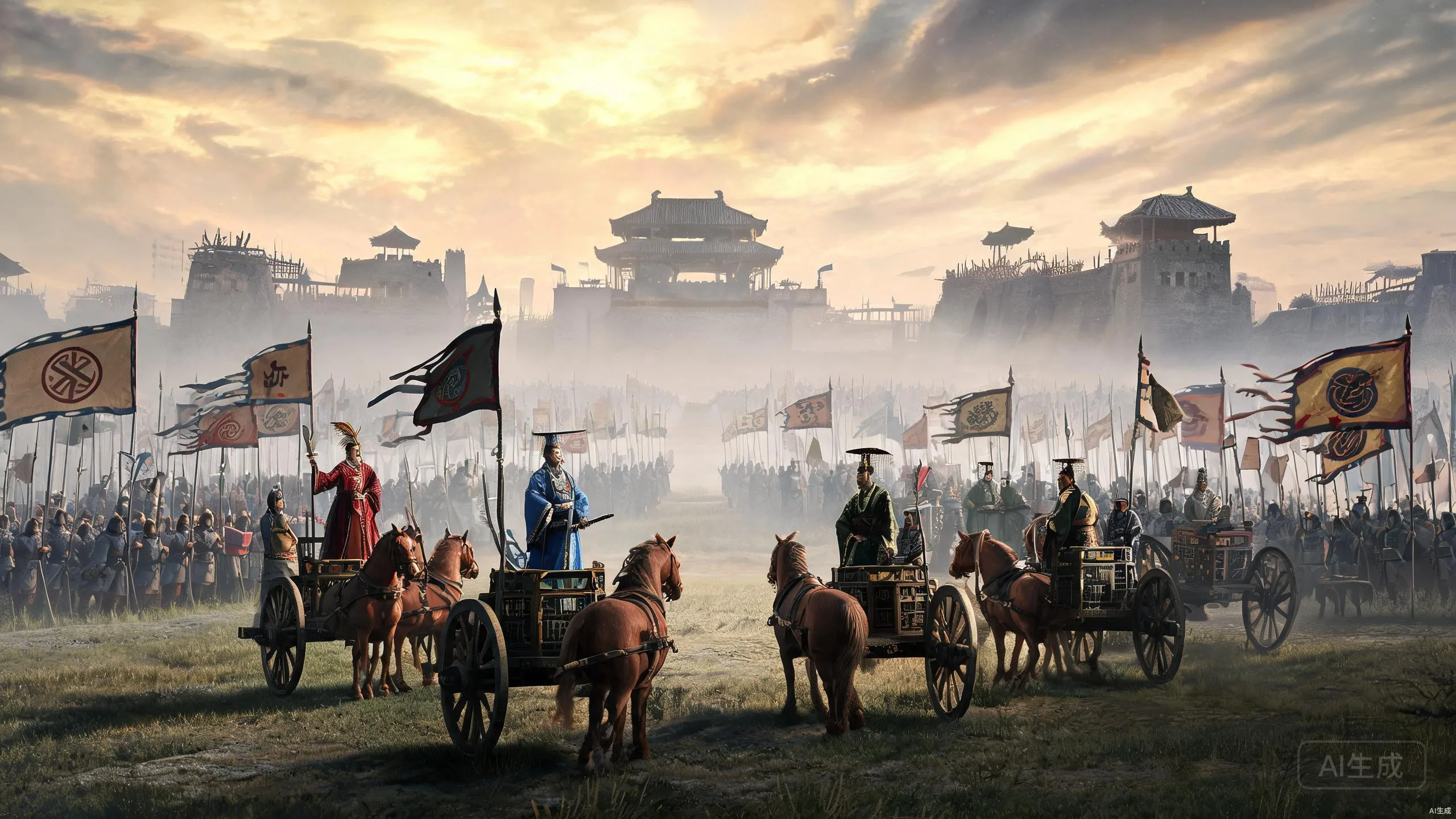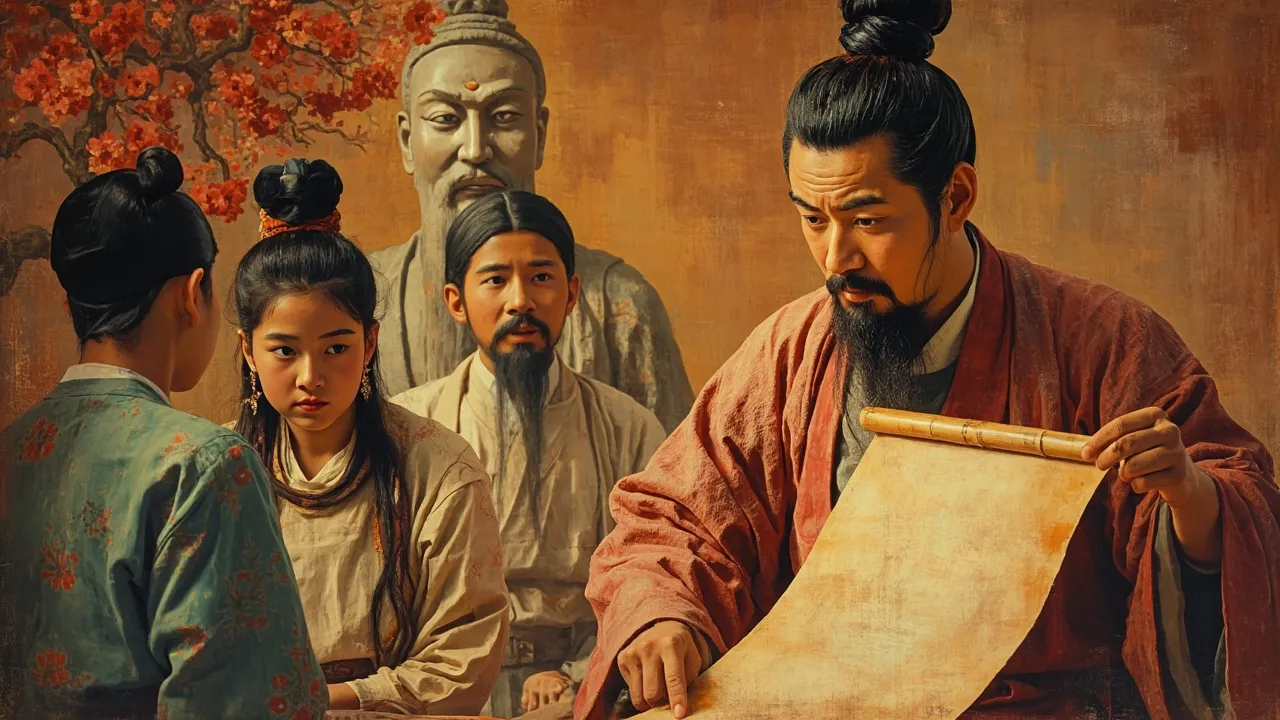
The legend goes like this: Around the 11th century BC, a king of the Shang dynasty named Wen was imprisoned by his enemies. He spent seven years in a stone cell, with nothing to do and no way out. To fill the time, he began studying the patterns of reality—the cycles of nature, the movements of the heavens, the rise and fall of dynasties. And he began to encode his observations in a system of 64 six-line figures, each made of six broken or unbroken lines. When his son Wu finally overthrew the Shang and founded the Zhou dynasty, the system that King Wen had developed became the foundation of the Zhou Yi—the “Changes of Zhou.”
Whether this legend is literally true hardly matters. What matters is that the text it describes—the Zhou Yi—is among the most read, most debated, most annotated, and most misunderstood books in human history. It was used for divination in ancient China. It became one of the Five Confucian Classics. It influenced the design of the Chinese writing system. It inspired the Taijitu, the famous Yin-Yang symbol. In the 17th century, it reached European missionaries, who carried it back to a fascinated Enlightenment audience. In the 20th century, Carl Jung called it one of the most important psychological texts ever written. Today, it sits on the shelves of business leaders who consult it for strategic decisions.
The Zhou Yi began as a manual for fortune tellers. It became one of the most consequential philosophy books ever produced.
King Wen’s Prison Invention: How the 64 Hexagrams Were Born
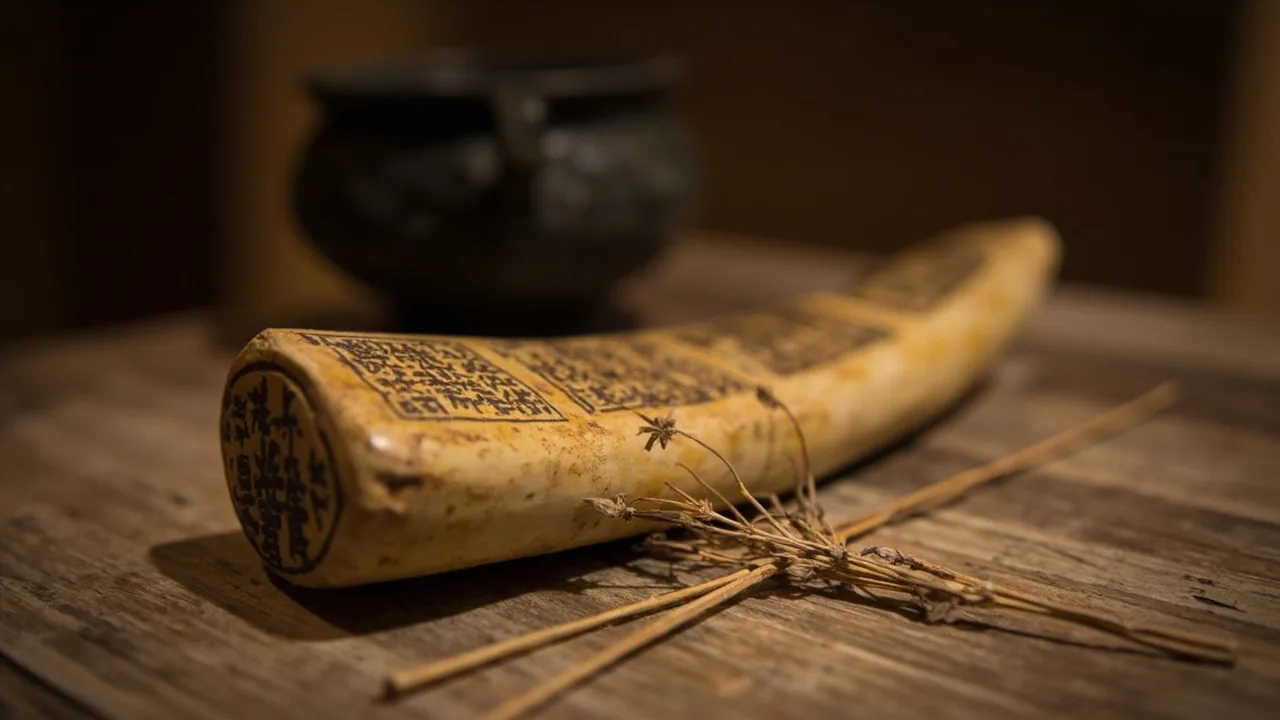
The Zhou Yi in its earliest form was a divination manual—a text that explained how to interpret the 64 possible arrangements of six lines, where each line could be either broken (representing Yin) or unbroken (representing Yang). The system was called hexagram divination, and it was performed using a bundle of dried milfoil stalks, manipulated according to a specific ritual to generate a hexagram, which was then looked up in the text to find the interpretation.
The earliest layers of the text probably date to the late Western Zhou period (around the 9th-8th centuries BC), though the legend of King Wen places its origin a few centuries earlier. What is clear from the oldest portions of the text is that the hexagrams were not randomly invented. They appear to encode observations about natural and social cycles—states of affairs that repeat in different forms across time. The hexagram called Qian (乾), for example, represents heaven, creativity, strength, and the north star—all concepts associated with pure Yang energy, the active, generative principle. The hexagram called Kun (坤) represents earth, receptivity, and the nurturing mother—all concepts associated with pure Yin energy, the passive, responsive principle.
The system works through binary opposition and transformation. Each hexagram is composed of two trigrams (three-line figures), and each trigram represents one of eight natural phenomena: heaven, earth, thunder, wind, water, fire, mountain, and lake. The combination of two trigrams into a hexagram creates a meaning that is more than the sum of its parts—a kind of emergent symbolism that allows for enormous subtlety. With 64 hexagrams, each with six lines that can each be in one of two states, and each line potentially changing to its opposite, the total possible readings of any single hexagram is vast. This is why the Zhou Yi rewards repeated study: it seems to generate new meanings as the reader changes.
The Three Parts: How One Text Became Three
The Zhou Yi as it exists today is actually three texts in one, added over several centuries. The oldest layer is the Tuan (彖), the “Judgments”—short evaluative statements attached to each hexagram that assess the overall situation the hexagram represents. These are probably the oldest portions of the text, dating to the Western Zhou or early Spring and Autumn period.
The second layer is the Xiang (象), the “Images” or “Commentary”—explanations of how each hexagram’s structure represents moral and natural lessons. The famous passage “the strong dragon lies in the deep water” (潜龙勿用), from hexagram Qian, belongs to this layer. These image commentaries were added during the Warring States period (475-221 BC), when scholars began reading the Zhou Yi not just as a divination manual but as a philosophical text.
The third layer is the Za (杂), the “Miscellaneous” or “Appended Judgments”—a collection of philosophical essays that represent the most developed layer of Confucian interpretation. This layer includes discussions of the relationship between the hexagrams and natural phenomena, the moral qualities of the lines within each hexagram, and the famous passage that describes the Zhou Yi as a text that “closes and opens, advances and retreats”—a book that meets the reader where they are.
Over time, the text was reorganized and divided into two parts: the Zhou Yi proper (the hexagrams and their judgments), and the Yi Zhuan (易传), the “Commentary on the Zhou Yi"—a collection of ten essays that became the basis for the text’s interpretation in the Confucian tradition. The Yi Zhuan is sometimes called the Tuan/Xiang/Za commentary or, collectively, the “Ten Wings” (十翼), because the tradition viewed these commentaries as the ten wings that allowed the text to fly.
Confucius and the Transformation of a Divination Manual into a Classic
The pivotal figure in the Zhou Yi’s transformation from divination manual to Confucian classic was Confucius (551-479 BC), or at least the tradition that attached his name to the text. The historical evidence that Confucius himself wrote any part of the Yi Zhuan is thin—the essays show signs of having been composed by multiple hands over several generations. But the tradition of attributing the philosophical commentary to Confucius gave the text an authority that its origins as a fortune-telling manual could never have provided.
Confucius is traditionally said to have read the Zhou Yi so many times that the binding cords holding the book together broke—three times. This story, whether or not it is biographical fact, captures something true about the text’s relationship with Confucian scholars: the Zhou Yi was read, reread, annotated, debated, and memorized. It became a subject of scholarship in its own right, generating a commentary tradition that produced thousands of volumes over the following centuries.
The Confucian reading of the Zhou Yi emphasized its ethical dimensions. The hexagrams were not just patterns to be interpreted for practical purposes; they were maps of moral situations. Each hexagram represented a specific configuration of forces—some favorable, some unfavorable—and the wise reader would use these patterns to navigate their own circumstances. The goal was not to predict the future but to understand the present more deeply, using the hexagram as a lens for ethical reflection.
This reading coexisted uneasily with the text’s continued use in actual divination. Confucian scholars who analyzed the Zhou Yi philosophically often distanced themselves from fortune-telling practices, treating the divination layer as a primitive outer shell that concealed the deeper philosophical core. But the text never entirely lost its connection to the practice of asking questions and receiving answers—and in practice, the boundary between philosophical interpretation and divination was always porous.
The Five Dynasties of Commentators: How the Text Kept Changing
From the Han dynasty (206 BC-220 AD) onward, the Zzhou Yi generated an unbroken tradition of commentary and interpretation. Each major dynasty produced its own canonical interpreters, and each new generation of scholars built on the work of their predecessors while adding their own innovations.
In the Han dynasty, the Zhou Yi was one of the Five Classics studied by official scholars, but even within the Han there were competing interpretive schools. The “Imperial Text” school (Jinwen) favored readings based on the oldest available versions of the text, while the “Popular Text” school (Guwen) favored interpretations passed down through private teaching traditions. These competing schools shaped the text’s meaning for centuries.
During the Tang dynasty (618-907), the scholar Kong Yingda (孔颖达) produced the definitive official commentary, synthesizing the best of the earlier Han interpretations and establishing the standard reading that would dominate for the next several centuries. His commentary became the basis for the imperial examination curriculum on the Zhou Yi—any scholar who wanted to pass the exams had to master Kong Yingda’s interpretation.
In the Song dynasty (960-1279), the philosopher Cheng Yi (程颐) produced a reading of the Zhou Yi that was explicitly ethical and rationalist. Cheng Yi rejected the more mystical and supernatural interpretations that had accumulated over the centuries, insisting that the hexagrams represented nothing more mysterious than the patterns of the moral world. His reading was enormously influential among Neo-Confucian scholars, who saw it as a key text for understanding the structure of reality itself.
By the time of the Qing dynasty (1644-1912), the Zhou Yi had accumulated over a thousand years of commentary. The Kangxi Emperor himself commissioned a new edition, attempting to synthesize the best of all previous interpretations. The result was a text so densely annotated that reading the Zhou Yi without a guide had become nearly impossible.
From missionaries to Jung: The Global Journey of the Yijing
The Zhou Yi reached European readers in the 17th century through Jesuit missionaries, who were fascinated by the text’s apparent similarity to some aspects of Christian cosmology. The Jesuit scholar Joachim Bouvet (1656-1730) believed he had found evidence that the Zhou Yi’s hexagrams contained the same mathematical and theological truths as Christian revelation—his interpretation was controversial even among his fellow Jesuits, but it generated enormous European interest in the text.
The first complete Latin translation appeared in 1687, and the text quickly became a sensation among European intellectuals. Gottfried Wilhelm Leibniz, the German philosopher and mathematician, was particularly struck by the hexagram system’s apparent connection to his own work on binary mathematics. Leibniz saw in the 64 hexagrams a binary encoding system—he wrote to the Jesuit missionary Joachim Bouvet explaining how the hexagrams could be read as binary numbers, with Yin = 0 and Yang = 1. This correspondence, whether or not it was what the ancient Chinese intended, is now recognized as one of the more remarkable coincidences in intellectual history.
In the 20th century, the Swiss psychiatrist Carl Jung (1875-1961) incorporated the Zhou Yi into his psychological framework. Jung believed the text demonstrated the existence of what he called the “collective unconscious”—a shared psychological substrate beneath individual minds that expresses itself through symbols and patterns that appear across cultures. The hexagrams, in Jung’s view, were a map of psychological states, useful not for predicting the future but for accessing deeper levels of the psyche. Jung used the Zhou Yi in his therapy practice and wrote a foreword to a major English translation that shaped how Western readers understood the text for the rest of the century.
Today, the Zhou Yi continues to attract readers from wildly different backgrounds: Taoist practitioners, business consultants, academic sinologists, and spiritual seekers of various kinds. It remains, after three thousand years, a text that seems to have no bottom—a book that can be read once as a fortune-telling manual, again as a philosophical treatise, and again as a psychological guide, and that yields different truths each time.