The first time I watched a Zhuang bronze drum being played, it was in a village outside Donglan County, Guangxi. The drummer — a stocky man in his sixties named Farmer Wei — struck the drum face with two padded wooden sticks, and the sound rolled across the karst hills like distant thunder. Within minutes, a crowd had gathered in the dusty courtyard: elders with thermos cups, children chasing chickens, a bride in a bright embroidered jacket arriving late. Nobody had called a meeting. The drum had called it.
That is the thing about the Zhuang bronze drum. It is not sitting behind glass in a museum. In the Red Water River valleys of Guangxi, where some 20 million Zhuang people live — China’s largest ethnic minority — these bronze discs weighing up to 500 pounds are still beaten for real occasions: spring planting, funerals, the frog festival, and most certainly weddings. The oldest ones were cast in the Spring and Autumn period, roughly 2,700 years ago. They have never stopped.
The 2,700-Year Ancestry: From Warring States Forge to Living Heirloom
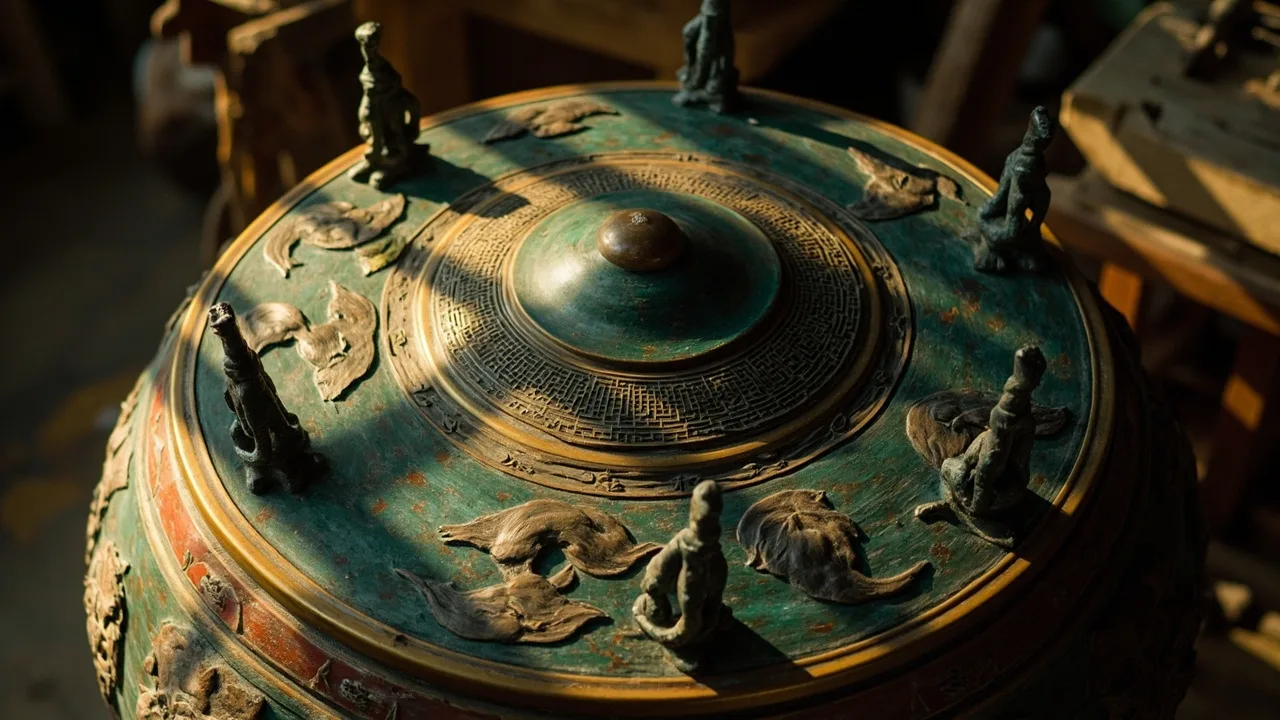
The story of the Zhuang bronze drum begins in the furnaces of the Warring States period, around the 7th century BCE, in a place that would become Yunnan Province. There, in the saddle valleys of the ancient Di Qiu people near modern Chuxiong, craftsmen produced what scholars recognize as the world’s earliest bronze drums — heavy, ritual vessels with flat faces and flared bodies, cast using the lost-wax method. Archaeologists call this the Wajiazhai type, and it represents the Proto-Zhuang ancestors, people whose language and cultural DNA would eventually flow eastward into Guangxi and become the Zhuang.
Over the next eight major dynastic transitions, the bronze drum traveled with migrating populations. When the Zhuang ancestors — then organized in shifting chiefdoms across the hills of what is now Guangxi, Yunnan, and parts of Guizhou — adopted the bronze drum tradition from their western neighbors, they did not simply copy it. They transformed it. The drums grew larger, heavier, and acquired an increasingly elaborate iconographic vocabulary. By the time of the Han Dynasty, when the Central Plains began to produce their own bronze ceremonial objects, the Zhuang had already developed at least eight distinct regional types: Wajiazhai, Shibanqiao, Lengshui Chong, Xunyi, Mahuang, Beiliu, Lingshan, and Ximeng types. Each corresponds to a specific geographical zone and reflects subtle differences in alloy composition, decorative motifs, and ritual function.
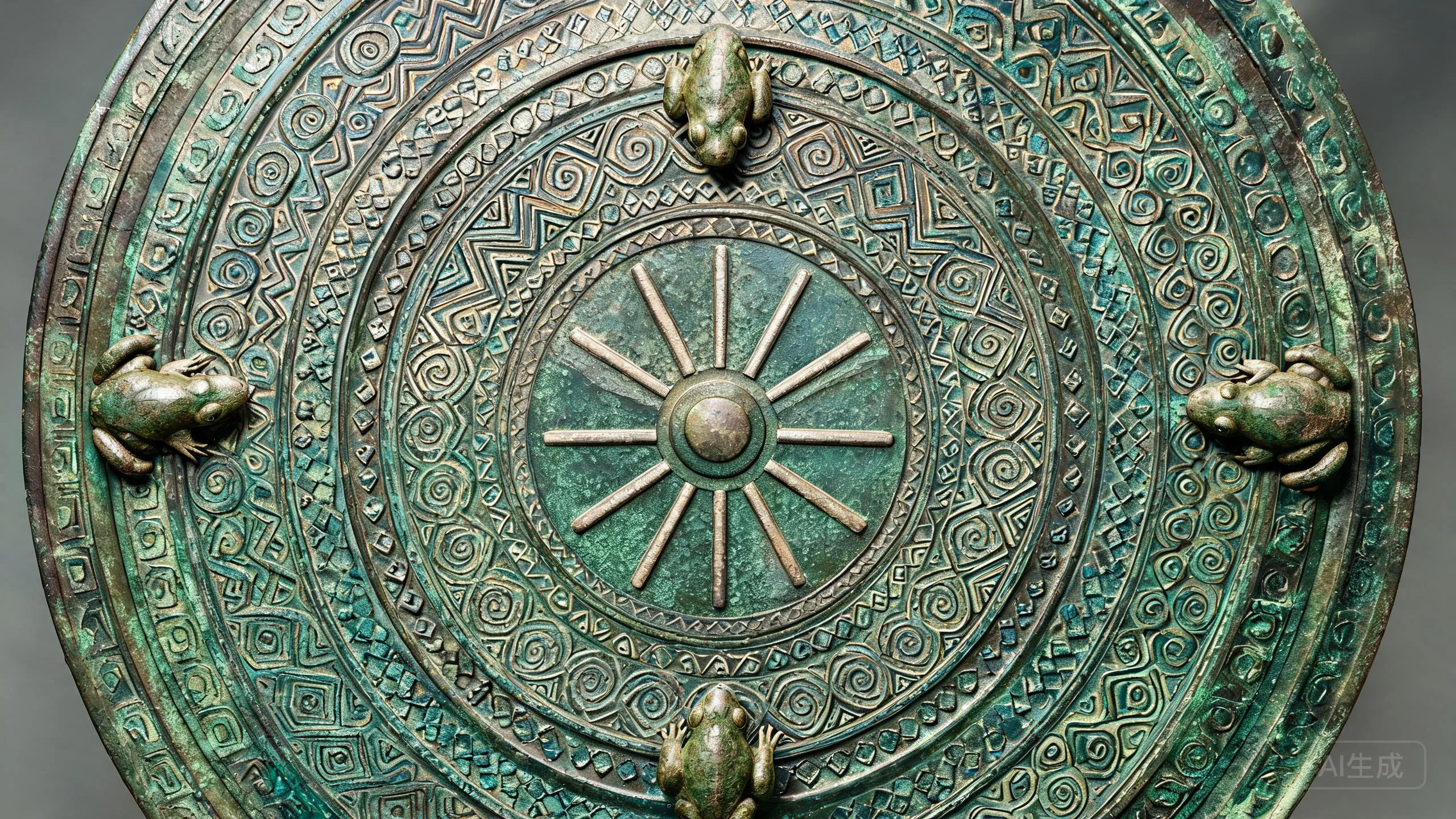
The Mahuang type — standardized during the Tang and Song dynasties — is what most people picture when they think of the classic Zhuang bronze drum. Mahuang drums range from 50 to 80 centimeters in diameter, making them the most common ceremonial size, and they feature a characteristic sun-ray pattern at the center of the drum face, surrounded by concentric bands of geometric decoration. The largest Zhuang bronze drums, the Beiliu type from the Han period, reach diameters of 165 centimeters and weigh over 300 kilograms — instruments that required an entire village to transport and maintain.
By the Ming and Qing dynasties, the bronze drum had become fully embedded in Zhuang social life, not merely as a musical instrument but as a symbol of lineage authority, community wealth, and spiritual potency. Families that owned a drum were families of consequence. A drum passed down through seven generations was worth more than a rice paddy.
Today, Donglan County in Hechi City, Guangxi, is widely regarded as the “Homeland of China’s Bronze Drums.” As of 2024, the county preserves over 1,400 folk bronze drums across its villages — the densest concentration of living bronze drum culture anywhere in China. And these are not antiques in storage. They are played.
The Code on the Drum Face: Sun, Frogs, and a Cosmology in Bronze
Walk close enough to a Zhuang bronze drum and you will notice something remarkable: the entire universe is cast onto its surface. The drum face is dominated by a central sun — a raised circular boss with radiating芒纹 (awn-pattern rays) that seems to pulse outward. Surrounding it, a hierarchy of concentric rings contains the drum’s deeper meanings.
Four small bronze frogs sit蹲踞状 (crouching) at equidistant points around the drum’s rim, their legs folded beneath them in a pose that scholars believe evokes readiness, alertness, the coiled energy before a leap. The frogs are not decorative afterthoughts. In Zhuang cosmology, they are the drum’s most sacred element.
According to Zhuang oral tradition passed down through shamans and village elders, the bronze drum is a thunder object — a vessel that summons and controls rain. The frogs sitting on its rim are agents of the sky. Frog croaking means rain is coming; when farmers hear frogs in the spring, they plant. The drum’s deepest ritual function, practiced in some form for at least two millennia, is the “sacrificing frogs to pray for rain” ceremony, conducted before the spring planting season. The drum is beaten to wake the frogs from their winter silence, to call the rain that will fill the paddies.
One legend I heard in a village near Baise tells of a great drought during the Tang dynasty in which a Zhuang chieftain ordered his craftsmen to cast a massive drum and place four frogs upon it. When the drum was beaten for the first time, the sky darkened and rain fell for seven days. Whether or not you believe the story, the underlying logic is clear: the Zhuang people mapped their agricultural calendar onto the drum’s surface. The sun at the center is rice — the staple that depends on rain — and the frogs surrounding it are the messengers between earth and sky.
Beyond the frogs and sun, the drum body carries bands of horizontal lines representing water currents, stylized cloud patterns evoking the space between earth and heaven, and sometimes animal motifs — elephants, hawks, oxen — drawn from the local ecology of Guangxi’s river valleys. The entire ensemble constitutes what one anthropologist described as “a cosmology cast in bronze.” Every element has a function in the Zhuang view of the world: copper for the sky god, tin for the earth, lead for the water, and the frogs as intermediaries who translate between them.
What makes the Zhuang bronze drum remarkable is not just its age but its coherence. For nearly three thousand years, the same basic iconographic vocabulary has been preserved on these drums — not as dead symbolism but as living ritual language. When a Zhuang elder today reads the drum face, he reads the same sky his ancestors read.
A Drum as Currency, Law, and Wedding Gift
In a mountainous economy where silver was scarce and paper money had not yet been invented, the bronze drum became something unexpected: a unit of wealth. This was not metaphorical. In the Qing dynasty, a legal document from a Zhuang village in what is now Debao County specifies a marriage contract in which the groom’s family paid “three faces of drums in exchange for four hundred jin of grain.” The drum was quantified, priced, and exchanged.
To understand how a musical instrument became a form of currency, you need to understand the geography of Guangxi in the 18th and 19th centuries. The karst mountains made overland transport of goods expensive and slow. Rice, bronze tools, and salt moved along rivers and mountain paths carried by porters. A large bronze drum — heavy, durable, and universally recognized as valuable — solved certain problems of exchange. A family could store wealth in a drum, transport it when necessary, and redeem it for land, livestock, or marriage payments. The drum’s metal content gave it intrinsic value; its cultural prestige gave it social value. It was both coin and crown.
But the drum’s role extended well beyond economics. In Zhuang village society, the bronze drum served as a legal instrument — a “peace drum” that was beaten to summon community gatherings, announce violations of village law, and conduct arbitration. When a dispute arose over land boundaries or an unpaid debt, the village headman would order the drum struck. The sound carried across the valley, and within an hour the adult men of the community would assemble to hear the case. The drum’s authority was spatial and psychological: its voice could reach every field and every household, and its sound was tied in the collective mind to justice and order.
The drum also presided over the two most significant ceremonies of a human life: death and marriage. At funerals, the drum was beaten continuously from the moment of death until burial — a practice that in some Zhuang villages continues today. The logic is both social and spiritual: the drum’s sound keeps evil spirits away from the body, announces the death to the ancestors, and summons the community to witness the transition. At weddings, the bride’s family presents a drum or contributes to its maintenance as part of the marriage alliance. A child born into a drum family inherits drum rights; a family without a drum occupies a lower social tier.
I spoke with a village elder in Tianyang who described how his great-grandfather settled a land dispute in 1934 by producing a bronze drum as evidence of his family’s prior claim. The opposing family, unable to match the drum’s prestige, withdrew their objection. “A drum speaks louder than a deed,” he told me, pouring tea with hands made rough by decades of rice farming. “Everyone in the valley knows the drum.”
Cold Mountain Forge: How a Zhuang Blacksmith Casts a 500-Pound Drum Today
If you want to understand how the bronze drum tradition survives in the 21st century, you go to the forge. I traveled to a workshop on the outskirts of Donglan County where a craftsman named Tan Zhenlin has been casting bronze drums for forty years. He is a nationally recognized inheritor of the intangible cultural heritage — one of six such designated masters living in Guangxi as of 2024.
Tan’s workshop smelled of charcoal and molten metal. Bronze ingots — a precise alloy of copper (about 78 percent), tin (roughly 14 percent), and lead (around 8 percent) — were stacked beside a clay pit where the lost-wax molds were prepared. The proportions matter enormously: too much copper and the drum becomes brittle; too much tin and it loses resonance. Tan’s grandfather taught him to judge the mix by the color of the molten metal and the sound it made when stirred with an iron rod.
The process begins with the model. Using a mixture of clay, sand, and rice husk ash, Tan builds a inner core shaped to the drum’s intended dimensions. Over this he applies the lost-wax layer — a mixture of beeswax and plant resins that will melt away when the molten bronze is poured in, leaving a precise negative space between the core and the outer mold. The outer mold is built up in layers, each allowed to dry before the next is applied. For a large drum, this preparation alone takes two to three months.
When everything is ready, Tan and his two assistants heat the molds in a pit furnace, melt the bronze ingots in a clay crucible, and pour. The metal flows at over 1,000 degrees Celsius into the gap left by the wax, taking the shape of the drum’s decorated outer surface. Cooling takes several days. Then comes the most labor-intensive phase: removing the inner core without damaging the thin decorative ridges on the drum face, a process called “cleaning the drum” that can take another month of careful chiseling.
The frogs — those four sacred figures on the rim — are cast separately and then attached using a hot-punch technique that joins bronze to bronze without visible seams. The final step is surface treatment: the drum is immersed in a mild acid solution that darkens the bronze to the characteristic deep brown-green patina that collectors find so beautiful, and that the Zhuang consider a sign of the drum’s maturity. A new drum, to the Zhuang, is incomplete. Only after years of playing and aging does it develop its true voice.
Tan showed me a drum he was finishing — 67 centimeters in diameter, patterned after the Mahuang type. It would take six months from first clay model to final surface treatment. When I asked him how many drums he had cast in his career, he smiled and said, “I stopped counting at sixty. Some years I cast one. Some years, three. Each one is different.”
By comparison, the legendary Mahuang drums of the Tang-Song period — the ones still played in Guangxi’s oldest drum families — measure between 50 and 80 centimeters in diameter, matching Tan’s current work almost exactly. The tradition has not merely survived; it has maintained technical continuity with its medieval peak.
Frog, Water, Rice: Why the Drum Is Still Beaten Every Lunar March
On the third day of the third lunar month, the Zhuang people celebrate one of their most ancient festivals: the Frog Festival, known in the Zhuang language as Coekgyaij (which literally means “frogs’ festival” or “calling the frogs”). In the Red Water River basin around Donglan, this day draws thousands of people to riverside clearings where the bronze drums are brought out, cleaned, and beaten in a ceremony that has been described in Chinese records dating back to at least the Ming dynasty.
The ceremony follows a strict sequence. In the early morning, young men and women go to the fields to collect frog specimens — in practice, they now often use clay frog figures — and bring them to the riverside. The village’s bronze drums are arranged in a line, and the eldest drum keeper leads a series of beats that, according to the tradition, “wakes the frogs from their winter sleep.” As the drumming intensifies, the frogs (or their symbolic replacements) are immersed in the river. The ritual is simultaneously agricultural prayer, ancestor veneration, and community theater.
Then comes the modern wrinkle. In 2006, the Zhuang Bronze Drum习俗 (custom) was listed as part of China’s first batch of National Intangible Cultural Heritage items (item number NM-♈-7). This designation brought government funding, academic attention, and a paradox: the same force that preserved the tradition also transformed it. Young Zhuang people who had moved to Nanning or Guangzhou for factory work returned home during festival season, some toting smartphones to record the drumming. Government-organized performances brought the drum out of the village and onto a stage. Drum troupes — semi-professional groups organized under the Guangxi Zhuang Autonomous Region’s cultural bureau — began touring, playing for tourists and officials instead of (or in addition to) the local community.
The authenticity question divides scholars and practitioners. On one side are traditionalists who insist that the drum must be played in the village, for the village, in the old way — the drum belongs to the lineage, not the state. On the other are younger Zhuang cultural workers who argue that without the government’s support, most of the smaller drum lineages would have lost their traditions already. The 2006 listing funded the training of new craftsmen, the documentation of drum types, and the construction of the Donglan Bronze Drum Museum, which now holds over 200 specimens.
As of 2024, six nationally designated representative inheritors keep the craft alive in Guangxi, passing techniques to apprentices in master-apprentice training programs. Tan Zhenlin, the Donglan craftsman, has taught seven apprentices in the past decade. “Three stayed,” he told me. “The others found factory jobs. I don’t blame them. The work is hard and the money is uncertain.” The survival of the craft depends on a narrow human chain — six masters, a handful of committed apprentices, and the stubborn persistence of village tradition.
The bronze drum still sounds across Guangxi every spring. You can hear it if you visit at the right time. The sound travels differently than you expect — lower than a bass drum, with a resonance that seems to come from the ground rather than the air. The frogs on the rim catch the light and seem almost ready to leap. In the courtyard, the village gathers, as it has gathered for twenty-seven centuries.